
Worth 1,000 Words: FESS PARKER’s DAVY CROCKETT

By Steve Crum
“Born on a mountain top in Tennessee” he was not, yet FESS PARKER, who died yesterday at age 85, will forever be DAVY CROCKETT, the frontiersman, congressman, and legendary hero of the Alamo. Thanks to Walt Disney and the millions of children who watched Davy Crockett and his adventures on TV beginning in 1954, Fess Parker (Aug. 16, 1924 in Ft. Worth, Texas-March 18, 2010) is THE coonskin hat wearer of all time.
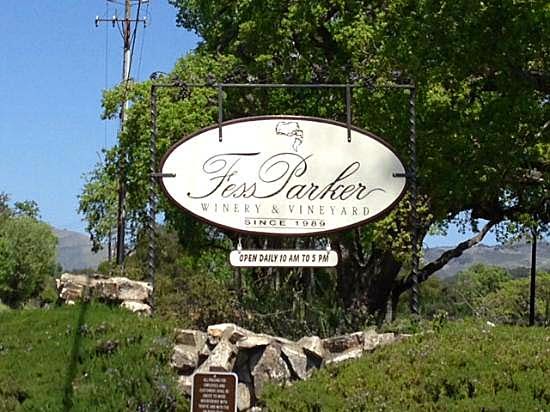 Still under contract to Disney, Fess Parker starred in The Great Locomotive Chase, Old Yeller, and Westward Ho! The Wagons. Post-Disney, Parker starred in the short lived series, Mr. Smith Goes to Washington. Typecast as a frontiersman, Parker signed with NBC-TV for the series, Daniel Boone. From 1964-70, Fess Parker wore the moccasins, fringe leather, and cookskin cap once again. Before retiring from acting, Parker turned down the role of modern lawman cowboy McCloud. Instead, Dennis Weaver successfully took the role. Soon after, Parker opened the Fess Parker Family Winery & Vineyards in Los Olivos, California. His logo on the award winning wines produced under his name: “The Golden Coonskin Hat.” Fess Parker died of natural causes on his wife’s 84th birthday.
 ——————-
Worth 1,000 Words: AL JOLSON & WILLIE RITCHIE

WHAT A KNOCKOUT PHOTO! Sitting in a 1920’s (or earlier) touring car are The World’s Greatest Entertainer, AL JOLSON (May 26. 1886-Oct. 23, 1950), alongside The World’s Lightweight Boxing Champion, WILLIE RITCHIE (Feb. 13, 1891-March 24, 1975). Someone has written their names in white ink on the photo. The vintage photograph, stamped on the back by the Laval Co. Inc. Commercial Photography of Fresno, CA, is rich in personalities depicted, but weak on any specific information as to the year, location and circumstances under which it was taken. [from Steve Crum’s collection]
 Ritchie’s birth name, Gerhardt Anthony Steffan, was changed to hide the fact from his mother that he had taken up boxing. He began his boxing career in 1907, and eventually became the World’s Lightweight Champ (1912-14). He retired from boxing in 1927, the same year Jolson’s heralded talkie, The Jazz Singer, premiered. Willie Ritchie was inducted into the Boxing Hall of Fame in 1962.
 Worth 1,000 Words: GABBY HAYES leads the sidekick parade

 FROM A SMALL PHOTO taken from way back and above the crowd, Gabby Hayes rides in a convertible while in a parade. I acquired this unpublished snapshot years ago without any explanation as to the location and date. It appears to be in the late 1930’s or early ‘40s. If anyone knows anything about the location (using a magnifying glass might help ID the town), please leave a comment below. [from Steve Crum’s showbiz memorabilia collection]
Depp + 3D visuals are ‘Alice in Wonderland’ draw power

 But visually, which is where this Alice really radiates, there are many riches. Ken Ralston’s visual effects are stunning and surreal; Colleen Atwood’s costumes are dazzling; and Dariusz Wolski’s photography is spot on. However, all suffer because most scenes are so darkly shot. How can one fully appreciate their good work when even the brightest days seem like sundown or dusk? Either Burton and Wolksi purposely took the visual design from Arthur Rackham’s sepia-tone illustrations for the 1907 publishing of Alice’s Adventures in Wonderland (which includes dimly lit imagery) or the problem was at my screening. Perhaps the 3D projector had an under-watted bulb?
 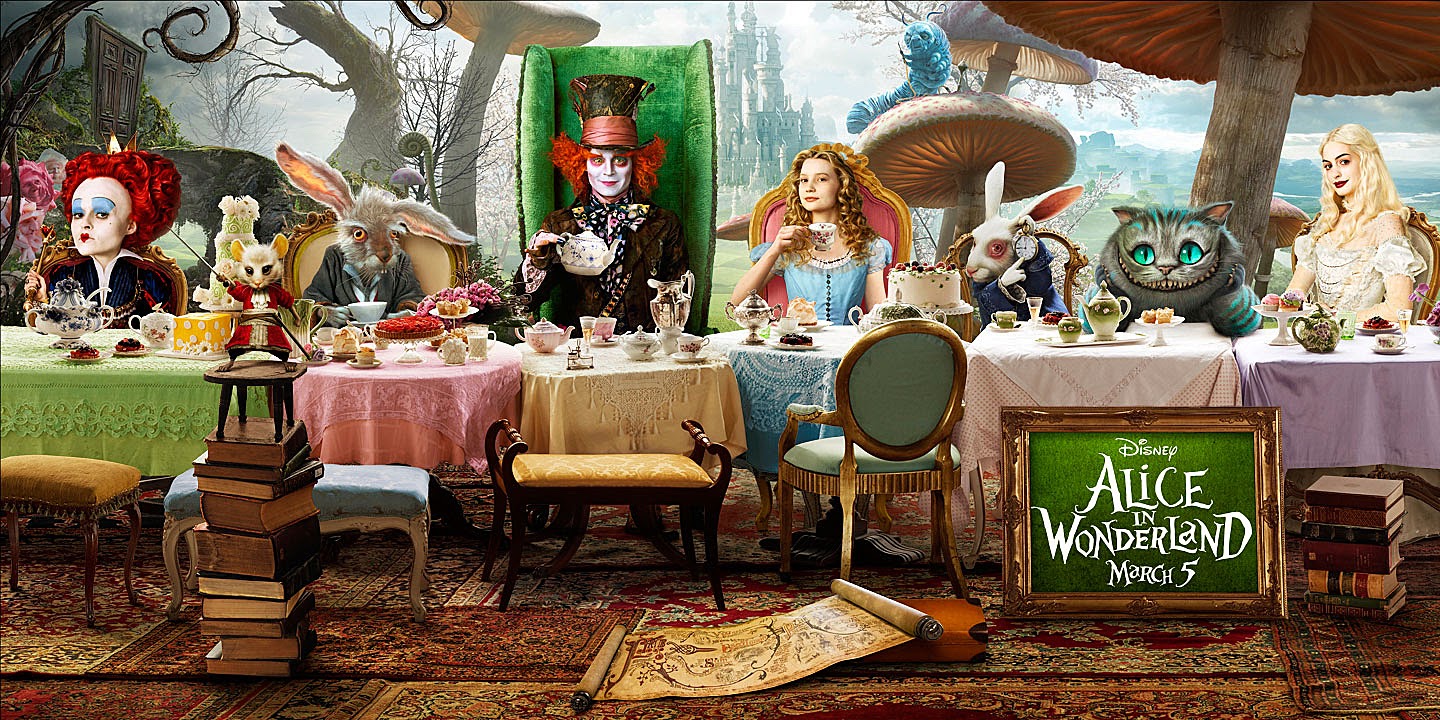 For the record, Helena Bonham Carter sneers as Red Queen; Anne Hathaway is sweet goodness as White Queen; Crispin Glover’s head digitally sits atop a tall and evil knight called Stayne, Knave of Hearts; and Matt Lucas has his face morphed on the roly-poly, identical twins Tweedledee and Tweedledum. There is fine voice work by Stephen Fry (Cheshire Cat), Alan Rickman (Blue Caterpillar), Michael Sheen (White Rabbit), Paul Whitehouse (March Hare), Timothy Spall (Bayard), and Barbara Windsor’s Dormouse.
 Worth 1,000 Words: ‘SPANKY’ McFARLAND at Harmon

By Steve Crum
HAS IT REALLY BEEN nearly 22 years since “SPANKY” McFARLAND spoke to a packed house of 1,000+ students and faculty members at J.C. Harmon High School in Kansas City, Kansas? Sure enough. It was mid-morning on Monday, Sept. 12, 1988, when I introduced Spanky at a special assembly in the auditorium. (I was teaching journalism, mass media and English at Harmon then.)
Earlier that morning, I had driven to the Doubletree Hotel in Overland Park to pick up Spanky, along with his golf clubs and luggage. He was in town as one of the celebrity players at the Peter Marshall (The Hollywood Squares) Celebrity Golf Tournament in K.C. Spank was drinking a cup of coffee, and waiting on the hotel sidewalk when I drove up.
On the drive to Harmon, Spanky complimented me on my safe driving in between talking about Alfalfa, his growing up in Texas, fellow “Rascal” Scotty Beckett, and show business in general. Regarding his memory of Scotty Becket, with whom he was paired in numerous Our Gang shorts, Spanky said, “Oh God, Scotty Beckett. Poor, poor Scotty. What a sad story. What a talent. So sad. He left us far too soon.” (Beckett had a relatively brief but illustrious career in film, radio and TV, but died at age 38 in a nursing home. Drugs, alcohol, martial problems and depression factored into his tragic circumstances.)
 It was all prearranged by my good pal Jim Peters, the leader and founder of our Hog Wild Tent, which is the local chapter of the Laurel and Hardy, Sons of the Desert organization. (All the fan club’s branches are called tents, and each is named after one of Stan and Ollie’s classic comedy films.) Spanky met Jim at a Laurel and Hardy convention, and agreed–for a price–to appear at both of our schools. Jim was teaching at Eisenhower Middle School, a few miles away.
 So Spanky introduced clips (on 16mm) of vintage Our Gang/Little Rascals to an appreciative audience. At that time, the students were very aware of Spanky, Alfalfa, Buckwheat, Darla and the gang thanks to repeated showings on TV. Spanky talked and fielded questions about himself and other cast members for an hour. Then he was off to do likewise at Eisenhower. (Jim then drove him to the airport so Spanky could fly home.) He received $500 for each gig; students paid $1-$2 per admittance. Both Spanky and our schools profited. It was absolutely a very cool experience. Before the show, I introduced Spanky to the principal and his secretaries. All were thrilled.
 BORN GEORGE ROBERT PHILLIPS McFARLAND on Oct. 2, 1928, SPANKY began his show biz career as a very young child, modeling clothes and appearing in print Wonder Bread ads. A reliable source says he was first nicknamed “Buddy.” Another source claims he was called “Sonny.” Nonetheless, it was “Spanky” that stuck when he auditioned for Hal Roach’s Our Gang series at age 3. Spanky was immediately a sensation, and became the virtual on-screen leader of the Gang, later renamed The Little Rascals in TV syndication.
 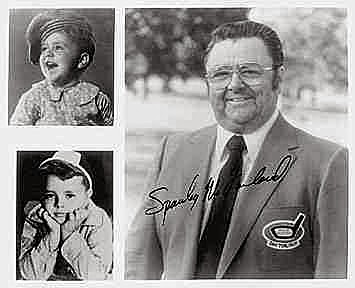 After 95 film shorts, Spanky retired in 1942. Typecast forever, and always looking very much like he always did in movies–thanks in part to his shortness, Spanky could not get work in Hollywood. He worked at various businesses, finding success as National Sales Director of Philco-Ford in Texas. For a time, he hosted a local kids’ TV show (featuring Little Rascals movies) in Texas, and participated in celebrity golf tournaments (as well as his own). On June 30, 1993, Spanky died of a heart attack at age 64 in Grapevine, Texas. The more recent photo of Spanky was taken at the Harmon assembly in 1988. [from Steve Crum’s showbiz memorabilia collection]