
 [The following review was published in The Kansas City Kansan on Dec. 23, 1994. Since The Kansan was a local newspaper, the editor included the fact that I was also teaching at a local high school.]
By Steve Crum
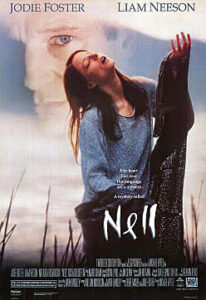
It is the innocence of Nell in Nell that will squeeze tears out of most viewers. In fact, it is sometimes a rating experience to watch Nell because we know the at any minute Nell’s world will be invaded, her private life savaged.
Jodie Foster is Nell, and Jodie Foster will surely be nominated for an Oscar. Bank on it. Foster, who also produced, is stunning as the backwoods child-woman whose link with humans has been almost solely through her late mother. Since her mother was partially paralyzed and her speech grossly distorted, Nell’s speech is similarly impaired through exposure. Add to that the mother abusive control over Nell. (She was never permitted to leave the house in daylight.)
So what happens when a local doctor (Liam Neeson) is called to trek the boondocks after the mother’s corpse is discovered? He finds Nell in hiding, and is obsessed with trying to communicate with her. A local psychiatrist (Natashia Richardson) is also involved. 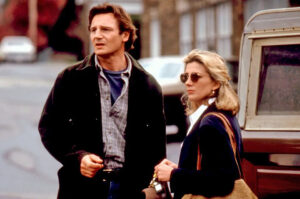 Piecing together Nell’s language and personality, the two are fearful early on of a media circus once Nell’s existence is known.
Another Oscar envelope, please, to Neeson. Neeson is a fascinating actor. As Oskar Schindler in last year’s Schindler’s List, Neeson underplayed with powerful reserve. Now he excites us about discovering what makes Nell tick. He makes us care that he cares. That he knows too well how vulnerable Nell is only frustrates us more.
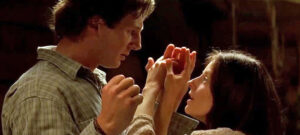 1948’s Johnny Belinda is the story of a deaf-mute young woman whose innocence was corrupted. Thanks to a sensitive local doctor who teaches her sign language, Belinda is able to tell him and community her story.
The parallel to Nell is striking. The joy of communication lives in both films. Nell’s doctor is driven in similar was as Belinda’s, and once the truth is known, then what? The doctor has become the protectorate—or as Nell calls Neeson’s Lovell, her “guardian angel.” It is at this point, the last third of the film, that Nell becomes contrived. Blame
the writers, William Nicholson and Mark Handley, for tacking on an epilogue (“Five years later…”). Tack on director Michael Apted as well.
But it is the first two-thirds, encompassing the discovery of Nell that spotlights Foster, Neeson and Richardson’s ensemble performances, that clinches.
__________
GRADE on an A-F Scale: B+
(Steve Crum is the journalism teacher at Washington High School.)