
 By Steve Crum
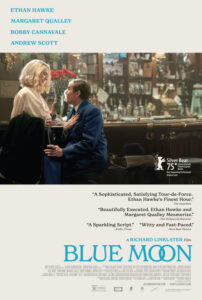
Let’s get right to it. Blue Moon is a fascinating bomb of a movie. It is essentially 100 minutes of nearly non-stop talking by Ethan Hawke as the legendary lyricist Lorenz Hart. Press materials label the film “a biographical comedy-drama.” I consider it a biographical-drama that borders on tragedy. It is also tragic that this is what director Richard Linklater and writer Robert Kaplow give us as either entertainment or, really, information. Blue Moon amounts to a depressing psychological study.
Considering only Hawke’s extraordinary portrayal of famed lyricist Lorenz Hart, Blue Moon is genius. But it plays out in a nearly non-cinematic format. Presenting Blue Moon on stage MIGHT have worked.
The story’s opening moments occur on March 31, 1943 in an alley. The remainder plays out in flashback beginning minutes earlier, during a singing sequence from the premiere of Rodgers and Hammerstein’s Oklahoma! Standing in the back of the theatre is Lorenz Hart, Richard Rodgers’ musical collaborator for two decades. Hart’s alcoholism and unreliability have prompted Rodgers to team with Oscar Hammerstein II for this new venture It turns out to be a very successful venture.
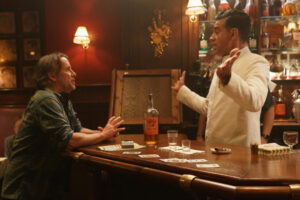 In the meantime, Hart leaves the show and retreats to a near empty Sardi’s to await Rodgers, Hammerstein, actors, and audience members to arrive and celebrate opening night. So goes the plot as the sober Hart immediately wanders to the bar and exchanges quips, stories, and grievances with the bartender, Eddie (Bobby Cannavale). Hart was known for his clever language and witticism. It is
 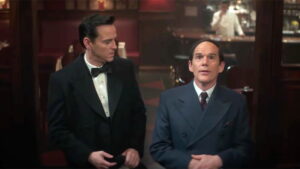 Hawke’s expertise at dialogue that carries the picture. Lorenz Hart was an unattractive, comb-over hair guy who stood only five feet tall. And Ethan Hawke pulls it all off perfectly. (The height issue is accomplished through body language, camera angles and actor double.)
What occurs within Hart’s time in Sardi’s depends on both who is already in the bar (Eddie; a WWII soldier [played by Jonah Lees] on leave and playing piano; and various restaurant employees. The talkative, friendly, and growing drunk Hart speaks with them all.) When the Oklahoma! crowd wanders in, Hart tries to converse with everyone, even his new rival Hammerstein (Simon Delaney). Hart is particularly on the prowl for 20 year-old  Elizabeth (Margaret Qualley), who he clumsily tries to impress.
On several occasions, he approaches his former partner Richard Rodgers (Andrew Scott) to re-team. Kudos to all the actors in Blue Moon.
As for all those great Rodgers and Hart songs from Broadway and Hollywood, we get to hear barely a smattering of them as piano background—infrequently. It is ironic that 1948’s spectacular musical Words and Music was jammed with Rodgers and Hart music while the team’s personal stories were either fabricated or missing.
Blue Moon has limited appeal except for a target audience of show biz/theatrical fans. I love Rodgers and Hart’s musical legacy, particularly their superb song “Blue Moon,” but not this sad telling.
__________
GRADE on an A-F Scale: C+