
 By Steve Crum
The Secret Agent is a fascinating, at times confusing, historical political thriller set in Brazil during 1977. Corruption and turmoil abound with a military dictatorship in power. What a not so great time for widower Armando Solimões (well played by Wagner Moura) to return home to his young son Fernando (Enzo Nunes).
Incidentally, much of the story confusion is attributed to the film’s Brazilian Portuguese language. Sure, it is subtitled in English, but…be aware. The plot centers on Armando, who left the country some time ago due to both the death of his wife as well as his work with anti-government resistance. His son has been staying with elderly relatives. Because the police are still searching for Armando, he uses the alias Marcelo.
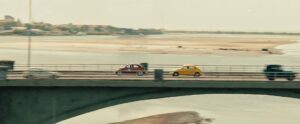 It doesn’t take long for Armando/Marcelo to encounter crooked police as he stops for gasoline on the outskirts of Recife. A man’s rotting body is partially covered by a sheet as it lies where it has been for several days. And that’s a few feet from the gas pumps! No doubt the police killed him. I won’t go into detail about all the violence in The Secret Agent, but it is plentiful—based on the facts of that time.
Produced, written and directed by Kleber Mondonça Filho, The Secret Agent follows Armando as he reconnects with his son, becomes active once  again with his dissident friends, and eludes being killed when a contract is placed on his life. The action becomes even more intense and bloody.
Along the way, expect mini-adventures with a severed leg (which makes headlines in local news), a man-eating shark, a hungry pack of dogs, open sex on the streets, and great comradery among the dissidents.
There is also a clever conclusion, per se epilogue, featuring Wagner Moura in another surprising role.
 A supporting cast led by Carlos Francisco, Tânia Maria and Robério Diógenes are pluses. Add Evgenia Alexandrova’s cinematography. And tack on that yellow VW Beetle!
At the film’s beginning, 1977 Brazil is described as a “period of great mischiefs.” Indeed so.
__________
GRADE on an A-F Scale: B+