Worth 1,000 Words: Will the real Clarabell the Clown please stand up?


By Steve Crum

SIXTEEN YEARS AGO, in 1994, buckskin clad BUFFALO BOB SMITH appeared at Bartle Hall in Kansas City, Mo. as a featured celebrity at the annual auto show. Naturally, Smith brought with him his famed puppet and longtime Doodyville pal, HOWDY DOODY. Among the baby boomers standing in line to meet him (we who had grown up watching the Howdy Doody show on NBC, from 1947-60) was yours truly. Smith reminisced about those early TV years with me and posed (for a small fee) for photos. No doubt I was the 18 millionth fan who had told him how much fun and enjoyment he had provided during my childhood. I was but another “little buddy” of his from the other side of the TV tube.

What I recall most about my few minutes with Buffalo Bob is his anxiety regarding his wife back home in Hendersonville, North Carolina. That area had just suffered a vicious ice storm, and his wife was stranded in their house without electricity. He told me the road to his house was so icy no emergency crews could yet get to her. He was heading back home immediately after the Kansas City gig. I wished him and his wife the best, and got a “Thanks, little buddy” in response.

My regret is I never asked Howdy to speak, forgetting that Bob Smith supplied Howdy’s voice in the TV show. After all, Howdy was sitting there right between the two of us, smiling that wooden smile and silent as a cord of oak. Incidentally, the two similarly posed photos above were taken some 45 years apart. That is Clarabell the Clown (Lew Anderson) to the left in one, and me to the left in the other. I point out my identity since it looks suspiciously like Howdy’s twin brother cheesing beside him.

Sadly, Buffalo Bob died four years later, on July 30, 1998. Following his death, a custody battle for the original Howdy Doody marionette (pictured) ensued. Howdy now resides, ever smiling, in the Detroit Institute for the Arts. [from Steve Crum’s showbiz memorabilia collection]
——————–
Some HOWDY DOODY trivia
•BUFFALO BOB SMITH was born Robert Emil Schmidt on Nov. 27, 1917 in BUFFALO, New York.
•The HOWDY DOODY show featured puppets and real life actors portraying: Heidi Doody (Howdy’s sister), Dilly Dally, Mayor Phineas T. Bluster, Chief Thunderthud, Princess Summerfall Winterspring, and Flub-a-Dub (a conglomeration of eight animals!).
•BOB KEESHAN (CAPTAIN KANGAROO) was the first to portray Clarabell the Clown.
•BOB SMITH and HOWDY DOODY had a career rebirth thanks to the nostalgia craze in colleges and universities during the 1970’s.
•HOWDY DOODY had 48 freckles on his face, one for each state–at that time.
——————–
Say kids, what time is it?!?! Join the Peanut Gallery here: https://www.youtube.com/watch?v=9pK0hNljoTg
Share:

Worth 1,000 Words: Chaplin & Goddard walk the walk

By Steve Crum

RELEASED IN 1936, CHARLIE CHAPLIN’S MODERN TIMES was one of the few comedies to thematically deal with the ongoing Great Depression. Laden with socio-political references to assembly line industry, anarchy, unionism (or lack thereof), homelessness, love, and even drugs (the white powder being consumed in the prison sequence ain’t supposed to be C&H sugar), Modern Times was controversial, bittersweet, knee slap hilarious, heartbreaking, incisive, and…well…Chaplin. The film was released nearly 10 years after sound came to motion pictures, yet director, writer, composer, star Chaplin made this one mostly silent, except for recorded music and sound effects. There is sparse dialogue, but at least movie audiences got to hear Chaplin’s voice as he briefly sang.

 
CHARLIE CHAPLIN, born Charles Spencer Chaplin (April 16, 1889-Dec. 25, 1977), filmed Modern Times over a two year period, 1934-35, perfecting as he went. He collaborated with composer David Raksin on the score, since Chaplin could not read music. The hit song Smile was a later result.
 
PAULETTE GODDARD, born Marion Pauline Levy (June 3, 1919-April 23, 1980), was fine and gorgeous support for Chaplin’s Tramp character, playing the gamine, Ellen Peterson. A serious relationship between the two actors developed, and they were married in 1936. (The union lasted until 1942.)
——————–
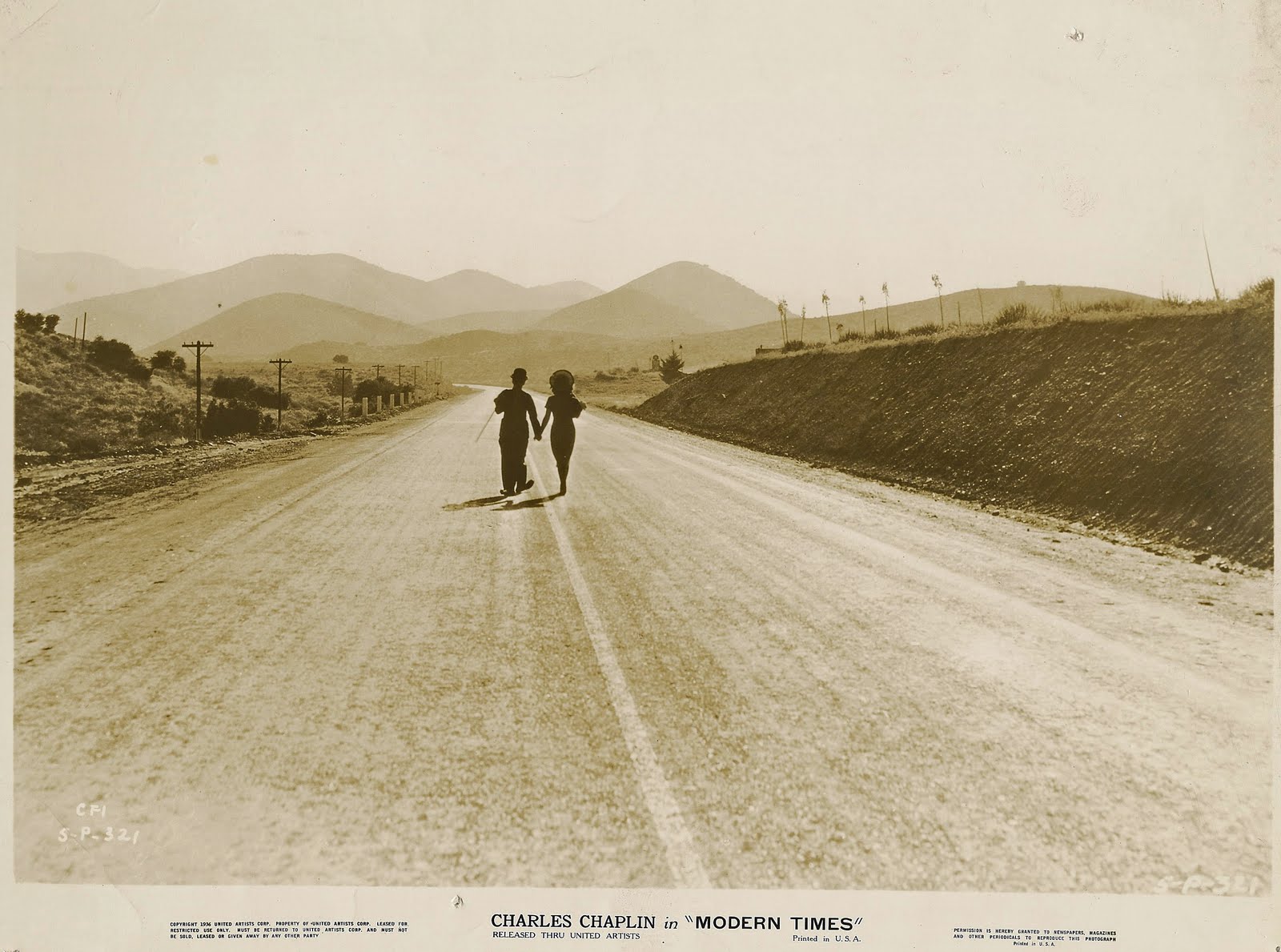
The vintage, original United Artists Studio promo photo above shows Modern Times’ iconic finale as Chaplin and Goddard’s characters walk hand in hand towards their uncertain, hopeful future down the long, winding road. The symbolism is Chaplin through and through, beautifully realized by his long time cinematographer Rollie Totheroh. [from Steve Crum’s showbiz memorabilia collection]
——————–
Share:

3D glasses on for ho-hum ‘Clash of the Titans’

By Steve Crum

 
Is this remake of Clash of the Titans really necessary? Nope, by Kraken. Sure it boasts 3D tech, along with a fresh cast and digitally moving creatures, whereas effects guru Ray Harryhausen’s 1981 effects were accomplished via the jerky, stop motion method. Yet this nearly three decades newer Clash disappoints in pacing, special effects and 3D. The special effects, with the exception of a pretty cool looking Pegasus, are obviously computerized to the extent most combat sequences are in close-up with the dreaded handheld camera look, which always seems a budgetary ploy to hide cheapness. The result is rapid, blurred movements that imply action more than deliver.
 
Director Louis Leterrier (The Incredible Hulk) and writers Travis Beacham, Phil Hay and Matt Manfred have mostly duplicated director Desmond Cross and writer Beverley Cross’ ’81 film. The retro result is a throwback plot with new faces and digitally Botoxed monsters.
 
Once again, Perseus (Sam Worthington, who rode the flying Direhorse in Avatar and gallops astride a soaring Pegasus here) is cast out to sea soon after birth because he was fathered by the Greek god Zeus (Liam Neeson). Rescued and raised as a mortal by a kind fisherman, Perseus eventually discovers his heritage, and that he must lead a crusade to overtake the evil god Hades (Ralph Fiennes) who plans to turn earth into hell. There are scenes of Zeus, Hades and fellow gods and goddesses in mythical heaven manipulating Perseus and others on earth as if they are chess pieces.

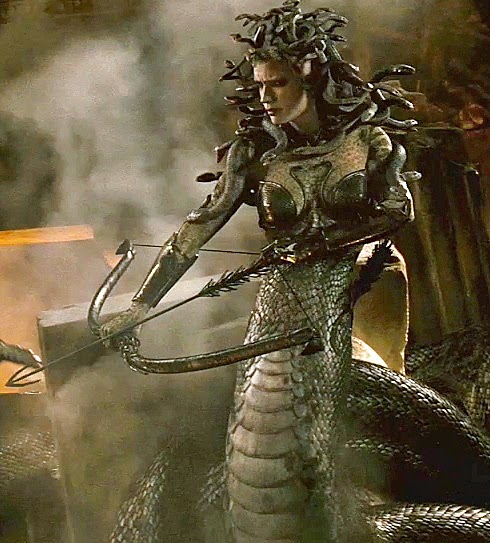
Perseus and his small army, which includes Draco (Mads Mikkelsen), must overcome challenge after challenge before eventually severing the head of Medusa to avoid unleashing the feared Kraken monster from earth’s bowels. If only the dialogue was a good as this description. SEE the attack of giant scorpions! SEE killer birds of prey! SEE Perseus’ magic sword! See CGI effects galore! Shades of Ulysses, Sinbad and Hercules.
 
Also SEE the homage, as if the entire movie isn’t a homage, to Ray Harryhausen when his famed mechanical owl is briefly shown before Perseus embarks on his quest. The owl, a fixture of the 1981 movie, is never seen again, yet it reminds us of the original’s semi-classic stature, a quality the 2010 version lacks.
 
Finally, the 3D is wasted. Not one sequence includes anything remotely leaping out of the screen. (Avatar is now the benchmark of 3D, being jammed with in-your-face dimension.) Sure there is the basic illusion of depth throughout Clash, even during the many talky scenes. But it is pretty static overall.
 
Therefore, a couple of considerations need to be made at this point regarding the 3D resurgence, as theaters worldwide are being equipped for 3D, and HD-TVs enter the 3D game. First, Avatar set the bar high for 3D with dazzling effects. A movie like Clash of the Titans, with mediocre 3D, signals a major quality control problem for the future of the process. Alice in Wonderland similarly suffered with only a couple of effective 3D bits. It could be said that Avatar revolutionized 3D much like Star Wars did for special effects. Pre-Star Wars fantasy and sci-fi flicks look quaint and pedestrian in comparison.
 
Secondly, if a 3D movie does not meet higher entertainment standards to justify its own inflated admission price, what is the future of 3D as industry? The 3D fad of the 1950s could be repeating its sad and similar arc by, say, 2011-12. It was a short lived gimmick then; it could be the same now. The big difference is that the investment nowadays is on a greater scale, involving theater chains and the future of home entertainment.
 
My suggestion after the fact would have been to re-release 1981’s Clash of the Titans, reprocessed in 3D, and forget about any remake. Forget this remake, for sure.
——————–
On an A to F grade scale: D+
——————–
Share:

Crummy Art, Crummy Laughs: ‘GONE with the WIND’

Share:

Worth 1,000 Words: Cowboy Superstar BUCK JONES rides the KC range
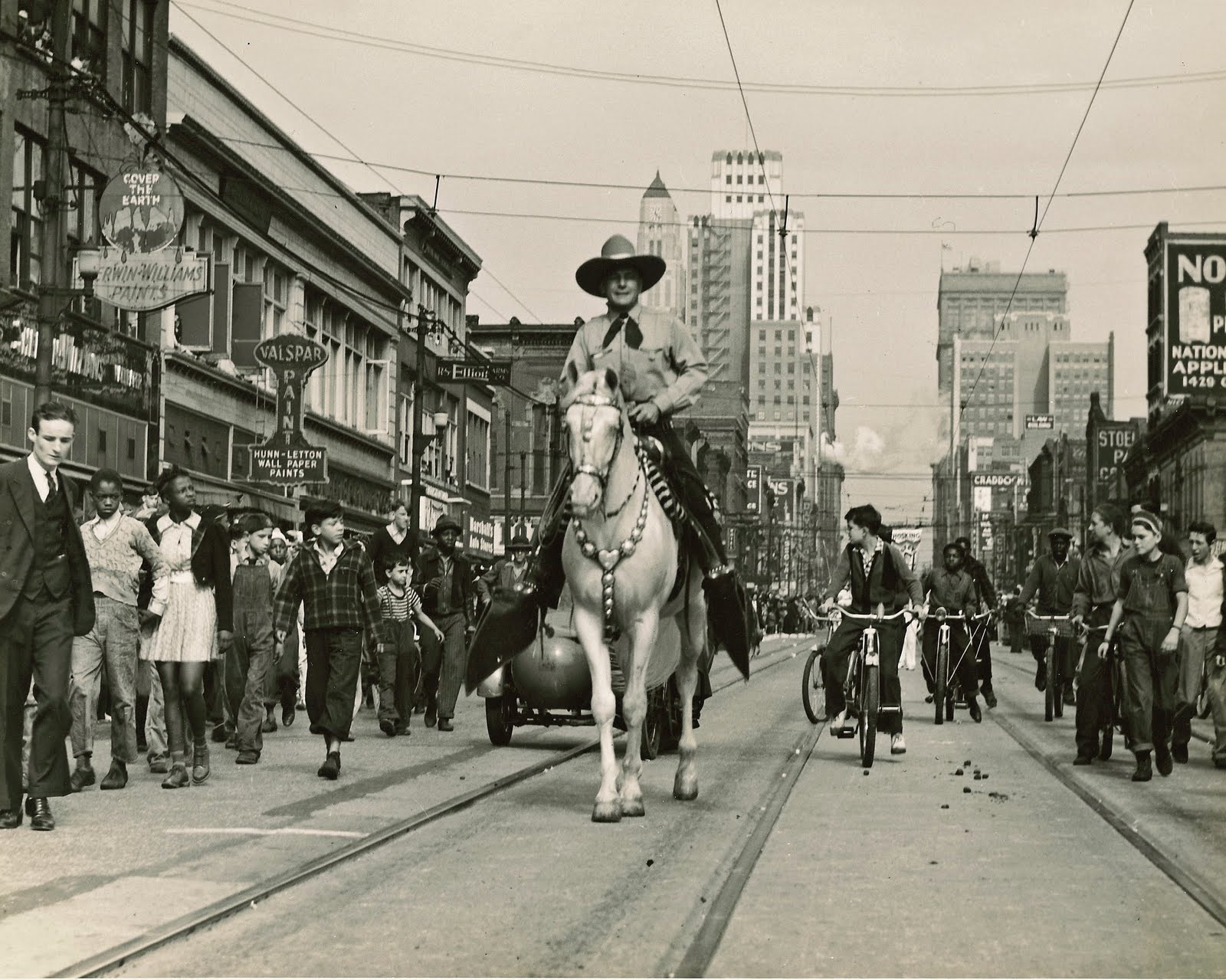
This unpublished photo of Buck Jones astride his steed Silver was taken during a visit to Kansas City, Mo. during the 1930s. Not much is known about the exact date and circumstances, but Buck was probably part of a parade. Judging by the long gone R. S. Elliott Arms Co. sign down the street on left, the location should be 15th and Grand Ave. It is interesting to see the streetcar tracks and overhead power lines. [from Steve Crum’s showbiz memorabilia collection]

By Steve Crum

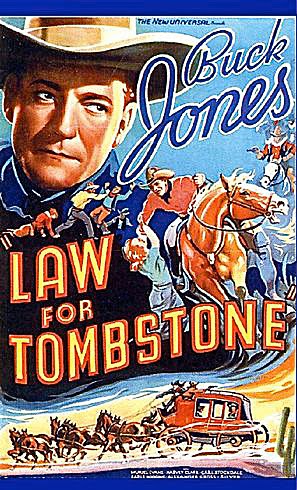
BUCK JONES (Dec. 12, 1891-Nov. 30, 1942), like Ohioan Roy Rogers, was a major cowboy movie star not bred in the West. Buck was born Charles Frederick Gebhart in Vincennes, Indiana. Much like the western knights he portrayed later, Buck’s heroics began when he was 16 years old. After joining the army and fighting in the Moro Rebellion in the Philippines, 1907-09, the teenager was mustered out of the service after being wounded. He re-enlisted a year later, desiring to be an airplane pilot, but was disqualified since he was not an officer. In 1913, his military career ended.

Then Buck Jones the cowboy emerged. He was working as a ranch hand in Bliss, Oklahoma when he met his future wife, “Dell,” who was an expert rider. Together, they joined a Wild West show and briefly toured. To make more money, Buck signed on at Universal Studios as a bit player and stuntman. Before long, his charisma, looks and horsemanship brought him his first starring role, in the 1920 silent, The Last Straw. Buck was soon among the top movie cowboys in popularity and money making, joining the ranks of Hoot Gibson, Tom Mix and Ken Maynard. 
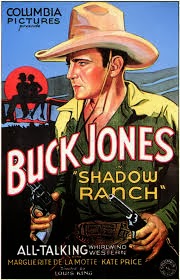
In 1928, he felt independent enough to start his own movie studio, which did not last. Signing with Columbia Pictures in the early 1930s, Buck began his career in cowboy movies with sound. By the early 1940s, he had 160 cowboy flicks under his fancy belt. By this time, there was the successful “Buck Jones Model” air rifle sold by Daisy. Unlike the Red Ryder model, it was distinguished by having a sundial in the stock.

Buck’s career tragically ended following 1942’s infamous Cocoanut Grove fire in Boston. Legend has it that Buck initially escaped and then went back in to rescue patrons. Historians now say he was merely one of those trapped behind doors that would not open among highly flammable surroundings. Buck and 241 others died.
——————–
Listen to the Buck Jones song, and view images, here: http://www.youtube.com/watch?v=bZ_P1ZdQcys
Share: