
Movie Asides: ‘THE EDDY DUCHIN STORY’
At 123 long, long minutes, The Eddy Duchin Story (1956) remains an incongruous musical biography centering on 1930’s-‘40s society pianist-bandleader Eddy Duchin, impressively portrayed by Tyrone Power. The script meanders through bouts of mental and physical illness sandwiched between great interpretations of a dozen or so tunes from the Great American Songbook. That said, this is arguably the darkest movie musical ever produced…outside the death-themed All That Jazz (1979).
However, there are two magical scenes that have made me watch The Eddy Duchin Story at least a dozen times. One is set during WWII when Duchin is stationed on a Pacific island. At this stage in the story, Duchin is wallowing in depression, having given up playing the piano due to tragic circumstances back home.

While in a native village, he stumbles upon a dilapidated upright in a shack, and starts noodling “Chopsticks.” A local boy enters and encourages Duchin to play more. Duchin has the kid bang some keys in accompaniment as he goes full force into the old standard. An appreciative crowd immediately gathers amongst the surrounding bomb rubble in what turns out to be a joyful, energizing sequence.

The other memorable moment is the film’s celebrated tearjerker finale, wherein Duchin and his young son Peter (Rex Thompson) sit down at twin, facing grand pianos to duo-play the film’s theme song, “To Love Again” (adapted from “Chopin’s Nocturne Op. 9 in E Flat Major”). By this time, Eddy’s imminent death (due to leukemia, but never said in the film) is known by his son and others, so it is an emotional wallop when a closeup shows his hands convulse and move out of view. The camera then pulls back, revealing an empty seat where Eddy was sitting. His son is still playing—now solo. Music segues into a full orchestra conclusion. Just try to swallow and hide the tears when “The End” appears on screen.
——————————
Now, 58 years later, Eddy’s son Peter is an elderly, semi-retired pianist who has had a fine career himself.
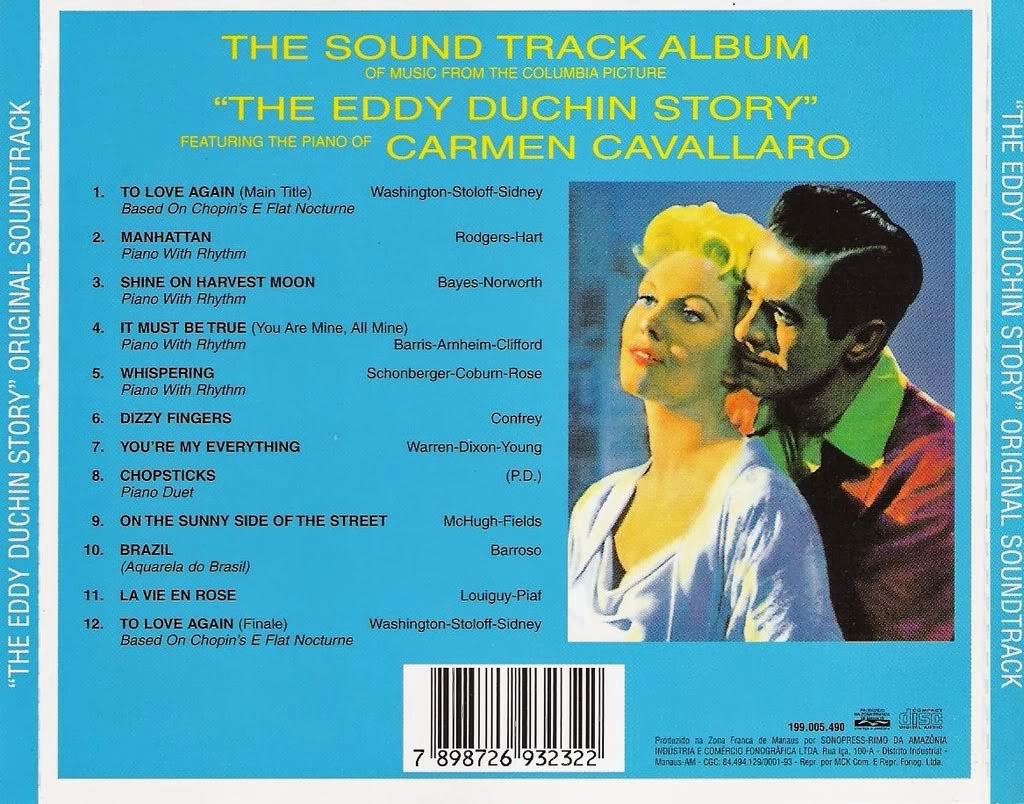
Incidentally, Tyrone Powers’ piano playing was dubbed by Carmen Cavallero. It is his hands we see playing in closeups, but Powers is totally convincing in his body language.
Eddy Duchin died of acute myelogenous leukemia at age 41, five years before The Eddy Duchin Story opened.
———-
Enjoy the great “Chopsticks” sequence: http://www.youtube.com/watch?v=61Se7MrKrpY
Writing soundtrack music with David Raksin
By Steve Crum
No fooling, I spent April 1, 1989 with David Raksin, “The Grandfather of Film Music.” That is, he was my teacher for the day in a Saturday class held in Overland Park, Kansas via a seminar series produced and moderated by Prof. John Graves of Central Missouri State University. Having the esteemed composer Raksin as guest instructor was a highlight of the class.
Best known as the composer of Laura (1944), Raksin composed over 100 films and over 300 TV scores. His credentials date back to orchestrating Modern Times (1936) in collaboration with Charlie Chaplin. Lecturing to our class was undoubtedly familiar to Raksin since he was then a full time instructor-lecturer at the University of Southern California. He flew in to do this KC gig, and then returned to the West Coast.
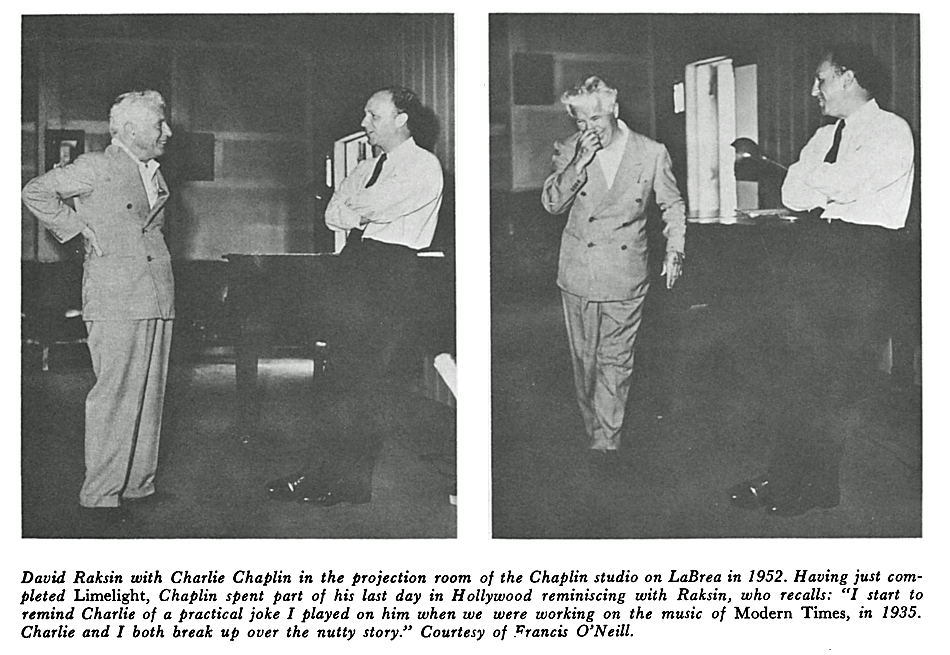
I spoke to him during a break, and found him to be very comfortable and personable. Like during his presentation, he talked of working with Gershwin and Chaplin, and his philosophy of composing. “I’m not so elaborate in theories,” he said. “I just sit down and write a few notes.” Those “few notes” translated into the likes of scores for The Bad and the Beautiful (1952) and Forever Amber (1947).
To illustrate his point of film being “an art of components,” Raksin showed the class a clip of Laura without music, and then with the score added. He also included the same scene with annotated timing marks used in the scoring process—fascinating stuff I had never seen before.
He spoke of Alfred Newman’s butting creative heads with director George Stevens over the scoring of The Greatest Story Ever Told (1965); and of his own disappointment that much of his music was cut from the TV movie, The Day After (1983). Nicholas Meyer, the director, thought “the use of too much music would manipulate the audience.”
Raksin also conflicted with director Nicholas Rey on Bigger Than Life (1956). While Rey wanted a bombastic musical effect at one point, Raksin objected, eventually winning his point for a more inert, moody feel. “Music has to say something,” Raksin said, “to assert itself.”
The first time I heard the term “Mickey Mousing” was through David Raksin at this seminar. The phrase refers to the sound-effecting of music to directly fit with the film’s action. Cartoons use this technique virtually all the time, which is the origin of the term.
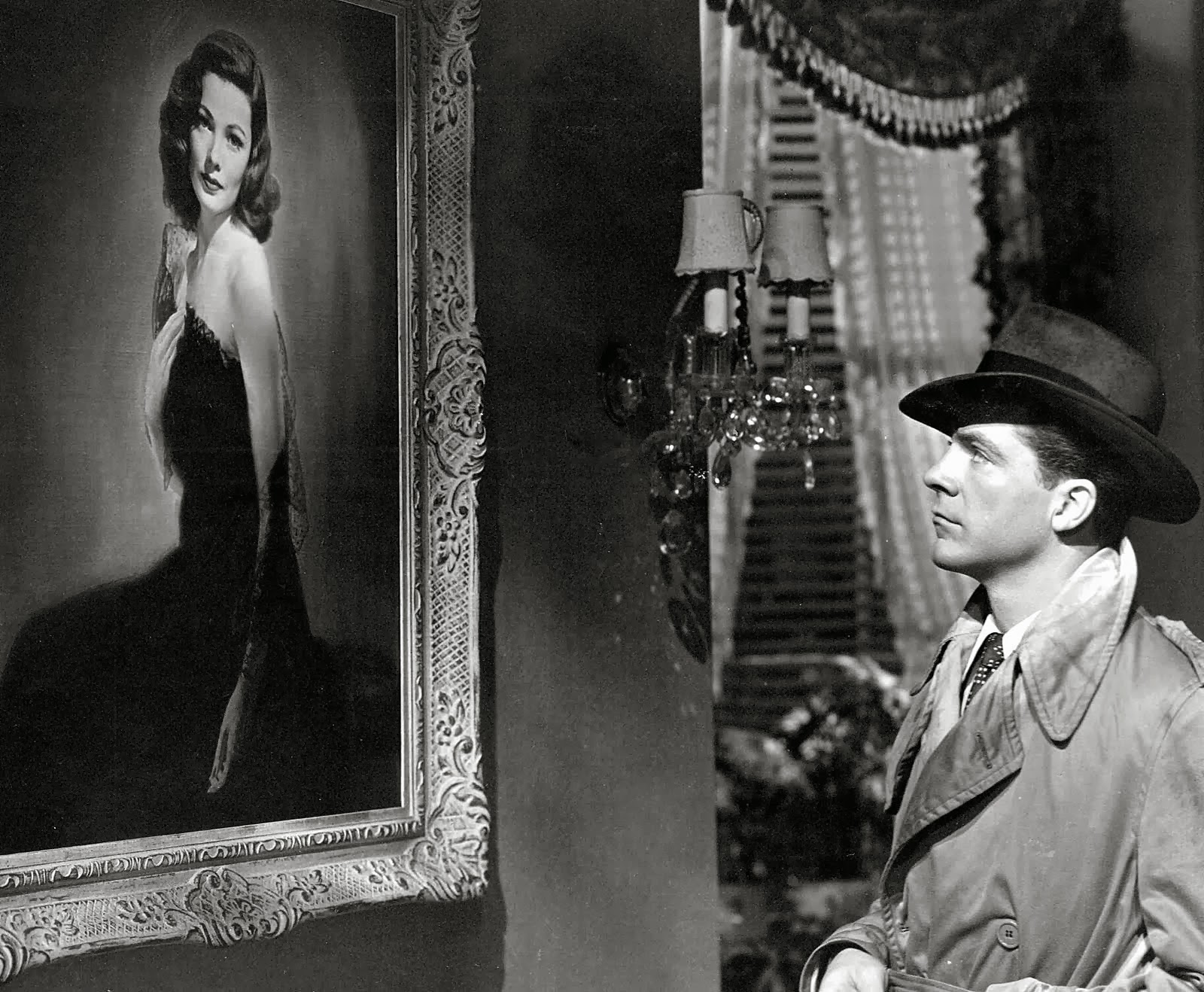
Referencing Laura, his signature film score, Raksin said director Otto Preminger wanted him to write hardcore detective music, but “I saw it as a picture about love.” His choice won out, and fabulously so. It is unimaginable to think of Laura without that haunting theme.
Working with the Gershwins as orchestrator on The Goldwyn Follies (1938) had particular challenges like “doing six weeks work in two weeks” of orchestrating the ballet sequence. Then there was Forever Amber, a major test for Raksin since it required “114 minutes of music.”
Some of Raksin’s then current favorite film composers were Dave Grusin, Jerry Goldsmith, and John Williams. On that topic, he talked with disdain about the trend away from original film music to the use of pop music. (He would no doubt be livid about rap’s prevalence in movies.) Using electronics in scoring is “a choice by the studio based on money, and not necessarily art.”
“Today we have A&R people making decisions as to what’s good for the recording subsidiary, and not what’s good for the movie,” Raksin said. “I don’t go to movies to listen to a record album.” Raksin emphasized he is not interested in writing rock music scores.
To be a successful film composer takes “guts, a gift, and the ability to educate oneself.”
——————————
David Raksin was one of several guest lecturers John Graves arranged for his Creative Complex in Film and Television seminars which featured nationally noted film and television professionals. Earlier in his career, Graves served as producer and executive with three TV networks. Medical Center and The Courtship of Eddie’s Father were among his producing credentials. When he moved from mainstream Hollywood to a professorship in mass communications at Warrensburg, Mo., he benefited from his California contacts. So did his students. Thanks to Graves, an array of celebrities flew to the Midwest to participate in his seminars. I enrolled in three of his classes, thoroughly enjoying every minute.
Assisting Graves was Michael Sevareid, an adjunct lecturer in mass media at SMSU and former Hollywood producer, writer, and actor. His father was the acclaimed Eric Sevareid of CBS News.
——————————
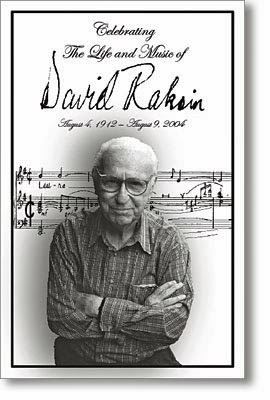 John Graves has long since retired from teaching, and David Raksin died in 2004.
——————–
TV Asides: ‘ANTIQUES ROADSHOW’

Movie Asides: ‘MUD’ (2013)
About 40 minutes into what I consider Matthew McConaughey’s true breakout film, Mud, I thought, “Here’s a McConaughey movie, and for the first time he has not taken off his shirt.” Honest to God, a minute later there was a cut to him shirtless.

The World’s Greatest Entertainer & The Perfect Fool…
A seldom seen photo of two showbiz greats, Al Jolson and Ed Wynn, sharing a laugh at the Friars Club Testimonial for Ronald Reagan, April 2, 1950. Six months later, after returning from entertaining our troops in Korea, Jolie died.
