
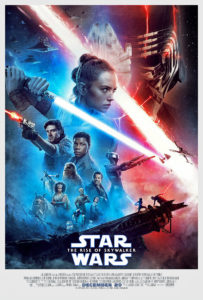
42 years later, ‘The Rise of Skywalker’ brings ‘Star Wars’ saga to spectacular, heartfelt finale
 By Steve Crum
For a Star Wars fan like myself (I still have the original 1977 program sold in the lobby), screening Star Wars: The Rise of Skywalker was both a proverbial labor of love AND a duty. My fervent anticipation of a new Star Wars flick was still flickering. Per se. However, News Flash: This grand finale to the “Skywalker Saga” nine films is a must see, but a bit disappointing.
Credit J. J. Abrams, who co-wrote, co-produced and directed this episode as well as episode 7, The Force Awakens, in 2015. In his defense, it was a daunting task to tether all the plot lines and character elements into a cohesive conclusion. Think of all the characters from Luke Skywalker to Darth Vader to Palpatine to Kylo Ren and Rey. Then there are the robots, storm troopers, brothers and sisters (Luke and Leia), husbands and wives (Han and Leia), and various planet inhabitants. If it sounds like a bulk of beings to squeeze into 142 minutes, it is because it is. As a result, one has to look fast and wide to glimpse the many cameos and walk-ons.
The end result is an obviously huge scale action-adventure tale with state of the art effects and sparse time for good natured joking and character development. Then again, why is character development necessary? In most of the movie, it isn’t  needed. We already know these people, these creatures, these robots. However, major characterization change does occur with two of the principal characters: the last Jedi Ren (played by Daisy Ridley); and Kylo Ren (Adam Driver), the Supreme Leader of the First Order and son of Leia Organa (Carrie Fisher) and Han Solo (Harrison Ford).
To summarize the overall plot, using studio publicity, The Rise of Skywalker takes place “a year after the events of The Last Jedi. The 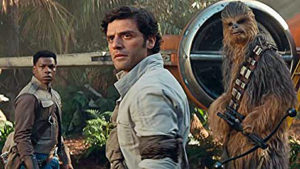 remnants of the Resistance face the First Order once again—while reckoning with the past and their own inner turmoil. Meanwhile, the ancient conflict between the Jedi and the Sith reaches its climax.”
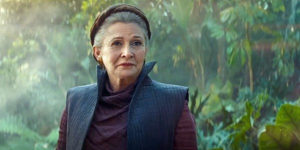 It is good seeing Carrie Fisher return as Leia, albeit via clever editing and unused footage from The Force Awakens. (Fisher died in 2016.) And 82 year-old Billy Dee Williams has more than just a line or two in his return as Lando Calrissian, the original owner of the Millennium Falcon.
Richard E. Grant, last year’s Best Supporting Actor Oscar winner for Can You Ever Forgive Me?, displays his evil chops as First Order General Pryde. The long list of Star Wars returnees includes Mark Hamill (Luke Skywalker), Oscar Isaac (Poe Dameron), Anthony Daniels (C-3PO), Lupita Nyong’o (Maz Kanata), Ian  McDiarmid (Palpatine/Darth Sidious), John Boyega (Finn), and Joonas Suotamo (Chewbacca).
Spoiler Alert: There are some surprise characters returning as well as some surprise deaths. That’s all I will reveal….except to look for a sea of quicksand.
Oh yes, let us not overlook composer-conductor John Williams. The brilliant 87 year-old came out of retirement to score yet another Star Wars movie.
Star Wars: The Rise of Skywalker lacks the outright fun and originality of the previous episodes, but it achieves its goal of providing big scale closure.
=====
GRADE, On A to F Scale: B
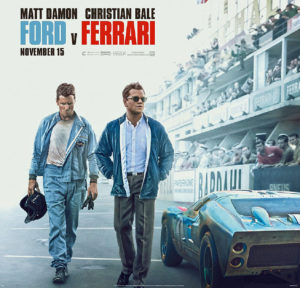
Realistic car racing underscored by human drama in ‘Ford v Ferrari’
 By Steve Crum
Whether or not one is a fan of either cars or car racing has little bearing on enjoying the factually based Ford v Ferrari. It is arguably the best movie about auto racing ever produced. FvF is that good, that compelling. (And I am neither a car nor car racing devotee.)
Pistons and torques aside, FvF is really about friendship, love, trust, and risk. It is a balancing act superbly orchestrated by director James Mangold (Cop Land; Logan), and his screen scribes Jez Butterworth, John-Henry Butterworth, and Jason Keller.
Heading a pretty stellar cast are Matt Damon and Christian Bale. The actors are solid and the car racing sequences should garner Oscar noms for cinematography (Phedon Papamichael) and editing (Michael McCusker, Andrew Buckland).
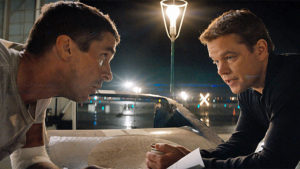 The story, set in 1963-66, focuses on car racing legends Carroll Shelby (Damon) and Ken Miles (Bale), who soon team to design and build a race car (for the Ford Motor Co.) that will surpass any offered by the seemingly unbeatable Italian Ferrari. This ultimately leads to the history making 1966 make-or-break (or brake) challenge at the grueling 24-hour Le Mans race in France. Specifically, it was the just developed Ford GT40 that faced Ferrari’s best. (No spoiler here about who wins.)
The tender heart of FvF involves the human relationships between Shelby 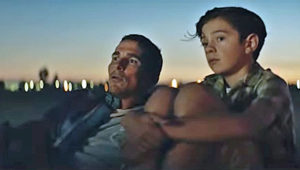 and Miles; Miles and his wife Mollie (played by Caitriona Balfe); and son Peter (Noah Jupe). Jupe, by the way, is terrific.
All this contrasts with some really dictatorial corporation heads, Henry Ford II (Tracy Letts) and Enzo Ferrari (Remo Girone). It is their rivalry that leads to the ultimate showdown in France.
In fine support are Josh Lucas as Leo Beebe, a Ford exec, and Jon Bernthal’s Lee Iacocca, VP of Ford. Worthy of mention is Marco Beltrami’s racing score, which 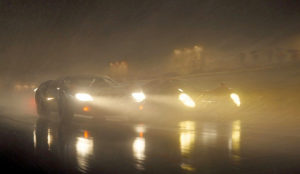 keeps one on edge with a modified heartbeat—seemingly pacing the track.
As a casual driver who dislikes driving at night, the scenes of cars barreling along at 200+ mph during the grueling Le Mans in near pitch black, overnight conditions hit me like a shock horror flick. Make that Fear v Ferrari.
=====
GRADE, On A to F Scale: A
‘Harriet’ covers some heroics of Tubman’s life, but verve is sadly missing
 By Steve Crum
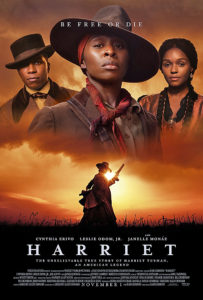
The central character in the biographical Harriet is Araminta “Minty” Ross (1822-1913), far better known then and today as Harriet Tubman. She is extraordinary, this movie far less so. And that is a shame, since Tubman’s exploits deserve more than just a mostly dry telling. For example, the 125 minutes certainly adhere to the facts of her enslavement since birth in Maryland, followed by her escape north to safety in Philadelphia, and then repeatedly returning (13 times) to her Maryland roots to free relatives and friends.
However, it is unfortunate that director/co-screenwriter Kasi Lemmons (Talk to Me) fails to give Harriet and her story anything more than a one-dimensional treatment. The film looks and feels more like a well done History Channel reenactment. The facts are solid, but the emotional impact is lacking.
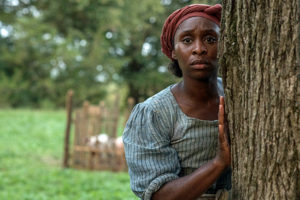
The story itself (co-written by Lemmons and Gregory Allen Howard—based on his story) focuses on Harriet (Cynthia Erivo) when she is in her early 20s, and living as a slave on a plantation in Dorchester County, Maryland. She falls in love with and marries John Tubman (Zackary Momoh), who is enslaved at the same location. When the stern “master” plans to sell her to another slave owner, she immediately makes plans to escape, and then travel north via an “underground railroad” to the free state of Pennsylvania. Through drive and good luck, Harriet eludes her owner’s tracking dogs and posse.
Noteworthy is the fact that Harriet’s faith in God is demonstrated throughout her escape. Even with bloodhounds baying in the near distance, Harriet would often drop to her knees 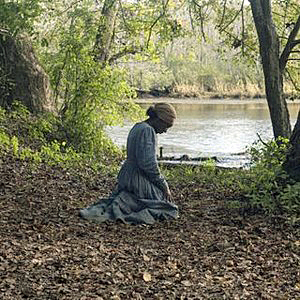 in the forrest, and engage in prayer—asking for guidance in deciding which way to run for safety. The film portrays this as trance-like behavior. God would tell her to either go right or left, according to the movie.
This is a good time to interject that when Tubman was a child, she suffered a severe head injury when an overseer threw a heavy weight at another slave, hitting her instead. Harriet later said, “It broke my skull.” Historical accounts report that Tubman had painful headaches and seizures the rest of her life.
All this might be due to her bouts of dropping to pray at various stressful times in her life, occurrences that Tubman attributed to hearing God’s call. Incidentally, the film references her injury (though not in detail), and infers it affected her anti-slavery actions for the rest of her life. This is because Tubman herself thought her head pains guided her on the righteous path to free slaves by God.
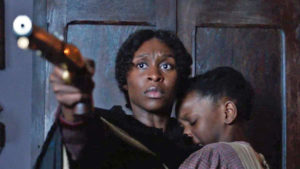 Once with anti-slavers in Philadelphia, Tubman is aided by William Still (Leslie Odom Jr.), an abolitionist/writer. He is so inspirational that Harriet decides to return to her Southern homestead to rescue her husband and bring him back to Philly. He has remarried, thinking Harriet was surely dead. Then he refuses to go with her. Harriet finds others to rescue (like her parents and siblings), a trek repeated over a dozen times.
Note: The movie indicates that Harriet changed her first name from Araminta after meeting Still. In fact, she changed it to Harriet soon after marrying John. It is no big historical deal, really. Just chalk it up to poetic license.
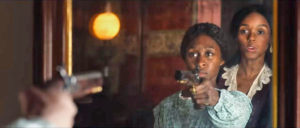 In Philadelphia, Harriet befriends Marie Buchanon (Janelle Monáe), a boarding house proprietor.
Harriet’s ongoing rescues ratchet up the intensity to capture her. Her former owner, Gideon Brodess (Joe Alwyn) employs professional slave catchers to tighten the search. It soon becomes a deadly match between Tubman and Brodess, which occupies about 3/4 of the film’s running time. It was during this period that Harriet was appropriately nicknamed “Moses.”
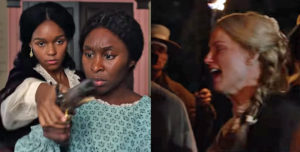 There is a brief narrated scene toward the finale which depicts “Moses” leading an armed assault during the Civil War, in which 750 slaves were rescued. Yes, Harriet always carried a loaded pistol, and used it when necessary. Omitted from the screenplay is Tubman’s memorable anti-slavery work with abolitionist John Brown. (That would have made a movie unto itself.)
There were many other valiant episodes in Harriet Tubman’s life unmentioned in Harriet, but it would take a mini-series or 5-hour movie to cover it all. That said, the Harriet Tubman story would have fared better as a Ken Burns documentary than as a Kasi Lemmons fictional biography.
Then again, with the former we would be missing some fine work by Cynthia Erivo.
=====
GRADE, On A to F Scale: C+
Surprise! Renée Zellweger triumphs in Garland biopic, ‘Judy’
 By Steve Crum
First things first, ladies and gentlemen. Of course, Renée Zellweger does not sing as well as Judy Garland. But wow, Zellweger does the great Garland proud! In Judy, Zellweger captures Judy Garland’s persona and—surprisingly—her voice and performance demeanor. She is enough like Judy to convince this longtime Garland fan.
Believe me, I dreaded seeing this movie ever since I heard it was being made. And with Renée Zellweger as Judy Garland, God forbid. Not to worry. All is very OK, even though Garland’s daughter, Liza Minnelli, reportedly does not endorse it. (She is briefly portrayed in it, however, by Gemma-Leah Devereux.) Director Rupert Goold, predominantly a director of British stage dramas, handles this film quite well.
For the most part, movie biographies are anti-climactic. The life of the person depicted is usually public knowledge. Judy is no exception, so it is unsurprising 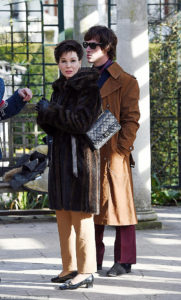 full of pathos and tragedy. It should be no spoiler that Garland’s life ended at age 47 on June 22, 1969 in London, where she was performing a five-week run of concerts. Shortly before, she married her fifth husband, promoter/lounge singer Mickey Deans (Finn Wittrock). It is depicted in the movie.
Although Judy focuses on her final weeks, there are numerous flashbacks to her MGM days, beginning with the most famous Garland movie of them all, The Wizard of Oz. Darci Shaw plays the young Judy, as she is confronted on the set by MGM’s studio head, Louis B. Mayer (Richard Cordery). His “fatherly” private conversations with her are depicted throughout Judy, each time getting more despotic and terrifying. Mayer is shown to be an absolute thug spewing out threats and insults designed for Judy’s pushing herself way past any human’s limit, let alone a child’s. It is child abuse to the 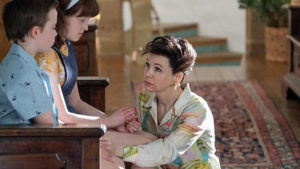 max, including his orders forcing her to take drugs to keep her awake and drugs to make her sleep. As shown in the film, those bad habits and resulting instabilities were still Judy’s inner demons by 1969.
Later in life, Judy loses custody of her younger kids to ex-husband Sid Luft (Rufus Sewell) because of lack of income and home—taken by taxes and poor management. Her London engagement was hoped to be a positive turning point.
So the movie Judy goes, accentuated by Zellweger’s realistic take on Garland’s mood swings, drinking, and drugging. It was peaks and valleys on stage and off.
Noteworthy is the fine work of Jessie Buckley as Judy’s exasperated yet sensitive personal assistant while in London.
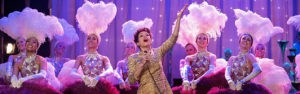 Of the half dozen Garland songs sung by Zellweger, her performance of Come Rain or Come Shine is pretty fantastic, a real salute to Judy.
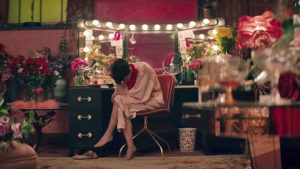 Zellweger, who undoubtedly will be Oscar nominated for her stellar work, has the advantage of falling short of Judy Garland’s 1940s-‘50s voice quality…but pretty much equaling the final days of the diva’s voice in the late 1960s. By then, Garland’s sound was rough edged, the vibrato weaker. Singing and those familiar Zellweger mouth puckers aside, Renée’s acting is terrific.
Regarding Tom Edge’s screenplay (based on Peter Quilter’s book, End of the Rainbow), the film falls way short of displaying the witty Judy Garland’s sharp sense of humor.
If nothing else, seeing Judy will trigger Garland fans to get out the old CDs and revisit those Capitol and Decca recordings…like her 1961 Carnegie Hall concert, for starters.
=====
GRADE, On A to F Scale: A-
Brad Pitt, stunning visuals highlight slow-paced space tale, ’Ad Astra’
 By Steve Crum
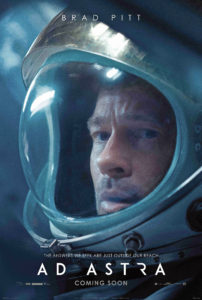
The apt title of the spectacular outer space film opening today, Ad Astra, means “to the stars” in Latin. Indeed, the journey takes us there and further. Directed and co-written by James Gray (The Lost City of Z), Ad Astra’s slowly paced 124 minutes follow astronaut Roy McBride (Brad Pitt) from the earth to the moon and beyond…to find his father and save the universe.
Gray has described his work as “the most realistic depiction of space travel that’s been put in a movie,” and he nearly achieves that goal. Let us just say that his creation is much closer to 2001: A Space Odyssey than Star Wars. While Ad Astra lacks 2001’s Strauss music on its soundtrack, the atmospheric electronic score by Max Richter is an appropriately welcome touch.
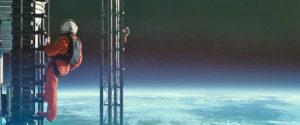 However, Gray was essentially referring to the feeling of isolation and the introspection of an astronaut, in this case provided in frequent narration by Pitt’s Major McBride. In that sense, Gray has at topped 2001’s Dr. David Bowman (Keir Dullea), whose lone astronaut never shares his thoughts. (And we could have used some of Bowman’s explanation during 2001’s surreal finale.)
McBride’s thoughts are shared with us during a galactic journey forced upon him by his superiors to helm an emergency mission. Jarring power surges are being felt on earth, and scientists fear they will increase with catastrophic results. 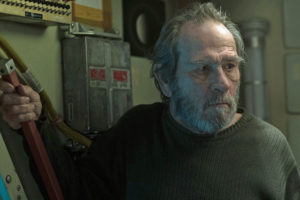 They have pinpointed Neptune as culprit central. It appears that McBride’s supposedly dead father, Clifford (Tommy Lee Jones), is not only living but responsible for the problem.
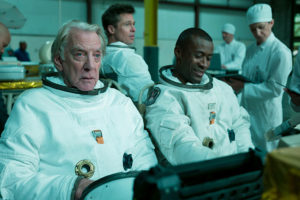
Accompanying the younger McBride is Col. Pruitt, well played in a brief turn by Donald Sutherland.
Before and after the trip, McBride’s commentary centers on being estranged from his wife (Liv Tyler), reactions to frequent psychological testing, and memories of his father.
The mundane aspects of space travel are definitely shown, but thankfully broken with some action— space monkeys and moon pirates included. During both sequences, I thought the movie was veering into Alien and Buck Rogers territory. Of course, that would have impeded on Gray’s goal of depicting realism in outer space. (So space monkeys and moon pirates are realistic?)
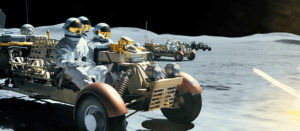
Visually, Ad Astra is a stunner, digital effects and cinematography included. (See it in IMAX if possible.) But the acting is impressive as well. Brad Pitt is on screen most of the time, appearing both unnerved and determined. Thankfully, McBride’s psychological testing requires those attributes.
Will the son suffer the sins of his father? Climb on board to find out.
=====
GRADE, On A to F Scale: B-