
Moore, Turturro are memorable, moving in dramatic ‘Gloria Bell’
 By Steve Crum
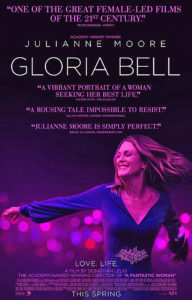
Simply put, Gloria Bell is a character study of a middle aged divorcee and her complicated relationships—one in particular. Of course, there are layers more to the character Gloria than her Plain Jane nerdiness and history of subservience to men. Julianne Moore envelopes those aspects in her remarkable performance as the title character.
Directed and co-written by Sebastián Lelio, Gloria Bell is a remake of his 2013 Chilean film, Gloria. (I have not seen the original.) Like its predecessor, this new take has been described as drama-comedy-romance. The movie’s comedic moments, particularly during the very satisfying finale, are tempered with irony and bliss.
 The film opens in what is essentially an over-50 singles bar wherein Gloria goes to dance on weekends. She loves dancing, and has learned—perhaps from the last 12 years of her post-divorce, lonely existence—to dance by herself. On a crowded and dimly lit dance floor, who would notice or even care? Really, Gloria has a very upbeat, positive attitude about her life. She does not frequent the bar to pick up men. But one night, a guy is attracted to her.
The guy, Arnold, is played by John Turturro, an actor we as movie fans have not seen enough of over the years. As usual, Turturro is unflinchingly in character, this time as a year ago divorced father of two grown daughters. Gloria has two adult kids herself, a son (Michael Cera) and daughter (Caren Pistorius). Arnold and Gloria chat, and begin a rather spontaneous relationship of dancing, paintballs 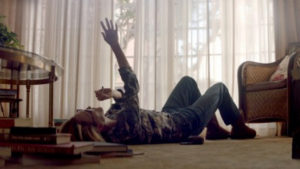 (Arnold owns and operates a business), and sex.
By this time in Gloria’s life, she has pretty much accepted being alone. But it is OK being with a guy right now. No strings. No future plans. As the plot develops, we learn that is definitely not Arnold’s mindset. Whereas Gloria is an independent soul, her new boyfriend is anything but. That is putting it, as they say, mildly.
Witness the time Gloria invites Arnold to meet her two kids, as well as her ex, Dustin, and his new wife. (Brad Garrett plays Dustin.) There are issues, thanks to Arnold. Or a trip to Vegas. Dreadful issues, thanks to Arnold. Without getting specific, Gloria could well have developed into a horror movie due to Arnold’s  obsessive behaviors and stalking tendencies.
But fear not such fears. Gloria has nothing to do with crimes of violence, but everything to do with crimes of the heart. Like Gloria herself, that latter is something we all fear.
Julianne Moore’s extraordinary performance convinces us that Gloria will not only survive, but conquer.
=====
GRADE, On A to F Scale: A-
‘Us,’ Jordan Peele’s nightmarish follow-up to ‘Get Out,’ features new horrors, old fears
 By Steve Crum
Since 2015, when he split from Kegan-Michael Key after years on TV as the hilarious Key & Peele, Jordan Peele’s showbiz life has gone onward and upward. He has kept his comedic roots alive by producing a couple of funny TV series—sans his onscreen presence. 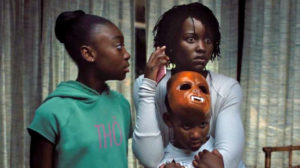
So it was surprising when he decided to make a foray into horror movies by way of producing, writing and directing. His first, 2017’s Get Out, was a critical and box office sensation. Peele deservedly won the Best Screenwriting Oscar, and the film was nominated for Best Picture and Best Directing.
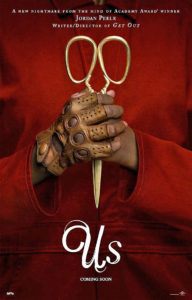
Does he equal or top Get Out with this newest screamfest, Us? Well, not quite on both counts. But Us is still jammed with creepy shivers and high production values. It is a gotta-see for horror fans. You know a movie is really scary when audience members at the preview keep yelling at the screen, “Don’t open that door!” and “Look out!” (I didn’t say such, but I sure thought it.) Us contains abundant surprises, turns, and twists throughout.
Much like Peele’s Get Out, Us involves a seemingly innocent trip to a secluded home. [Incidentally, Us is NOT a sequel.] In this case, it is a family of four trekking to their summer home, which happens to be near the Santa Cruz, California beach. The couple, Gabe and Adelaide Wilson (Winston Duke and Lupita Nyong’o), have a teenaged daughter, Zora (Shahadi Wright Joseph), and younger son, Jason (Evan Alex).
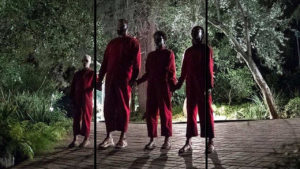 The couple moves in, and all goes well for a few hours, until Adelaide feels unstable and fearful, based solely on her instincts. At sundown, her fears are justified when four strangers dressed in red jumpers show up, standing in the driveway. So begins the Wilsons’ nightmare, playing out in murderous blood and screams for remainder of the film’s 116 minutes.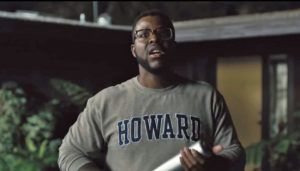
A bit of a spoiler hint: The driveway four (known later as “The Tethered”) are also portrayed by the principal cast of Duke, Nyong’o, Wright Joseph, and Alex.
As the Wilsons are finally able to flee, there is a horrific encounter with their neighbors from down the street, Josh and Kitty Tyler (Tim Heidecker and Elisabeth Moss), and their two teen daughters. Incidentally, scissors and knives are integral to the action in Us. There is also a motorboat. And many more red jumpsuits.
Enhancing the film is a terrific music score by Michael Abels, who also scored Get Out. Kudos to cinematographer Mike Gioulakis as well.
 Overall, Us becomes a horror hybrid, infusing zombies + Invasion of the Body Snatchers + slasher flick touches + psychological chills. The movie’s first third is as terrifying and involving as a scary movie could be. The second third expands the plot with new characters and repeated terrors. By the finale, we are wondering where the movie has taken us. The conclusion seems hurried and muddled. That lack of resolution is the film’s weakness.
However, this does not detract from the thrill ride that is Us, and its stellar ensemble cast that has to perform in virtually every scene—often in duplicate roles.
=====
GRADE, Based upon A to F Scale: B+
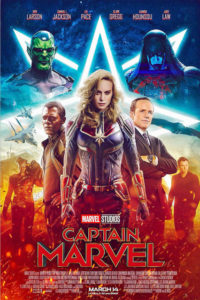
‘Captain Marvel’ flies and zaps, managing some fun sequences within muddled plot
 By Steve Crum
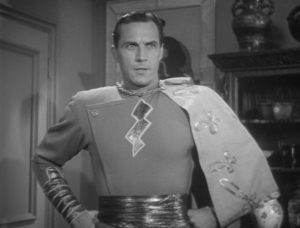
Don’t you love it in 1941’s great black and white Republic Pictures serial, The Adventures of Captain Marvel, when young Billy Batson says “Shazam!” and—in a cloud of smoke—changes into the tall, muscular Captain Marvel (Tom Tyler), complete with short cape and bulging biceps?! That was then. NOW is female actress Brie Larson in Captain Marvel, via wide screen color, minus the cape. In fact, her entire costume is day and night opposite the comparatively drab ’41 wardrobe. So is her persona, including her powers in obliterating the bad guys.
Of the two versions, the original remains the classic. This 2019 take has flashier visuals, but so-so 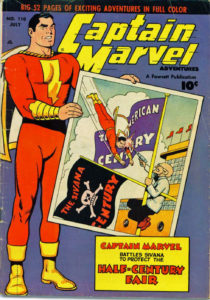 results. Comparing the two Captains encompasses 79 years of a hodgepodge of Captain Marvel makeovers in comic books, TV shows, and movies. Capsulizing Captain Marvel’s history, since Fawcett comic books created the character in 1939, is a daunting task. Bear with me.
The metamorphosis from Billy Batson/Captain Marvel to Carol Danvers/Captain Marvel covers a long list of legal suits, copyright intrusions, and Hollywood one-upmanship. Fawcett comics first had Captain Marvel, but DC Comics sued and won, claiming Superman had essentially been ripped off. In the late 1960s, Marvel Comics legally resuscitated the Captain Marvel trademark. Then the superhero underwent no less than seven incarnations, from the alien military officer Captain Mar-Vell, in 1967, to monikers like Monica Rambeau, Genis-Vell, Phyla-Well, Khn’nr, Noh-Varr, and finally…Carol Danvers. (And don’t even confuse this Danvers with DC’s Supergirl and her secret identity, Linda Danvers. We are talking the Marvel Universe here.)
Cut to Larson’s Danvers in Captain Marvel, opening in theaters today, as she explores her meaning and purpose in life by way of codirectors Anna Boden and Ryhan Bleck—who also helped with the screenplay. This is Captain Marvel’s origin story, a sub-genre fans have come to expect thanks to the explosion of superhero movies during the last three decades. As such, Captain Marvel is the first Marvel-based superhero film to feature a woman as the single lead. 1984’s Supergirl holds that distinction for the DC Universe movies.

In a synopsis nutshell, Carol Danvers is having nightmares due to her past as a U. S. Air Force fighter pilot and member of a secret unit called Kree. An accident has imbued her with superhuman strength, energy protection, and the ability to fly like Iron Man—but without need for any special suit. One of the problems with Captain Marvel is just that: the redundant flying sequences are staged more impressively in the Iron Man series.
 At this point in the comic book movie genre, comparisons are unavoidable.
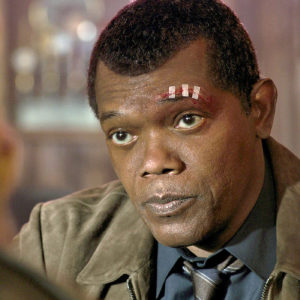
The fun of Captain Marvel is not so much Danvers/Marvel, but her pal Nick Fury, portrayed by the ubiquitous Samuel L. Jackson. He is encountered in a trip back in time to 1995, before he became the Director of S.H.I.E.L.D. He’s just an agent now, along with his sidekick, Phil Coulson (Clark Gregg). Danvers is chasing bad guy shape-shifter Talos (Ben Mendelsohn), through a strip mall. (Blockbuster Video and Radio Shack stores are part of the nostalgic landscape.) Fury and his unit arrive on the scene after reports of violence. It is not long before Danvers dazzles Fury with her superpowers. When she and Fury eventually team, the movie sparks alive.
 As if the plot isn’t convoluted enough, there are additional characters Maria Rambeau (Lashana Lynch)—an old friend and fellow pilot; and Annette Bening as the Supreme Intelligence/Mar-Vell/Dr. Wendy Lawson. She is the collective intelligence of the greatest minds of the Krees, and ruler of their empire. Factor in Danvers’ mentor, Yon-Rogg (Jude Law), a good-bad guy that just might confuse you like he did me. In fact, most of Captain Marvel befuddled this casual fan of the Marvel Universe.
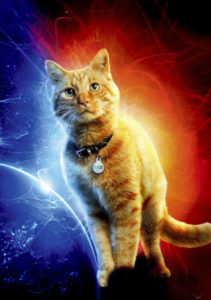
But I did love the inclusion of the the stray cat, Goose, adopted by Nick Fury. Cuteness aside, beware his puddy tat mouth and claws. Enough said.
Captain Marvel seems more apt to shine among a group like the Avengers, a point suggested at the conclusion of the end credits. Remain seated if that interests you.
=====
 CAPTAIN MARVEL BITS:
•Both Samuel L. Jackson and Clark Gregg appear 20+ years younger, believably so. The amazing transformation was done frame-by-frame, using computer digitalizing, great makeup, and wigs.
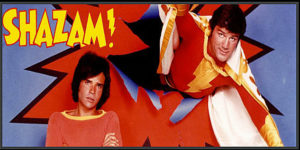
•Do not confuse Captain Marvel with the 1970s kid show, Shazam! THAT one was based upon the original Fawcett Captain Marvel. Just to make things more bananas, the DC version of Shazam! will be released next month.
=====
GRADE, Based upon A to F Scale: C+
TRUE BUT STRANGE: See here, Bret Maverick!
 By Steve Crum
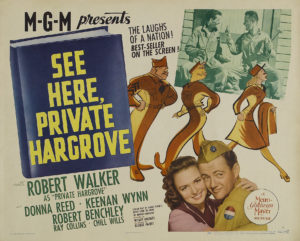
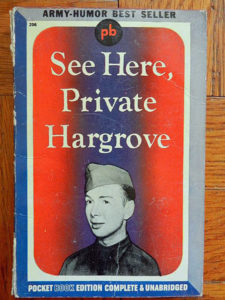
MARION HARGROVE (1919-2003) was quite a writer, having first written the best selling book See Here, Private Hargrove in 1942, an oft times hilarious account of his experiences as an Army soldier during WWII. It was such a sensation that MGM produced a 1944 hit movie of the same title, based on Hargrove’s book. Robert Walker was cast as Hargrove. There was even a sequel, What Next, Corporal Hargrove?—also starring Walker—in 1945. (TCM frequently airs both movies.)
After the war, Marion Hargrove made a living writing feature stories for magazines, including a stint as Feature Editor of Argosy magazine. This branched out to writing scripts for movies (Cash McCall, The Music Man) and TV shows: The Restless Gun, The Waltons, Colt .45, The Magician, The Rounders, and the pilot episode of 77 Sunset Strip.
Notable in his itinerary are the nine scripts he wrote for the classic TV comedy-western series, Maverick, starring James Garner as Bret Maverick. Most remembered is his script for “Gun-Shy,” a parody of the very popular TV western, Gunsmoke. Not only was Gunsmoke a CBS show, while Maverick was on ABC, but “Gun-Shy” lampooned the major characters and overall premise. This cross-network ribbing was unheard of then.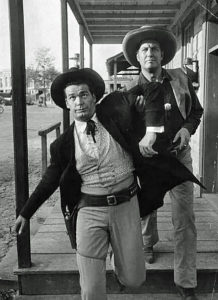
Instead of Marshal Matt Dillon, Hargrove renamed him Marshal Mort Dooley, making him a tall and not overly bright hero. Dillon’s deputy Chester Goode became Clyde Diefendorfer. Doc Adams morphed into Doc Stucke. (Incidentally, Chester’s last name on the radio version of Gunsmoke was Proudfoot.)
The plot involves Bret Maverick wandering into Elwood, Kansas (a Dodge City takeoff), and running afoul of the town marshal. Marion Hargrove even wrote in a reference to Richard Boone’s Paladin character from Have Gun Will Travel, another popular western series of that time.
Maverick remains one of the best western series of all time, thanks in part to Marion Hargrove’s witty contributions.
Must-have 1941 concert for Greek Relief CD showcases America’s greatest popular composers, singers, comedians
NOTE: Following is a review I wrote several years ago for Amazon, praising a double-CD set containing a rarely heard 1941 concert for Greek Relief. The CD is still available on Amazon—and perhaps other sites, but it has been out of print for some time. It can be purchased through other Amazon merchants, and is a gotta-have for the definitive vintage show business aficionado.
=====
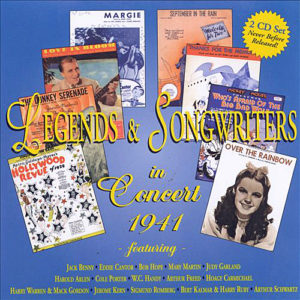 By Steve Crum
Deep in my heart the melody lingers, and the song never ends. That is why this marvelous double CD set produced by Brian Gari, Legends and Songwriters in Concert 1941, appeals to me. It will also connect with any lover of the American popular song.
The 45 tracks represent a spectrum of song hits beginning in the teens of the 1900s. As the title suggests, this is a concert–a rarely heard concert even in its time. Taken from what was thought to be lost discs, the Feb. 25, 1941 Greek Relief Fund evening features not only the songs, but the composers. (Many died within a few years of this recording.) Some sing their own creations (always a joy, even when they cannot sustain all the notes), and some accompany other singers via a piano or play solo piano.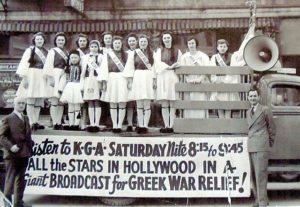
The war in Europe was festering. Pearl Harbor was only months away. So this precious two hours and 20 minutes
recording exists as a history bookmark–an extremely entertaining one. There are patriotic songs (Tony Martin belts out a very mean and stirring “God Bless America” at the conclusion–nearly equaling Kate Smith’s final note); and there are references to the Greek resistance effort against the Axis in a special lyric that Bob Hope sings via “Thanks for the Memory.”
Performed at the Shrine Auditorium in Los Angeles and broadcast on radio only to West Coast listeners, this 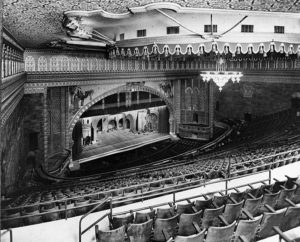 extravaganza includes some of the great entertainers of all time. There is Jack Benny (playing his theme song “Love in Bloom” on the violin–a complete version played straight and gorgeously); a young Judy Garland (singing “Over the Rainbow” with its composer Harold Arlen on piano and David Rose conducting the orchestra–to a thunderous ovation); composer Hoagy Carmichael singing what many still consider the greatest pop song ever written, “Star Dust”; and Eddie Cantor, CD producer Brian Gari’s grandfather, singing his immortal “Makin’ Whoopee” as songsmith Walter Donaldson accompanies him on piano.
This is one honey of a CD set. The live performance includes numerous fluffs, including Dinah Shore having to restart “South American Way” several times, and Bob Hope coming back for curtain calls twice, even though he is told on air that the show is running late. Sound quality is monaural, no surprise, and there are a few clicks and scratches due to the condition of the original discs. But such imperfections are minor.
On with the plus factors:
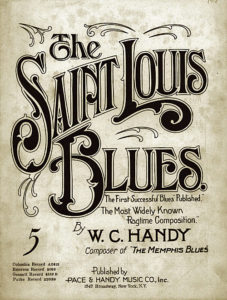 *”St. Louis Blues”–performed by the composer, W.C. Handy, on trumpet.
*”Smoke Gets in Your Eyes”–Jerome Kern plays the piano, backed by full orchestra. (The orchestra, conducted by either David Rose or Alfred Newman, assists most of the artists.)
*”Lover, Come Back to Me”–played by Sigmund Romberg, the composer, along with a medley of his hits.
*”Indian Love Call”–Rudolf Friml on piano.
*”You Made Me Love You”–played and sung by its soulful and warbly-voiced creator, Jimmy Monaco. 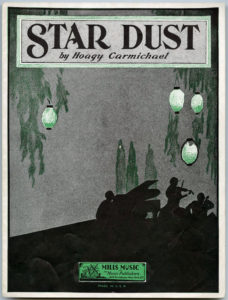
*”My Heart Belongs to Daddy”–Mary Martin sings her signature song with writer Cole Porter on piano.
*”My Buddy”–Remember the wonderful Frances Langford? She sings a wrenching version as composer Walter
Donaldson accompanies.
Perhaps the surprise of the show opens the program. Albert Von Tilzer might be a forgotten song writer, but he sings his own all-time hit that will always be remembered: “Take Me Out to the Ballgame.” Wait until you hear its seldom sung verse.
Pardon me as I listen again.
=====
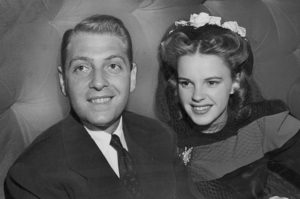 Epilogue: At the time of this concert, David Rose was married to Martha Raye. They divorced on May 19, 1941. Two months later, July 28, he married Judy Garland. They divorced in 1944. This was the first of five marriages for Garland.