
‘Deathly Hallows’ is more spectacular, brooding than ever

By Steve Crum
Spectacular and increasingly brooding as ever, Harry Potter and the Deathly Hallows: Part 1 marks the near end of the series and–we assume–franchise. (Spinoffs, anyone?) It is, for the 11 souls unaware, the film version of J. K. Rowling’s final Harry Potter novel. Forgive the half-truth. The grand finale (Part 2) plays mid-July, 2011.
Yes, Deathly Hallows 1 is a cliffhanger that abruptly, yet elegantly, concludes after nearly two and a half hours, Do not look for a ”To Be Continued” insert, however. This lack of story resolution will still disappoint Potter fans, even though they knew it was coming. Anticipation is everything, isn’t it? When Star Wars originally baited us to wait three years between chapters, it was a killer. Prepare for more pain.
The Potters have now stretched through seven magical films, or eight including the second half out next summer, over the last decade. Even more incredible is its three main stars have not totally outgrown their characters. Of course, their book counterparts also aged. In either case, these more mature Deathly Hallows actors are a long stretch from retirement age.

Each Potter episode offers its own character revelations, its own visual dazzles. Deathly Hallows is the most foreboding and shocking of them all, Steve Kloves, who has written all the Potter screenplays, has faithfully adapted Rowling’s final chapter to emphasize the book’s tensions on the race to resolution. David Yates’ crisp, fast paced direction helps.
Among the myriad delights, Deathly Hallows features multiple Harrys, a clever, fun ID safeguard for our central wizard boy. Essentially, Harry’s clones guard Harry’s life. In addition, there are group scenes and interactions of all Hogwarts’ good guys as well as all its villains, including the giant serpent. (It becomes more than a mere man eater here.) Central to Deathly Hallows hype is the well publicized death of one of the major characters. I don’t know about Part 2, but there are at least three well knowns who violently kick off (SPOILER DANGER) in Part 1. Enough, maybe too much, said on this grim point.
Briefly, the story follows two plot lines, one being the Dark Lord Voldemort’s (Ralph Fiennes) control of the Ministry of Magic and Hogwarts. The grand old wizard academy has transitioned from a warm, eccentric, learned institution of wizardry to a cold, dungeon-like, warehouse of evil. Quidditch has given way to Voldemort’s Death Eaters. Unfriendly skies, indeed.
 Harry, Ron and Herione (Daniel Radcliffe, Rupert Grint and Emma Watson) team to finish the late Prof. Dumbledore’s quest to find the rest of the Horcruxes to defeat Voldemort. Despite sparse hope to succeed, they race cross country to attain the Deathly Hallows trifecta: The Elder Wand (buried with Dumbledore), a Resurrecting Stone, and The Invisibility Cloak. (Another spoiler: Michael Gambon has a cameo as Dumbledore.)
 It is no shock that the friendship between Harry, Hermione and Ron is further tested, since that has been the case in every Potter movie so far. However, this time around, their comradery veers toward tragedy. Just a side note: As the three actors have aged since the first Potter film premiered in 2001, so have their acting skills. Unknowns then, they are forever a well known, vital part of the Potter legacy. There will no doubt be a rerun of this and similar nostalgic thoughts in my Part 2 review next year.
Maybe I am a bigger Harry Potter fan that I have thought all these years.
A TRIVIA TONGUE IN CHEEK: Look for an Equus poster on the background wall in the London diner scene with Harry, Ron, and Hermione. Daniel Radcliffe starred in that very play.
——————–
GRADE On an A to F Scale: B
——————–
RICHARD BOONE, from ‘Medea’ to ‘Medic’ to Paladin

Pictured: RICHARD BOONE as DR. KONRAD STYNER in MEDIC. [From Steve Crum’s showbiz memorabilia collection.]
———-
By Steve Crum
Although he will be forever known as Paladin in the long running (1957-63) TV western, Have Gun-Will Travel, RICHARD BOONE (June 18, 1917-Jan. 10, 1981) had a life and career worthy of his own reality series, had such existed in those days. Boone appeared in over 50 movies and TV shows, as well as acting on Broadway.
After serving in the Navy during WWII, Boone used his GI Bill opportunity to take acting lessons. His talent and drive were immediately obvious, sparking a short run of plays on Broadway in 1947, beginning with Medea and Macbeth. Contracted by Twentieth Century Fox, Boone’s first film was The Halls of Montezuma (1950), starring Richard Widmark. Segue to television, and Richard Boone portrayed Dr. Konrad Styner in the early, influential medical series, Medic (1954-56). Boone introduced each episode as Styner, and acted in many of them. Incidentally, the series’ theme music, Blue Star, composed by Victor Young, is considered one of the most memorable TV themes of all time. Boone received his first Emmy nomination for his portrayal.
 Boone received two Emmy nominations for playing the highly educated and moralistic hired gun with a conscience in Have Gun-Will Travel. Following his departure from the series, he developed and starred in The Richard Boone Show, a dramatic anthology series that regrettably ran only one season, from 1963-64. After his family moved to Hawaii, Boone was offered the title role of Steve McGarrett in the upcoming series, Hawaii Five-0, but turned it down. (Jack Lord then got the part.) It is interesting to note that Boone is responsible for convincing the show’s producer to film the series in Hawaii, a decision that benefitted not only the show’s ratings, but Hawaii’s Tourism Dept.
  Other TV roles followed, most notably Boone’s Hec Ramsey western-detective series, which ran from 1972-74. Movie appearances, over the years, include three with John Wayne (The Alamo, Big Jake, The Shootist), The Night of the Following Day (with Marlon Brando), and The Big Sleep (with Robert Mitchum).
 Shortly before Richard Boone died of throat cancer in 1981, he wrote a newspaper column for a Florida newspaper, and taught acting.
———-
Some Richard Boone Family Trivia: He was a descendant of Squire Boone, Daniel Boone’s brother.
———-
A Personal Note: In the late 1950’s, during Have Gun’s run, my Aunt Ada Holley bumped into Richard Boone. Literally. While shopping with her family in Tijuana, Aunt Ada was chasing her young son through the aisles of a shop. Partially bent down as she ran, she turned a corner, and head butted Richard Boone in his chest. He was taken aback, but laughed, as she nervously did too. She apologized, he accepted such, and off she went to grab her little boy. Have Kid-Will Travel.
——————–
A complete episode of the classic TV show, MEDIC, starring RICHARD BOONE: https://www.youtube.com/watch?v=xErX5vN4s4o&list=PLmHgXUJMN1TVRnTnRJKZ9cUSZA6YRDuQa&index=2
Eastwood’s ‘Hereafter’ is heartfelt, sensitive storytelling

By Steve Crum
Clint Eastwood has chosen to tell the compelling Hereafter as three stories set in a like number of international locations with Matt Damon’s character serving as the interconnecting lightning rod. As its title suggests, Hereafter deals with death; however, its focus is on departed souls’ influence on and communication with the living. Although various precepts of love are plot elements, the film is not so much a love story as it is a story of loving in humane ways. Hereafter is a heartfelt, sensitive film, qualities inherent in most of Eastwood’s directed work, particularly over the past decade.
Matt Damon is George Lonegan, a laborer working in San Francisco with his brother Billy (Jay Mohr). Lonegan used to have a much more lucrative job, at least potentially so, when he discovered his ability to connect with the afterlife. His brother relentlessly encourages him to take advantage of his gift, but George has found it to be more of a curse. The emotional impact of his readings (he merely touches the person to connect with his or her dearly departed) has worn him down to the extent he avoids socializing with virtually everybody. Yet potential clients seek him out to speak to a departed loved one.
 There is a particularly telling sequence wherein George takes a chance in exposing his celebrity as a psychic, and enrolls in a cooking class, which he feels will be a safe and fun way way to socialize while avoiding death issues. What he does not count on is being partnered with cute redhead Melanie (Bryce Dallas Howard–Ron Howard’s daughter). Their blindfolded, taste-testing scenes are charming and funny. In fact, they border on the erotic with close-ups of lips and tongues, reminiscent of the eating scene in Tom Jones. (This is a new Eastwood turn.) As their food partnership segues into a serious relationship outside of class, the plot takes serious, sad turns.
Concurrently, French journalist Marie Leley (Cecile de France) is vacationing with her boyfriend when a Tsunami hits their island resort. (Actually, this spectacular sequence opens the movie.) The tidal wave hits while she is shopping downtown, with disastrous results. Without giving away far too much, I will say her experience will later inspire her to write a memoir about the incident. Eastwood’s recreation of the Tsunami is realistic and terrifying, certainly an achievement for his digital/special effects gurus.
Eastwood and screenscribe Peter Morgan (Frost/Nixon) add the story of London schoolboys Marcus and Jason, well acted by twin brothers Frankie and George McLaren, to the plot triad. Not long into its initial sequence, wherein the boys’ wretched life with their alcoholic mother is depicted, a turn of events puts Marcus on his own. Without getting too specific, this eventually triggers a search to personally meet with George, whose reputation as a legitimate psychic is well known. Scenes of Marcus as he stubbornly pursues George are alternately humorous and disturbing. Eastwood handles the material superbly.
 It is no coincidence that George Lonegan a super fan of Charles Dickens, and that Hereafter plays out much like a Dickens novel. Chance meetings, coincidence, characters (in this case George, Marie and Marcus) crossing paths later in the story, a search for the truth, and destiny are elements familiar to Dickens’ readers.
 Eastwood has used subtitles before, as in the Japanese sequences of Letters From Iwo Jima, and he uses them here, sparingly, in the French portions. Factoring in the on location filming in Paris and London, low key dialogue-speak, the multiple plot structure, and long takes, Hereafter has a foreign film look and feel.
It should not be surprising that Clint Eastwood has created a thoughtful work with exemplary acting (Damon, de France and McLaren), and a compelling story that wrenches and tugs at tears and heart. He continues to reinforce his reputation as one of the most important filmmakers of our time.
——————–
GRADE: On an A to F Scale: A
——————–
Absorbing ‘Social Network’ is high profile, fascinating

By Steve Crum
Ironies abound in The Social Network, a fact-based, fictional film about the creation, impact, and financial gold strike of Facebook. The first irony is that I had to tear myself away from Facebook at home to drive to a screening of a movie about the very addictive site I just left. Irony 2 involves the story’s main character, Mark Zuckerberg (Jesse Eisenberg), who conceived the idea for the world’s largest Internet chat room, yet has scarce public social mores himself. In fact (Irony 3), virtually everyone involved with the technical and business parts of Facebook appears to have negligible one-to-one communication skills.
The Social Network is a fascinating, absorbing film well worth friending.
Opening at a Boston bar in 2003, the story focuses on nerdy Harvard sophomore Zuckerberg as he repeatedly, dare say intellectually, insults his girlfriend (Rooney Mara). After she sharply tells him off and leaves, he storms back to his dorm room, determined to revenge himself by posting negatives about her on his blog. It turns out to be a near lethal move on his part. His displeasure then turns to rampage against all female students. Zuckerberg hacks into Harvard’s main frame to access sorority photos he then exploits via “Hot or Not” beauty contests posted on Harvard’s network. Feedback is immediate and lasting; thousands of Harvard students are viewing his postings.
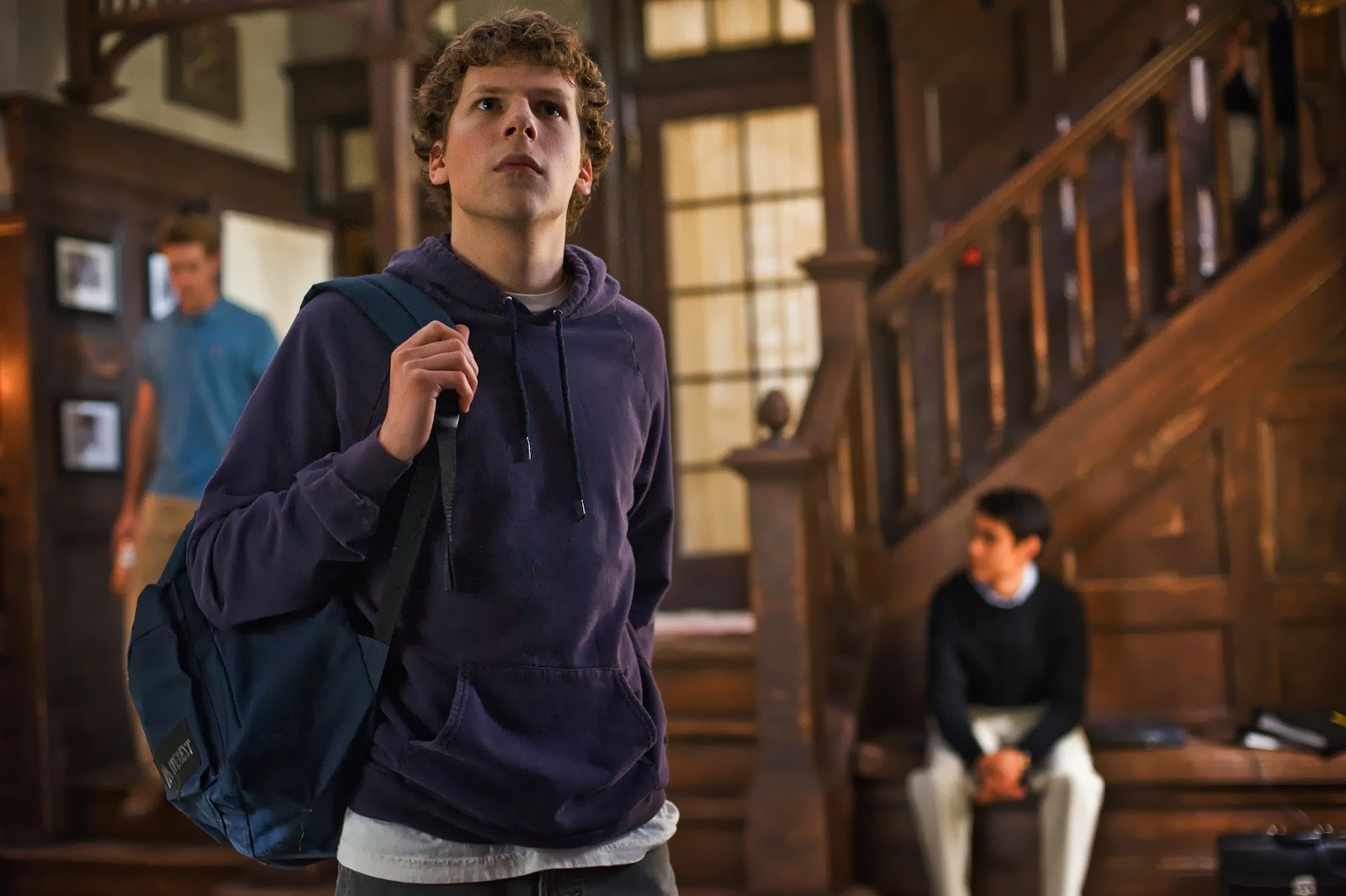 A couple of steps down the line, Zuckerberg’s genius computer skills further refined, the origins of Facebook emerge. Like Facebook, the plot is about the step-by-step connections that led to its creation and popularity.
 The Social Network’s credentials are stellar. Director David Finch also helmed Zodiac and The Curious Case of Benjamin Button, two superb films noted for their innovative, precise storytelling. Screenwriter Aaron Sorkin penned Charlie Wilson’s War as well as 154 episodes of TV’s The West Wing. Sorkin has taken Ben Mezrich’s book, The Accidental Billionaires, and structured TSN around the numerous lawsuit hearings that occurred as Facebook grew to worldwide popularity. For example, litigant Zuckerberg and his attorney face off behind closed doors against former Facebook partner Eduardo Saverin (Andrew Garfield) and his counsel. Flash back to the origin of their conflict when the two were Harvard roommates just beginning their website.
The flashbacks reveal the growing problems, many of them ego-based, that led to to mistrust and legal backstabbing. Amongst the fray is Sean Parker (Justin Timberlake), who befriends Zuckerberg not long after Facebook launch, and immediately causes more rifts within the growing Facebook empire. Timberlake, incidentally, does a fine job as the Napster music site entrepreneur.
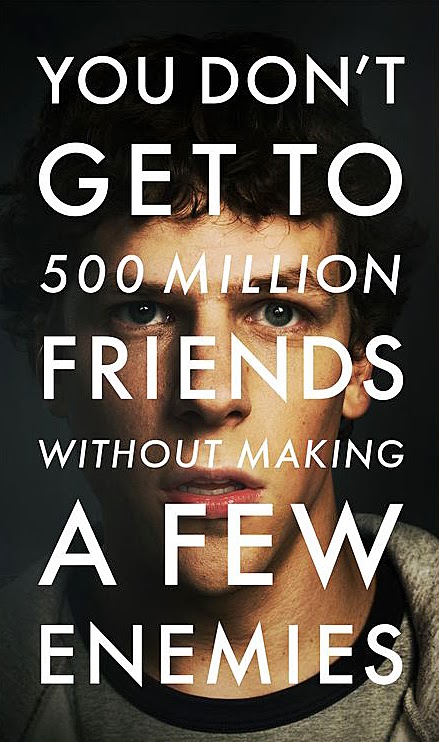 The two leads, however, give the film its credible base. Saverin portrays Garfield as an insecure, constant whiner, contrasted to Eisenberg’s rapidly speaking, distant, and pretty much emotionless egghead, Zuckerberg. He comes across as a close cousin of The Big Bang Theory’s Sheldon Cooper, minus the humor.
 It is difficult to feel empathy when the lead characters are millionaires beset by lawsuits threatening their megabucks. An on-screen tag informs us that Zuckerberg is the youngest billionaire in the world.
Witnessing their ego-based tantrums certainly does not trigger our tear ducts either. It is sort of like observing a fender bender between two Rolls-Royces. However, the attraction of wealth colliding with wealth is unique voyeurism. Fincher and Sorkin understand that tableau quite well, being very good storytellers.
GRADE on Scale of A to F: A-
——————–
Trailer of The Social Network: http://www.youtube.com/watch?v=lB95KLmpLR4
Affleck’s direction, not acting, makes ‘The Town’ watchable

By Steve Crum
Ben Affleck is a far better director (and writer) than he is an actor. Gone Baby Gone, the 2007 kidnapping drama wherein he directed his brother Casey, asserted such; The Town tries hard for confirmation. Affleck wrote, directed, and stars in The Town, an above average heist flick. Don’t be misled, however. The Town has exciting action sequences, including cleverly staged car chases and bank/armored car robberies. The down side is its long stretches of talk, talk pleading for edits. Just as we are beginning to nod off from a combination of Affleck’s slurring words and wordy dialogue, a cut to the bad guys dressed as nuns in fright masks awakens us again.
Affleck’s acting deficiency stems from his stiff body language and mumbling speech pattern. NOTE TO MR. AFFLECK: Ben, e-n-u-n-c-i-a-t-e. Project a bit, actually a lot more. You’ve written yourself a slew of intimate dialogue scenes in “The Town,” yet you could barely be understood. Your rigid, tight lips make reading them impossible. Regards, A Wannabe Fan of Your Acting.
 The Town’s real acting honors go not to Mad Men’s Jon Hamm, who does an admirable, credible job as the lead FBI agent, but to Jeremy Renner, last year’s Oscar nominee for The Hurt Locker, itself a Best Picture winner. You just cannot take your eyes off of Renner in any scene. He is a charismatic, dynamite performer. That he portrays a psychopathic killer, with a hint of Joe Pesci’s style, accentuates his presence even more.
The movie’s preamble explains the setting, the Boston suburb of Charlestown, a neighborhood that accounts for most of the 300 bank and armored car robberies occurring in Boston each year. In fact (we assume it is actual fact), Charlestown leads the nation in bank robbers, per capita. The robbers are highly organized, efficiently operating like a family run, albeit mafia-type, business, One of its lieutenants, Doug MacRay (Ben Affleck), has tried to break out of the “family,” but is harkened back again and again. He is estranged from his father (Chris Cooper), who is serving prison time.
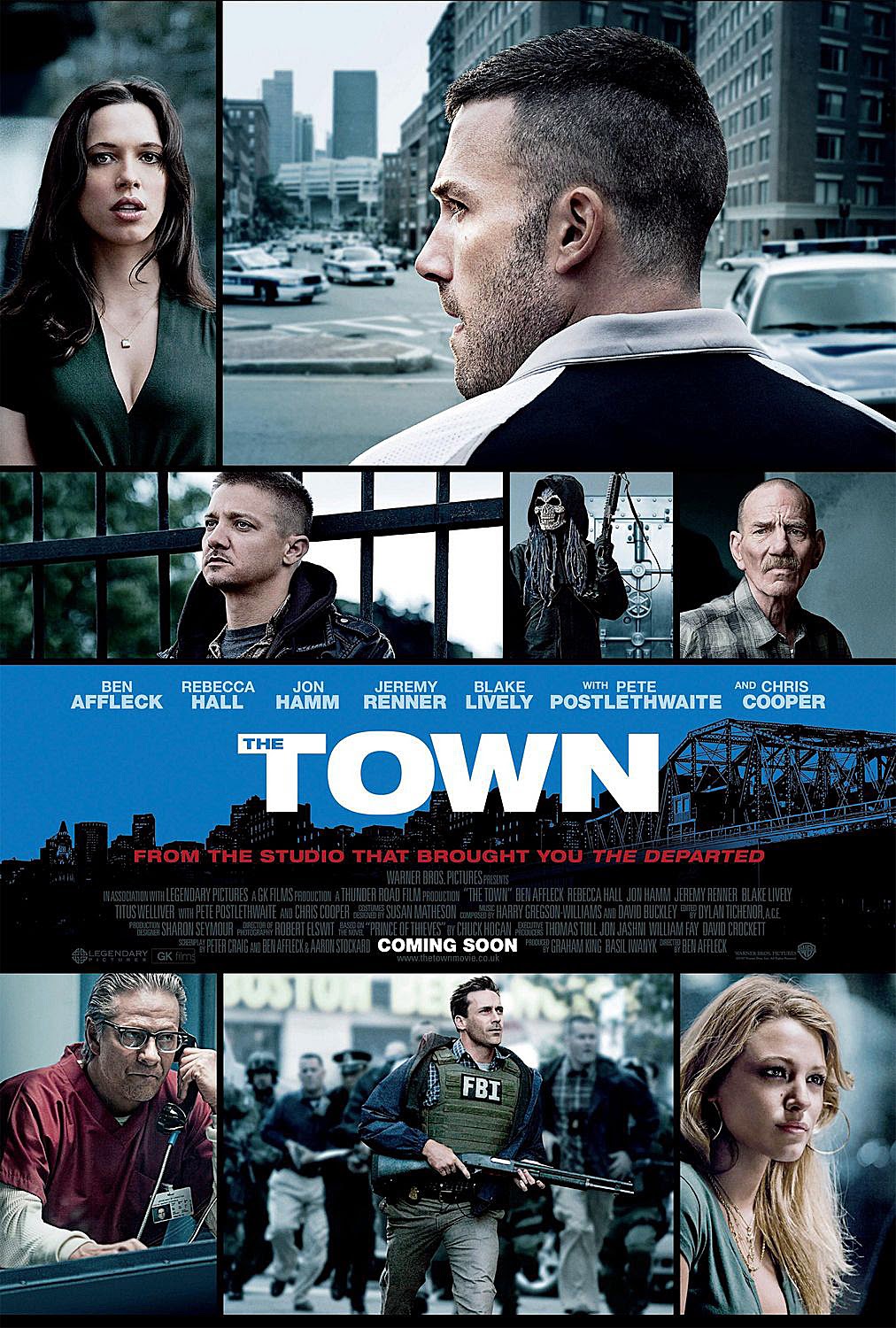 MacRay has a tenuous relationship with his closest friend since childhood, Jem (Jeremy Renner), despite Jem’s tendency to explode at virtually nothing. After a heist wherein Jem viciously kills a bank officer, a witness (Rebecca Hall) just happens to cross paths with McCray at a laundramat. Who would have thunk? Since he was masked during the robbery, she does not recognize him, but he soon recognizes her. No surprise they fall in lust and love, and that is where this plot revelation ends. Their relationship becomes more and more complicated, let’s say.
Cut to FBI agent Frawley (Jon Hamm), who is leading a task force to outwit and stop the slew of robberies. Each crime is planned and executed to the hilt, leaving behind zero clues. Robbery in this neighborhood has become precision art. Like most crime films, the back and forth interplay between police and criminals is key. Outwitting each other is the game.
The Town features powerhouse actors, besides those already mentioned, Pete Postlethwaite, Blake Lively, and Titus Welliver. Postlethwaite is always a presence, and particularly strong here.
Add to the pluses a riveting, action score by composers Harry Gregson-Williams and David Buckley.
GRADE on a Scale of A to F: B-
——————–
Top Photo: Ben Affleck directs Jon Hamm on location.
——————–
THE TOWN trailer: http://www.youtube.com/watch?v=QQ7wcayQQLQ