
Farewell, Steverino
[Published 11 years ago, Nov. 3, 2000, in The Kansas City Kansan, regarding Steve Allen’s death]
By Steve Crum
 Death of an icon. The passing of a show business pioneer. Cliché headlines that are true in this case. As I sit here Tuesday afternoon, two hours after hearing of Steve Allen’s death, I am stunned.
Friends have called, leaving messages of his sudden death that occurred Oct. 30, the day before I write this. According to the Allen family’s official statement, he was “at the home of his youngest son, Bill, in Encino, California. Mr. Allen was resting after a visit with four of his 12 grandchildren when he lost consciousness and died of an apparent heart attack.”
Steve Allen was about a month away from his 79th birthday.
Press reports got the story mostly right, even though half the TV and newspaper blurbs incorrectly said he had died Oct. 31. Six different media sources that I read and heard (including the three major TV networks) said that Allen had written 4,000 songs in his career. This is true, but not all the truth. He actually had over 8,500 original songs published, which garnered him the Guinness Book distinction as “the most prolific composer of all time.”
 I was well aware of the media errors, because I have made it my business to know Steve Allen. He is the person about whom I have said from my youth I would most like to emulate. The majority of wit and humor I have been accused of possessing is traceable to Allen. Maybe all of it. Because of him, I sneaked late night TV viewings from as far back as grade school in the late 1950’s. He exposed me to humor–purely zany, wonderfully ridiculous, infectious and inventive. I was a member of his comedy club of which there were millions more like me, inclusive of all ages. It was a vicarious experience, of course, but with me were Tom Poston, Louis Nye, Don Knotts, Gabe Dell, and Dayton Allen.
 And it was a party time full of laughter and camaraderie. The skits were clever with characterizations as defined as Nye’s Gordon Hathaway (“Hi, ho, Steverino”), Poston’s man on the street who never could recall his name, and Knott’s nervously shaking persona. Steve Allen, the host, was always the joyful ringleader. He laughed at his comics, and at himself. His was a high-pitched blast of a laugh that some have labeled a cackle. But it was more like an amplified, uncontrollable giggle–and America loved to hear it. That is because it was a spontaneous happening triggered by someone’s wig slipping or a piece of scenery falling or a wild double take. Not only was Allen’s laugh in itself funny, his reaction also abetted the overall hilarity.
I shall not try to repeat what the media has already said this week regarding Allen’s show business credentials. In fact, I devoted two consecutive columns weeks ago to his accomplishments. That was after I spent three days in Allen’s presence during his Lawrence-to-Iola, Kansas tour in conjunction with the annual Buster Keaton Celebration held at the end of September. (Allen performed at Lied Center in Lawrence and was special guest speaker at the Keaton affair.)
 Saying at the time that it would probably be the last time I would ever get to see Steve Allen in person (I had interviewed him in 1964 as a Wyandotte High School Pantograph reporter), I meant it in a proximity sense, since Allen resided on the West Coast. Allen and his wife Jayne still did limited touring with a romantic play, and Allen himself performed various one-nighters–like the one he did in Lawrence. There he reminisced, played the piano, sang some of his great songs like This Could Be the Start of Something Big, and relaxed on an on-stage couch commenting on clips shown from his six decades on TV and the movies.
 In Iola, I sat a seat behind Allen as he and a packed auditorium watched Buster Keaton’s 1924 classic, Sherlock Jr. Allen suppressed his famous giggle, but he chuckled constantly. Afterwards he admitted he had never seen this Keaton film, and felt it was “way ahead of its time in humor and film technique.” He even asked for a video copy to take home to show his grandchildren. He got his wish.
Steve Allen was always a great social observer and lover of language. At least half of his 50-plus books deal with such subject matter. No doubt that is why he became so adamant a supporter for cleaning up what he considers the film filth and moral decay promoted through the entertainment industry. The Parents for Television Council, led by spokesman Allen, feel that the media is “leading children down a moral sewer.” It was Allen’s passion that his cause would change our lives and our children’s lives for the better.
Now he is gone, but his reform movement not only survives but flourishes, thanks in huge part to him. We also have late night talk shows because of him, as well as his music, recordings, books, and memories.
 Oh, those great TV shows with you, Mr. Allen: The Tonight Show, the men on that street, the angry letters to the editor, The Question Man, the ad libs, The Gravy Waltz, Vine Street, the Be-Bop Fables, a Hebrew National Salami, What is a Freem?, Meeting of the Minds, Andy Williams, Steve Lawrence and Eydie Gorme, on opposite Johnny Carson, earlier up against Ed Sullivan, your great love of jazz.
 And your great love of life that you shared with me and the world, Steverino.
——————–
Addendum: In Iola, I asked Steve Allen about his daily regimen. Allen replied, “My daily regimen? It’s easy. I just get up at the crack of dawn, stuff up the crack, and climb back into bed.”
——————–
‘Real Steel’ needs more grit, less melodrama

By Steve Crum
Real Steel could have been, should have been much more. Based on Richard Matheson’s 1956 short story and his gritty 1964 Twilight Zone TV episode, Steel (starring Lee Marvin), Real Steel is neither gritty nor classic. Instead, it succeeds as a sort of Family Channel robot bonding tale, in some ways a live action Iron Giant. Such is far from my expectations.
Director Shawn Levy (Night at the Museum) and screenwriter John Gatins have circumvented Matheson’s original premise of a down and out boxer who literally climbs inside his robot boxer for a desperately needed final victory. In this reboot (or re-robot), the focus is on both Charlie Kenton (Hugh Jackman) and his estranged, 11 year-old son, Max (Dakota Goyo). Sure, there are various robots along the way, and they look cool while performing spectacularly. As one robot after another is beaten into scrap iron, from Ambush (who fights live bulls at rodeos) to the flashy import Noisy Boy, Charlie’s great metal hope is accidentally discovered mostly buried at a metal parts junkyard. Soon after named Atom, the robot has a literal hand in saving Max’s life. The boy is immediately smitten with Atom, and proceeds to rebuild and recondition the discarded sparring-bot to champion status.

The premise for Real Steel is, nonetheless, fascinating. Set in a future of human-less (and bloodless) boxing matches, robots are the superstars. (Humans still coach, ref, and promote the matches.) Championship bouts are held at the Crash Palace, the Madison Square Garden of tomorrow. It is interesting that, except for the robots and the technology involved in the matches (humans sometimes operate computer control panels to control the robots), the future looks like our present day.
For example, take the impressive opening sequence set in a county fair rodeo arena, which features the robot Ambush tussling with an 800 pound raging bull–not played by De Niro. The set resembles any typical rodeo of today, including screaming fans. As the robot matador tries to clobber the beast into unconsciousness, he/it loses a leg, yet tries to continue fighting, balancing on his good one. The mistake occurs due to trainer Charlie’s neglect at managing Ambush’s remote control on the sidelines. This is the best sequence in the film because of its no frills, bare-boned action. No animals were harmed during the making of this movie, but plenty of robots were.
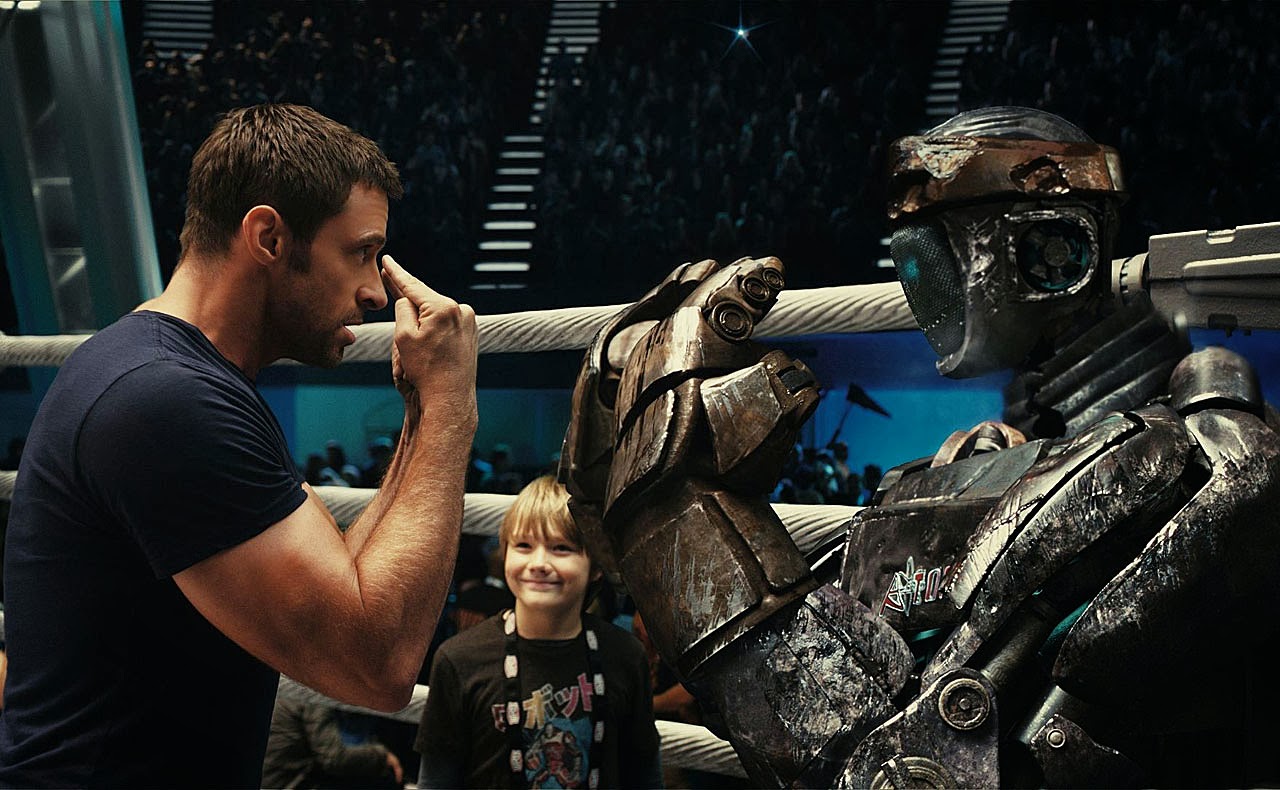 There are sub-plots of Charlie’s wheeling and dealing with bookies and loan sharks (he is over his head for thousands), and his friendship with robot tech Bailey Tallet (Evangeline Lilly). But the crux of the story centers on Charlie and son Max. Via divorce, Max has exclusively lived with his mother. His mother’s sudden death forces Max to either live with his dad (Charlie) or his rich aunt and uncle. At first, Charlie is happy to sign court papers for Max to move in with his ex-wife’s sister, especially since her husband offers Charlie big bucks to legally sign the boy over to them. However, as Max becomes more involved with bot fighting, he and his father grow closer. While the father-son scenes set a positive, moral tone for the film, they are often ponderous, and distract from the core theme of battling robots, and man’s obvious need for violence, even on a simulated basis. This need for violence extends to children aka Max.
 Incidentally, Sugar Ray Leonard supervised the boxing scenes, via professional boxers who were “motion-captured,” computer-wise.
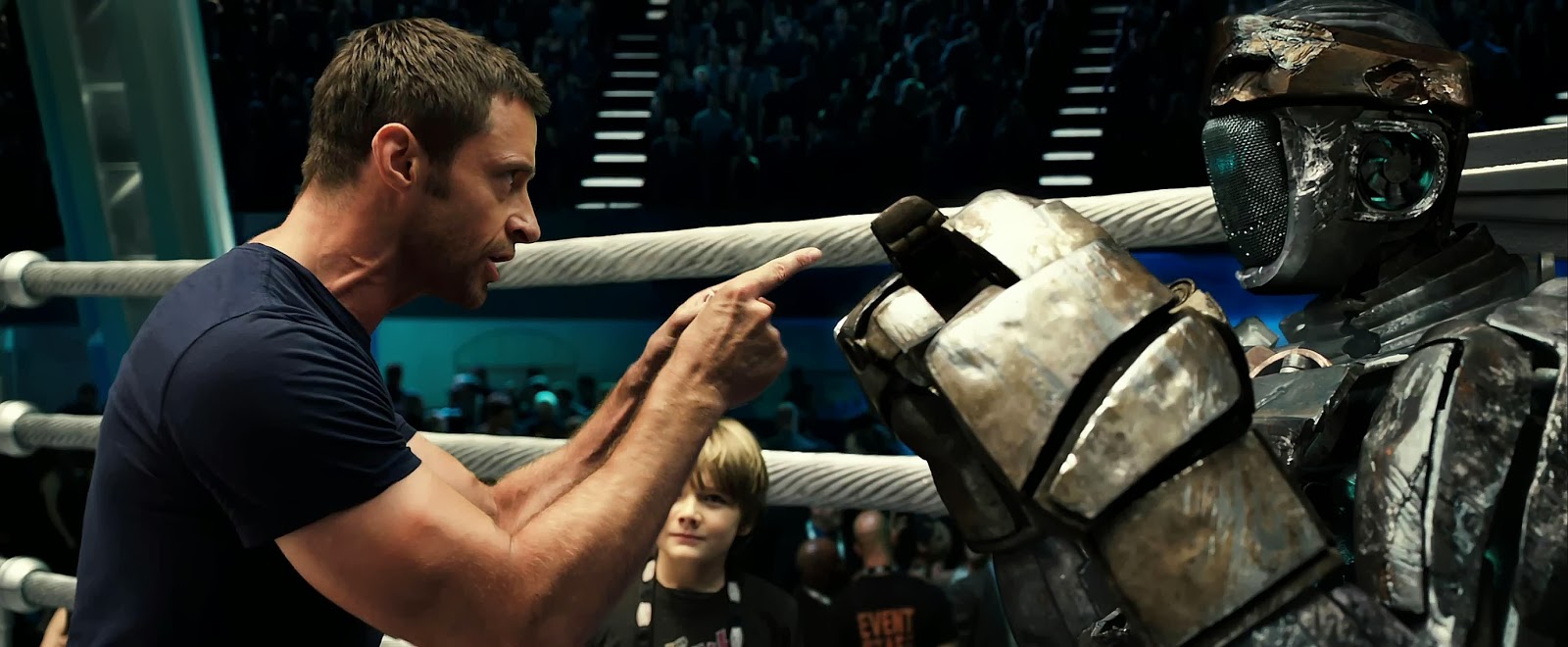 Acting in Real Steel is generally very good, with Jack’s desperate trainer and Goyo’s whiz kid personas particularly impressive. But what one takes from the movie, cutting through all the human family melodrama, are some outstanding robot sequences. After all the Transformers exposure over the last few years, who would have guessed more battling bots would hook our interest? Maybe it is because Real Steel’s bots need humans to think for them.
 ——————–
GRADE on an A-F Scale: B-
——————–
NIGHTMARES for the American Dream Factory/Remembering 9-11

Originally published in The Kansas City Kansan, Sept. 28, 2001
By Steve Crum
The horrific events of Sept. 11 continue to affect every American. What was funny on Sept. 10 is not so funny now. Humor, particularly political satire, instantly fell out of fashion as politicians fast became heroes or, at the very least, harbingers of hope and justice.
The mass media, reflecting an awkward stock market, began playing bear with its entertainment news industries. The mood of a country influences its citizens’ viewing, listening and reading habits, of course.
During the last 17 days, initial shock has given to patriotism and a somber uncertainty. Movie studios, networks and publishers sensed that mood immediately, and acted upon it. No upcoming motion picture was going to be even hinted at as distasteful, unpatriotic or insensitive.
The so-called “dream factory,” always catering to its ticket-buying public (after all, we are talking about a multibillion dollar industry), rushed to edit or re-shoot scenes in a number of films. Soon to be released movie openings were changed–some to next year, some to an undetermined date.
TV shows were likewise handled. A handful of programs slated for a September premiere are on hold until the barometer of viewers’ feelings changes. Add print media to the affected mass. The New Yorker magazine, the long time, slick paper voice of Big Apple culture, appropriately featured a Sept. 24 cover of chilling impact. What appears at first to be a solid black cover (with the title, date and price in bold white across the top), a closer look reveals the silhouette of the twin WTC towers in solid black, set against an ultra dark, purple sky.
Inside, film critic Anthony Lane, in his essay, “This Is Not a Movie,” speaks of mass media’s link with reality. After repeated doses of explosions and catastrophes via motion picture special effects, we were force fed the real thing.
“It was hard to make the switch,” he writes. “The fireball of impact was so precisely as it should be, and the breaking waves of dust that barreled down the avenues were so absurdly recognizable–we have tasted them so frequently in other forms, such as water, flame, and Godzilla’s foot.” Except these were no stunt men. No computer graphics here. “Here,” Lane observes, “as emergency services groped through the black-and-white fallout of the vanished towers, and as color drained from the scene, the horror was new. We could bear to look, and all we did was look.”

The entertainment industry responds: Arnold Schwarzenegger, a man whose career was built on gun blasts and explosions, needs a comeback. Maybe later. The Oct. 5 release of his new flick, Collateral Damage, is now delayed, very likely until 2002. Warners decided the violent plot is ill-timed.
Schwarzenegger plays a fireman whose wife and young son are killed when a Colombian terrorist blows up an American consulate building. He seeks revenge. No question why this was shelved.
Both David Letterman and Jay Leno have stopped political jibes. Bill Maher, host of TV’s Politically Incorrect, was criticized for the very thing about which he is noted: being politically incorrect. After making comments about our government’s past military actions, and saying terrorists who crash into buildings “are anything but cowards,” several sponsors canceled. A you’re-either-with-or-against-the-USA attitude prevails. Maher apologized on air.
 The enjoyable preview for the upcoming movie, Spider-Man, was yanked. In it, which I saw a couple of times, a helicopter full of robbers speeds around a building in Manhattan. Suddenly, a force drags them backwards. The camera pulls back, showing the helicopter caught in a giant spider web that is suspended between the World Trade Center towers. Word is that this scene was shot only for the trailer, so no editing will be necessary in the actual movie.
 Tim Allen’s yet unreleased feature film, Big Trouble, which ends with a nuclear bomb being smuggled into an airport, is on hiatus until next year…or later.
KCPT-19, Kansas City’s public television station, is in the process of re-editing showings of the sketch comedy program, Right Between the Ears. The locally produced show, heard nationally on National Public Radio stations, taped three heralded TV shows this summer. Having not missed a taping of their radio show (from Lawrence’s Liberty Hall) during the last three years, I know that at least half of the funny group’s skits focus on politicians.
Cynthia Smith, former Channel 4 anchor and now a KCPT executive, told me this week that all political jokes are being cut or at least reconsidered. “They are editing the tapes as we speak,” she said.
“And that is not all,” she said. “Channel 19 canceled an episode of its popular kids’ show, Jay Jay, the Jet Plane, because it showed a plane crash.” It would have run at 11 a.m. on September 11.
——————–
‘Cowboys & Aliens’ provides rip roarin’, monstrous time

By Steve Crum
As fresh and catchy as the title Cowboys & Aliens is, the plot has been explored at least once before. Except when singin’ cowpoke Gene Autry starred in Mascot’s The Phantom Empire in 1935, the aliens, called Muranians, had set up shop 20 thousand feet underground, and mostly stayed there. (Actually, one should call these guys inner-earth aliens.) At least they never ventured into the skies via cliched flying saucers, zapping and lassoing cowboys and cows alike as in C & A. Instead, Autry had to contend with boxy-looking robots controlled by humanoids of the substrata.
The outer space invaders in the western-science fiction romp, Cowboys & Aliens are tall, lanky, slimy, and extremely lethal, looking like killin’ cousins of the boogie creatures in both Alien and Predator. (They DID meet up in that one movie, so maybe this is offspring?) And they are hell bent on conquering earth by first experimenting on its inhabitants. Sounds like evil alien behavior in, oh, approximately 83 percent of sci-fi movies since 1950.
 Whereas Autry’s film undoubtedly looked cheesy in its day, as now, Cowboys & Aliens is state of the familiar art CGI, along with actors who can truly act (sorry, Gene), great stunt work, and nearly non-stop action that kicks in about 10 minutes into the film, when some range riding cowboys have a fiery, alien encounter. Even earlier, Daniel Craig’s Jake Lonergan wakes up on the prairie with a strange, metallic wristband on, and has to defend himself against three attacking cowboy thugs. (Throughout this and other sequences, Craig’s fighting prowess is all James Bond.)
 What follows are cleverly scripted action pieces, centered on a revenge story: Harrison Ford’s cattle baron, Col. Woodrow Dolarhyde, wants to catch and punish outlaw Jake for stealing his gold. Soon after arriving in Absolution to both hang Jake, who has already been jailed, and free his half-witted, gun crazy son, Percy (Paul Dano), from an adjoining cell, the downtown skies are full of UFO’s. Such is not commonplace in New Mexico Territory, circa 1875. Enemies Jake and Woodrow become fast allies as cowboy and cowgirl alike are whisked upwards by alien lariats, and carried away. Woodrow’s son is among the abducted.
There is the cartoonish look of Tim Burton’s Mars Attacks in the lassoing sequences, as humans are whiplashed into the stratosphere. Yet, like Mars Attacks, we discover these aliens are capable of real violence, from torture to disintegration. Incidentally, there is another similarity: Cowboys & Aliens is based upon a comic book; Mars Attacks evolved from cartoonish collector cards.
 Director Jon Favreau handles the script (credited with eight writers!) much like he successfully did with the first two Iron Man movies. The action is balanced by fast, clever dialogue, and tempered with great stunts and special effects. While the aliens themselves look much better in half-light, hidden in caves, their outside, daylight appearances are pretty impressive. It should not be a spoiler to expect a third act finale of all-out war between the title characters. Indeed, not only basic cowboys, but a cowboy outlaw gang and a tribe of Apaches unite in the war. By then, the invaders have become every earthling’s mortal enemy. This is a logical turn and, again, no spoiler surprise.
 Good guy humans include Keith Carradine’s Sheriff Taggart, Sam Rockwell’s Doc, and Buck Taylor (of TV’s Gunsmoke) as Wes Claiborne. Particularly noteworthy is the mesmerizing Olivia Wilde (“13” on TV’s House), she of the piercing cat-eyes, as the mysterious Ella Swenson.
My only complaint is by the time this was screened, TV previews as well as an HBO behind-the-scenes special had revealed far too much of the fun and games contained within. But that is a complaint of most trailers over the last decade or so. It is time to rename trailers spoilers.
Still, leads Ford and Craig have the necessary chemistry to carry Cowboys & Aliens for its rip-roaring two hours. True, Daniel Craig handles all the rough and tough physicality, while the elder Harrison Ford is, appropriately, much more reserved. They’re still Indiana Jones and James Bond versus monsters, no matter.
——————–
GRADE: On an A to F Scale: B+
——————–
Pardners, mosey up to the movie’s trailer: https://www.youtube.com/watch?v=Az3z1Ih6VSI
——————–
Pardners, mosey up to the movie’s trailer: https://www.youtube.com/watch?v=Az3z1Ih6VSI
‘Deathly Hallows-Part 2’ is grandest of film finales

By Steve Crum
All is said and done, and Harry Potter’s 10 year movie quest has ended. Closure? Superb closure! As I have repeated in each of my Harry Potter movie reviews over the decade, I have not read any of the Potter books, yet I have become a fan of the movies. That said for the final time, my fondness for this franchise has only increased after seeing Harry Potter and the Deathly Hallows – Part 2. Surprisingly, there is now high desire to watch the previous seven films over again for both enjoyment and juxtaposition. You see, I still have problems with all the names, wizardly and otherwise. Re-watching would help. That would mean seeing DH2 again at the theatre, and that suits me fine. (See it in 3-D, if possible.)
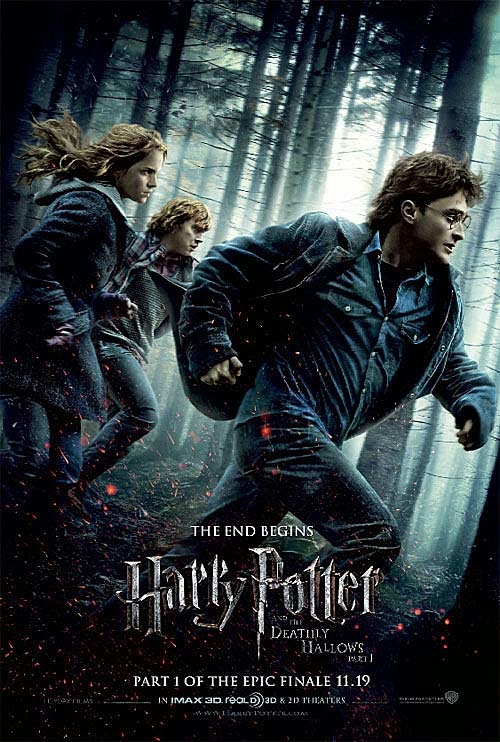 Where the death of the lovable house elf Dobby was arguably the biggest shocker of DH1, DH2’s conclusion provides multiple surprises and revelations. I cannot understate the heroics to be found throughout DH2, and not perpetrated by just Harry and his two cohorts. Valdemort villains by the dozen are zap-wanded and obliterated by Potter’s old guard friends and colleagues. Of course, evil does overpower the good guys as well in a few instances. (I am trying not to spoil things by being too specific.)
 DH2 opens essentially where DH1 ended, with Harry (Daniel Radcliffe) squaring off against Lord Voldemort (Ralph Fiennes). There is a lull, since Harry and friends Ron Weasley (Rupert Grint) and Hermione Granger (Emma Watson) are ill prepared for all out battle since they have yet to find–and destroy–the remaining Horcruxes. Four sinister items remain, and each is embedded with portions of Voldemort’s soul. Voldemort requires each and every item to insure his immortality. As long as one item survives, the dark lord cannot be defeated.
Essentially, that is half of DH2’s story. The race is on to sneak into guarded places to find and destroy, while Voldemort tries to obstruct such. In no episode of the Potter saga is it clearer that Harry has matured to manhood, with the single-minded drive to kill Voldemort, even if he himself has to die in the process. There is a particularly nail-biting sequence in which Harry, Rupert and Hermione (in disguise) sneak into the Gringotts Bank, assisted by the goblin Griphook, who has agreed to help if he can have the magical sword of Gryffindor as payment.

Incidentally, the very opening of DH2 is quiet, sans music, and with sparse, softly spoken dialogue. It is wise convention that director David Yates uses to advantage, since hellfire action kicks in not long after. The jolting effect works, appreciably so.
Memorable scenes feature a dragon, snake, fire, water, and golden goblets. There is also a portion toward the end involving a white world of limbo–or is it? Think 2001: A Space Odyssey.
Nostalgia is everywhere in this final Potter telling. Characters from much earlier films in the series reappear, and often interact with major consequences. Maggie Smith’s Minerva McGonagall finally takes charge, as does Mrs. Weasley (Julie Walters). Expect Bellatrix Lestrange (Helene Bonham Carter), Draco Malfoy (Tom Felton), Rubeus Hagrid (Robbie Coltrane), Prof. Trelawney (Emma Thompson), Prof. Slughorn (Jim Broadbent), Prof. Sprout (Miriam Margolyes), and a slew of others. Major surprises ensue with Prof. Snape (Alan Rickman) and the Dumbledores, brothers Aberforth (Ciaran Hinds) and Albus (Michael Gambon). Let’s not overlook the element of romance in DH2, and that refers to the return of Harry’s love interest, Ginny Weasley (Bonnie Wright), Ron’s sister.
Harry Potter author J. K. Rowling said early on that she “had a very, very clear idea of where Harry was going to go.” Yates and screenwriter Steve Kloves have lovingly transported her vision to the most satisfying finale, truly grand, in film history.

Think of it. Rowling’s genius, via books and films, have not only entertained us with some of the most popular fantasy adventures in media history, but created a unique lexicon in the process: Dobby, Hagrid, Hogwarts, dementors, Voldemort, Quidditch, and on and on. Paramount above all it is the unforgettable Harry Potter himself–all in the span of 14 years, since the first book debuted.
I will especially miss Rickman’s darkly garbed Prof. Severus Snape, and his meticulously timed delivery of lines. Classic.
——————–
GRADE: On an A to F Scale: A
——————–
Let’s visit HP and the gang again via the trailer: https://www.youtube.com/watch?v=5NYt1qirBWg
——————–
Let’s visit HP and the gang again via the trailer: https://www.youtube.com/watch?v=5NYt1qirBWg