
Streep as Thatcher makes ‘Iron Lady’ essential viewing
By Steve Crum
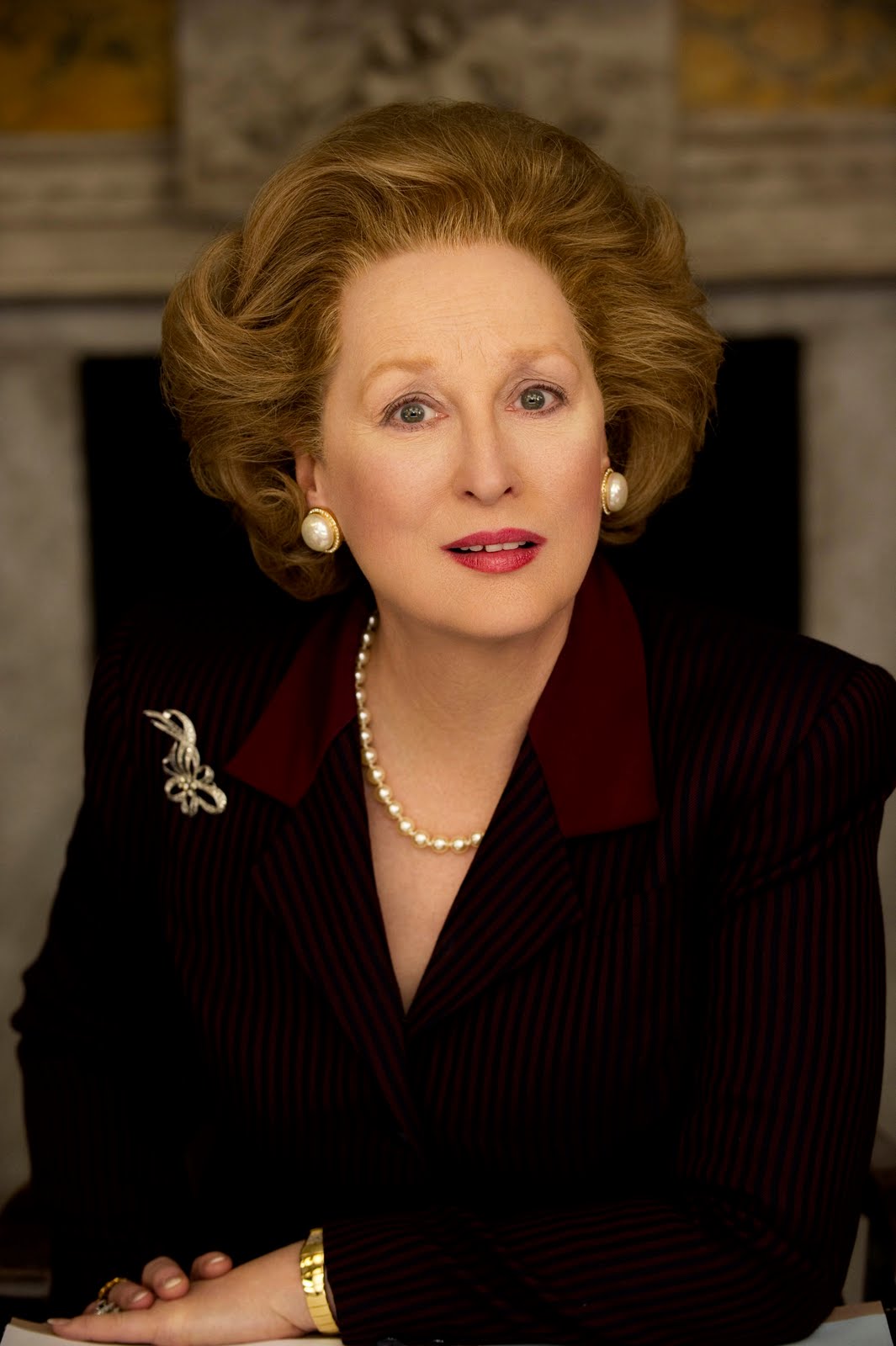
Had The Iron Lady been made with an actress less capable than Meryl Streep, it would have been a mediocre, passable movie. But Streep headlines, which makes this biography of Britain’s legendary prime minister a must see. The screenplay itself is problematic, but Streep dazzles.
Past holiday seasons have given us The Queen and The King’s Speech, two exceptional films featuring charismatic lead actors and compelling stories. In fact, The Queen’s backstage at the Royal Palace approach was an immediate hook since there has been so little known about the queen’s daily life over the past 50 years. Same goes for King George in The King’s Speech.
Margaret Thatcher, Great Britain’s prime minster from 1979-90, is another story–a less interesting story. Director Phyllida Lloyd (Mama Mia!) and screenwriter Abi Morgan are not entirely to blame for this failure. That is because Thatcher’s life lacks verve. If only her husband, the humorous and eccentric Denis (Jim Broadbent), were the sole focus of The Iron Lady. That would have been a far more interesting story. What a whimsical soul he evidently was, according to his depiction here. When Denis does (frequently) appear, the film bursts alive and fresh.
 A base problem is the very nature of Margaret Thatcher’s Conservative Party-based, political career. Add to that her persona, including a droll, tempered speaking manner. One plus one equals conservatism at its most orthodox.
 Specifically, the plot is told in flashbacks from the vantage point of 24 hours in the present day life of long retired Prime Minister Margaret Thatcher. It is obvious she suffers from dementia, but this is implicit via actions, and never actually said. (Baroness Thatcher, in fact, is still living at 86, and reportedly has dementia issues.)
Canvased in is Thatcher’s working class childhood, followed by challenges early on as a female breaking into male dominated politics of The Tory Party. (Alexandra Roach is fine as the young Maggie.) Echoing last year’s The King’s Speech, Thatcher is coached in proper speech techniques, particularly enunciation.
 More flashbacks recall her rise to the House of Commons as a Conservative, and her destiny as Great Britain’s first female prime minister. The story segues back to present and so on, with Jim Broadbent’s terrific portrayal of Denis shown in real time (the past) and as a wise cracking ghost (present) that only Margaret can see and hear through her skewed sense of reality.
 During her tenure of office, Thatcher initiated The Falklands War, and dealt with the sinking of the Belgrano. She was also burdened with her country’s economic and unemployment issues. These events are included in The Iron Lady, but not elaborated upon. In other words, there are no Falklands battle scenes, which is wise since that would detract from the gist of the story. Then again, this script could have used the adrenaline.
Yet we have Streep. More than just the greatest character actress of our time, she is the greatest, living film actress, period. Her Margaret Thatcher is no caricature, she becomes Thatcher.
It is a jolting, Oscar caliber portrayal amidst a mostly prosaic film, Jim Broadbent’s sequences being another exception.
———-
GRADE on a Scale of A to F: B-
——————–
‘The Descendants’ leads KC Film Critics’ winners

By Steve Crum
Alexander Payne’s serio-comic The Descendants was awarded Best Film among 25 nominees at Sunday night’s (Jan. 8) voting of The James Loutzenhiser Awards by Kansas City Film Critics Circle members. The movie, directed and co-written by Payne, stars George Clooney as a Hawaiian-based attorney dealing with a land development issue as well as his two daughters and comatose wife. Clooney was named Best Actor.
Terrence Malick’s controversial The Tree of Life garnered a Best Director win. Officially, it is named The Robert Altman Award for Best Directing, due to Altman’s Kansas City roots. The movie also won for Best Supporting Actress, Jessica Chastain.
The complete list of winners:
BEST FILM…THE DESCENDANTS
ROBERT ALTMAN AWARD FOR BEST DIRECTING…TERRENCE MALICK
BEST ACTOR…GEORGE CLOONEY (The Descendants)
BEST ACTRESS…KIRSTEN DUNST (Melancholia)
BEST SUPPORTING ACTOR…CHRISTOPHER PLUMMER (Beginners)
BEST SUPPORTING ACTRESS…JESSICA CHASTAIN (The Tree of Life)
BEST ANIMATED FILM…RANGO
BEST FOREIGN FILM…A SEPARATION
BEST DOCUMENTARY…CAVE OF FORGOTTEN DREAMS
BEST ORIGINAL SCREENPLAY…BEGINNERS
BEST ADAPTED SCREENPLAY…MONEYBALL
VINCE KOEHLER AWARD FOR BEST SCIENCE FICTION, FANTASY OR HORROR FILM…HUGO
The last award is in tribute to long-time KCFCC critic and sci-fi, fantasy, horror fan, the late Vince Koehler. The James Loutzenhiser Awards is named for the late Dr. James Loutzenhiser, founder of the KCFCC.
——————–
Epic ‘War Horse’ delivers love, loyalty, perseverance

By Steve Crum
In the exhilarating drama War Horse, director Steven Spielberg neither aims for the sci-fi/fantasy heights of E.T. nor the starkness of man’s inhumanity (Schindler’s List). Thematically, War Horse straddles both genres, clocking in as a mixed breed of the reality of war’s brutality and animal lover fantasy. I say fantasy because the exploits of the title horse stretch beyond credibility. Hybrid or not, the movie is a thoroughbred winner.
Lee Hall and Richard Curtis’ screenplay could be described as thoroughbred as well since it is drawn from Michael Morpurgo’s best selling children’s book and the Tony Award winning play–both sharing the film’s title.
The story is reminiscent of Courage of Lassie (1946) since it involves a beloved pet, of sorts, that is thrust into a world war, and whose survival, let alone return to its home base, is fraught with impossibility upon impossibility. Of course, in War Horse, the “pet” is an English farm family’s horse named Joey. Ted Narracott (Peter Mullan) buys the hunter colt at auction despite the fact he cannot afford it. To make matters worse, he has to face his wife, Rosie (Emily Watson) who obviously realizes more than her husband just how tight their meager budget is. Ted has gone to town to purchase a much needed plow horse, but returns with a steed clearly bred for the race track. Their teenaged son, Albert (Jeremy Irvine) is pleased nonetheless, and vows to train the horse to pull a plow if only they will not resell it.

There is a marvelous sequence involving Albert’s desperate attempt to lead the painfully struggling Joey into plowing a field of rock-hard earth (amidst a number of actual rocks) as virtually the entire town observes. Included amongst is the landlord of the Narracotts’ farm, who plans to close on their property if Joey fails.
At the outbreak of WWI, Joey is sold to the military who, like the enemy Germans, used horses to carry supplies and pull wagons and artillery. It is hard to believe such animal mistreatment under modern standards, but it was very true then. The sale occurs despite Albert’s desperation. Here the story unfolds into realistically staged battle sequences in France, including horrific fighting in and out of the infamous trenches of “the war to end wars.” Through the confusion of battle, Joey journeys from British lines to German, pulling ambulances and becoming a loyal servant to both sides. For a time he is separated from battle altogether, and befriends a civilian French girl and her grandfather.
The film’s most memorable set piece is its most grueling, and involves the horse literally caught on its own during battle in No Man’s Land between the English and German trenches. I had to turn my head away due to the intensity. Spielberg does use an animatronic horse for parts of it, which will not lessen the extremely sympathetic impact. It is the stuff that bad dreams are made of.

Joey’s long journey does not end in the previously described scene, but does involve humans he has befriended along the way. That is enough said without destroying the film’s wonderment. It all makes for a tissue-to-eye finale. Incidentally, there were 14 Joeys used throughout the filming. Considering what this horse endures, it should be no surprise.
John Williams’ score is sweeping and, at times, heart wrenching. Janusz Kaminski’s photography, particularly in capturing the English countryside and French fields, has fine, oil painted color and texture. Accolades are deserved all around, marking another Spielberg triumph and, undoubtedly, Oscar contender.
———-
GRADE on a Scale of A to F: A
——————–
——————–
Sadistic, yes, but ‘The Girl With the Dragon Tattoo’ delivers suspense, thrills

By Steve Crum
First, no. I have neither seen the already released Swedish versions of The Girl With the Dragon Tattoo series nor have I read Stieg Larsson’s best selling books. But how could I have avoided–even though I was not trying to do so– hearing about the books and the movies? Point made, since you need to to realize the lack of tattoo girl baggage I brought to the screening of this English language adaptation. Director David Fincher has crafted a disturbing dazzler of a thriller, embellished by sharp acting.
Central to the murder-mystery plot, explained ahead, is the complex title heroine, Lisbeth Salander, brilliantly portrayed by Rooney Mara. Salander is indeed a girl just turning legal age, whose dark features accentuate her goth clothing, facial piercing, and demeanor. Tattoos decorate her body, including a large dragon. As the story progresses, we know Salander is far more than a loner with dubious sexuality and limited intellect.
 Daniel Craig plays the driven writer/researcher (“financial reporter” is his official designation) Mikael Blomkvist. Looking for work after losing his job in a libel scandal, Blomkvist is hired by wealthy Swedish industrialist, Henrik Vanger (Christopher Plummer). Journeying to a remote village on the Swedish coast, Blomkvist is initially surprised Vanger wants him to solve a cold case murder of his niece, Harriet. Missing for 40 years, she is assumed to be dead since her body was never found. Vanger believes she was murdered by one of his relatives who live nearby. Interestingly, his family members are pretty much estranged from each other, yet live in separate houses within walking distance.
 Agreeing to accept what is a private eye’s job, Blomkvist chooses the unlikely Lisbeth Salander as his assistant/researcher. The irony is that Salander is an employee for the security firm that helped ruin Blomkvist’s previous career. Nonetheless, she impresses Blomkvist with her unusual investigative methods. She is likewise impressed with him, and the challenge to solve a possible murder. Her drive, memory skills and high IQ prove invaluable. Still, Lisbeth’s motorcycle riding, black leather persona symbolizes a life of mistrust and pain. As both Blomkvist and Salander delve into Vanger Family history, it is apparent this family has its own demons, including multiple murders.
 While the murder mystery itself is involving, there is a disturbing side-story regarding Lisbeth’s financial status, and her legal guardianship. Circumstances have placed her under the legal power of a sleaze who demands sexual favors from her so she can receive minimal money for food. It turns out he is not only sleazy, but brutal. Without specifying and revealing too much, just realize Lisbeth is a lethal force unto herself. I could not help comparing her to the Kalinda character in TV’s The Good Wife. Kalinda Sharma, played by Archie Panjabi, works as an investigator for a law firm, and will do virtually anything to get what she needs, professionally and personally. While they are kindred spirits, it is Lisbeth who possesses the cutthroat DNA.
Speaking of violence, there are heaps of it, including with sadism, rape and torture, in TGWTDT. It continues to amaze and (truthfully) disturb me that studios choose to release violent, exploitive, R-rated films during the season of good will toward men. But, a dollar is a dollar, and apparently justification enough.
Artistically, TGWTDT boasts fine photography (Jeff Cronenweth), particularly of snowy, Swedish landscapes; and interiors by production designer Donald Graham Burt. The unusual yet memorable score is by Trent Reznor and Atticus Ross.
No doubt that the American film version of the next book, The Girl Who Played With Fire, is planned.
———-
GRADE On an A to F Scale: A-
——————–
——————–
‘Tower Heist’ provides laughs, cliffhanger thrills

By Steve Crum
Multiple choice test. Spot the heist movie: (a) The Anderson Tapes (b) Topkapi (c) The Day They Robbed the Bank of England (d) The Italian Job (e) Oceans 11. Answer: The whole lot. Two of them, Topkapi and Oceans 11 (the original, and its remake and sequels) include comedy elements. Now comes the blatantly named Tower Heist, which is played for broad laughs, including Harold Lloyd-like, hanging from building shtick.
The screenplay, written by Ted Griffin and Jeff Nathanson, has about a relevant center as one can get. Decades ago, it would have been advertised with “torn from the front pages” hyperbole, since it concerns an ultra wealthy investment titan, Arthur Shaw (played with oozing sleaze by Alan Alda), who has ripped off $2 billion from trusting investors. No mistake that his character is based on the infamous Bernie Madoff.
Shaw resides in the top floor suite of NYC’s most luxurious hotel, simply called The Tower. (Consider the hotel an actor unto itself since it is really Trump Tower.) Opening scenes establish that Shaw is extremely friendly with and very dependent upon the hotel’s manager, Josh Kovaks (Ben Stiller). who seems to know the nuances of each and every resident and employee. Ultra efficient is he.
 Shaw is so wealthy that he keeps his gleaming red, prized possession, a 1953 Ferrari once owned by Steve McQueen, parked in his living room. How did he get it there? It is logical, as explained in the film. I won’t spoil it.
 It is when Stiller’s Kovaks finds out Shaw has absconded with the pensions of virtually all the hotel’s staff that the revenge-based plot ensues. This occurs after Shaw has been put under house arrest, pending trial, for the $2 billion charge. Kovaks is soon fired, along with other staffers, for harming Shaw’s prized car. A plan hatches, spurred by retaliation and reimbursement. Kovaks and associates will steal the millions reputedly hidden in Shaw’s apartment, and redistribute the wealth to Shaw’s hotel victims.
The motley recruits for the caper include Charlie (Casey Affleck), destitute ex-Wall Street broker Mr. Fitzhugh (Matthew Broderick), bellhop Dev’Reaux (Michael Pena), and man-hunting bachelorette Odessa (Gabourey Sidibe). Tea Leoni’s FBI agent, Claire Denham, provides both love interest and caper roadblock for Kovaks. The acting, and laughs, are well distributed and handled among the ensemble. Then there is Slide, played by Eddie Murphy, a petty crook bailed out of jail by Kovaks to teach the amateurs the fine art of gangsterdom.
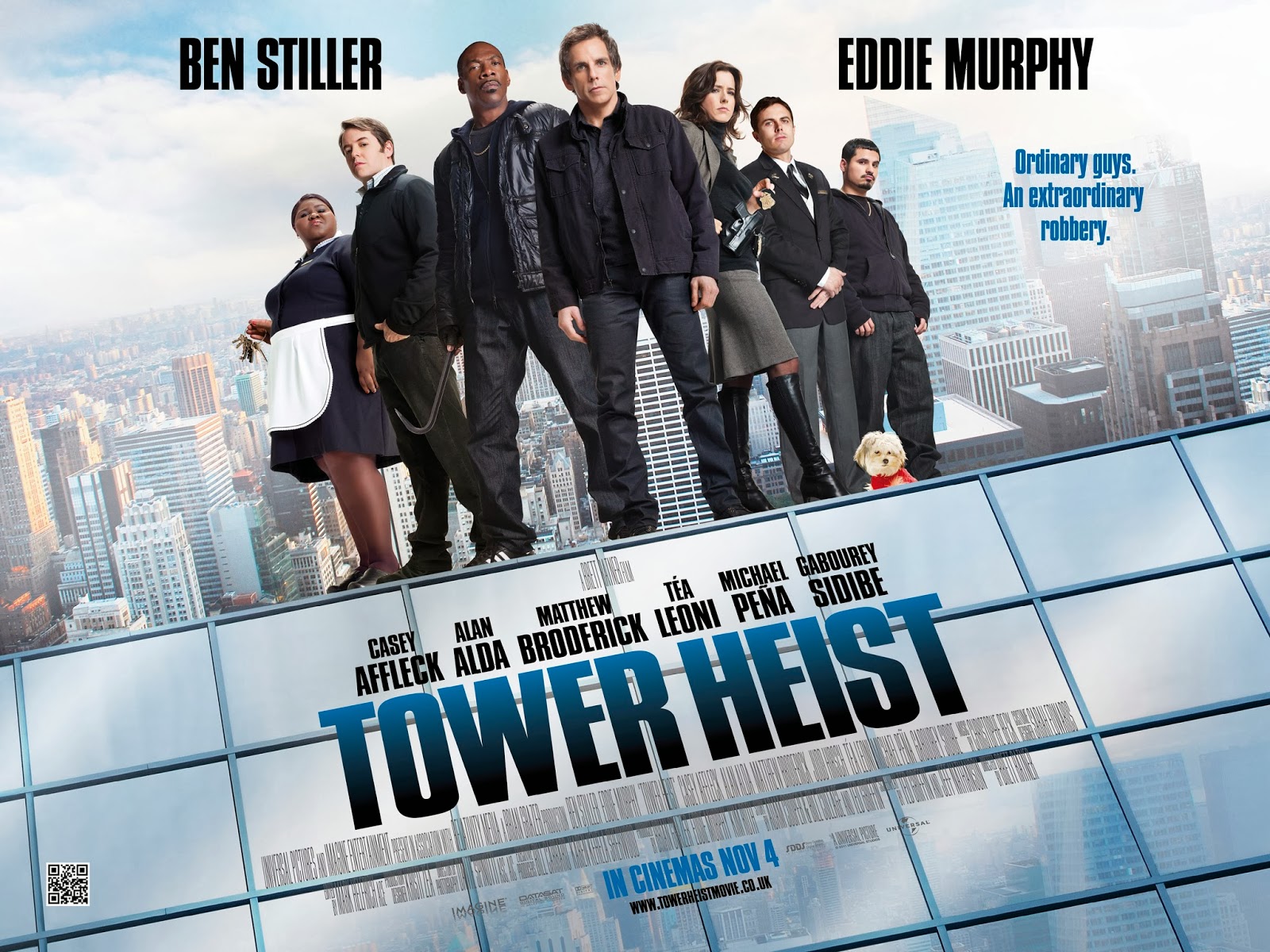 As for this being Eddie Murphy’s great comeback movie, think again. Think about the fact Murphy has hardly been away long enough for any supposed comeback. His Shrek Donkey persona, via voice, has kept Murphy’s comedy going nonstop, in sequel after sequel. Just consider his Tower Heist role as his voice reconnected with human body. The delivery, and frequently crude cracks, are essentially Donkey-alike. “Look at her big ass….eww, but she has a big ass!” Maybe Donkey-like IS appropriate here.
 Really, Eddie Murphy fits perfectly within the Tower ensemble, much like he does within his Shrek crowd. Even though he is billed under Ben Stiller as lead actor, his role is more supporting than star. Stiller is the film’s true anchor. No doubt Murphy’s reputation (and agent) demanded the spotlight.
The production overall is breezy and fun, with a nonstop pace after the first half hour. That is when the action really kicks in. The on location filming, particularly Trump Tower and the Macy’s Thanksgiving Parade, is superb. The cliffhanging sequences from the top of the building will cause anyone with acrophobia (like I suffer) to frequently avert the eyes. Director Brett Ratner (Rush Hour) is adept at such screen thrills. He also does fine by a solid, funny cast.
GRADE On an A-F Scale: B
——————–
——————–