Terrific Bullock, Clooney headline superb space adventure ‘Gravity’

By Steve Crum


The superbly produced Gravity begins afloat in space with astronauts chitchatting via compression helmets during a routine checkup outside their space shuttle. It is all breezy and mundane until a sudden debris shower devours their craft, leaving two of its inhabitants, played by George Clooney and Sandra Bullock, fighting for their lives. The only backstory we get about them and their mission is sparse. Increasingly, the audience learns enough about these two survivors to be hooked on their desperate journey.

Director and co-screenwriter Alfonso Cuarón (Children of Men) has created a sci-fi instant classic that achieves maximum audience involvement by intensifying sound and visuals as well as using omniscient camera shots. We see Ryan Stone’s (Bullock) point of view from within her helmet, looking out the visor. It is a technique only used a couple of times, but it effectively adds to our feeling of Stone’s terror. As well, 3D imagery has the audience literally ducking and swerving. Add directional sound and the use of dead silence, and one’s sensory feelings pretty much max out. 


Within the first 15 minutes of Gravity, I was totally pulled into the plot, along side the two castaways, as they gasped for oxygen while in free float. There are so many hold-your-breath moments, at times it felt like an upscale, interactive amusement park ride. Accolades to Steven Price’s unobtrusive yet emotional score that really enhances the film’s effectiveness. 


There is, of course, much more than sound and visual superlatives to Gravity. Alfonso Cuarón and his son, Jonás, have penned a fantastic yet credible story of courage, friendship, and survival. Even the title, Gravity, is appropriate in its dual simplicity. Its physics aspect refers to an object drawn to the center of a body, while the other meaning involves plot tone, the element of grave consequence. 

Veteran astronaut Matt Kowalski (Clooney) is on his final space venture, while Bullock’s Dr. Ryan Stone, a science officer, is a rookie. After all hell breaks loose at space station central, the two slowly churn through space, tethered together. (There are even more harrowing moments before their bonding.)  Communications with Mission Control in Houston are nil, but Kowalski has a plan. Avoiding plot spoiler data, I will say their trek is fraught with tragedy as well as humor. For example, Kowalski does his best to keep Stone in good spirits through endless quips and funny stories–and all this on limited oxygen.

While Clooney is very good as the sage astronaut, Bullock is the real focus here, in an Oscar worthy turn as the novice space explorer. Of the 90 minutes running time, Bullock solidly holds solo for at least 30 minutes. It is a credit to both her and the director. There are so many memorable moments throughout, including an awesome finale. Pure genius. 

That is the gravity of the situation, dear reader, and the situation of Gravity.  

Gravity is a perfect movie. Seeing it in IMAX-3D is perfection plus.  

———-

GRADE on a Scale of A to F: A
——————–

This trailer gives you good idea of what happens in Gravity: https://www.youtube.com/watch?v=d6sk3HudM4k

Share:

‘The Butler’ covers recent history via stunning White House story, stellar cast

By Steve Crum

Historical fact and fiction successfully merge in the very watchable Lee Daniels’ The Butler. Danny Strong’s script covers 34 years of mid to late 20th Century American history as witnessed by White House butler Cecil Gaines. (Gaines is based on the real life Eugene Allen.) Forest Whitaker portrays Gaines, a turn that will likely garner an Oscar nomination. Daniels, who catapulted to directorial fame with 2009’s Precious, does a superb job here. He and Strong have compressed an engrossing saga covering the Civil Rights Movement, five presidents, a family’s generational growth, and a love story into 132 minutes. It had to be a daunting task, but it works. 

Similarities exist between The Butler and the 1979 TV miniseries, Backstairs at the White House. But the stories are far from parallel. Backstairs was based on the best selling book by Lillian Rogers, which recounted both her and her mother’s tenure as White House seamstress and housemaid, respectively. Backstairs’ historical times range from Presidents Taft to Eisenhower. Butler Cecil Gaines’ White House service begins with Eisenhower, and ends with Reagan, covering eight presidential terms. 


We get Cecil Gaines’ backstory as the film opens in 1926 Georgia. A young Cecil works with his parents as sharecroppers, but overseen by nothing less than a white plantation thug. Beatings, rape, and unprovoked shootings are commonplace, and Cecil is soon orphaned. He works for years as a house servant, and then, as a penniless teen, leaves to travel north. Luckily for his survival, a progression of jobs ensue involving butler duties. Fast forward to knowing the right people and being recommended to a White House butler position. 

Once he is hired and establishes a comfortable relationship with his fellow White House butlers, the script takes a necessary shorthand turn–as it had already done when skipping through a decade of Gaines’ early years in Georgia. This is no criticism; just realize the need to do so. Otherwise the film would require a 10-hour miniseries. 

The Butler certainly is not short on star power. Oprah Winfrey is Gloria Gaines, Cecil’s wife, who supports her husband and children with love and bearing. I have to say that while Winfrey’s acting chops are seldom utilized (this is her second movie since 1985’s The Color Purple), she is a fine performer. In fact, virtually every actor and actress in The Butler is above average. Cuba Gooding, as fellow butler Carter Wilson, does so well in a role worthy of his Oscar winning stature. Others include Terrence Howard as a drunken, immoral friend of the Gaines family; and David Oylowo as the Gaines brilliant but idealistic son, Louis. 

Again, the plot covers a whole lot of territory, reflecting the history of that time. So we get capsule glimpses of events, mostly tragic, like the Freedom Riders’ bus, marches, and Woolworth sit-ins. Sure, the KKK is there, along with vulgar, spitting bigots that shame USA history. All the time, Cecil Gaines silently serves a line of presidents, hearing hurtful things he cannot discuss, and witnessing history behind the scenes without comment. Even at home, he is sworn to secrecy. Forest Whitaker’s sad eyes serve him well here, reflecting an inner struggle and pain. 


All the presidents are played by name actors who do okay, and most are cast against type. Robin Williams as Dwight Eisenhower does not have much to say, and is pretty staid. (For Williams that IS acting.) Seeing him with white hair, and nearly bald, Williams resembles Truman more than Ike, due to his nose and chin. James Marsden does a credible JFK; and Liev Schreiber has some very good acting moments, both hilarious and troubled, as the eccentric LBJ barking out orders while sitting on the toilet. Nixon (John Cusack) has his own quirks, accented by foul language. (Presidents Gerald Ford and Jimmy Carter are oddly missing from the film. A time constraint?)

Casting Alan Rickman as Ronald Reagan is too much of a stretch. However, Jane Fonda is absolute perfection in her brief scenes as Nancy Reagan. 

It is admirable that the script reflects on historic events, such as Dr. Martin Luther King’s assassination, by juxtaposition from the White House point of view to Cecil Gaines and his family’s. In each case, Gaines is exposed to multiple sides of current events while struggling for inward balance. 

The powerfully emotional sequences in The Butler make the bravura finale truly wrenching. 
———-
GRADE on a Scale of A to F: A-
——————–

Even the film’s trailer is fascinating: https://www.youtube.com/watch?v=FuojHqfe4Vk


Share:

Blomkamp’s sci-fi yarn ‘Elysium’ has its moments, but pales to his ‘District 9’

By Steve Crum


Elysium concerns the haves and have-nots, featuring a society with no middle class, only the rich and poor, and a strictly enforced border to keep the two classes separated. Why, it’s a documentary about 2013 USA! No, it is a sci-fi yarn set in “the late 21st Century” which paints a bleak future for the world. Like the Tom Cruise vehicle Oblivion that came and went earlier this summer, Elysium is all about the social mores of control, particularly government control. Just to emphasize the connection to the status quo, there are references to Homeland Security. 

Current paranoia about our federal government is realized here, probably enough to reinforce those who reportedly are storing up their guns and ammo in fear of some kind of takeover. In Elysium, there are indeed stored guns, but per se underground, accessed through illegal means. Earth’s leaders do not permit its slave-like citizenry to have weapons. 

Director-screenwriter Neill Blomkamp, who imprinted the movie history map with his incredibly original District 9, does not equal that triumph. But portions of Elysium come near. Reminiscent of District 9 is the overall slum that earth has become. Blomkamp frequently and wisely cuts to overhead establishing shots so we are reminded. Ground zero is a life of filth, disease and squalor, gang graffiti-splattered walls, and raggedly dressed civilians kowtowing to robot policemen figuratively and sometimes literally keeping them in line. When central character Max DeCosta (Matt Damon) snidely jokes with one cop, he is immediately beaten to the ground for insubordination. In fact, his jesting nearly gets him arrested with another robot. In flashback, we find DeCosta has been a rebellious back talker since he was raised by orphanage nuns. 

DeCosta’s childhood friend and sweetheart, Frey (Alice Braga) is now a nurse supporting a terminally ill little daughter. By the time DeCosta reunites with her, he has a criminal record, and is soon to contract a cancer virus thanks to an accident at his workplace factory. The plot really gets interesting when he, his old girlfriend, and her child shuttle off to the luxurious, high tech space station Elysium. Think the stereotypical circular space station depicted in 2001: A Space Odyssey, and the indoor track astronauts would jog. Multiply the size of the station by about 10, and you have Elysium, within which a huge city exists with manicured lawns, trees, modern buildings, and swimming pools. 

Factor in that DeCosta has willingly been transformed into an android to sustain his life by giving him superhuman strength. In the trailers, one can see metallic additions from his bald head and down. Since Elysium citizens have access to MRI-like machines that rid one’s body of any imperfections, including diseases, both DeCosta and Frey definitely want to take advantage. 


Elysium turns out to be not so utopian after all, since it is on the verge of a coup due to the rambunctious and cold blooded Secretary of Defense Delacourt (Jodie Foster) wanting control over the slightly more humanistic President Patel (Faran Tahir). 


Blomkamp definitely has a flair for sci-fi, and does well with the look and feel of a future earth. Action sequences are very well done, but, like most movies of this genre, acting overall is secondary to the action. However, both Damon and Copley stand out. Jodie Foster is virtually wasted with little dialogue and no memorable scenes. Her best line is representative: “Send them to deportation! Get them off this habitat!” Incidentally, the always watchable William Fichtner is notable as a factory CEO. 

Oh, and add some drones the government uses to keep its earthlings in line. Surely Blomkamp is not referencing anything to do with 2013. 
———-
GRADE on a scale of A to F: B
——————–

Check out the Elysium trailer: https://www.youtube.com/watch?v=QILNSgou5BY


Share:

The X factor for ‘The Wolverine’ features incredible action sequences


By Steve Crum

 
Marvel has the most tortured, flawed superheroes in the comic book universe. Proof positive is substantiated throughout The Wolverine, arguably the best of the shiv-wristed franchise. It is also the most grueling to watch. 
 
Unlike most superheroes, Marvel or otherwise, Wolverine’s roots have never been fully explained–at least in the movies. We know Spider-Man evolved after Peter Parker was bitten by a radioactive spider, and that Superman began as a Kryptonian baby. However, Wolverine aka Logan (played with perfection by Hugh Jackman) is an enigma. He is a mutant suffering from a kind of sleep apnea, and prone to nightmares. During one dream, we see him as he physically looks today, except it 68 years ago when he is imprisoned at a Japanese POW camp located on Nagasaki, Japan. A U.S. bomber then drops the atomic bomb–a sadly historic moment. And Wolverine obviously survives. Unlike other dreams he has, this is a valid memory, not a hallucination. How can this be? (Gasp as you ask.)
 
It is an intriguing premise, which also opens the movie, immediately hooking the audience. No surprise when the story’s locale easily shifts from the USA to present-day Japan, where it remains until the end of the film. With virtually any movie set in Japan, expectations include at least an appearance by ninjas or samurais. The Wolverine gives us pagodas packed with kicking, jabbing, and arrow shooting ninja warriors. As for a samurai warrior, would you believe a gigantic, silver-plated, robotic samurai? Ah so. 
 
To take up any slack at Japanese action central, prepare yourself for dozens of lethal Yakuza thugs. Wolverine is multi-challenged. Fortunately, his body absorbs any bullets, arrows, stabs, and punches, and then immediately heals itself. Thanks to some scientific conniving, orally delivered by a lethal babe appropriately called “Viper,” Wolverine’s regenerative powers are jeopardized, affecting his life and those he is trying to protect. 
 
Time to backpedal a bit, plot-wise, without disclosing too much. Be aware that The Wolverine is essentially a sequel to X-Men: The Last Stand, which ended with Logan in deep depression and traipsing out to the wilderness following the death of Jean Grey, his honey. He has frequent dreams  in which she appears next to him in bed and elsewhere. In each case, she implores him to join her in death. 
 
Now a recluse, and looking the part of a homeless man with unkempt beard and all, he is tracked down by a pert young lady adept at martial arts, Yukio, charismatically played by Rita Fukushima. She is sent by an old colleague of sorts who immediately needs his help in Japan. By the way, in this early part of the movie, Wolverine has already encountered a Grizzly as well as a half dozen thugs in a barroom. In fact, the fight scenes are plentiful, lengthy, and wow-factor impressive. Listing all of them in detail would be a disservice, but I have to mention one action stunner involving Wolverine battling a squad of killers atop a moving Japanese train zooming 300 mph. Fight scenes on top of moving trains have been around since the dawn of motion pictures, but this new ingredient takes the cake. Sorry, sushi.


For good reason, The Wolverine is reminiscent of a favorite James Bond adventure, 1967’s You Only Live Twice, also set in Japan. Both heroes battle martial arts foes, and both fall in love with a Japanese woman. For Wolverine’s Logan, she is the young lady he repeatedly saves, Mariko Yashida (Tao Okamoto).

 
Director James Mangold and screenscribes Christopher McQuarrie, Mark Bomback, and Scott Frank transition Wolverine on an incredible journey from 1945 to present day Nagasaki. By the finale, the body count is high, and Wolverine’s purpose in life is ascertained. Doubters need only catch the brief epilogue inserted about three minutes into the credits, featuring a couple of major folks in Marvel’s gallery. Set in an airport as Logan prepares to return to the USA, the bit also serves as hype for Wolverine’s inclusion in the next X-Men flick. What brilliant, comic book showmanship.  
———-
GRADE on a Scale of A to F: B+
——————–
 
Share:

Return of hilarious minions plus awesome 3-D make ‘Despicable Me 2’ must-see


By Steve Crum
 
The minions have me hooked again. Despicable Me 2 again wisely features the diminutive little critters, resembling yellow board game pieces with a big eye or two. As in Despicable Me #1, they are dedicated and loyal factory workers for their boss, the once evil Gru. He’s the lanky, pointy-nosed, bald fellow who stole the moon in the 2010 animated film. Gru became an adoptive father in the first movie, reformed his evil ways, and continues to raise his three youngsters here. 
 
Despicable Me 2 is just as charming, hilarious, clever, and well paced as its predecessor. The credit goes to the same crew who created DM1: co-directors Pierre Coffin and Chris Renaud, writers Cinco Paul and Ken Daurio, and the army of talented Illumination Entertainment technicians and artists. 
 

Funny how voice actors are now so recognized, given top billing, and paid so well…compared to Golden Age of Animation voice artists like Mel Blanc, June Foray, and Daws Butler. They are better known today, thanks to a wide recognition of their talents during the last three decades. Classic Disney movies like Pinocchio and Snow White seldom employed major name actors to voice cartoon characters. While comedians like Ed Wynn and Phil Harris would occasionally voice for a feature cartoon, their names were never prominently displayed in the titles. 
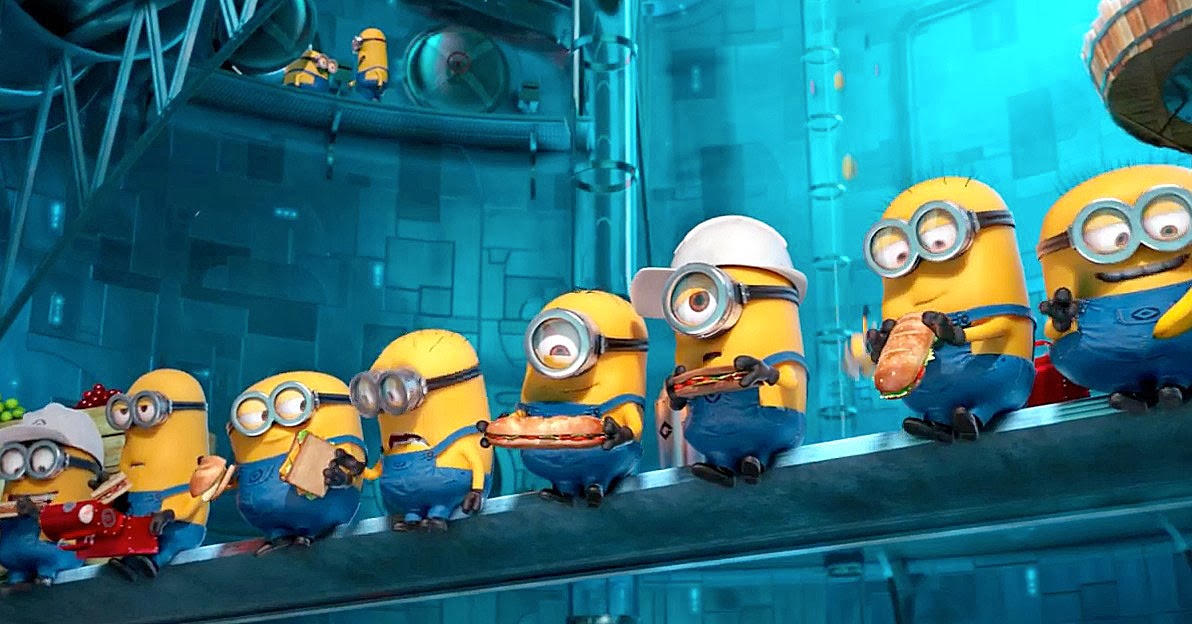
 
In this truly second Golden Age of Animation, major stars voicing in animated features have become a given, and several have expressed their pleasure for getting paid so well for the use of their voice talents. Despicable Me 2 is trendy in that respect, featuring the voices of Steve Carell, Kristen Wiig, Benjamin Bratt, Russell Brand, and Ken Jeong. Their names are highly touted in movie ads, hooking patrons to see the film. 


The plot of DM2, taking up pretty much where the first movie ended, follows the Anti-Villain League as it tries to find who stole a lab, using a giant magnet (!), which contains a dangerous chemical compound that morphs living things into indestructible monsters. AVL agent Lucy Wilde (voiced by Kristen Wiig) is on the case, and enlists former villain but still super genius Gru (Steve Carell) to join her in the hunt. But Gru is into fatherhood, even dressing up as a fairy princess for his three kids. 
 
Gru relents, and the ensuing chase includes bouts with TNT, an active volcano, a wig store, a Mexican restaurant, a giant shark, and dealing with his oldest daughter’s new boyfriend. The boyfriend might be connected to El Macho (Benjamin Britt), who is an AVL suspect. Factor in visual jokes via the hundreds of minions being experimented upon with the evil chemical, and fun ensues. In fact, it is fun for the entire family, a rarity in Hollywood movies these days.
 
If you can see Despicable Me 2 in 3-D, do so. Particularly during the clever closing credits, the three dimensional effects are the best of any movie. Ever.
———-
GRADE on a Scale of A to F: A
——————–
Share: