
Author: Steve Crum
‘High Stakes’ makes world premiere
 By Steve Crum
Remember those sleazy drive-in movies of the 1960s and ‘70s, which were filled with sex and violence usually mixed with teenagers and monsters? It was a time when Russ Meyer reigned as the smut king of B-movies.
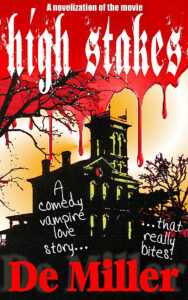
Local filmmaker De Miller obviously does, and serves up a halter top full of parody in his second direct-to-video film, High Stakes. It played to a receptive and sporadically giggling Granada Theatre audience of more than 100 at its world premiere on July 7 (1995).
Many of its actors, minus name stars Cathy Turner, Tiny Tim and Jerry Mathers, attended.
Aimed at what producer-director Miller says is “foreign markets,” High Stakes takes the cliché plot of a car (really a van in this version) breaking down on a deserted road, forcing the passengers (three barely clad young women—headed by Olympic medalist Turner) to seek help in a nearby spooky house (the exterior of the reputedly haunted Sauer Castle in Argentine).
At the door they are greeted by the ghastly Rentfield (Tiny Tim, not requiring any additional make-up to perform in character, in one of several scenes shot in March). The plot and blood thicken. A family of vampires resides within, and conveniently three of them are males. Bring on the gratuitous sex! Leering, touching, kissing and, did I mention, leering occupies most of the paired-up couples’ time during the several days (?) the bimbo…er, young ladies spend at the abode waiting for delivery of a new distributor for their vehicle.
The videoplay, as written by Miller (who also edited) and son, Mark, includes two scenes that go beyond the 52 separate cleavage and short-shorts posterior closeups. One has Remus, vampire brother of Romulus (Get it? Hey, these are the jokes in this humor-in-vein flick.), changing into a dog so he can secretly leer at Nina (future Penthhouser Chrissy Mountjoy) as she steps from the shower. Then there is a graphic-without-showing-genitalia intercourse scene between Remus and Lucy.
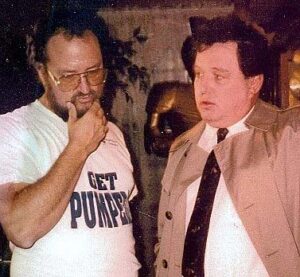 Though not rated, the video (which was projected with some difficulty on the giant screen) would weigh-in at a strong “R.” Parents of the few children attending the screening were probably aghast.
The plot does include the old stake-in-the-heart sequence, and a turn by Mathers as professor Von Heavensing (instead of Von Helsing, ouch). Unfortunately, Mathers was only available for his scene one day, and a lengthy, talky sequence has him mostly behind a cluttered desk, explaining how to kill a vampire to Turner and cohort. Then they carry out his instructions. Golly, but it might have been a blast to see The Beaver himself drive the stake.
The best moment in the film is a double, double take between Tiny Tim and guests assembled in the living room. There is no real meaning or purpose, but it comes in from left field and works in a humorous, surreal way.
Tim’s otherwise hammy performance ranks a nose better than the rest of the cast, who should at least be given credit for memorizing their lines.
Credit Max Groove for an impressive sound recording and musical track that often suggests Ennio Morricone’s low and driving heartbeat sound in The Thing.
High Stakes is a local product and, like fellow local filmmaker Todd Scheets’ direct-to-video horror efforts, the audience is limited. In other words, few reading this critique will ever see High Stakes or even Miller’s promised upcoming, big-budgeted production, Godfathers, Da Movie?
Even so, it is hoped that Miller’s obvious talents will go beyond parody laced with soft-core porn, salable as that is.
∞∞∞∞∞
GRADE on an A-F Scale: D-
°°°°°°°°°
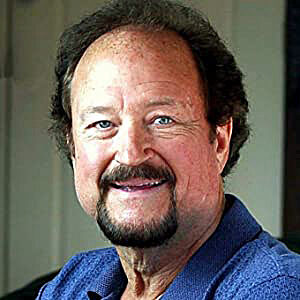 NOTE: The above review first appeared in The Kansas City Kansan newspaper on July 11, 1995. Immediately after the issue hit the stands, I received a phone call from De Miller. He was furious, accusing me of not getting enough sex in my life. From all indications, High Stakes went nowhere after its “world premiere.” However, Miller did publish a book based upon his movie. For awhile, the book was available on Amazon. That was a couple of decades ago, however. Miller has since moved from KCK to Florida, and is now producing Christian movies. High Stakes is nowhere to be mentioned in his biography on either Amazon or the Internet Movie Data Base. The bios of Jerry Mathers and Tiny Tim do not list it either.
°°°°°°°°°°
‘The Gray Man’: Violence begets violence begets violence
 By Steve Crum
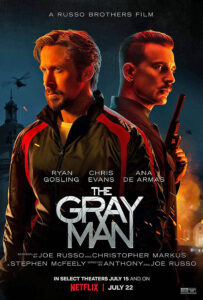
The great entertainer, Jimmy Durante, first said his catchphrase a century ago: “I’m surrounded by assassins!” That line is apropos for 2022’s spy vs spy spectacular, The Gray Man, 129 minutes of nearly non-stop action and violence.
Clearly, it is a movie as devoted to fists, guns, and kicking as much as the Fast and Furious series showcases speeding cars. In fact, The Gray Man is the first in a planned series based upon Mark Greaney’s novel of the same title. Banking on the success of this first adaptation, which has been showing on Netflix since its limited theatrical release, is key. It is a big bucks gamble, among the most expensive production budgets in Netflix history.
But so far, so very OK. The popularity of The Gray Man is attributable to its production team, including the 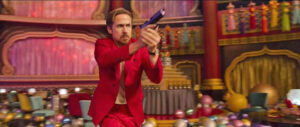 screenplay and direction: The Russo Brothers, Joe and Anthony. Joe helped write the movie; Anthony and Joe directed. (Joe even has an unbilled acting role.) The two have teamed numerous times previously, handling similar duties on four Marvel movies (2 Captain Americas and 2 Avengers). And their list goes on from the Emmy Award winning TV series, Arrested Development, to a dozen other movies and TV shows.
Stars Ryan Gosling and Chris Evans lead a capable cast that includes Billy Bob Thornton, Alfre Woodard, Ana de Armas and Jessica  Henwick. Their “capability” also rests on their gymnastic abilities to kick box, jump, fisticuff, and fire weaponry. The arsenal and action are seemingly endless here.
I will not get into plot specifics for a couple of reasons. The first is the spoiler factor. Secondly, there are so many characters, possessing so many similar names. For example, Ryan Gosling’s “Court” Gentry is a CIA black ops assassin given the code name “Sierra Six.” Then there is “Sierra Four.” Add to the mix assassins like the Chris Evans’ psychopathic Lloyd Hansen, who is hired to capture Six. While the plot thickens, per se, why not add even more CIA agents and more assassins? Who is to be trusted?
 Before answering that ongoing question, Six is repeatedly either attacked or trying to physically thwart some bad guys—and gals. There is even a huge twist on this theme at the film’s conclusion. (It surprised me!)
Really, the action is so engulfing that one forgets to take any reasoning breather.
I have to add that the Russos’ casting of their Captain America good guy Chris Evans is brilliant. It is against type, but it works beautifully. What a great baddie.
The Gray Man is a fun and frantic diversion which is a somewhat distant cousin to James Bond’s 007 and all the other secret agent “O’s.” 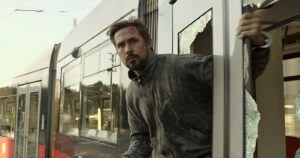 Gosling is no Sean Connery or Daniel Craig, but he does nicely as Six.
The meaning of the title The Gray Man? It is never explained but infers “ghost” or “chameleon”—perfect qualities to have when hiding.
∞∞∞∞∞
GRADE on an A-F Scale: B
Movie theater annoyances & pet peeves
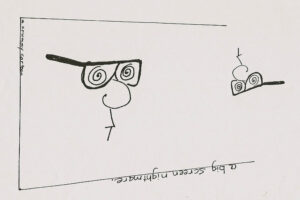
This lengthy piece ran in two editions of The Kansas City Kansan newspaper, Feb. 23 and March 16, 2002. Twenty years ago, buying movie tickets via your cell phone was mostly unheard of. That said, dealing with cell phones in theaters has become an even worse problem. Also, those were the days before the many movie streaming channels we now have. Just put my thoughts in retrospect. (Incidentally, the illustrations are mine.)
 By Steve Crum
Do you know what really ticks me off? As Lassie once barked, “Ticks.” Dog-eared jokes aside, there are a number of things about the moviegoing experience that dig under my nails, and raise my Hollywood hackles. Since a perk of writing movie reviews is getting free screening passes, I rarely pay to get into a movie. Otherwise, I would moan about the escalating ticket prices. That said, any treats I get at a screening I pay for out of pocket. More on that later.
MOVIE THEATER PARKING
Are there really that many handicapped folks coming to the theater? One Kansas City area theater’s parking lot gives the first two  rows—long rows—to Reserved-For-Handicapped parking. I had to park so far from the front doors a few weeks ago (and there were 19 handicapped spots vacant) that I was limping by the time I trekked from my North 40 parking spot.
And let’s get a cop outside to direct the banana land traffic after the show lets out. Add a packed theater, late night, and you have potential vehicular trauma.
CATTLE LINES
What else would you call the roped-off mazes (inspired by theme parks) that keep 100-plus human beefers in line at screenings? Surely this does not happen to paying customers. But with non payers possessing passes at a free evening screening, it is first-come, first-served for empty seats. But the masses have to be contained so no one feels cheated. Head-‘em up, move ‘em in. (A 2022 NOTE: Since this was written, KC movie critics have reserved seating and do not have to stand in line.)
 BUYING TICKETS
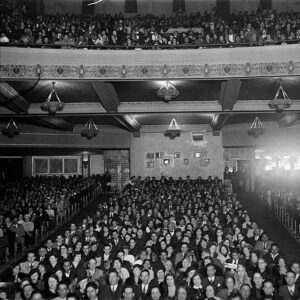
I rarely have to buy tickets, but when I do, it truly exasperates me to have to stand outside, like I am at Kemper Arena, to purchase a ticket A wind chill of 15 below adds to my overall joy. Young lady, that ticket roll you have inside your warm ticket-taker room could make a fine little bonfire.
USHERS
The old days are over. Ushers were people dressed in military style uniforms who were hired to seat the audience while holding snappy looking flashlights. They would also patrol the aisles throughout the movie, checking for rude souls. That was then. Goodbye, ushers. Hello, rude souls.
BACK SEAT KICKERS
There are those numbskulls who kick the back of your seat. (This is also a problem on airplanes.) And it is usually in an erratic, yet rhythmic tempo. Sometimes it is a kid, sometimes an adult. What is it with you people? Are you unaware? Is there a psychotic, nervous strain in your lowly developed family? Or are you just trying to start something? I usually give a half-over-the-shoulder look without making eye contact—as a display of irritation. I also rock my seat forward and back, if possible, to help ward off rude feet.
My ex-wife had her way of dealing with seat kickers. She would merely stand up, turn around, and firmly curse them out. It was effective. But her target always looked like he or she wanted to punch ME out, since I was the man sitting beside her.
 THE RUDE SHOE
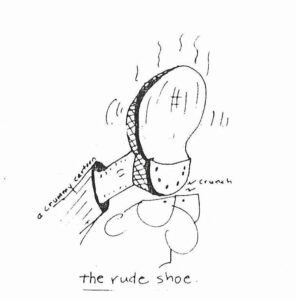
Then there is the low life who hoists a foot between seat backs, resting a stanky shoe near the side of my face. These are violators of another kind. Oops, I accidentally poured my Diet Coke all over your guilty flip flop.
CELL PHONES
Cellular phones have become my numero uno gripe in life. And not just at the movie theater. Why does anyone want to share a phone conversation with nearby strangers? I don’t. I was at a meeting recently when a person in the audience got a call on her cell phone. The nifty ring sounded like a Bach Toccata except. “Hello,” she said at a very audible sound level. “Hello?” she repeated. “Hello,” once again. She finally did leave the area to continue her conversation, but ONLY because she had poor phone reception where she was sitting. When she came back in, the meeting had resumed smoothly. Then her phone chimed again, and the “Hellos” began anew. She left the room again, too. Thank you, Alexander Graham Bell.
At the movie theater, the problem is the ringing. I have yet to hear any actual phone conversations going on during a movie. But maybe I am just a popcorn kernel lucky in that respect.
 BLABBERERS
An ongoing problem is people who talk during the movie. I do not care whether you are telling what is happening next in the movie (actually I DO care) or spouting off about the weather in Olpe. Just refrain from taking. Zip the lips. Open the ears and eyes. Or close them. Just shut up.
BABIES & INFANTS
There is nothing that makes me both sad and angry as when a baby or small kiddo starts crying or talking during the most repulsive scene in an R-rated movie. I could kick some parental buttocks. Why would any decent parent bring a kid to such a movie? It is selfishness, my friends. The “adult” parents want to see the flick at any cost. Grow up, you parents who do this irresponsible thing! And wait until your own kids are grown before bringing them back to a movie house.
 MOVEMENT DURING END CREDITS
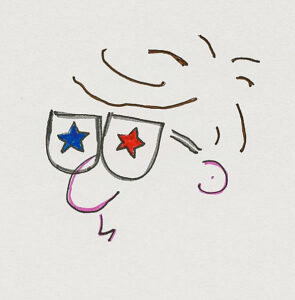
The movie concludes and end credits start rolling. This is a cue for Cro-Magnons in the audience to immediately stand up to leave, in the process blocking the vision for those still seated who want to read the credits. Too bad for the early leavers. Sometimes there is an additional scene following the credits. Leave early, you miss it. Airplane, Lethal Weapon II and A Bug’s Life come to mind.
In A Bug’s Life, the additional “outtakes” (a joke unto itself since this is an animated film) occur as the credits roll. I recall when the credits began at the screening, half the audience were on their way down the aisles to exit. Then they all froze in standing place to watch, effectively blocking those who had remained seated.
Add to the disruption those who stand up and start talking on their way to the exit. Unnerving.
 THEN THERE ARE THOSE SNACK LINE IDIOTS…
•Who wait until it is their turn at the counter to start figuring out what they want.
•Who HAVE to take a giant swig the second they receive their drink at the counter.
•Who devour that huge bite of popcorn direct to mouth—no hands, while you patiently wait directly in back of them at the counter. And they always do it while facing you, to make sure you get a good, butter-topped view. Oink.
∞∞∞∞∞∞∞∞∞∞
There is a lot to be said for watching a movie at home.
#
‘The Time Machine’: Is this trip really necessary?
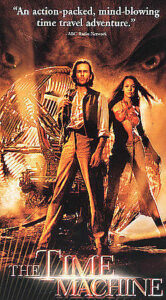 My review of the disappointing The Time Machine (the second version) was published in The Kansas City Kansan on March 9, 2002.
By Steve Crum
It does not take a time traveler to realize that the newest take on The Time Machine, which opened yesterday, will be forgotten in the very near future. And that is too bad, because on the surface, this production has a trio of pluses.
•First of all, Simon Wells, the real life great-grandson of H. G. Wells, directs. The elder Wells, of course, wrote the classic science fiction novel upon which this movie is based. This is Simon’s first live action effort, having helmed four animated features, including The Prince of Egypt. Interesting trivia: Gore Verbinski (The Mexican) took over the last 18 days of shooting when Wells collapsed due to “extreme exhaustion.”
•Second, the star is one of the notable young actors in Hollywood, Guy Pearce. His work in 1997’s L. A. Confidential is terrific. But he is nowhere near the necessary beefy and emotional presence of Rod Taylor, who starred in the 1960 original—directed by George Pal.
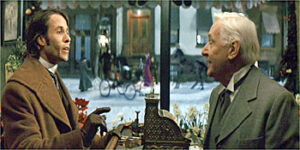 •The third plus involves a personal kudo—the inclusion of Alan Young. Young co-starred in the far superior ’60 version—in two different roles, no less. (Yes, this is the same Mr. Ed Young who played Wilbur.) Young does technically appear in this remake, and that is about all. He has a couple of lines of dialogue delivered in his unnamed character’s dimly lit flower shop. He did not own a flower shop in the earlier movie. The fact that neither of his original two roles is worked into this script is a grievous mistake. Why then include him at all? For old times sake? Please. For viewers who remember him with Rod Taylor, good luck in the confusion.
So what does The Time Machine, circa 2002, have going for it? There is a slight save when Orlando Jones’ Vox character appears as a 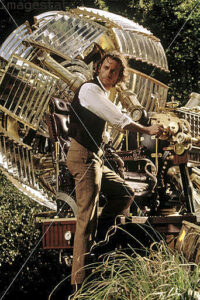 holographic librarian, a virtual encyclopedia. If only the rest of the film had any similar depth or humor.
Oh, there are the state-of-the-art special effects. The time machine itself is larger, has more valves and knobs, zaps concentrated light, and encompasses itself in a power sphere en route. (Remember that the machine never moves; the world moves around IT.) Is all this impressive? Not really. Give me the simplified original of 42 years ago. Then there are the digitals included in very dark sequences, set underground in the land of the Morlocks. (Morlocks are ape-like villains.) Scenes of the creatures being disintegrated are cheesy looking even in the semi-darkness.
Let’s continue to assume you are familiar with the 1960 plot. Both movies are set at the turn of the 20th Century when cars were far outnumbered by horses. This version’s central character, Alexander Hartdegen (Pearce), is a nebbish genius/inventor whose life seems changed when he falls in love. After his fiancé is killed in a botched robbery, he uses his untested time device to change history. Without spoiling too much, just realize there are complications.
Alex eventually decides to gyrate into the future, only a few years a time at first. As in Pal’s original, there are cool looking passage of time 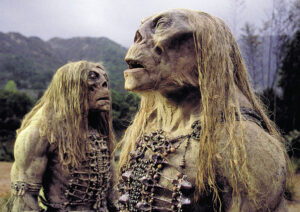 scenes of the sun and moon rising and setting in quick time. There are rapid fire dress changes on mannequins in a local shop’s window. Buildings rise, expand, fall, are rebuilt, and destroyed. There is an impressive overview shot of the entire city in metamorphosis over many, many years.
An accident causes the machine to veer some 800,000 years into the future, a time when fragments of an exploding moon have wiped out most of the earth. Alex lands in a country inhabited by passive cliff dwellers, the Eloi, and the underground cannibals, the aforementioned Morlocks. Amazingly, Professor Nerd morphs into Mr. Macho, and single-handedly lowers himself into Morlock city to rescue his begotten Eloi babe, Mara (Samantha Mumba). By the way, the vicious Morlocks in this version are not lumbering and green as in the original. These brown things leap and run on all fours like the apes in last year’s Planet of the Apes.
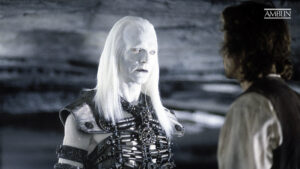 And what should one make of the underdeveloped and far too brief inclusion of Jeremy Irons as the albino Uber-Morlock? Looking and acting like a reject from the X-Men (or Johnny Winter on a bad day), this baddie even has super strength. He also has the ability to read and bend minds. Yet somehow he lets Pearce’s character outwit him. But I thought…that he thought….
Just don’t think.
Before you know it, this confusing and empty-hearted Time Machine has clocked on by. Consider it a bit of disappointing movie history that could easily be remedied by going back in time, and scrapping the very idea of a remake.
∞∞∞∞∞
GRADE on an A-F Scale: D
∞∞∞∞∞
‘We Were Soldiers’: Into the valley of death
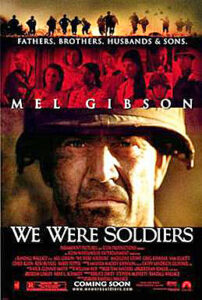 My review of “We Were Soldiers” was published in The Kansas City Kansan on March 2, 2002.
∞∞∞∞∞
By Steve Crum
Following a bloody battle, Mel Gibson’s Lt. Col. Hal Moore grimaces, “I’ll never forgive myself—that my men died…and I didn’t.” The heroic Moore is the central focus of We Were Soldiers, which opened yesterday. Expect a no-punches-pulled war movie, set in Vietnam, that will make even a ‘Nam veteran cringe at the violent realism. (I speak as a Vietnam era vet.)
War film realism was forever reshaped after Spielberg’s Saving Private Ryan, much as science 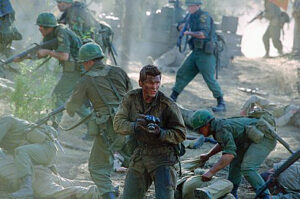 fiction movies since Star Wars have been influenced. The recent Black Hawk Down is an example of the former.
In director-writer Randall Wallace’s We Were Soldiers, based on a factual book, Lt. Col. Moore leads 400 Rangers into the first American battle of the Vietnam War. They have underestimated the North Vietnamese enemy strength, which is five times theirs. The ensuing fight is horrifyingly blood and, at times, seems destined to be a Little Big Horn for Wallace and his men. The fact is that Moore’s assignment is with the First Battalion of the Seventh Cavalry, the same regiment once led by Gen. George Armstrong Custer.
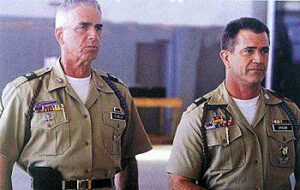 Early on, Wallace has nightmares that his destiny is akin to Custer’s, but is verbally slapped back into the reality that “you aren’t Custer, sir!” by his stern sidekick, Sgt. Major Plumley (Sam Elliott). Elliott, by the way, is superbly gruff in this film.
There is a lot to like about We Were Soldiers. Gibson’s inspired performance was chiseled from the real life Hal Moore, and the still very much alive Moore even oversaw all aspects of the filming—in person. Battle scenes are reportedly carbon copy true. I believe it; and thank God I was not there during the 1965 original.
Another plus of the film is the use of juxtaposition. At various times during battle, Randall jumps the story—in quick time—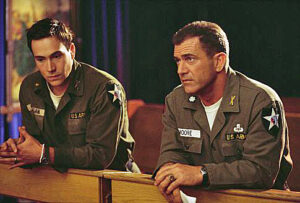 to the home front at Ft. Benning, Ga. We see Moore’s wife, Julie (Madeleine Stowe) who is literally her husband’s counterpart. It is her chosen (and wrenching) duty to personally deliver the telegrams fo death notification to the wives of the soldiers serving under her husband.
Those scenes, along with opening sequences of Moore playing and praying with his young children, as well as showing his obvious love for his wife, set the tone of the story. We are talking love of God, family and country.
Moore is everyone’s daddy in this film, and I don’t say that in a negative way—even though the movie is so clearly manipulative in its patriotism. Based on Joseph L. Galloway and Moore’s best seller, We Were Soldiers Once…and Young, Wallace’s screenplay is full of lump-in-your-throat hero-speak.
 Moore, to his men before departure to Vietnam: “This I swear, when we go into battle, I will be the first to step on the field and I will be the last to step off. And I will leave no one behind…dead or alive. We will all come home together.” John Wayne would have fought a regiment to play Moore.
And won’t Moore’s words be remembered in movie history as much as the opening speech in Patton?
As in the book, the film humanizes the North Vietnamese…to a degree. They are given distinguishing personalities, like the soldier who looks at a picture of wife before battle begins. Scenes jump to and fro during the fighting, showing what strategies are discussed by both sides.
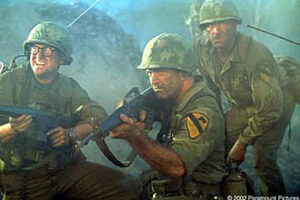 We Were Soldiers is not the first realistically violent movie about the Vietnam War. Platoon takes that dubious honor. Neither is it a jingoistic treatment like The Green Berets. And it is not a psychological, artsy Apocalypse Now spectacular.
It is gritty and moving. It is the best Vietnam War movie ever.
∞∞∞∞∞
RATING on an A-F Scale: A
∞∞∞∞∞