
Going out with explosive bangs via Denzel’s stylistic violence
 By Steve Crum
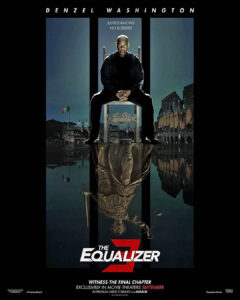
There are the Universes of Marvel and DC…and then there is Robert McCall, a non-costumed superhero-type who fights—viciously—for the rights of the innocent. Stir in a lot of revenge, and you have The Equalizer 3, the finale of director Antoine Fuqua’s Equalizer trilogy.
It is a lollapalooza. But take that as contextual praise.
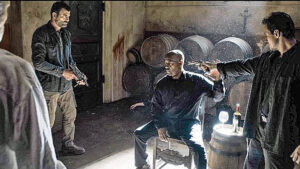 The Equalizer films are known for nail-biting action as well as graphic violence. Beheadings, gunplay and torture are part of the universe for retired international agent McCall. The bad guys take, and he is given to respond. McCall will stop a gunfight by hurling a paper clip, which becomes a lethal weapon unto itself. And he never shows emotion. He knows he will win against any adversary. Sure it is formula heroism, but it works.
By the way, that paper clip sequence is found in The Equalizer (2014), the first of the trilogy.
Before focusing on The Equalizer 3, realize that the first best selling Equalizer book was published in 2014. It was based on a 1985-89 TV series of the same name with Edward Woodward as McCall. Since 2021, Queen Latifah has portrayed the vigilante McCall—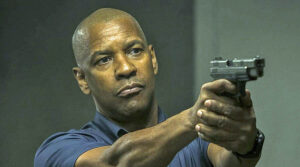 Robyn McCall—on TV!
Far more violent than Woodward or Latifah is Denzel’s McCall. In E3, Richard Wenk’s screenplay places a recuperating (from the film’s bloody opening sequence) McCall in a local doctor’s care in the quiet and friendly Italian coastal town of Altamonte. As he befriends the locals, it becomes clear there are high crimes happening to the residents. Drug-running Mafia types have moved in, and are terrorizing the citizens.
Enter Robert McCall. No sooner than he can finally walk without a cane, he begins physically defending the rights of innocent townspeople. Since he a 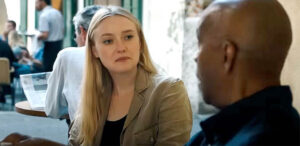 virtual one-man army, McCall is THE person to have on one’s side. Let the machine guns, bombs and beatings begin. McCall will end the tyranny through his own ninja fighting ways.
As in previous movies, McCall still has ties to the CIA, particularly Emma Collins (Dakota Fanning), who eventually joins him in Italy.
The production looks good with spot-on cinematography by Robert Richardson, and an effective heartbeat score by Marcelo Zarvos.
But the tempo and polish exist because of Antoine Fuqua and Denzel Washington.
—————
GRADE on an A-F Scale: B+
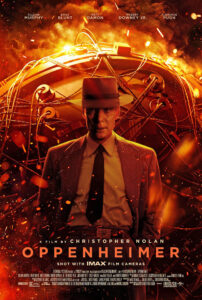
‘Oppenheimer’ triumphant as must-see instant classic
 By Steve Crum
Oppenheimer is not a joy to behold. But it is a fascinating motion picture everyone should see…and absorb. It is also likely to be heralded at the Oscars as Best Picture.
As a Boomer, the film personally connects. Being a high school varsity debater in 1965, I verbally sparred about the threat of nuclear war with Russia. “Peaceful Coexistence” was an oft used term—coming from teens who had “ducked and covered” in classroom drills during the 1950s. It was all about the threat of the atomic bomb, which by the mid ‘60s had escalated to the hydrogen bomb. Twenty years earlier, in 1945, WWII ended with our atom bombs devastating Japan.
J. Robert Oppenheimer, the renowned theoretical physicist and “Father of the Atomic Bomb,” is a name never uttered during high school debates. But “The Bomb” certainly was.
Oppenheimer clarifies and defines his era.
The film’s narrative, written and directed by Christopher Nolan, encompasses an effective blend of historical documentary with dramatic thriller and biography. The immense and complex 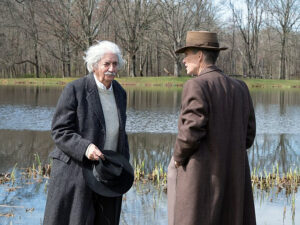 telling takes 181 minutes and a raft of excellent actors—Cillian Murphy, Robert Downy Jr., Emily Blunt, Matt Damon, Rami Malek, Kenneth Branagh, and Florence Pugh among them.
The story structure begins during Oppenheimer’s 1926 university year and stays its course through nuclear discoveries in the late 1930s to WWII developments (both military and scientific) and then to postwar years with Presidents Truman through Johnson.
 Oppenheimer’s (Murphy) love life is included, focusing on dating Jean Tatlock (Pugh), a Communist Party member. This was the beginning of the upending of Oppenheimer’s controversial political leanings. Not only does he have friends who are Communist Party members, but ends up marrying Katherine “Kitty” (played by Blunt), an ex-member. It is no surprise that the brilliant scientist becomes the focus of House Un-American Activities accusations. His personal life becomes fodder for political retribution, despite the fact his Quantum Physics expertise led to the development and eventual dropping of the atom bomb on Japan that ended WWII.
A major player in the movie is Robert Downey Jr., who does a fine job as Oppenheimer’s nemesis, Lewis Strauss. The Atomic Energy 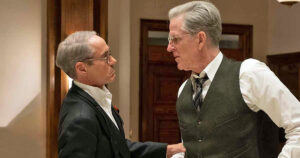 Commission’s Chairman, Strauss, held a long time resentment of Oppenheimer, and used his testimony to strip Oppenheimer of security clearance. Thus, Oppenheimer was blocked from anything to do with nuclear research. This sequence occurs in the third hour of the film. Before that happens, we witness Oppenheimer in full power as he heads a team in Los Alamos, New Mexico to develop a nuclear bomb to end the war.
It is fascinating to witness the re-creation of that town built to house the scientists and technicians (and their families) while work proceeds. It all had to do with privacy and expediency. And it worked.
Interestingly, the film’s structure is laced with flashback sequences necessary for context references. Also, much of the story is narrated by Strauss/Downey Jr. To minimize any confusion regarding the story’s point-of-view, director Nolan chose to film Oppenheimer’s sequences in color. Strauss’s stances are shown in black and white. The result is subtle and clarifying. It truly helps in a movie as complex as Oppenheimer certainly is.
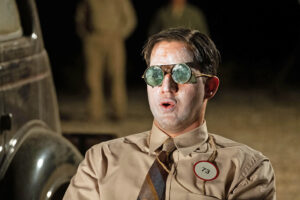 Oppenheimer is packed with outstanding performances, particularly by the mostly unknown Cillian Murphy. He not only greatly resembles the brooding main character, but is totally believable.
There were things about the famous during those years I found fascinating. Take Albert Einstein, as portrayed by Tom Conti. And I am still jarred by the persona of President Harry Truman (Gary Oldman). I will not detail the latter here, but I had to research it after seeing the film to verify he did indeed say such to and about Dr. Oppenheimer.
In that regard, Oppenheimer is enjoyable, shocking and educational. It is part of our American history. Nolan himself describes his work as “beautiful and terrifying.”
I could not agree more.
—————
GRADE on an A-F Scale: A
Superb ‘Nyad’ wins swimmingly for both Bening & Foster
 By Steve Crum
Even the failures depicted in Nyad are fascinating to observe. That’s because Nyad is the biopic of Diana Nyad, champion long-distance swimmer. Her multiple attempts at being the first to swim from Cuba to Florida (without a shark cage) were literally death defying.
In her Oscar worthy performance in the title role, Annette Bening is endurance exemplified. It is a stellar achievement. Jody Foster, who co-stars as Nyad’s best friend and  swimming coach Bonnie Still, deserves a Best Support Oscar nod.
Helmed by fledgling feature directors Elizabeth Chai Vasarhelyi and Jimmy Chin, the story begins with vintage clips of the actual Diana Nyad guesting on Johnny Carson’s Tonight Show, wherein Nyad describes herself as “overly ambitious.” As the story shifts to Bening’s portrayal, we find the self-description spot on.
Based upon Nyad’s autobiography Find a Way (adapted by Julia Cox), the Nyad trek begins with her charismatic junior high school swim coach to compete and win—never to give up. (The darker side of their relationship is explored later.)
Additionally, Nyad’s dad encourages her obsessive goal of marathon swim competition. “You could almost swim there—to Cuba,” says her father in flashback.
 Segue to the present, three decades later. “It’s been 30 years,” says friend Bonnie, “since you put on a pair of goggles.” Now she is 64, still wanting to successfully swim from Cuba to The Florida Keys. Nyad has already tried and failed, but is driven to fulfill her desire to navigate all 110 miles.
 A good portion of the film is focused on finding a competent crew for the voyage. She scores with seasoned navigator John Bartlett (the great Rhys Ifans). “CUBA 2013” becomes the rallying credo for yet another attempt that includes a shark attack.
In an earlier try, Nyad is attacked by jellyfish. Her resulting facial abuse is grossly but realistically shown by the studio’s makeup gurus. (Egad, why didn’t  Spielberg make a movie called Jellyfish?!)
But it is Annette Bening who encompasses the spirit, drive and braggadocio of Diana Nyad.
—————
GRADE on an A-F Scale: A
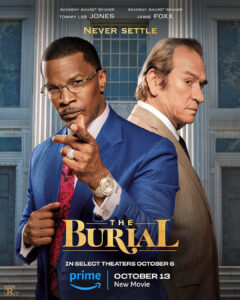
Jamie Foxx, Tommy Lee Jones score above & beyond in ‘The Burial’
 By Steve Crum
The Burial evolves into matters far deeper than the 6-feet under the surface implies. Its 126 minutes are jammed with multi-Oscar quality contenders from acting to direction to writing. A Best Picture is entirely possible.
Getting to specifics, the fact-based The Burial takes place in 1995. The story opens with Willie E. Gary (Jamie Foxx) in front of a Baptist congregation, moving around the stage in flamboyant, “let me hear an amen,” Bible thumping manner. Church elders and the choir behind him as  well as an ultra-responsive audience are totally enraptured at Gary’s high energy, animated presentation.
So is this a film about a dynamic preacher? No, it’s all about the popular (and wealthy) attorney, Willie E. Gary, a lawyer specializing in civil cases involving Black clients.
Segue to elderly Jeremiah O’Keefe (Tommy Lee Jones), who is grousing to his wife (Annette O’Keefe) about the near certainty that he is about to lose his long established funeral home in Biloxi, Mississippi to bankruptcy. In addition to his long time attorney Mike Allred (Alan Ruck), O’Keefe calls upon the aggressive Gary to co-handle his  contractual lawsuit against a Canadian group, the Loewen Group. When Gary reluctantly agrees, the fireworks begin. The Burial becomes a fast-paced courtroom drama.
Willie E. Gary, an attorney known for never having lost a case in two years, is at first played by Foxx like Johnny Cochran on steroids. “Litigation is war—a battle to the death!”—shouts Gary at one point. But as the trial proceeds, his empathy surfaces, focusing more on the inhumanity of his suffering client. By the same token, O’Keefe becomes more aggressive.
Tommy Lee and Jamie are believable, wonderful allies as the camaraderie between their characters evolves. Also impressive is Alan Ruck, whose Alfred is forced to take a back seat 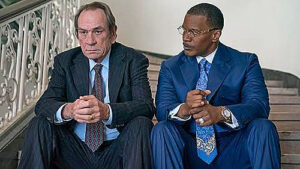 when Gary assumes the head counsel role. Directed by Maggie Betts, who co-wrote the screenplay, The Burial showcases Jurnee Smollett as Mame Downes, the defense counsel.
Specific mention must be made of this impressive, multi-layered screenplay (also co-written by Doug Wright). The Burial becomes much more than a mere courtroom drama. It is also a powerful re-evaluation of Black History.
—————
GRADE on an A-F Scale: A
‘Reptile’ grabs, hangs on…then…thud
 By Steve Crum
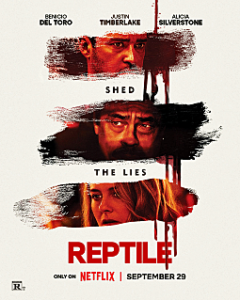
The taut opening moments of Reptile, featuring Benecio del Toro as a dedicated detective pulled into a horrendous murder mystery, is a hook I could not let go.
Before delving into the film’s highlights and criticisms, do not be misled regarding the “reptilian” title. It took at least 10 minutes before I realized Reptile was not a monster movie. I now figure it references del Toro’s Tom Nichols—a driven (even in his sleep) police dick of the old school. A bit slovenly here and there, he is nonetheless relentless to go above and beyond. In the process, he might lose friends and family. “A groveling or despised person” is the dictionary call.
 And so goes Detective Nichols in Reptile.
The movie’s premise is as simple as the final act is predictable. Directed by Grant Singer (his first feature film), the story follows typical problem-cause-solution progression. A young lady real estate agent is brutally killed—in one of the houses she is showing. Numerous suspects are investigated by the local police, led by Detective Nichols. Among them are the victim’s boyfriend (well played by Justin Timberlake) and the ex-husband, Sam Gifford (Karl Glusman).
When it appears the case is solved, Nichols defies his fellow policemen, and relentlessly keeps delving into alternative solutions. His rebellious actions affect his private life, particularly his wife Judy (Alicia Silverstone).
Singer, del Toro, and Benjamin Brewer crafted the screenplay, which has problems in the 136-minute film’s second half. Maybe this is due in part to to muddled editing (Kevin  Hickman)? Nonetheless, the story morphs into a kind of paranoid and bizarre narrative involving corruption. Actually, such a plot has been around in police dramas for decades—notably 1973’s Serpico.
While the music score by Yair Elazar Glotman and Black Label Media continually suggests there are some creepy things about to 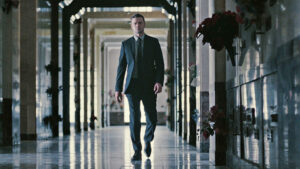 happen, it is much ado about hardly anything, a red herring at best. (Actually, the music often feels like a horror movie.)
What begins as a taut crime story ends as anything but. In fact, the finale leaves a couple of questions unanswered.
But what a stellar cast!
—————
GRADE on an A-F Scale: C-