
Unique ‘Birdman’ grabs four KC Film Critics Circle awards
 By Steve Crum
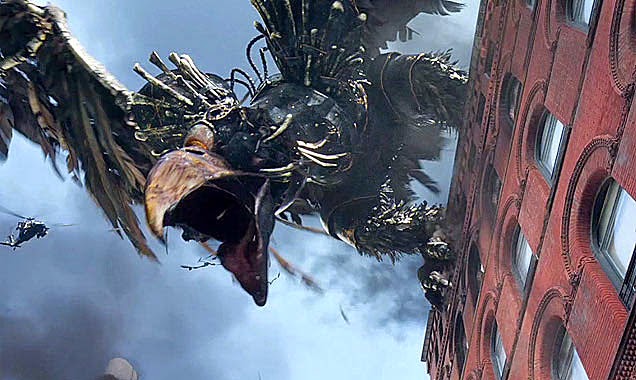
Birdman, the richly bizarre film about Hollywood fame, stereotype, self doubt and a Broadway production, took quadruple honors at the 48th Annual Kansas City Film Critics Circle Awards held Dec. 14. The 25 KC area film critics, including yours truly, voted Birdman’s Michael Keaton as Best Actor, and Ed Norton as Best Supporting Actor. It also won for Original Screenplay.
Gone Girl’s Rosamund Pike was awarded Best Actress. Patricia Arquette’s work in Boyhood garnered a Best Supporting Actress, while Boyhood’s director, Richard Linklater, won the Robert Altman Award for Achievement in Directing. (Just an FYI: Altman was from Kansas City.)
The complete list of winners:
Best Picture…BIRDMAN
Robert Altman Ward for Achievement in Directing…RICHARD LINKLATER/Boyhood
Best Actor…MICHAEL KEATON/Birdman
Best Actress…ROSAMUND PIKE/Gone Girl

Best Supporting Actor…EDWARD NORTON/Birdman
Best Supporting Actress…PATRICIA ARQUETTE/Boyhood
Best Original Screenplay…BIRDMAN
Best Adapted Screenplay…OBVIOUS CHILD
Best Animated Feature…THE LEGO MOVIE
Best Documentary Feature…CITIZENFOUR
Best Foreign Language Film…IDA (Poland)
Vince Koehler Award for Best Science Fiction, Fantasy or Horror Film…THE BABADOOK
 —————
—————The KCFCC is the second oldest film critic group in the United States (after the New York Film Critics Circle), and was founded by the late Dr. James Loutzenhiser. The annual awards ceremony is named in his honor.
Whizzo, Ol’ Dad, and Me
 By Steve Crum
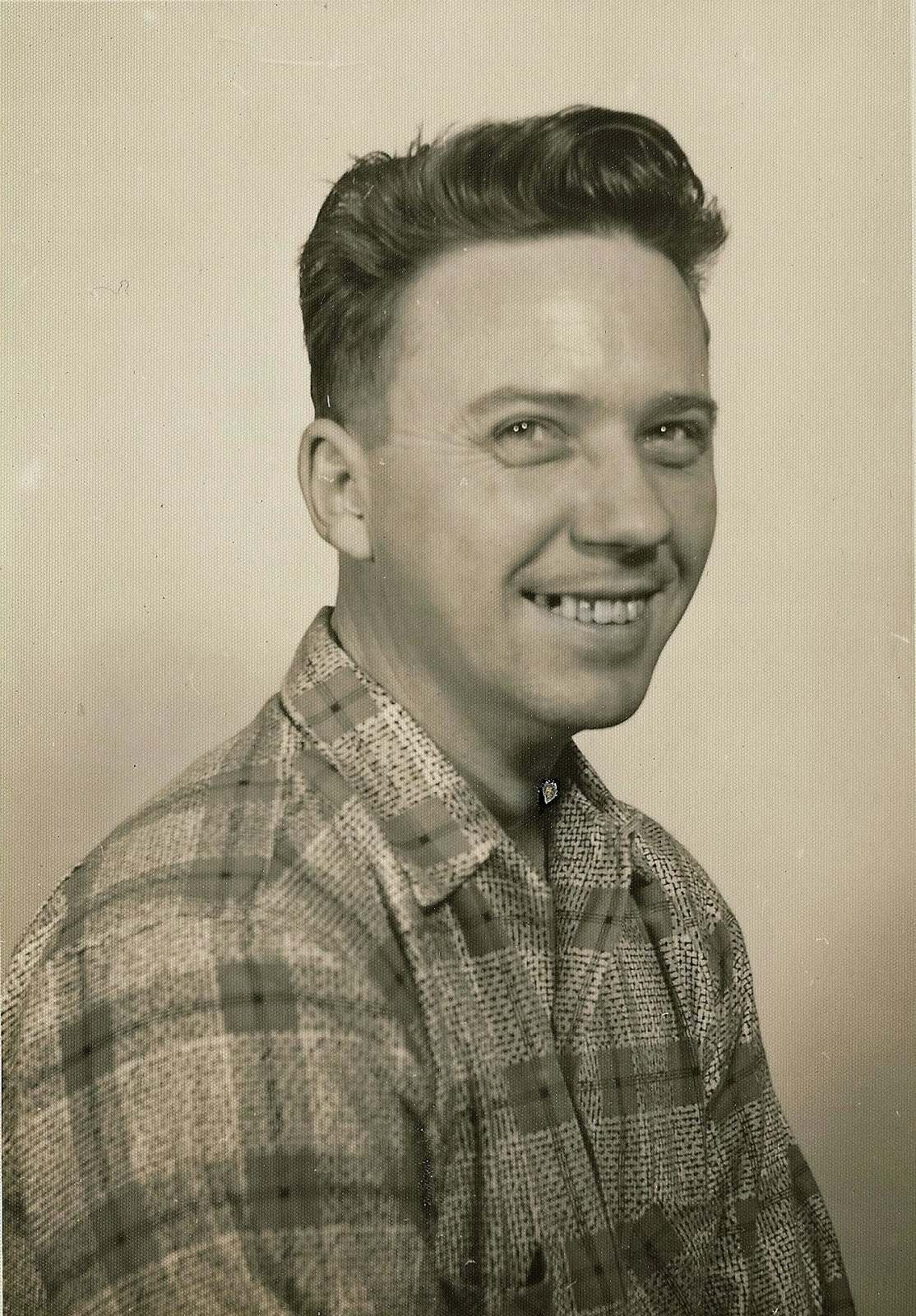
My late father, Harold Ronald Crum, always thought of himself as a business entrepreneur. He never called himself such, but his actions over the years clearly spoke to his desire of being self employed, the owner-operator of a business, and his own boss. Success would bring with it money, so he could quit his much hated machinist job.
I remember his foray into the lawn mower repair business. It cut out within a month. In his later years there was his dream job as a professional photographer, envisioned by him to be like Bob Collins’ cheesecake photographer on the popular TV show, The Bob Cummings Show. After buying a small studio and packing it with expensive photo equipment, his business failed to develop. Per se.
 Mom told me about a couple of his early business schemes, one involving Dad’s creative mind. He “invented” an emergency flare that motorists could keep in the car trunk. There were flares sold already, but his flare was somehow different. After his usual pattern of buying business cards, he invested in the materials of manufacturing the flares, including packaging. I assume some kind of gunpowder was required.
 Not long afterward, before any flares were sold (I guess Dad would call or visit area auto supplies shops), he discovered he had to prove he owned the copyright. He clearly did not have any such legality. In fact, his originality was not so original. Coincidentally, there were already flares like his on the market, and they were copyrighted. Fizzle. Yet another financial setback. It is likely Dad was out of work at the time, which was status quo throughout his life. We lived on the brink of poverty half the time.
Then along clomped Whizzo, the clown.
~~~~~~~~~~
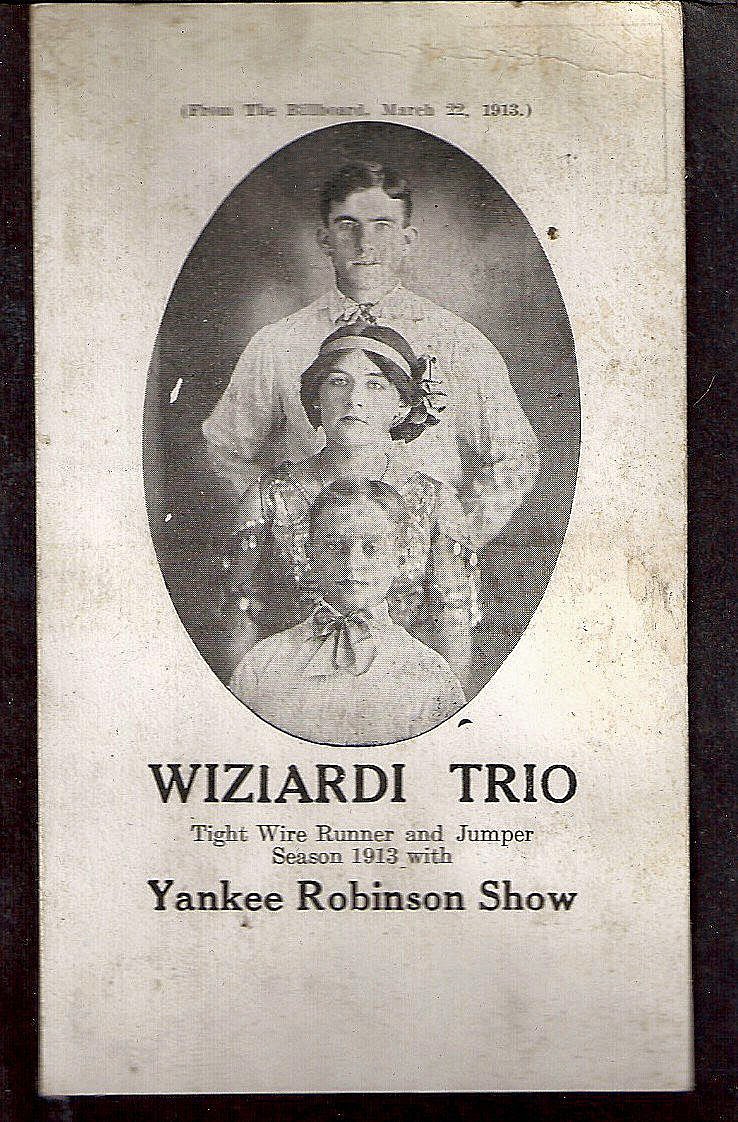
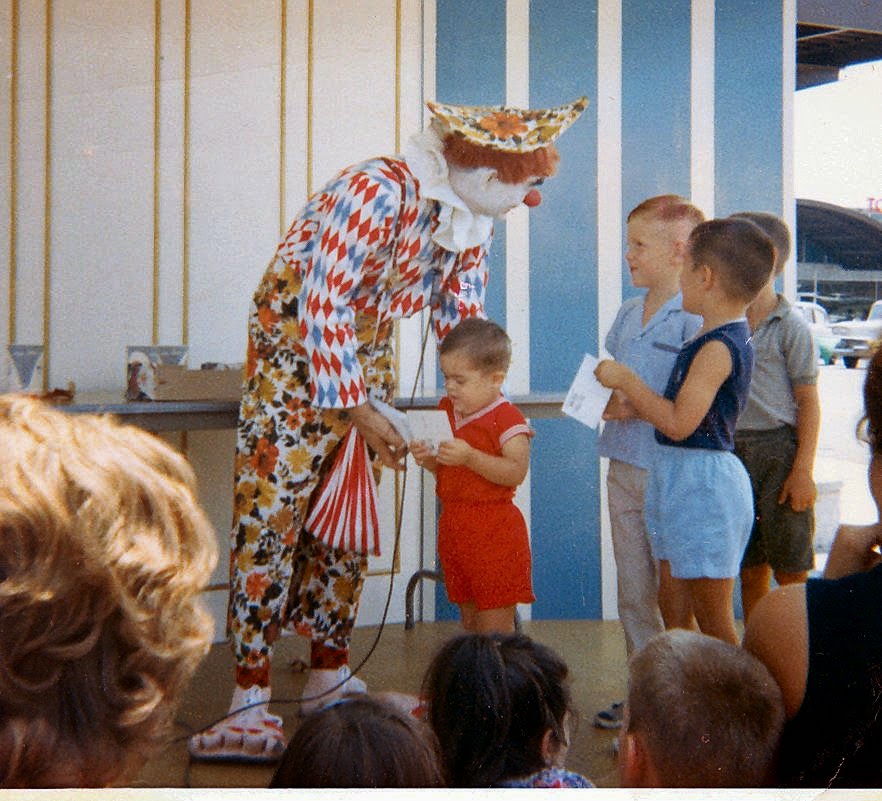
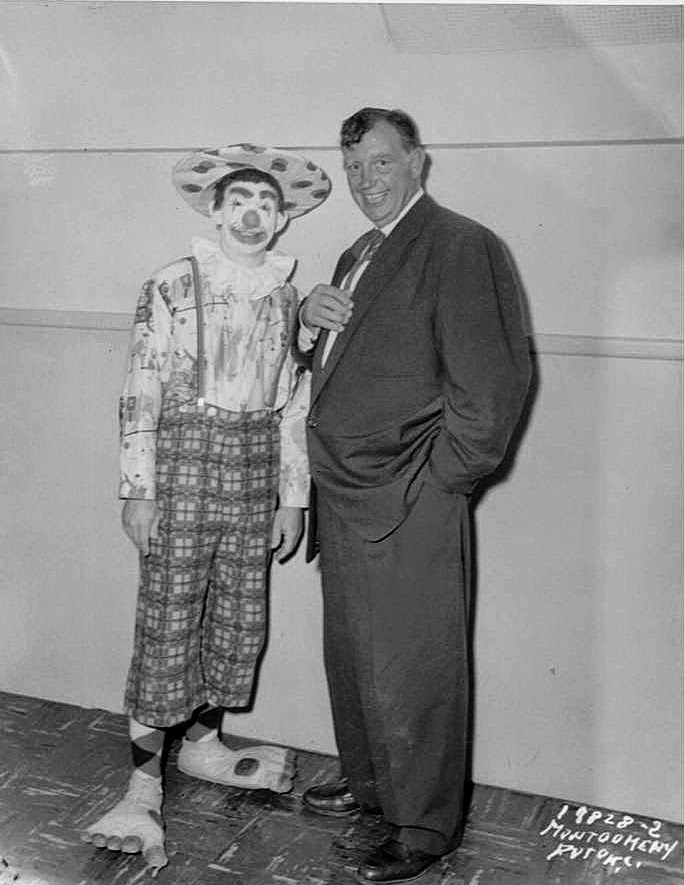
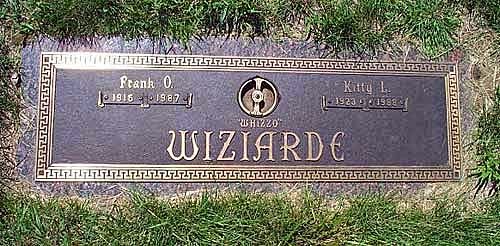
Frank Wiziarde was born in 1916, the son of circus trapeze artists. In 1952, Wiziarde was living in Kansas City, and working for fledgeling station KMBC-TV, which wanted to capitalize on Wiziarde’s circus credentials by having him perform on live daytime television as a clown. A slight play on his name became Whizzo, and a Kansas City legend was born. His morning show, Whizzo’s Wonderland, is memorable to those like myself who grew up in KC during the 1950’s. Everything about Whizzo was hilarious, from his original outfit with the huge feet to his constant physical and verbal improvising. His trademark yell “Whizzo-whee!” and “Whizzo Dog” (his puppet pet) were part of our vocabulary. Whizzo was so influential there were Whizzo toy banks sold, Whizzo-endorsed products, and a Whizzo amusement park.
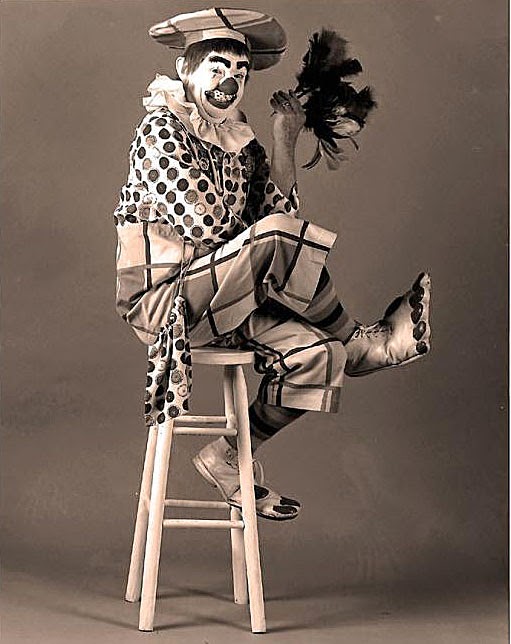 His show was enjoyed by adults as well as children. If there was a parade anywhere in Greater Kansas City, Whizzo was a featured attraction. For over 30 years, Whizzo was seen regularly on TV, first in Kansas City, and then in Topeka, Kansas. He was a trouper up until his death in 1987.
 During the summer of 1949, when I was a kiddo of 2, the pre-Whizzo Wiziarde hosted a local Kansas City half hour radio show broadcast live daily on WHB at 11 a.m. from a restaurant in the prestigious Country Club Plaza. The appropriately named Luncheon on the Plaza included women guests, and was geared to the predominately female radio audience. In those days, women guests were aka “housewives.” The show’s gimmick was that interviewed women were supposed to wear hats, and Wiziarde and company would choose the best. The woman with the chosen hat would win a prize.
  Does that premise crack you up as much as it does me? A visual gimmick…on radio? It’s reminiscent of Stan Freberg’s hilarious bit featuring acrobats on radio.
 Dad probably heard about the show from Mom, whose description obviously impressed him. And inspired him. At that time, Dad was working and Mom was indeed a housewife. What interested him most was the fact that the dozen or so women who appeared on the show would always identify themselves by giving their name and address. AND ADDRESS. In those days, women would invariably introduce themselves with their husband’s name, i.e. Mrs. John Jones. So there you have it. All one needed to contact the woman was to look up her husband’s name in the phone book, and verify the given address. Simple.
 Using the sparse money we had, perhaps borrowing it, Dad then invested in cutting edge technology, a reel-to-reel tape recorder. In 1949, this was state of the art. He also purchased many blank tapes. Oh yes, he also purchased a device to cut his own 78 rpm records, which he attached to his tape recorder. Dozens of blank discs were needed. A business was born.
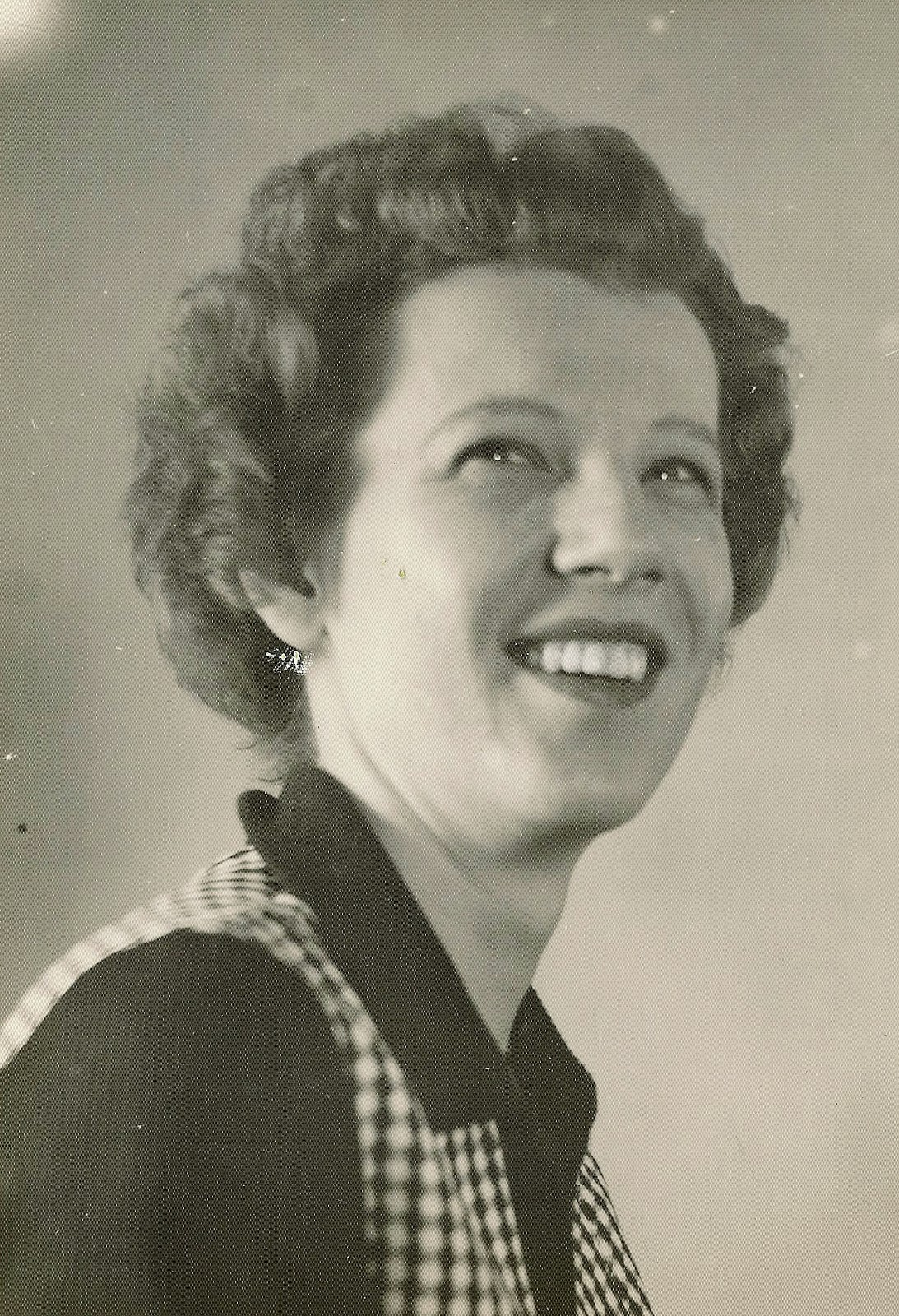
 Mom would record Luncheon on the Plaza, and Dad would later listen to it, writing down women’s names and phone numbers. He would then call each one, flatter her about the appearance on the show, and offer to sell her a recording of said appearance. Let’s say he’d ask $5. (I’m not sure.) Then he would mail the record to her. Easy money, and non taxable.
Two factors soon halted Dad’s business enterprise.
 First, he got a call from the telephone company warning him to stop using a public phone for business purposes. Someone had complained, and contacted the phone company. (At that time we had a party line, which made things worse.)
 Secondly, Luncheon on the Plaza had an ultra short radio run. It premiered in July, 1949, and ended in August, 1949. Wiziarde had much better luck in literally clowning around. Within three years, he realized his showbiz niche as Whizzo.
By the way, my late Mom actually appeared on Luncheon on the Plaza, no doubt wearing the required hat. I think she was interviewed by Wiziarde, but I will never know. I do know I have three recordings of show excerpts via Dad’s leftover, homemade 78’s. They are now 65 years old, nearly inaudible, and scratchy. However, I have digitized them for posterity.
 They also include women divulging their names and addresses. ID theft, anyone?
Massive Merv Griffin DVD set is must-have for show biz fans
 By Steve Crum
The Merv Griffin Show, 1962-86 DVD boxed set is arguably the most entertaining and eclectic show business celebration ever produced. The multiple Emmy Award winning talk show, which was more aptly a variety show, is represented via 12 DVD’s aka 42 hours (!) of dynamite guests, all introduced and interviewed by Merv Griffin.
 This is not to say all was song, dance, and comedy in the Griffin Show world. Like Jack Paar before him, Merv’s guest list often included extended and incisive conversations with the likes of Dr. Martin Luther King Jr., Rosa Parks, then former Vice President Richard Nixon, authors Alex Haley and Gore Vidal, and drug culture guru Dr. Timothy Leary. They are all part of this terrifically fun and fascinating DVD set which also serves as a social document of the mid to late 20th Century.
 Two years in the making, this massive broadcasting gem is a collaborative effort between Reelin’ in the Years Productions and The Griffin Group. During that time, outside sources were necessarily tapped since a majority of the 4,500-plus episodes were missing due to original video masters being erased, a common practice to save money decades back.
 As described in the set’s informative 52-page booklet, many of the Griffin shows included were found in private collections, including one gem from Merv’s own video stash. That particular program, helmed by Isaac Hayes, is an hour long, star packed musical salute to vintage Stax recording artists.
The Nixon library supplied two segments with—no surprise—Richard Nixon. Thanks to CBS Television, DVD producers were able able to include segments featuring Dennis Hopper and Willie Mays (who bats baseballs into the audience). At search’s end, nearly 1,800 of the 4,500 shows were found and, when necessary, restored to pristine condition. The early black and white shows through the later color programs are in superb audio and video shape.

Show business fans like yours truly will geek out on this massive overdose of movie, TV, music, books, sports, and political luminaries. Griffin seems to have had every conceivable name on his show at one time or another, and often in some of the oddest celebrity combinations imaginable. Take “King of the One-Liners” Henny Youngman, please. Henny shares Merv’s Nov. 11, 1965 dais with Frankie Laine, Minnie Pearl, George Carlin, and Col. John Glenn. Laine sings two songs, Pearl sings one, and Carlin does a standup. Oh yes, and Youngman does a standup. And Glenn does a sit-down interview.
 Incidentally, the shows vary in length from under an hour to 80 minutes, with commercials omitted. Merv’s shows over the years were from 60-90 minutes. Locales also vary, from Hollywood to New York to Las Vegas. Shorter celebrity spots are also added, usually in the “Extras” portion of each disc.
 Merv incorporated filmed segments into many of his shows, including a must-see 1970 hour with John Wayne at his ranch. Within that segment an earlier Wayne interview in Mexico is also shown. Both Wayne and Griffin had been hitting the tequila, so their repartee is a bit under the influence. Classic.
 From a young Stevie Wonder singing and playing the harmonica to Jayne Mansfield accompanied by her three children (including a toddler named Mariska Hargitay) and their dogs, eye candy and name dropping abound. I am still both pleased and disturbed about seeing the 1985 show featuring Orson Welles. For the first time publicly, Welles talked about his marriage to Rita Hayworth and films, including Citizen Kane. Hours after the taping, Welles died at his home.
 I feel like splashing the pluses of this boxed set like a Golden Age of Hollywood publicist: SEE Miss Lillian Carter dance with Andy Williams after he sings “Moon River”…Bette Davis and Olivia de Havilland in a salute to William Wyler…the cast of Star Trek II: The Wrath of Khan…the cast of The Golden Girls…the cast of Rocky III…Whitney Houston’s debut…Jerry Lewis doing extreme spit takes with Merv and Richard Pryor…Burt Ward and Adam West of Batman…Lucille Ball and Family…Danny Kaye literally taking over Merv’s show…and Moms Mabley, The Muppets, Mel Brooks, Steve Martin, and onward.
  Equally fascinating is Merv Griffin himself, a talented, educated, humorous, and extremely good host and interviewer. He leans into his guests’ comments, and listens. It is also obvious he did his homework in preparation. Thanks to Merv, venerable Hollywood movie actor Arthur Treacher enjoyed a happy, late career as Merv’s sidekick and announcer. Treacher is featured on the early shows from NYC, but declined to move when the show relocated to the West Coast in 1970.
  The accompanying booklet includes an impressively detailed, lengthy overview of the Griffin show by Steve Randisi and an introduction by Dick Cavett, who is also featured on a couple of the shows.
 The Welles and John Wayne pieces alone are worth the admission price.
——————–
GRADE on an A to F Scale: A
Unpredictable ‘Birdman’ is director’s triumph
 By Steve Crum
There has already been much positively said about Birdman or (The Unexpected Virtue of Ignorance), with good reason. First, its story is fresh and unpredictable. Reason two is the terrific acting. A superb Michael Keaton leads a talented ensemble that includes Edward Norton, Emma Stone, Naomi Watts, Zach Galifianakis, and Amy Ryan.
 Then there is the solo drum-dominant score full of jazz riffs that keeps both the plot and hand-held camera in steady motion. Speaking of camera work, add incredibly demanding cinematography by Emmanuel Lubezki.
 Most of all, Birdman is a directorial triumph for Alejandro González Iñárritu, who also helped write the screenplay. In short, this is a serious movie fan’s movie. Despite the title, do not expect a superhero movie, even though Keaton’s Riggan Thomson is a former Hollywood star once famous for portraying the superhero, Birdman. But that was decades ago, sort of like the real life Michael Keaton who was Batman in two movies, decades ago. Make no mistake, casting Keaton just layers in the somewhat whimsical irony.
 After a self imposed retirement from show business, Riggan desperately wants a comeback, but not in a redo of his Birdman character. Instead, he has chosen to direct and star in a hopefully Broadway-bound drama, “What We Talk about When We Talk About Love.” Birdman opens on stage during play rehearsal, and there are immediate obstacles involving egos and equipment malfunctions. From that point, Birdman’s story line careens from backstage to onstage, with most of the action occurring in various dressing rooms and narrow hallways. Do not confuse this sketchy description with the farce Noises Off, which is comedy dominant. However, there are some outrageously funny bits in Birdman, particularly a couple of ribald scenes featuring Norton’s Mike Shiner, an eccentric method actor who is a last minute play replacement.
 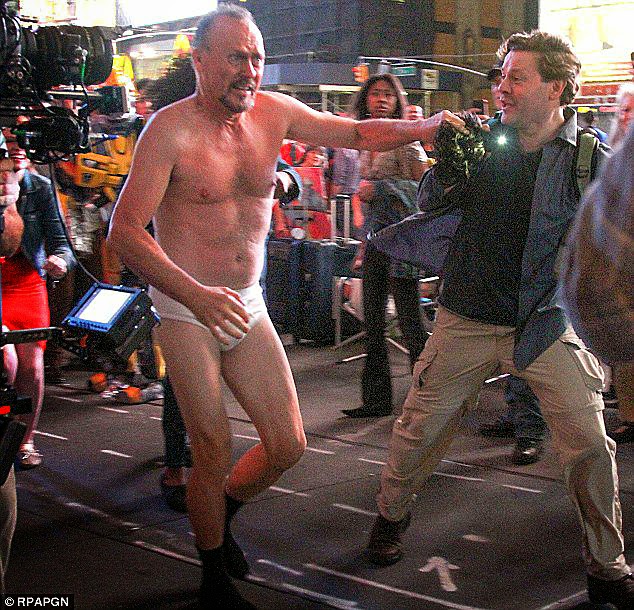 An extended humorous sequence involves an embarrassed but determined Raggan having to walk through crowded Times Square in his briefs and dark socks. It turns out to be a prettier picture than one might envision. It also speaks to celebrity and technology in our culture.
 Backstage dialogue is delivered crisply at fast pace, appropriate to the seamless camera work that appears to have been shot in one gigantically long take. In one scene the camera follows a briskly walking Raggan as he talks to his producer (Galifianakis), crosses paths with his daughter (Stone), then his ex-wife (Ryan), and on and on. Incredibly, the tag team technique works. It obviously took a lot of precision rehearsal.
 Some moviegoers might have trouble with dreamlike plot devices, like the actual Birdman character frequently talking to Raggan as his alter ego. Then there are a couple of flying sequences. Or three or four.
How masterfully reality and fantasy overlap here, echoing Shakespeare’s “all the world’s a stage.” Then again, the surreal Birdman says much more.
This is the most fascinating, original film I have seen in recent memory.
——————————
GRADE on an A to F Scale: A
Bill Murray is #1 reason to see ‘St. Vincent’
 By Steve Crum
St. Vincent is owned by its star, Bill Murray, from start to finish and extending into the closing crawl. (The latter is referenced later in this piece.) Without him, the seriocomedy would lose its crux. Murray’s delivery and deadpan demeanor ignite director Theodore Melfi’s screenplay and thus the entire film. It is a delightful occasion when Murray appears in any movie, but a starring role like his Vincent MacKenna character here is extremely satisfying.
There is a flip side to my Murray gushing, in that the screenplay is very familiar. One needs only to reference 2008’s Gran Torino, and hone in on Clint Eastwood’s central character, Walt Kowalski. Walt and Vincent are grumpy, antisocial bachelors who cuss and drink too much. Both are war veterans—Korea for Walt, Vietnam for Vincent.
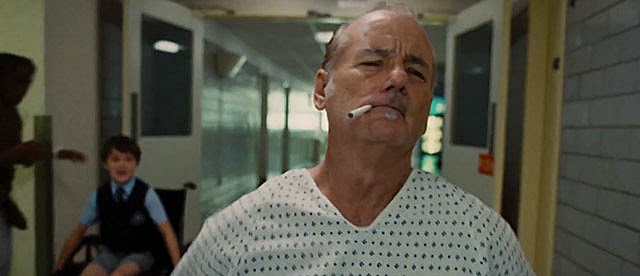
Both movies involve a codger reluctantly befriending a boy neighbor, and eventually becoming a surrogate father figure. (This development is telegraphed in the St. Vincent trailer.) A similar plot dates back to 1934’s Little Miss Marker, based on a Damon Runyon story. In that movie, a crusty criminal (played by Adolphe Menjou) is paired with a moppet played by Shirley Temple.
It was remade as Sorrowful Jones, a 1949 Bob Hope flick. In 1980, the title reverted to Little Miss Marker, starring Walter Matthau as the rascally guy who befriends a youngster. Over the years, each star has put his own spin on the lead character. Bill Murray follows suit, and greatly succeeds.
In St. Vincent (explaining the title would be a spoiler), Murray’s Vincent is about as unfriendly as one can get. He has a stripper girlfriend, Daka, played with sleazy aplomb by Naomi Watts. She is more so a lady of the night because he has to pay her for sex. Outside of trips to the horserace track, Vincent rarely crosses paths with fellow humans, preferring to hole up in his cluttered house and drink to unconsciousness. When his new neighbors immediately impose on him by via tree damage, Vincent is livid.

Enter Melissa McCarthy, toned down to nearly non-comedic, a recently divorced single parent of middle schooler Oliver (terrifically played by Jaeden Lieberher). Her new job keeps her late the first day. That and Oliver being bullied at his new school play out with the boy having to knock on Vincent’s door for help. Ah, the not so beautiful start of a relationship encompassing humor and heartbreak.

There are complexities to the plot involving a nursing home, pregnancy, the bank, and Catholicism. OK, so maybe it is not that much like Little Miss Marker after all. For sure those other movies lack Bill Murray.
Despite an extremely trite and sappy conclusion, St. Vincent works.
Despite an extremely trite and sappy conclusion, St. Vincent works.
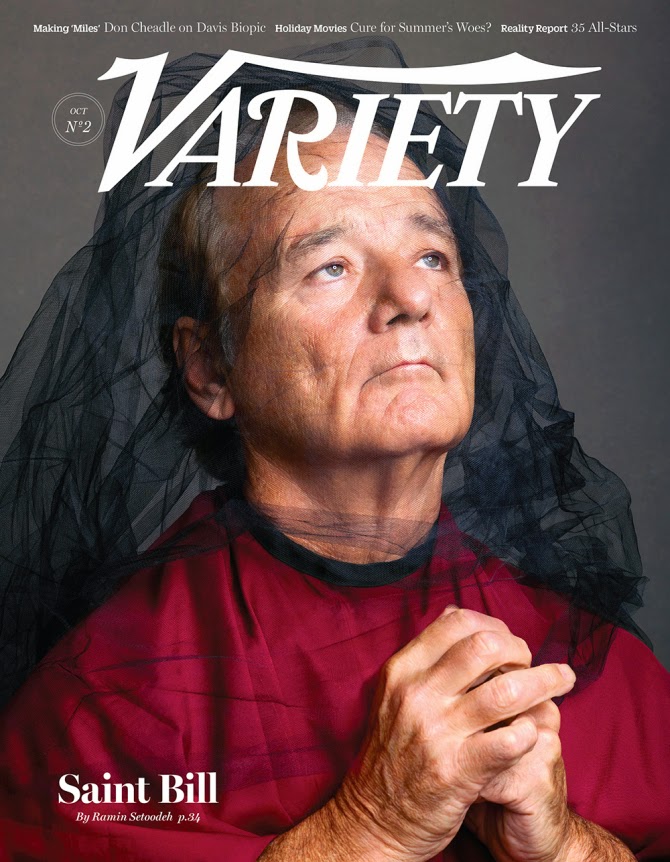 Be sure to stick around for the unique credit crawl. It features Murray’s Vincent in a non-verbal bit which is better seen than described.
——————————
GRADE from A to F: B+