
Adult cartoon ‘Anomalisa’ is typically insightful, bizarre Charlie Kaufman
 By Steve Crum
Those familiar with the films of Charlie Kaufman will expect some strange goings-on in his latest picture, an odd gem via puppet animation called Anomalisa. It’s worth watching. In fact, its bizarreness will grab from the get-go. This does not mean you will grasp any or all of its meaning or purpose when the 90 minute running time concludes.
Ready yourself for filmed eccentricity, ladies and gentlemen.

Before delving into Anomalisa (a created word used by the main character), realize that Kaufman has written only a smattering of theatrical motion pictures: Being John Malkovich; Synecdoche, New York; Eternal Sunshine of the Spotless Mind; Confessions of a Dangerous Mind; Human Nature; and this new one. Anomalisa and Synecdoche, New York are his only feature film—director works.
Kaufman himself labels Anomalisa as “existential”—an apt description befitting previous films. His TV-movie, How and Why, involves the discovery of a portal to a supernatural world. In Being John Malkovich, a group of miniaturized humans take advantage of a portal into the brain of actor Malkovich…and literally venture inside and out.

In the very adult themed, romantic comedy-drama Anomalisa, Kaufman’s first animated film (co-directed by Duke Johnson), a self-help writer named Michael Stone (voiced by David Thewlis) checks into a Cincinnati hotel one weekend to attend a conference of telemarketers. He is to be the main speaker, while at the same time promoting his book, “How May I Help You Help Them?”, aimed at an audience of phone sales people. We soon learn Michael has true fans among the telemarketers, including two ladies sharing a room right down the hall.

A technician adjusts the two primary puppets that serve as Michael and Lisa. Note the stabilizing clamps as the puppets are very slightly moved for the stop motion camera.

Once Michael is situated in his room, his loneliness and insecurity prompt a call to an old flame living nearby. Without getting into specifics, the two meet in the hotel bar only to realize why they previously broke up. Michael suffers even more. He should be rehearsing his speech for the next day, but matters of the heart and hormones dominate his thoughts and actions. Director-writer Kaufman takes us along on Michael’s journey of self satisfaction, from pondering his image in the bathroom mirror to shopping for an adult sex toy in a downtown store. He even hooks up with one of his fans, Lisa, voiced by Jennifer Jason Leigh. In addition, Michael has nightmarish fantasies.

Kaufman has said that with Anomalisa he aimed to make us forget we are watching an animated film and accept the characters as real. He succeeds, sure enough, except when he reminds us we ARE watching stop-motion puppetry. For sure, these puppets resemble humans, but their clearly hinged bodies are obviously robotic. A favorite scene: Michael’s lower face unhinges and falls to the floor. He merely picks it up and reattaches it.
Now that is surreal, very symbolic, and wickedly funny.
——————————
GRADE on an A-F Scale: A-
‘The Revenant’ triumphs as realistic, gritty survival epic
 By Steve Crum
Forgive me, Charles Portis and John Wayne, but The Revenant should be subtitled True Grit. However, labeling this gritty action spectacle “revenant” is also very apt since it refers to “one that returns after death or after a long absence.” That definition fits the epic, 2 hours-36 minutes, factual saga told in The Revenant.
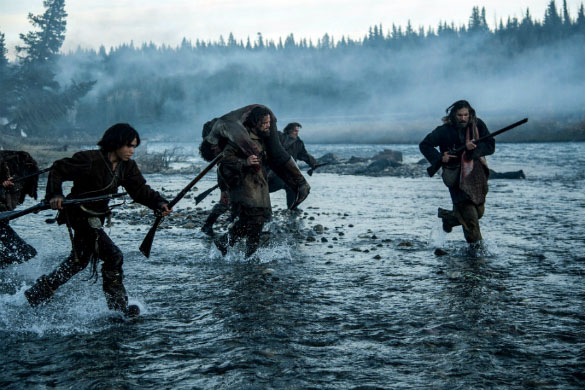
Adapted from Michael Punke’s The Revenant: A Novel of Revenge, the screenplay was co-written by the director, Alejandro G. Iñárritu (director and co-writer of last year’s Oscar winner, Birdman) and Mark L. Smith. The original story is based on the real life experiences of legendary fur trapper Hugh Glass. The “revenge” aspect plays out between Glass (Leonardo DiCaprio) and his nemesis, fellow trapper John Fitzgerald, portrayed by Tom Hardy.
 By the time Glass is faced with survival, driven by revenge, he has experienced a Sar Ah (Native American tribe) attack and slaughter of his hunting party (they are hunting for pelts in the Louisiana Purchase wild) and then an unbelievably vicious bear mauling. Surely I am not spoiling the plot since that bear sequence is repeatedly shown in the trailer. Abandoned and left to die by Fitzgerald, Glass is on his own, crawling at first, fighting snow, more Indians (this time the Arikara), and starvation.
 DiCaprio has little to say during the second third of the movie, since he is literally alone. That his character’s throat was damaged during the bear attack reduces his voice to raspy whisper. Yet DiCaprio speaks loudly with his eyes and body language. Glass’s goal is to survive, eventually reach civilization, recover his health, and then wreak havoc on Fitzgerald.
 A real plus of The Revenant is its expansive cinematography focusing on the gorgeous waterways, forests and mountains of the story’s setting of Montana and South Dakota circa 1823. Surprise, surprise. Actual filming was in 12 different locations encompassing three countries: the United States, Canada, and Argentina. Check out those repeated shots angled upward into the tall trees. Let’s give cinematographer Emmanuel Lubezki his due here.
Iñárritu’s realistic approach to filming, sans any computer generated effects, added to the difficulty of shooting on location. It took its toll on everyone involved, including the cast. (Several crew members quit or were fired during the production.) Natural lighting was used. The result is telling, a visual treat. Be forewarned that the visuals are sometimes realistically ghastly.
 Don’t expect a passionate love story or even Leonardo batting a passing eye at some lady of the trail. This is a man’s man movie absent of romance—or even comedy. (OK, there is a tad of humor when Glass encounters a friendly Indian midway through.) Alert, however. There is a female-driven sequence that turns out to be a plot definer. Other than that, it is grit-on.
  It is also my choice for Best Picture Oscar of 2015, even though it is opening nationwide today. (The Revenant qualifies since it had limited openings late last year.) Add another Best Director Oscar honor for Iñárritu. And DiCaprio’s performance is Best Actor worthy. The Revenant is quite an achievement.
 ——————————
GRADE on an A-F Scale: A
Like its elderly characters, ‘Youth’ is slow-gaited but has rewarding moments
 By Steve Crum
There is a whole lot of meditating and reflection aka deep thought going on in Youth, a dramedy that has already been heralded and crowned at Cannes. I cannot give the film that much praise, but there is a definite point of view expressed here, albeit a bit depressing. The search for life’s truth by both Youth’s elderly and youngish adults is rampant in this film, as its 124 minutes crawl along in search of answers.
Youth is a handsomely photographed, well acted movie. It is also distant and uninvolving. The lack of emotion of the characters’ demeanor is perhaps best characterized by the sex play between a long-married couple, which occurs in the woods as Michael Caine’s Fred Ballinger and Harvey Keitel’s Mick Boyle hide behind a tree to observe. Previous to the husband and wife’s woodsy display of lust, they were sullen and hardly said a word to each other. Perhaps that is Italian director Paolo Sorrentino’s point. (He also wrote the screenplay.) By the time a married couple is way past retirement age, the passion becomes play acting, and the sexual act is mechanical with rehearsed sound effects.

The problem with Sorrentino’s unwavering premise it that an audience watching his story has to endure a dozen or so such emotionless characters who seem to be searching for their lost passion of life, libido and otherwise.
 For central character Fred, a successful composer-conductor, coping with his depression takes some unique turns—from hand conducting cattle through a chorus of mooing on a hillside to soaking in an indoor pool with his pal Mick as they ogle a 20-something, nude Miss Universe who has chosen to join them at the pool’s opposite side.
 Mick and Fred are vacationing at an upscale resort, which somewhat resembles the Grand Budapest, and located in the Swiss Alps. Clientele is mixed, but heavily seniors. So many elders are there, in fact, the resort keeps doctors and nurses on staff for regular health checkups. At times the resort appears to be an assisted living abode. A rather plain Jane prostitute sits in the lobby, on call for any older gent in need of her special aid. What a logical, original touch.
 Early in the story, Fred is visited by an emissary of Queen Elizabeth who requests he conduct for her his beloved operatic composition, “Simple Songs,” but it is not to be. The real reason why he refuses is eventually disclosed, but it now appears Fred is bitter, antisocial, and solidly retired. His long time pal Mick, however, does want to perform again—and the sooner the better. He wants to direct a new film, and several writers have checked in at the resort to be a part. Two actors show up regarding the movie, Jimmy Tree (Paul Dano) and Brenda Morel, played by Jane Fonda in coarse, unflattering makeup. Fonda is pretty terrific as the outspoken actress.
 Rachel Weisz is very effective as Fred’s daughter, Lena, who is her father’s assistant. She is also married to Mick’s philandering son.

Throughout Youth, the young adults essentially ask, “What is life?” as their elders wonder, “What was life?” “I’ve grown old without understanding how I got here,” Fred laments. By film’s conclusion, we and Fred better understand.
—————————-
GRADE on an A-F Scale: B-
Heartfelt ‘Brooklyn’ is terrific 1950s love story linking Ireland and USA
 By Steve Crum
Brooklyn is a nostalgic, funny, sad, and overall heartfelt drama of a young Irish lass who emigrates to New York City during the 1950s. Central to the story’s theme are love, family and homesickness, ingredients perfectly blended and served by director John Crowley. Nick Hornby adapted the screenplay, based on Colm Tóbín’s novel of the same name. What a truly lovely film.
 This is the first mainstream feature by Crowley, even though Brooklyn will no doubt be exhibited exclusively in so-called art houses as it opens today. It really should be seen by everyone, even though the cast lacks general name recognition. Its leading stars, Saoirse Ronan and Emory Cohen, are recognizable if not by name. Ronan began as a child actress, garnering praise for her work in Atonement and The Lovely Bones. Cohen’s background is notably in the cast of TV’s Smash. They both turn in Oscar worthy performances here. Cohen is very reminiscent of a young James Dean or Marlon Brando.
 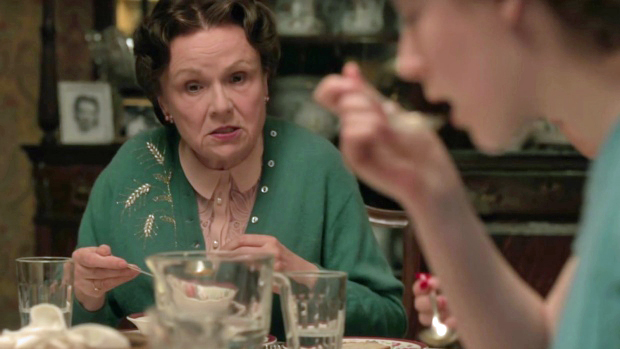 The two name actors in Brooklyn are both splendid here in supporting roles: Jim Broadbent (Topsy-Turvy) and Julie Walters (Educating Rita). Broadbent plays the Irish Catholic priest, Father Flood, and Walters is Mrs. Kehoe, the landlady of the boarding house in Brooklyn where Ronan’s Eilis Lacey stays.
Then there is Domhnall Gleeson as Eilis’ later day suitor, Jim Farrell. Gleeson is second billed, probably because he gained famed by portraying Bill Weasley in the Harry Potter series. This is not saying he is not fine in Brooklyn, but second billing is a stretch, considering the breadth of his role. Far more deserving is the terrific turn by Emory Cohen.
The plot is simplistic but layered. Ellis Lacey (Ronan) reluctantly follows her sister Rose’s advice to venture from their Irish village to America to pursue a substantial career. We later occasionally see Rose (Fiona Glascott) when the two are reading each other’s letters. Occurrences on board the ship transporting Eilis show how naive about life she is. But she befriends an experienced shipmate who clues her in on expectations and how to survive homesickness. “Sometimes it’s nice to talk to people who don’t know your auntie,” she tells Eilis. Like many small towns then and now, her town in Ireland has a gossip mentality.
Incidentally, Eilis’s processing scene at Ellis Island pleasantly grabbed me. It is rather refreshing to witness immigrants being politely and expediently welcomed to the USA.
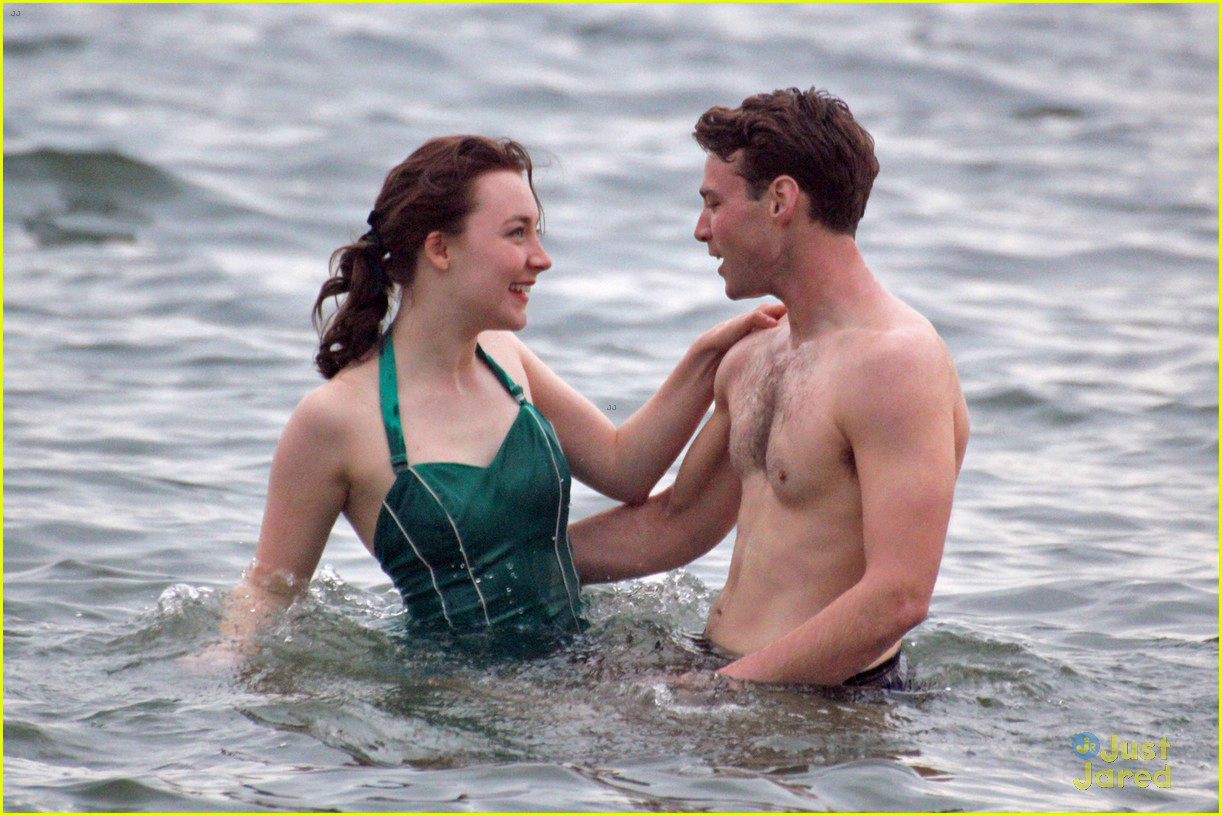
The Catholic Church has planned her travel and settlement venue, including an Irish-American boarding house for young Irish ladies. The local priest has even paid the tuition for Eilis’s night school so she can become a bookkeeper. Eilis works days at a department store, and her life is controlled if not mundane. Then she meets a young man, who is Italian-American. The story proceeds from there, including a third act when Eilis has to return home to Ireland for an emergency. Life altering decisions ensue.
 There are so many fine period and cultural touches in Brooklyn, from set design and clothing to mores about dating, church dances, and family loyalty.
 Above all, Brooklyn is a love story about two very likable, deserving souls.
——————————
GRADE on an A-F Scale: A
Kudos to Spielberg, Hanks for taut Cold War thriller, ‘Bridge of Spies’
 By Steve Crum
One would think that with credentials like being co-written by the highly regarded Coen Brothers, starring Oscar winner Tom Hanks, cinematography by Oscar winner Janusz Kaminski, and under the direction of the already legendary Steven Spielberg, Bridge of Spies would be a an “A” grade motion picture. Lo and behold, it is just that. What superb, must-see storytelling Bridge of Spies certainly is.
 “Inspired by true events,” Bridge of Spies plays out like a meticulously calculated Cold War thriller full of what old school movies and books would have labeled “intrigue.” Spielberg and his writers (Matt Charman, Ethan Coen, Joel Coen) certainly embrace the intrigue, particularly the frustrating secrecy that necessitates one country spying upon another. In this case the countries are the USSR (now Russia) and the United States. The story opens in 1957, and evolves through 1962 during Bridge’s 141 minutes.
 The story opens with a rather innocent appearing oil painter going about his daily life in Brooklyn, setting up his easel both in his modest apartment as well as curbside on the street. He is being stalked, and we do not know why. Incidentally, this is the first of several beautifully directed sequences. It turns out the painter, Rudolf Abel, is a Soviet spy, and the stalkers are FBI agents. Abel is wonderfully played by Mark Rylance—a laid-back, infrequently humorous, Oscar caliber performance.
 Abel is soon arrested for espionage, and readied for a rapid trial and conviction. Realize that the USA tenor of those times was violently anti-Communist via a country that had been ignited with Red hatred since the end of WWII. Even so, some semblance of civility and justice prevailed regarding Commie spies. To that purpose, a pro bono attorney is chosen to defend Abel: James B. Donovan, played by Tom Hanks. The fact he has sparse expertise in criminal law was undoubtedly why he was chosen. His role is to appear to defend Abel, and nothing more. That drastically changes, hence the central conflict, when Donovan decides to truly defend the spy, and not simply be part of a lynching.
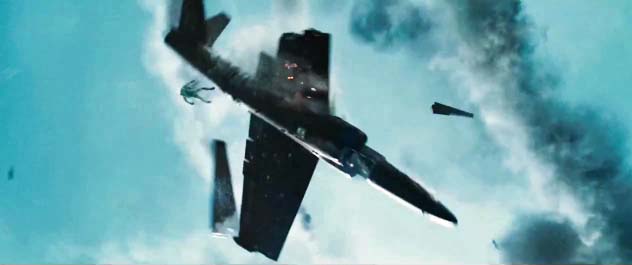
 Cut to CIA training headquarters wherein civilian pilots (curiously referred to as “drivers”) are being instructed on flying the newly commissioned U-2 airplanes that are equipped with huge lenses in their bellies to photograph Soviet military bases. One of the drivers is Francis Gary Powers. It is no spoiler to say he is eventually shot down over the USSR, and captured.
So the crux of Bridge of Spies is the interplay of two governments, and the wherewithal of exchanging one for the other on the Glienicke Bridge linking East and West Berlin. Donovan is involved as negotiator, and his frustrating and labored back and forth deal making between the United States and the USSR turns out to be fascinating entertainment.
 In the process, the setting often shifts to the building of the Berlin Wall. Scenes were shot in Wrolcaw, Poland, which obviously still looks like East Berlin of 55 years ago. This and other period sequences suggest a near documentary visual style. Spielberg successfully did likewise with Saving Private Ryan and Schindler’s List.
 Although the film’s setup might sound overly complex and bogged down with laborious dialogue, rest assured the conversations are crisp, and the overall pace rapid.
Kudos to Amy Ryan as Donovan’s wife, Mary; Austin Stowell as Francis Gary Powers; and to Alan Alda in a thankless role as Donovan’s law agency boss. An additional plus is given to composer Thomas Newman, who supplies an appropriate low key score. Newman was chosen to replace long time Spielberg collaborator John Williams, who had to bow out due to medical reasons.
 Bridge of Spies is a huge production featuring dozens of actors in elaborate sets, but there is a small scene that stays with me. It takes place in the hall outside a U. S. courtroom where photographers are snapping photos of Donovan and his client Abel. They use period press cameras, requiring large flashbulbs—which the photographers repeatedly flash, eject, and let fall to the floor before reloading another bulb. As the entourage eventually moves out of the area, everyone crushes flashbulbs underfoot. Spielberg captures that moment, and stays on those hard soled shoes crunching and shattering.
——————–
GRADE on a scale of A to F: A