
Remembering the forgotten GREENHOUSE magazine…
 By Steve Crum
 THROWING BACK to 1974, when I wrote a smattering number of reviews for GREENHOUSE, a 28-page monthly arts and entertainment magazine distributed throughout Greater Kansas City. It was The Pitch of its day, per se.
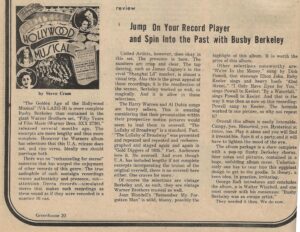 Greenhouse is among the 14 newspapers and magazines in my life that I either wrote for or advised/edited. Yes, I bleed printer’s ink.
Recollections of 1960s entertainers…
 By Steve Crum
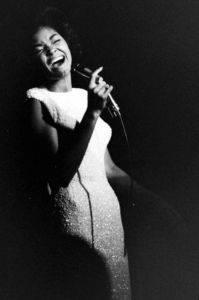
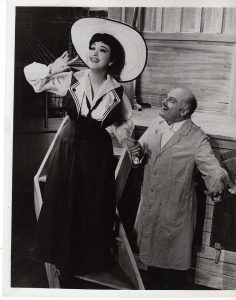 I was dazzled by: director/producer Tyrone Guthrie, “Man of La Mancha,” “Hello, Dolly!” (Dorothy Lamour), Hans Conried (“Absence of a Cello”), Kenny Rogers and The First Edition, Pat Paulsen, Skitch Henderson, Stan Kenton, Nancy
 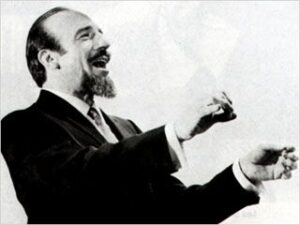 Wilson, The Amazing Kreskin, Mitch Miller, Preservation Hall (from New Orleans), Glenn Yarbrough, Pete Fountain, The Back Porch Majority, Sandy
  Baron, The Ramsey Lewis Trio, Mantovani and His Orchestra, Drew Pearson, Robert Russell Bennett, William Stafford (Kansas poet; my guest teacher for a session), and the touring musical “Half a Sixpence.”
Aptly titled ‘The End’ focuses on dark side living
 By Steve Crum
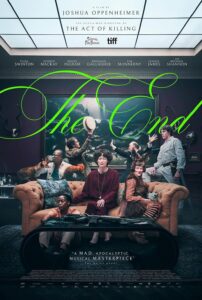
The film title The End references the apocalyptic end of the world. Joshua Oppenheimer (director/producer/screenwriter) has taken that grim premise to unfamiliar territory, fashioning it into 149 minutes of a family musical-drama-tragedy.
It is not easy to watch.
Co-screenscribes Oppenheimer and Rasmus Heisterberg set their tale two decades following an environmental disaster that has wiped  out most of the world. A wealthy family live in a relatively luxurious bunker (more like a mini-house) located within the confines of a cavelike salt mine. Among the group are Mother (Tilda Swinton), Father (Michael Shannon) and Son (George MacKay). Living in nearby rooms are the family’s butler (Tim McInnerny), doctor (Lennie James), and friends Mary (Danielle Ryan) and Bronagh Gallager (no character name).
The group tries to maintain a semblance of normal daily life, including physical exercises (they have a swimming pool), doctor checks (he also dispenses drugs), shared mealtimes, reading books, writing journals, and art collecting. (We assume they had access to a museum?) Oddly, they conduct safety drills.
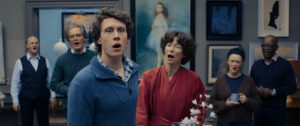 Individually, the soft spoken characters have quirks and nuances they still try to either hide or downplay after 20 years together. The real focus in this regard is on the son’s lack of sophistication about love and sex. His parents’ relationship is devoid of any display of affection, even in private. The boy’s lack of role modeling is challenged following the discovery of a wounded girl (Moses Ingram) in the outer cave. Their burgeoning relationship becomes the crux of the plot and hope for the future.
Note that at any given time, a character will burst into song and dance. Rename “burst” as speaking in rhyme—with full orchestral accompaniment. It is not even at Rex Harrison level of sing-talk. There are 13 such “songs” with titles like “A Wonderful Gift,” “We Kept Our Distance” and 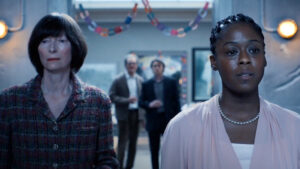 “The Mirror.” The latter tune is embellished by impressive camera work reminiscent of Orson Welles.
Overall, the sadly courageous group seems to suffer from PTSD via boredom and fear. Such is understandable. Laughs are a rarity in The End. I kept thinking about Debbie Downer from SNL.
If Tilda Swinton speaking a sorrowful lyric like “each day is like the last” entertains you, The End might be your tea cup.
—————
GRADE on an A-F Scale: C-
Psychic world explored in fascinating documentary ‘Look Into My Eyes’
 By Steve Crum
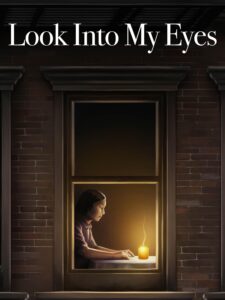
There are surprises and revelations in Look Into My Eyes. But the quirky documentary about psychics has a couple of unanswered questions. Maybe we need a psychic to figure it all out?
No crystal balls are used, but there are candles, dimly lit rooms and theatrics. Produced and directed by Lana Wilson, who has created four other documentaries, Look Into My Eyes is a fascinating glimpse into the life of a professional psychic. Make that seven psychics operating in New York City. The 108 minutes suggest they all function in their apartments—either in the same building or in close proximation.
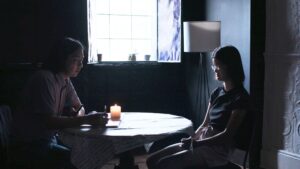 There is a scene, however, in which a psychic solicits readings outdoors.
The people seeking the mediums are troubled and obsessed in communicating. If you are like me, curious about the monetary payment for each meeting, stay wanting. Fees are not mentioned on camera. It must be substantial since the psychics do not seem to have another job. (By the way, the apartments are anything but elaborate.)
The central figures are not “fortune tellers.” These mediums share messages from departed spouses, friends, family members, and even pets.  They tap into the the outer world of the deceased, and elicit both joy and tears.
We witness the actual seance, the psychic’s connection with the client, the answered and unanswered questions, and tearful impacts. It seems real. Perhaps the most jarring exchange occurs when a client wants to know if his birth mother regrets having given him up when born. We  can all empathize.
Is everything we see in Look Into My Eyes true? Are we witnessing reality? My question is an ongoing one in our world of reality TV. For example, we know that a program like the super popular Survivor is unscripted, but it is all taped by several cameras. Participants realize they are on camera, even in supposed private conversations. Maybe everyone has learned to ignore a camera constantly focused on them. So goes the Eyes documentary. How can the psychic and client truthfully interact with one or two cameras obviously in the room?
Half of Look Into My Eyes is devoted to the private lives of the psychics themselves, sans clientele. What makes a guy or gal become a  psychic? Do they have anything in common with other psychics? (The seven regularly meet with each other in a therapy session to share common concerns, both professional and private.) One of the group is also shown at singing lessons. (He has a long way to go.)
These messengers are fraught with their own problems, insecurities, and histories. Yet they are driven to answer strangers’ queries due to their ability to connect.
Director Lana Wilson captures the isolationism of the psyche as it plays out in Hannah Buck’s spot on editing. The film is reminiscent of the style of documentarian Frederick Wiseman, and that is great praise.
—————
GRADE on an A-F Scale: A-
Raucous ‘Anora’ features unique story; standout acting by Mikey Madison
 By Steve Crum
Feature movies with a prostitute as the main character have existed for nearly a century. They include Anna Christie with Greta Garbo, Rain (Joan Crawford), Klute (Jane Fonda), Irma la Douce (Shirley MacLaine), Pretty Woman (Julia Roberts), and Midnight Cowboy (Jon Voight).
Add Mikey Madison to that stellar list. Make that the Oscar nominated Mikey Madison. She memorably portrays the title character in Anora. (The film has received five other Oscar noms as well, including Best Picture.)
 Everyone in the cast is way above average, including Yura Borisov as Igor. (He is an Oscar nom for Best Supporting Actor.) Sean Baker (The Florida Project) is director, producer, screen scribe and editor—all nominated. All said, the combination of that creativity results in a unique and unforgettable film.
Anora is touted as an “American comedy drama,” which indeed it is. It is also wild, raucous, and sexually explicit. Label it Super-R. The story opens in Anora (“Ani”) Mikheeva’s (Mikey Madison) main workplace, a strip club brothel in New York City. Her prostitution demands sometime take her and a client to a nearby location outside the club. That scenario occurs when she hooks up (yeah, a pun) with a Russian young man, Ivan (“Vanya”) Zakharov, a man-child played by Mark  Eydelshteyn. After some horizontal activity in a back room at the club, Ivan insists Anora party with him for a week ($15,000) while staying in his rich parents’ nearby mansion. Mom and Dad are still in Russia.
The set-up escalates into a private plane trip to Las Vegas, more sex…and marriage! They return to NYC, word gets out to Ivan’s parents, and the outraged family calls on their hired fixer, an Armenian priest, to retaliate. In one of the funniest bits in the film Toros (Karren Karagulian), the head handler, is in the middle of a christening when he gets a call to dissolve Ivan and Anora’s marriage. He immediately responds, running out of the ceremony and taking two of his strong arms with him: Igor and Garnik (Vache Tovmasyan).
 Be prepared for pushback from the newlyweds: screaming, threats, throwing things, tying up, barfing, a couple of car escapades, and general chaos. Everything escalates when the Russian parents arrive to make things worse.
Much of Anora’s dialogue is laced with foul language, particularly the f-word. In fact, her lines are a close runner-up to the nasties in 1992’s Glengarry Glen Ross. Then again, Anora’s use seems totally natural and expected. She uses the word as both punctuation and angry leverage.
By the story’s resolution, Anora has withstood numerous challenges. A happy ending? Not necessarily.
Up to and particularly including the last 30 minutes of this 139-minute gem of originality, I had zero idea where the story was going. Thusly, my affection for this terrific movie was a given.
—————
GRADE on an A-F Scale: A