
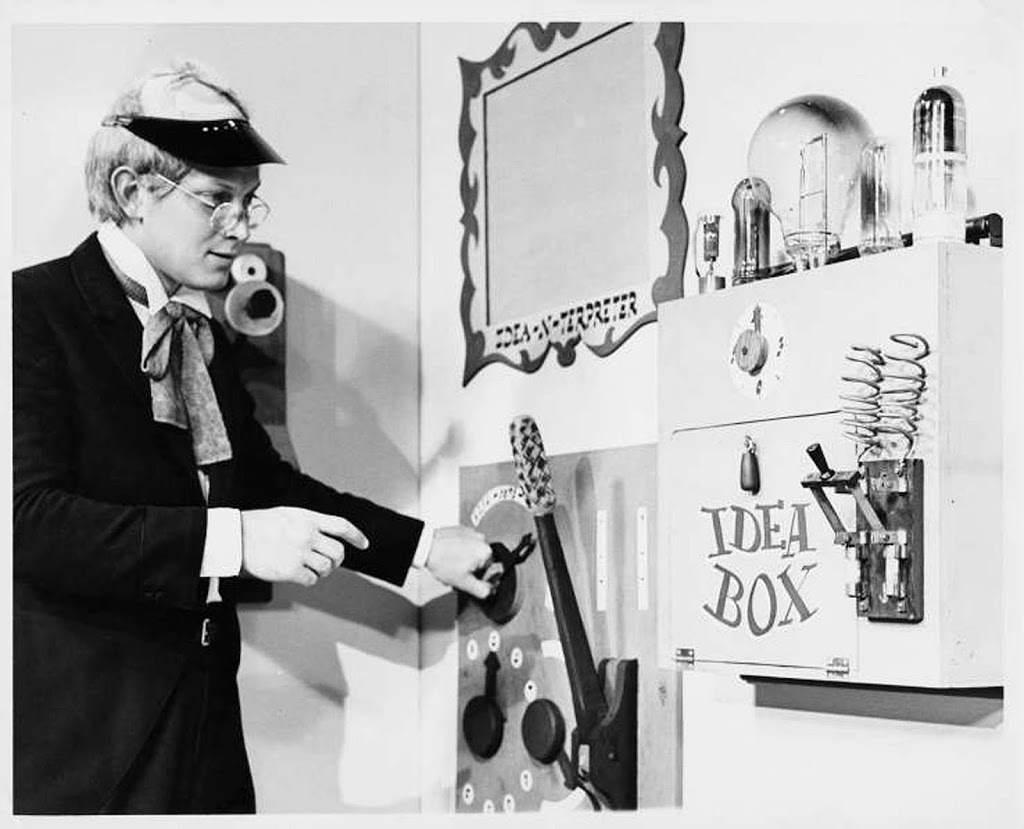
Throwing Back to…’DR. N. VENTOR’
By Steve CrumKansas City TV’s Dr. N. Ventor (Murray Nolte) sets the gears on his Idea Box. His local kids show was popular during the 1950’s on WDAF-TV’s Channel 4 (when it was owned by NBC). The good doctor puttered among his inventions, gave us light humor, and showed cartoons from Paramount Studios. He also had a tall robot, Oom-a-gog.
Nolte also announced for the station, did commercials, and was eventually elected Mayor of Merriam, Kansas…in Greater Kansas City. He died in 2001.
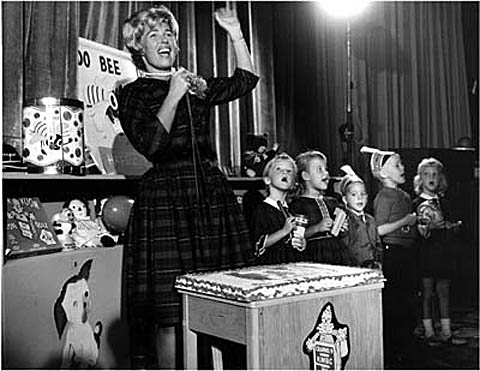
Throwing Back to… ‘ROMPER ROOM’
By Steve CrumThrowing back to 1954-64 TV in Kansas City…when Miss Virginia led her daily guest kids through a half hour of Mr. Do-Bee, rules of etiquette, how to say The Pledge of Allegiance, how to pray before a meal, and how to eat de-crusted sandwiches. The show was Romper Room. The franchised and syndicated show was unique in that it was broadcast live in major cities throughout the United States, but with different hosts. For example, there were Miss Nancy, Miss Jean, Miss Rosemary, Miss Barbara, and so on…depending on the city. The show began nationally in 1953.
I was never a fan (it focused on 4-5 year-olds), but my younger sister Becky definitely was. However, I am still upset that Miss Virginia never saw me and said my name via her magic mirror.
———-
An Addendum: 1940 Wyandotte High School (KCK) grad Virginia Lee Green Hassenflu starred as Miss Virginia. She died in 2016.
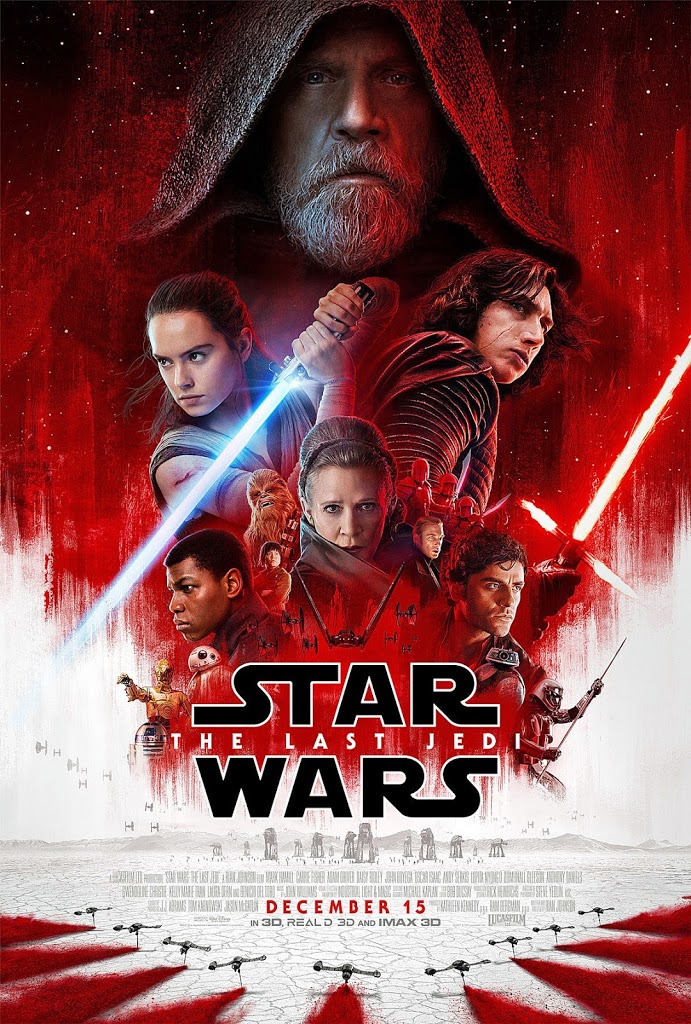
Terrific ‘Last Jedi’ thrills with new faces, old favorites + spectacular action sequences
 By Steve Crum
A new Star Wars movie, particularly another chapter in the mainstream series, is an EVENT—in caps. Such is the terrific Star Wars: The Last Jedi. The event two years ago (Star Wars: The Force Awakens) focused on Han Solo’s return and ultimate death. This time, in Chapter VIII, it’s the appearances of Leia and her brother, Luke. Whether death is involved with either will not be divulged in this piece.
Director/screenwriter Rian Johnson (2012’s Looper) has truly delivered the galaxy goods on this event—the second installment of the sequel trilogy. The timing is important, since The Last Jedi clearly serves as the transition from the Star Wars of Luke, Leia and Han to a new generation of heroes: Rey, Finn and Poe. Being the second part of a trilogy, The Last Jedi advances conflicts that rose in The Force Awakens. Most importantly, major issues are resolved in this installment.

In other words, it does not end in a cliffhanger like The Empire Strikes Back (1980). So fear not. Waiting three years to see if Han Solo would be freed from that block of carbonite was excruciating. By the way, we only have to wait two years for part three of this trilogy. Did I say “only”?
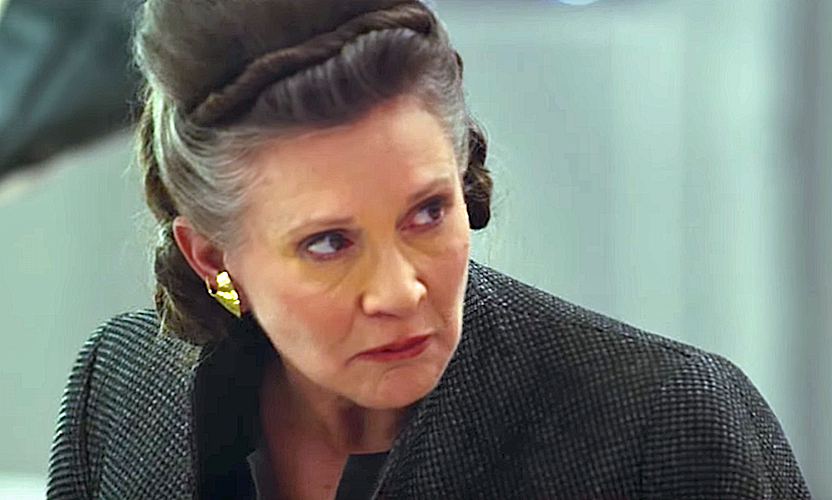 While there are relatively new faces at the X-wing and thereabout, including Oscar Isaac’s Poe Dameron, John Boyega’s Finn and Daisy Ridley’s Rey, expect a slew of long familiar ones, from Mark Hamill’s Luke Skywalker and Carrie Fisher’s Leia (now General Leia Organa) to R2D2 and Anthony Daniels’ C3PO. Chewbacca is back too. On the evil side, Adam Driver’s Kylo Ren emerges big time. If you recall, he killed his papa, Han Solo, in the last episode…much to his mother Leia’s suffering.
 Brand new to the Star Wars universe are Laura Dern’s Vice Admiral Amilyn Holdo (of the Resistance) and Benicio del Toro’s underworld con man and slicer.
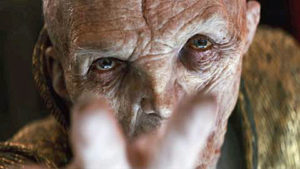 Yes, The Last Jedi has deja vu plot elements echoing the origin of Darth Vader and the dark side of The Force. Instead of the evil, controlling Emperor Palpatine, we now have Supreme Leader Snoke (realized by Andy Serkis via computer imaging).
Red is a dominant color in The Last Jedi. Snoke surrounds his throne with a barrage of lightsaber wielding guards, outfitted in vivid red. A key sequence late in the film takes place on what at first appears to be an ice planet, but in actuality is covered by white salt with a blood red undersurface. It is reminiscent of the great ice planet battle in The Empire Strikes Back since there are again giant walkers attacking the rebels. The splashing red creates a stunning effect.
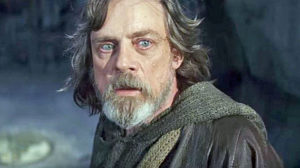 Much, maybe too much, of the story occurs on a desolate, rocky island wherein Luke has lived for decades. As the last Jedi of the title, he is summoned by Rey to return to the Rebel Alliance/Resistance to help defeat Snoke and his onslaught. He resists, and he resists. Let’s just say he reaches a Jedi compromise that would make Obi-Wan Kenobi proud. (And what a spectacular sequence that is.)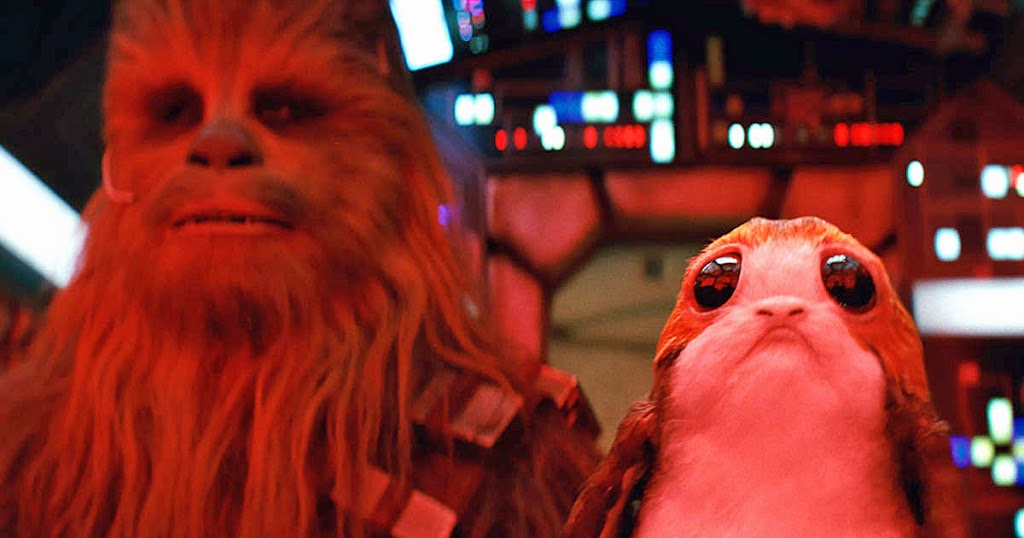
The action and subplots are involving…IF you are a Star Wars fan. Otherwise, you need to watch the previous installments. Even if you haven’t seen another Star Wars flick, you will be delighted with the introduction of the little, cute, bouncy, flying Porgs, which will soon hit toy store shelves—if not already there. I prefer the ice foxes, called “crystal critters” by Poe.
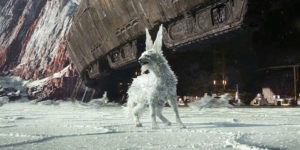
Prepare to be both dazzled and saddened by The Last Jedi’s treasures.
——————————
GRADE on an A-F Scale: A-
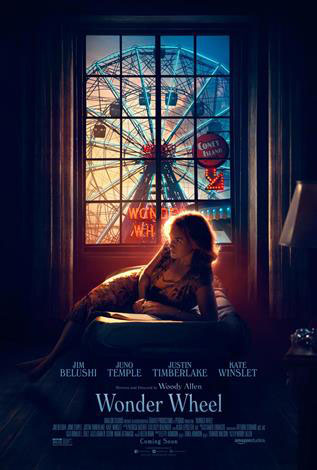
Though contrived, ‘Wonder Wheel’ has stunning color, Kate Winslet as pluses
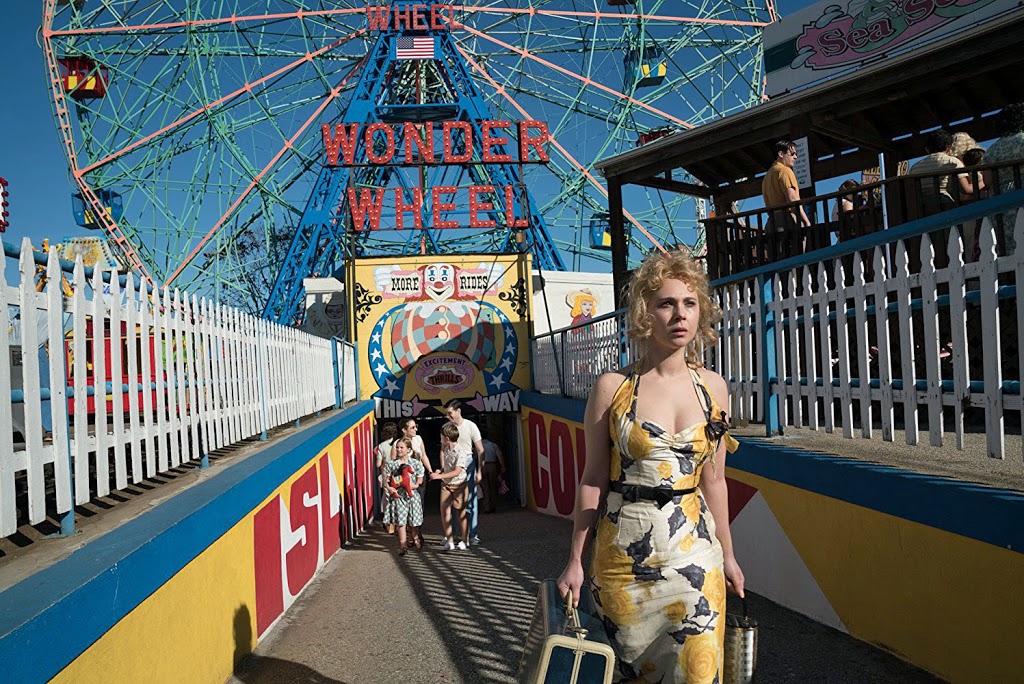
By Steve CrumDespite stars Kate Winslet and Justin Timberlake, the real celebrities in Woody Allen’s Wonder Wheel are his cinematographer, Vittorio Storaro, and Suzy Benzinger, Allen’s longtime costume designer. Then there’s the fantastic filming location, Coney Island.
Storaro’s opening panorama shot of Coney Island in blazing color is awesome, as well as his stunning use of color hues during dramatic scenes.
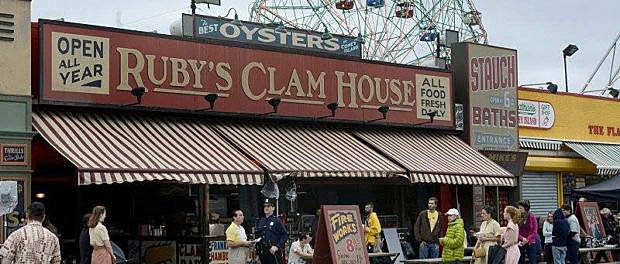 In this 53rd Allen-directed film (including his TV work), the focus is on a 1950 summer at Coney Island in Brooklyn. More specifically, it is a drama/character study whose central figure, Ginny (superbly played by Kate Winslet), is a lost soul married to Jim Belushi’s Humpty. (Yep, that’s his name.) He’s a carousel operator, and she waitresses at Ruby’s Clam Shop. Not only do they work at Coney Island, but live above the amusement park’s noisy shooting gallery. They and Ginny’s son from a previous marriage, Richie (Jack Gore), while away their days in unique ways.
  Humpty enjoys fishing off the pier with buddies. Ginny thinks she has found true love and lust in an affair with lifeguard Mickey, effectively realized by Justin Timberlake. And middle schooler Richie is fired up about…fires. The young pyromaniac starts them whenever and wherever he can. A unique family, indeed. So when Humpty’s estranged daughter Carolina (Juno Temple) knocks at his door after a decade, things change. That she is on the lam from the mob adds another layer of uniqueness.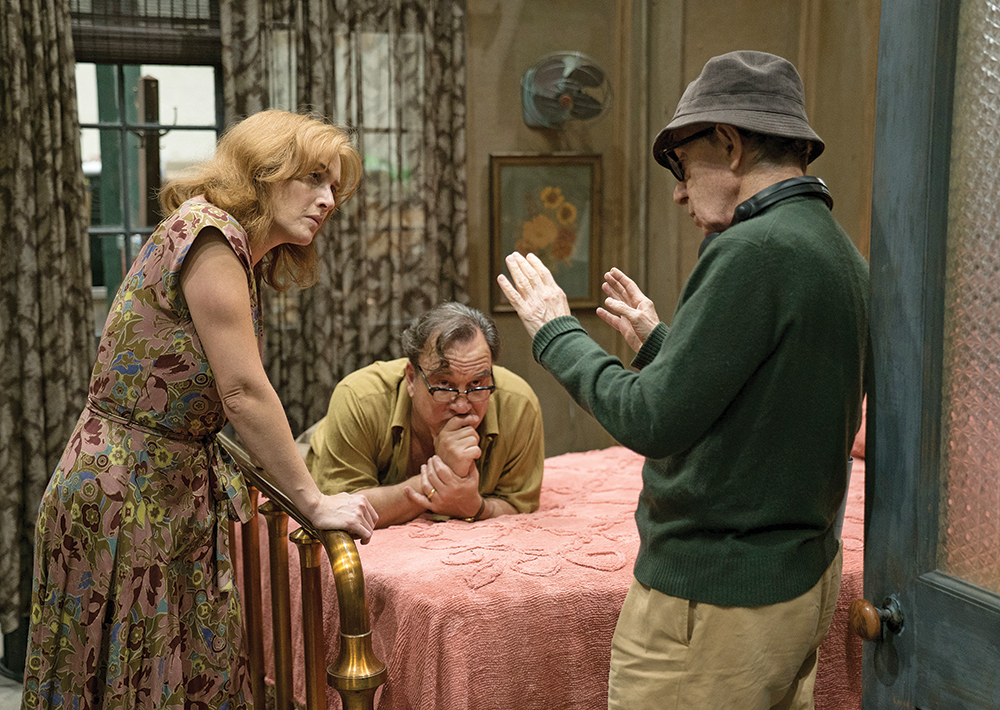
_______
Woody Allen sets up a shot with Kate Winslet and Jim Belushi.
_______
Quoting Mickey, who also speaks to us as narrator, “It just seems to go from one drama to another.” That pretty well sums up Allen’s screenplay, which comes across as pretty contrived and a bit too “unique” for its own good. The overlapping plot lines trail on without resolution, becoming more of a psychological study of Ginny and the sad existence of those around her.
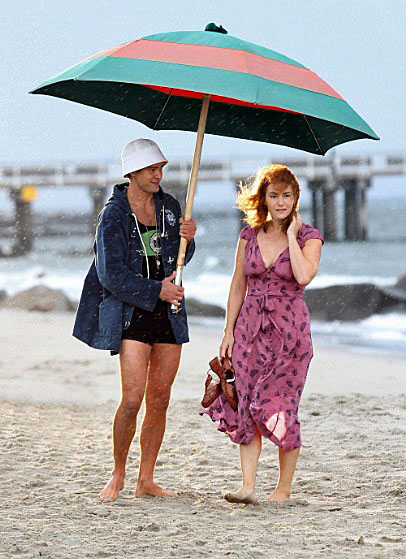 Still, Kate Winslet captures Ginny well, including her Brooklyn dialect, not easy for a Brit, and her frumpy body language. Mourning her own birthday celebration, she responds to the comment, “Turning 40 is a milestone”: “No, it’s a tombstone.” (A great Woody Allen line, if ever.) Obnoxiously insecure, she is self-centered with desperation. Like the park’s 150 foot ferris wheel of the film’s title, life turns.
As Ginny’s character ultimately morphs into a rough blend of Blanche Dubois and Norma Desmond, one speculates on her fate while admiring Winslet’s acting chops.
——————————
GRADE on an A-F Scale: B-
Dickens’ inspiration for ‘A Christmas Carol’ realized in ‘The Man Who Invented Christmas’
 By Steve Crum
Do not expect spectacular visual effects like materializing ghosts in The Man Who Invented Christmas. For that matter, forget about being transported via time machine to the past and future. But it is also true this is a movie involving Ebenezer Scrooge and Ghosts of Christmas Past, Present and Future. Based on Les Stanford’s historical fiction book of the same name, this film adaptation is closer to being a stage production than a digital effects-driven fantasy.
As such, The Man Who Invented Christmas is a handsomely filmed and solidly acted 104 minutes. Compelling? Well, so-so. A unique take on the familiar Charles Dickens tale, A Christmas Carol? Definitely.
Be forewarned: If you have neither read the book nor seen one of the 200-plus film and stage productions, forget about seeing this one. You just won’t get it.
 The Man Who Invented Christmas is aptly named since the film’s plot involves the six desperate weeks Charles Dickens had in 1843 to create what would be finally titled A Christmas Carol. It became his best remembered work, and a holiday season must-read and must-see. During radio’s golden heyday in the 1930’s and ‘40s, it also became a must-hear.
 Through screenwriter Susan Coyne and director Bharat Nalluri, we first see Charles Dickens (well played by Dan Stevens) during one of his touring lectures, playing to an audience packed with those who want to see and hear the author of the best selling novel, Oliver Twist. At this point, Dickens and his manager are in turmoil. Since Oliver Twist, Dickens had authored three books—all rejected by publishers. His professional fate now rests on creating a new novel, and the deadline grows near.
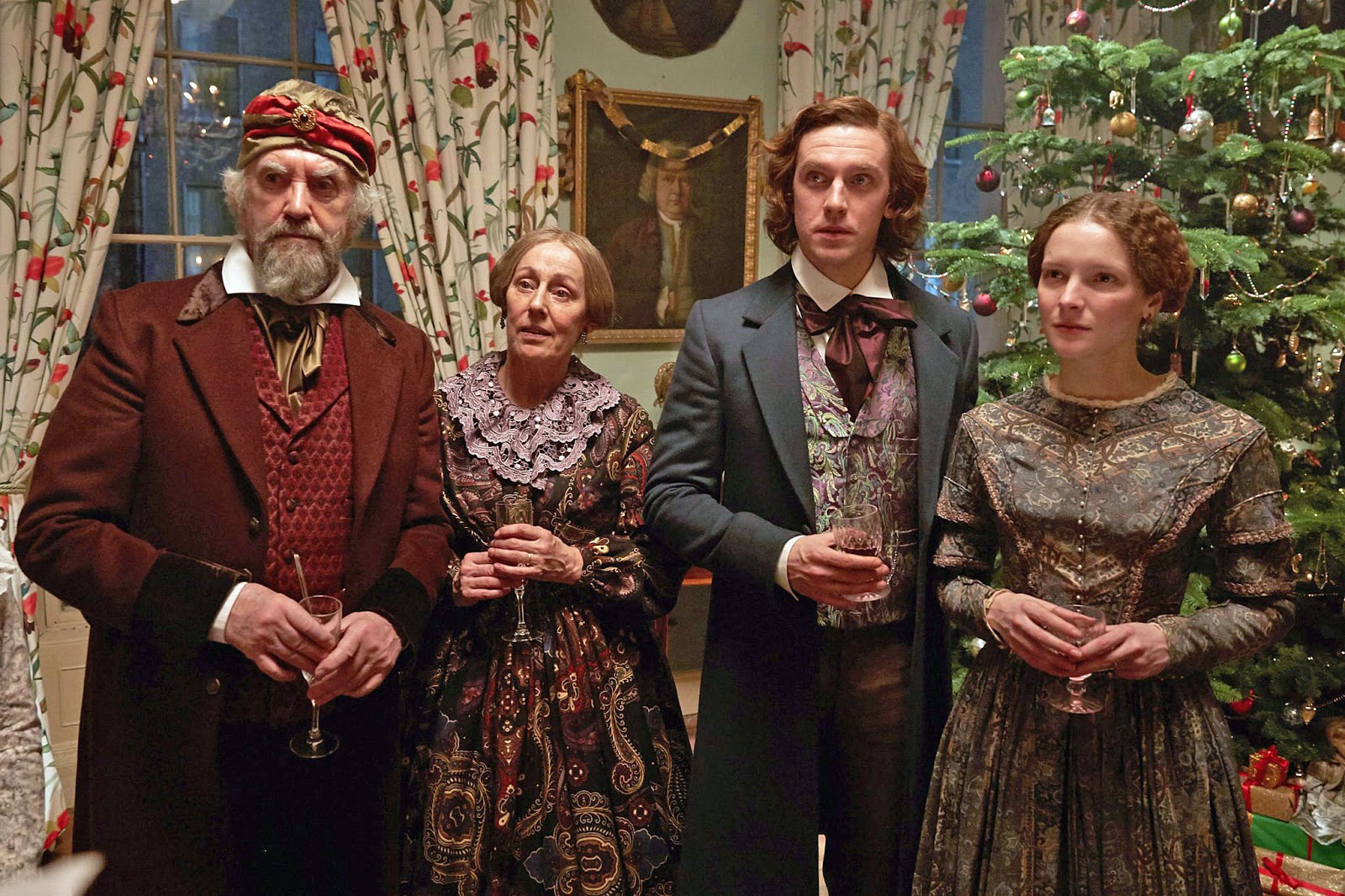 At this point in the film, Dickens’ creativity mixes with his personal life at home in London. He is surrounded by a doting (and pregnant) wife, several children, servants, and his live-in parents. His relationship with his deadbeat father John (Jonathan Pryce) is strained. And there are bills to be paid.
 There is sage advice I was once given when writing fiction: “Write about that which you know.” Dickens fully recognizes such, and begins creating characters to drive a plot around a central Christmas theme. “Get the name right,” he says, “and if you’re lucky, a character will appear.”
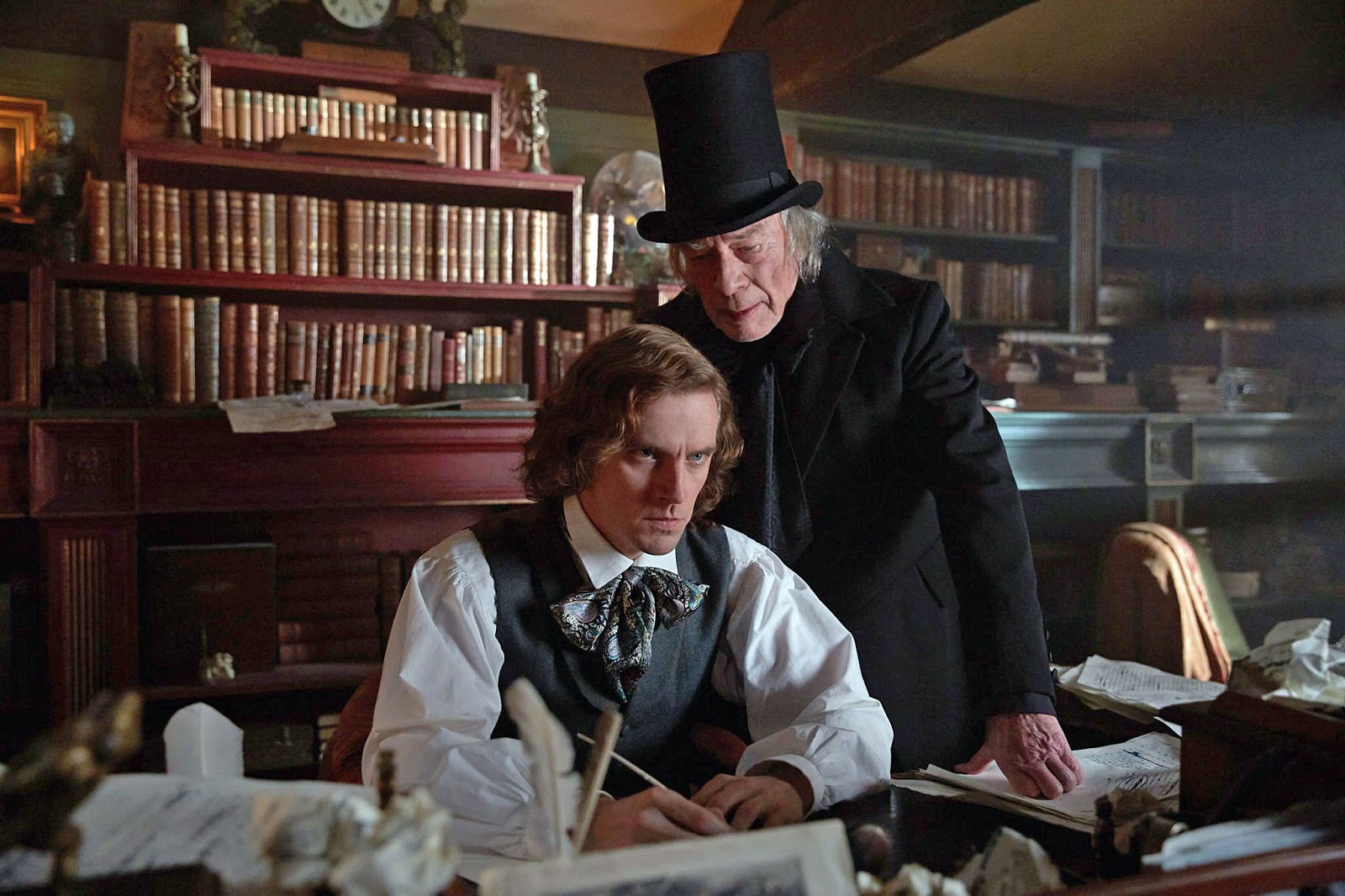
The characters’ names and personages are therefore based upon those who he knows…from relatives to strangers. His thoughts are then visualized for us. For example, one gent he briefly meets becomes Scrooge (finely portrayed by Christopher Plummer). Eventually, all the characters come to Dickens’ mind, and adapted into his new book. They even hang around his study, invisible to others since they are solely in his—as they say—mind’s eye.

The Man Who Invented Christmas is a well crafted film with gorgeous period settings and costumes. I guess there is nothing really wrong about it resembling a high budget Hallmark Channel movie.
——————————
GRADE on an A-F Scale: B-