
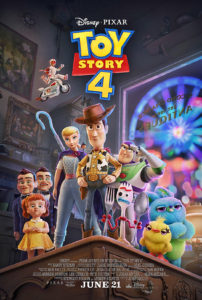
‘Toy Story 4’ continues/concludes memorable animation series brilliantly
 By Steve Crum
Question: Has it really been 25 years since the first Toy Story movie was released?
Answer: Yup. (Incidentally, that cowboy language “yup” is nowhere near the King’s English spoken by the film’s main character, Woody, the cowboy doll. Tom Hanks has voiced him since the beginning.)
Since Toy Story 4, directed by Josh Cooley, was released last June, fans and critics have once again gushed over every aspect of the CGI animated gem. It was no surprise that it soon won the Oscar for Best Animated Feature. It is doubly an accomplishment since after the first Toy 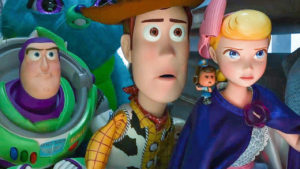 Story in 1995, plans were shelved to produce Toy Story 2 to theaters. Execs thought it better/safer to release it in direct-to-DVD form. But they gambled, and won. The second Toy Story was a sensation that led to Toy Story 3 and now #4.
And what sensation exists in Toy Story 4!
The screenplay, by Andrew Stanton and Stephany Folsom, takes up where 2010’s Toy Story 3 left off. Bo Peep (voiced by Annie Potts) and her close friend Woody are rescuing the human Andy’s remote-controlled car. Segue into a major catastrophe as Bo herself is donated to a new owner. Woody is crushed because he has been in 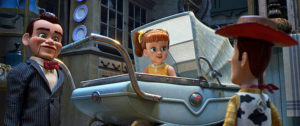 love with Bo forever—or at least in maximum doll years. Jump to years later when Andy is a young man, and all his toys are given to a little girl, Bonnie (Madeleine McGraw).
Enough of early plot details! Just realize that in the midst of Woody and his toy buddies (Rex, Hamm, Slinky Dog, and Mr. & Mrs. Potato Head among them) adapting to a new environment, a major plot change occurs. It involves a reunion of Woody with Bo Peep, a carnival, and some very creepy toys therein.
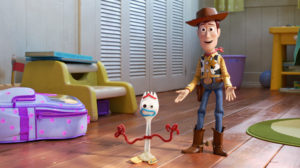 But the most memorable of all the new characters is a simply created toy, a plastic fork, called “Forky” (Tony Hale). Forky has proven to be so popular that Pixar has already created a Forky CGI short.
TS4 was supposedly the grand finale of the franchise. But, hey, money speaks. Even Tim Allen (the voice of Buzz Lightyear) has recently said that Toy Story 5 is a possibility. The public demand is undoubtedly there. Pixar Animation Studios/Walt Disney Pictures will have to decide.
=====
GRADE, On A to F Scale: A
Popping up here & there in his own movies: Alfred Hitchcock
On the occasion of what would have been Alfred Hitchcock’s 100th birthday in 1999, I wrote this vignette about the great director’s cameo appearances in his films. This is a reprinting of my Crum on Film column that ran in The Kansas City Kansan newspaper on Aug. 20, 1999. Hitch died April 29, 1980 at 80.
 By Steve Crum
How appropriate that the great late director Alfred Hitchcock’s 100th birthday fell on Friday the 13th last week. The “Master of Suspense” must have had a hand—or at least his silhouette—in the planning. It is just too coincidental otherwise. After all, the genius behind Psycho and The Birds was meticulous about every detail in filming, including the publicity angles.
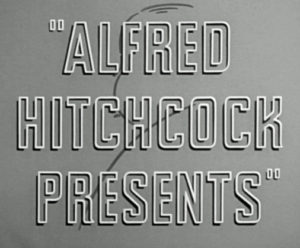
Hitch was also the most well known and recognizable of any film director in history. Thanks to his decade-running TV series Alfred Hitchcock Presents, wherein he memorably introduced and closed each episode, Hitchcock became one of the world’s premier personalities.
Beginning with The Lodger in 1926, in which he subbed for an extra, Hitchcock was both flattered and increasingly bothered that fans looked for his brief appearance in virtually every film thereafter. Rightfully concerned that audiences might be distracted from the movie itself, Hitchcock tried to include his seconds long bit early in the movie. Hitchcock fans, of course, love his movies. That includes trying to spot his cameos. Selected Alfred Hitchcock movie appearances follow, so look fast.
 •THE LODGER (1926)—Hitch appears twice: at a newsroom desk and later as a crowd member who is watching an arrest.
•THE 39 STEPS (1935)—Seven minutes into the film, look for him throwing away some trash as Robert Donat and Lucie Mannheim run from the theater.
•THE LADY VANISHES (1938)—Near the end of the movie, in Victoria Station, he wears a black coat as he smokes a cigarette.
•MR AND MRS. SMITH (1941)—He passes Robert Montgomery in front of his building.
•SHADOW OF A DOUBT (1943)—Hitchcock plays cards on the train to Santa Rosa.
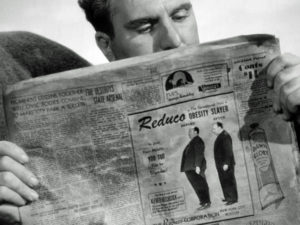
•LIFEBOAT (1942)—A tricky appearance, since the entire film takes place in lifeboat on the Atlantic Ocean. William Bendix looks at a newspaper that shows Hitchcock in a “before” and “after” weight loss ad for the Reduco Obesity Slayer.
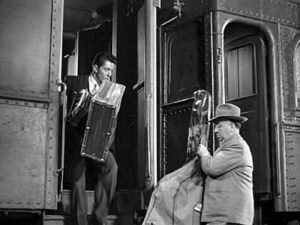 •STRANGERS ON A TRAIN (1951)—As Farley Granger gets off the train, guess who boards the train, carrying a double bass fiddle?
•DIAL M FOR MURDER (1954)—Thirteen minutes into the film, zero in on the left side of the class reunion photo.
•REAR WINDOW (1954)—Hitch winds the clock in the songwriter’s apartment that Jimmy Stewart is observing through his binoculars. That happens about 30 minutes into the movie.
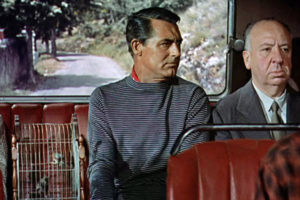
•TO CATCH A THIEF (1955)—He sits to Cary Grant’s left (10 minutes in).
 •THE TROUBLE WITH HARRY (1955)—Twenty minutes into the flick, Hitch walks past the parked limo of an old man who looks at paintings.
•THE MAN WHO KNEW TOO MUCH (1956)—Just before the murder in the Moroccan marketplace, he watches acrobats—his back to the camera.
•THE WRONG MAN (1956)—He narrates the prologue.
•VERTIGO (1958)—Eleven minutes in, he walks the street in a gray suit.
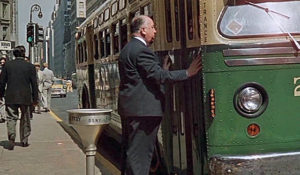 •NORTH BY NORTHWEST (1959)—He misses a bus during the opening credits.
•PSYCHO (1960)—Look for him four minutes into the film, through Janet Leigh’s window when she returns to her office. Hitch wears a cowboy hat.
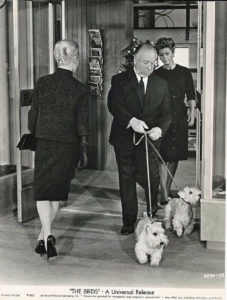 •THE BIRDS (1963)—As Tippi Hedren enters a pet shop, he leaves with two white terriers on his leash.
•MARNIE (1964)—He enters from the left of the hotel corridor, five minutes into the flick, as Hedren passes by.
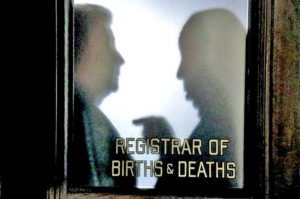 •FAMILY PLOT (1976)—Hitchcock’s last movie and last movie appearance: he is in silhouette through the door of the Registrar of Births and Deaths (41 minutes in).
∞∞∞∞∞
Just an added trivia goodie: Hitchcock’s only cameo appearance in one of his Alfred Hitchcock Presents TV shows is in “A Dip in the Pool.” His photo is on the cover of a magazine someone is reading. It aired June 1, 1958.
Roy Rogers in KCK: Home, home at the Ranch
It turns out that the late Roy Rogers, “The King of the Cowboys,” had a link to Kansas City, Kansas. My coverage of that tie-in was originally published in The Kansas City Kansan (Crum on Film) on Aug. 25, 2000. Since then, the Rogers museum in Victorville, California has closed…as has his transplanted museum in Branson, Missouri.
 By Steve Crum
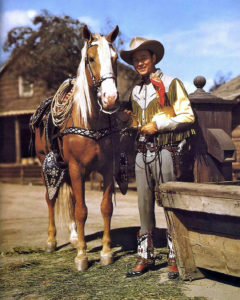
The legend of Roy Rogers continues. The two years following this great singing cowboy’s death have only positively affected the heartfelt wholesome, All-American persona of the man who will forever be King of the Cowboys. Fans of Roy Rogers—like yours truly—are fans for life. Thanks to TV and movies, and especially the video copies thereof, he will forever live.
The Cincinnati boy who was born Leonard Franklin Slye became a heroic icon during the early 1940s when the then Republic Pictures top cowboy star Gene Autry left the studio for armed forces service in World War II. A name change from Slye to Dick Weston was soon replaced with Roy Rogers, and a new king was in the saddle. That was a few years before he rode off into the sunset to Kansas City, Kansas. Sorry pards, ah’m gittin’ ahead of myself.
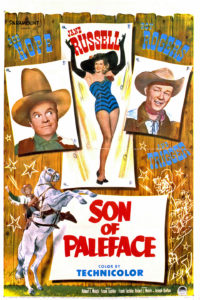
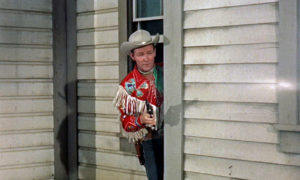 From 1935-98, Roy Rogers made 116 movies, which is staggering even realizing many of the “features” he made at Republic average 60 minutes in length. Then there was The Roy Rogers Show on TV in the early 1950s, after Republic had folded. Let us not forget his terrific co-starring role with Bob Hope in 1952’s Son of Paleface. Seven years later was that Hope comedy-western in which Roy made a memorable cameo appearance, Alias Jesse James. His scene is toward the end when he appears out of nowhere to help star Hope’s character fight the bad guys. Rogers levels his pistol at a varmint about to shoot Hope. He fires and connects, commenting, “And happy trails to you!” It is a perfect zinger from the hero of heroes.
 About the time Alias Jesse James was released, Roy Rogers moseyed into Kansas City, Kansas. He and his entourage were appearing somewhere in Greater Kansas City—undoubtedly singing (exact details unknown)—and staying at the gone-but-never-forgotten Town House Hotel in downtown KCK. It was then, in the late afternoon, that Jackie Heffley got a phone call. She and her late husband Rex ran the Ranch Bowl (bowling alley, that is) at 5604 State Ave.
“One of Roy’s men called, telling me that Roy and and his friends were wanting to rent the bowling alley after midnight.” She does not remember the exact date, but does recall that the voice said that Roy wanted to “unwind by bowling,” and would privately bowl for a couple of hours. The Heffleys were stunned, but immediately agreed to the arrangements.
“Roy and 67 other men came down and bowled a couple of hours,” Jackie said. “The had a good time.”
Was Roy Rogers a good bowler? Jackie said that she really does not know how he bowled that early morning. She just gave him the privacy he desired, treating him like any other bowling customer. “He was a very congenial, 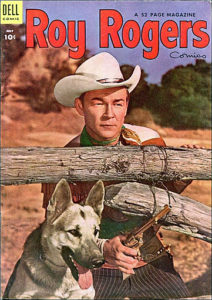 earthy person.”
Autographs or pictures with Roy? “No, we didn’t even think of pictures at all,” she said. “But he did autograph two plastic bowling pin banks we had there.” Did he bring his own bowling shoes? “Yes.” (I refrained from asking if his shoes had spurs.) Was Trigger or Dale Evans with him? “No.”
Jackie said that years later she realized just how much important bowling was to Rogers when she and her family toured his Roy Rogers Museum in Victorville, California. “There is an entire section devoted to Roy’s bowling trophies, team pictures and awards. He was a huge bowling fan, and was for years a Victorville Bowling Team member.
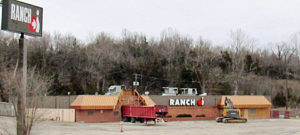 (UPDATE: The very aptly named Ranch Bowl was demolished in 2018. See photo.)
So the legend continues, and a King of the Keglers emerges. Happy strikes to you until we bowl again.
Yeah, I know—spare me.
Loretta Young’s death triggers childhood memories
Loretta Young’s death on Aug. 12, 2000 prompted this remembrance published in The Kansas City Kansan (Crum on Film) on Aug. 18, 2000.
 By Steve Crum
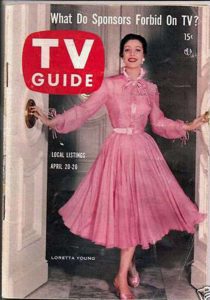
Loretta Young was a salvation for my sister and me throughout most of our pre-school through grade school years. Young’s death on Aug. 12 (at 87) reminds me that when Sunday evening rolled around, our baths finished, it was 9 o’clock bedtime. “But Mom, can’t we just stay up until Loretta Young is over?” This weekly plea invariably ended with my madre (who made decisions in matters of this magnitude) giving in. The dialogue was repeated week after week, year after year, during The Loretta Young Show’s sturdy 300 episode run, 1953-61.
To be truthful, in the beginning it could have been the New York Stock Market Report for which we pled. We just needed an excuse to stay up later. Mom realized our ploy, but knew that the show afforded us learning through entertainment. And that it did. We quickly grew to love it. The Loretta Young Show, thanks in full to its namesake, featured half hour stories of human compassion. It was an uplifting and inspiring series as well as class production. Young starred in a majority of the episodes, playing a challenging gamut of roles. Her three Emmys and two Golden Globes are testament.
 Loretta Young has long forbade that her old series be rerun, due to the fact that each episode begins with her showcasing what was then a chic dress as she twirls through her entrance door to greet the home audience. She thought that modern audiences would laugh at the way she was dressed. Maybe so. More likely the black and white filming might turn some audiences away. Then again, Perry Mason, I Love Lucy and The Fugitive reruns are still strong draws. Quality is the key, and the endurance of Young’s series is evident within the handful of video tape copies that are commercially available. (By the way, during the first broadcast year, the show was entitled Letter to Loretta. Young would read an actual viewer’s letter, and tie it in to the evening’s program.)
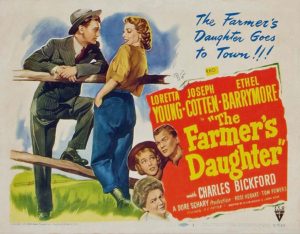
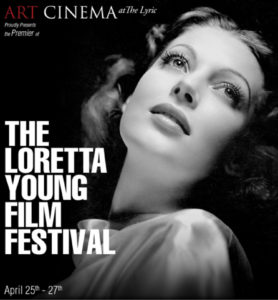 Growing up, and thanks to TV again, I discovered that Loretta Young was also a movie star. There was the film in which she played Sister Margaret in the moving Come to the Stable (1949), for which she was Oscar nominated. In the Christmas classic, The Bishop’s Wife (1947), Young dealt with heavenly Cary Grant. Her 105 movies were varied in plot and characterization. For example, Young could play light comedy brilliantly, as she did in her Oscar winning role as Swedish farm girl-turned-congresswoman in 1947’s The Farmer’s Daughter. She sparred with Gary Cooper in the comedy-western, Along Came Jones (1945); and in a more romantic way dealt with suitors William Holden and Robert Mitchum in the delightful Rachel and the Stranger (1948).
From small child roles in 1917 silent movies (she was born in 1913), to her last work as narrator in 1994’s TV movie Life Along the Mississippi, Loretta Young earned her film star 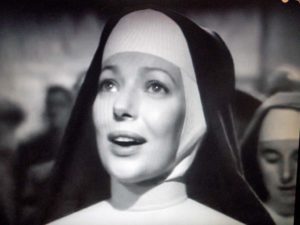 status. She was also one of the very first successful TV stars to embrace the new medium in place of continuing a big screen career.
The great actress, born Gretchen Michaela Young, positively impacted fans via TV and movies for more than 70 years.
On a personal note, she helped me lose a half hour’s sleep every Sunday night of my youth. I am forever thankful.
LISTEN! In the CD player! It’s neither a bird nor a plane. It’s ’Adventures of Superman’ soundtrack music!
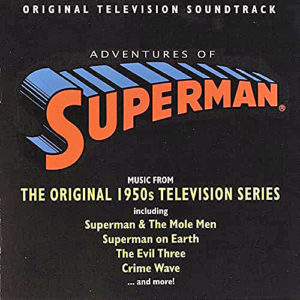
My review of the then newly released CD featuring soundtrack music to the 1952-58 TV classic, Adventures of Superman, was published in The Kansas City Kansan (Crum on Film) on April 7, 2000…a bit over two decades ago.
 By Steve Crum
Lois and Jimmy jump into the ’53 Nash (“Hit and Run” theme up), unaware of the hooded thug crouching in the back seat. (“Quiet Tension” theme insert.) They have been given strict orders by Editor Perry White to bring back an exclusive interview with Waldo, the eccentric inventor of a “mind machine.” (“Shadows on the Wall” theme excerpt here.) Now their fate—and the fate of the powerful invention—is jeopardized. This is a job for…SUPERMAN! (“Superman Theme” up.)
Action and music went hand-in-cape in the 1950s TV series, Adventures of Superman, which is perhaps the preeminent and most memorable TV show for baby boomers. Video copies of the original 104 episodes, including the glorious first season’s 26, have been in collectors’ hands for years. I have a few dozen myself. (2020 NOTE: All episodes have since been released in multiple boxed sets.)
 But the music is another galaxy altogether…until now. And thank you, Varese-Saraband recording company. With bullet speed, the CD, Original Television Soundtrack Adventures of Superman (VS302-066-093-2), has arrived on retail earth. Make that a slow motion bullet, since it has taken nearly 50 years to happen. Nonetheless, the single light blue disk, emblazoned with the familiar Superman logo, contains 72 minutes of original soundtrack themes. The vintage recordings are in super (forgive me) condition with crystal perfect mono sound.
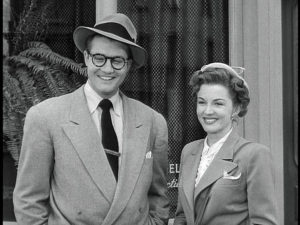
The 35 tracks have titles like “Shadows on the Wall, “Blood and Thunder,” and “The Skeleton,” evoking moods and theme cues that were edited into each half hour Superman story. (There is an extra 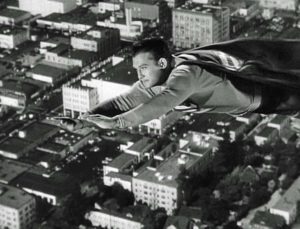 surprise track with dialogue and music included. You have to hear it to believe it.) I cannot full express how deeply this music touches and moves me after all these years. Each selection triggers a long embedded memory that I obviously stored when I was that little Crum kid with a towel tied around my neck (my Superman cape). Picture me grooving on the sights and sounds of George Reeves, Noel Neill and Jack Larson. (Of course, as any true Supie fan knows, the best Lois Lane was portrayed during the first season by the gritty Phyllis Coates.)
 Until I listened to this set, I had no idea of how deeply this series still affects me. Excuse my naked revelation, and pardon my passion. But honestly, I almost tied a towel around my neck again during playback.
Adventures of Superman was a one-of-a-kind series in several aspects. For one, no series before or since utilized music like this one did. Almost every second is filled with musical themes. From the liner notes: “This CD celebrates a landmark TV series and one of the most familiar background music libraries of the 1950s.”
That library reference also makes this CD a gotta-have. The music was not only used for Superman themes, but many low budget TV series, individual shows and B-movies of that era. Taken from Mutel Library originally compiled by  Mutel’s company founder David Chudnow, the music has no known composer. Even the musicians have never been identified. To avoid a musicians’ union lawsuit in the late 1940s, Mutel’s music was recorded in Europe. Anonymity was necessary, since there was an urgency for cheap, available and very adaptable background music in early TV. Adventures of Superman became identifiable with these generic sounds. (The name Mutel is taken from Music for Television.)
The famous “Superman Theme” itself was composed by Leon Klatzkin, and orchestrated and recorded in New York by Jack Shandlin in 1952. Its similarity to the Mutel cues is striking, but then again Shandlin was hired by Chudnow.
Fly, do not run, and swoop up this disk. (GRADE: A)