
Slow paced ’On the Rocks’ is tailor-made for Bill Murray
 By Steve Crum
In her 2002 Lost in Translation, Sofia Coppola cast Bill Murray as Bob Harris in a midlife crisis role. The producer/director/writer has now recast Murray as a gray haired, wealthy divorcee in the dramedy On the Rocks. Murray’s Felix Keane is older but not much wiser as he doles out lovelorn advice to anyone who will listen. It is not a blessing when the object of such is now his adult daughter, Laura (Rashida Jones).
Specifically, Laura and husband Dean (Marlon Wayans) are an upscale Manhattan couple with two young kids, Maya and Theo. Laura is a struggling novelist while her husband is beginning to rise to  the top of his tech start-up. Since he is increasingly out of town for business trips, Laura assumes the role of stay-at-home mom. Things change when she sees a change in her husband as the passion seems to be dwindling from their relationship.
Her suspicions really rise after she confides her misgivings to her estranged father, who happens to stop by to visit when Dean is away. Of all people to offer marital advice, her father should be the last person to do so. He has a history of infidelity, yet he claims to know women (and men) better than anyone. Just ask him. It is here that Bill Murray really sparkles. He is Mr. Smooth, who dishes out advice and flirts with virtually every lady (including waitresses) he encounters. Yet he believably pulls it off in a way catered to Murray’s demeanor. It is pretty hilarious at times. Even his daughter, who ought to know  better, falls under his spell and goes along with him as he convinces her that husband Dean is cheating on her.
Coppola’s script is a tight 96 minutes, yet ambles on at a slow pace. It turns out that there isn’t really too much to the story, but Murray’s eccentric, charismatic presence sells it. The charming Felix will even arise and burst into song without the drop of any hat at a restaurant. The classic Theme to Laura is his fav. (Who else but Bill Murray could get away with harking back to his lounge singer schtick from his days at Saturday Night Live?)
What happens to Laura—as well as her father—involves pursuit and investigation. Consider them amateur detectives. Along the way, the pairing of introvert Laura and extrovert Felix nears explosion.
 Laura: ”Do you really have to make such a big entrance everywhere you go?”
Felix: “What happened to you? You used to be fun.”
There is obviously a multiple meaning to the title, On the Rocks.
∞∞∞∞∞
GRADE on an A-F Scale: B
Hanks’ stunning, underplayed performance highlights western, ’News of the World’
 By Steve Crum
Unless one wrongly counts his voiceover as the Sheriff Woody doll in the Toy Story series, Tom Hanks has neither made nor starred in a western movie. Until now. Until News of the World, a tender and heartfelt Texas-set tale that showcases yet another solid Oscar worthy performance from Hanks. It is a stunning turn due to Hanks’ underplayed, character driven demeanor.
Directed and co-written by Paul Greengrass (United 93, Captain Phillips), the film is based upon Paulette Jiles’ novel, News of the World. Regarding the movie, what an absorbing 118 minutes.
Hanks portrays Captain Jefferson Kyle Kidd (yes, he’s Captain Kidd), a widowed Civil War vet who makes his living traveling by horseback from town to town in Texas, delivering the news to paying folks who are starved of such. The date is 1870, when few towns even have their own newspapers. That includes Wichita Falls, where the story opens. Kidd carries a dozen or so national newspapers of recent publication that he has perused and organized in a sort of “best of” order. But he does not merely read headlines and leads to stories. Instead, Kidd summarizes the most sensational (like a Pennsylvania mining cave-in) or humorous, and presents them as either funny stories with punchlines or human dramas with payoff conclusions. He is essentially a storyteller, and he is masterful—judging from his enthralled listeners who hang on every word and react with laughter, cheers, and applause. What an incredibly unique way to make a living. It turns out to be pure theatrics via truths: Walter Cronkite with a Shakespearean twist. Kidd’s style is impeccable.
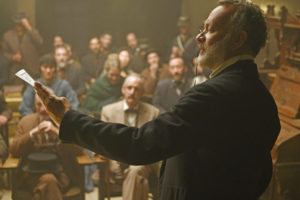
Incidentally, his performance occurs inside a cozy building—not outside on a medicine wagon or the like.
On the road to yet another town, the rather sullen Kidd comes upon the ghastly site of a hanged man near an overturned buckboard. Crouching in fear not far away is a blonde, 10 year-old girl in buckskins, Johanna Leonberger (Helena Zengel, in an impressive performance). She only speaks the Kiowa language because she has lived with them for years—after they killed her parents.
It is here the story shapes, as the two travel en route to Johanna’s aunt and uncle (listed in a document found on her buckboard). Along the long route to the other side of Texas, stops are made so Kidd can make his living delivering the “news of the world.” As they become more comfortable with each other, there are violent encounters with various ruffians.

Speaking of ruffians, another stop Kidd and Johanna make is at a populated tent city remotely located on the prairie. What occurs there is a heated discussion regarding what is real news. The camp’s despotic leader publishes his own “news,” and violently rejects stories found in any of Kidd’s newspapers. More than a bit timely, eh?
Encounters involve man vs nature as well as man vs man.
A positive turn occurs when Kidd stops at friend Jane’s boarding house to visit. Mare Winningham’s Jane is welcoming to both the girl and old friend Captain Kidd. And she speaks the Kiowa language. But the sequence is brief, as the two travelers soon move on.

No spoiler here, but the film’s conclusion packs an emotional wallop.
Throughout, the message of love, trust and compassion prevail. James Newton Howard’s score complements the rich flavor of the late 1800s Panhandle, complete with banjo and orchestra.
Like the news presented by Kidd, News of the World grabs us with irony, drama, and humor—revered qualities anytime, but especially during today’s challenges.
∞∞∞∞∞
GRADE on an A-F Scale: A
Terrific acting from all-star cast, crackling Sorkin dialogue describe ‘The Trial of the Chicago 7’
 By Steve Crum
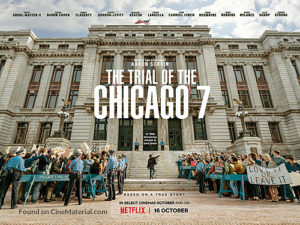
That cliché of history continuing to repeat itself lives on in writer/director Aaron Sorkin’s eventful historical legal drama, The Trial of the Chicago 7. That is because elements of 1969 and ’70 are so akin to today’s disruptive times. Sorkin (The West Wing, A Few Good Men) has written an absorbing account of what many call a “show trial” that lasted several months.
The U. S. Federal Court charged seven antiwar activists for inciting a riot at the 1968 Democratic Convention in Chicago. Actually, eight were originally charged until Bobby Seale successfully had his trial separated from the others. Simple  math renamed the defendants “The Chicago 7.” While the outcome of the trial resulted in acquittals for conspiracy, Judge Julius Hoffman’s contempt of court charges against all on trial racked up hefty sentencing. Not to give away too much, his charges were later reversed. So much for your American history lesson.
Kudos for Sorkin and particularly editor Alan Baumgarten for compressing the preceding into 130 minutes of crackling dialogue and courtroom drama that is both tense and shockingly funny. We have the defendants: Abbie Hoffman (played by Sacha Baron Cohen), Jerry Rubin (Jeremy Strong), David Dellinger (John Carroll Lynch), Tom Hayden (Eddie Redmayne), Rennie Davis (Alex Sharp), John Froines
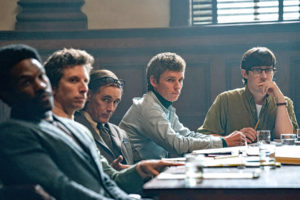 (Daniel Flaherty), Lee Weiner (Noah Robbins), and Bobby Seale (Yahya Abdul-Mateen II). From the get-go, Seale wants to be separated from the others since his actions in Chicago were totally apart from the others.
Representing the government is prosecutor Richard Schultz, portrayed by Joseph Gordon-Levitt.
Obviously representing the government as well is the anything-but-impartial Judge Julius Hoffman (Frank Langella). Langella’s wild and crazy judge dominates courtroom sequences. Note that there are numerous flashbacks that illustrate defendants’ testimony, covering plans for their protests to what occurred during the protests. Interspersed is actual footage from 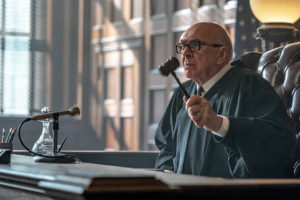 the Chicago riots.
The trial itself becomes a mini-riot of sorts—with a wacko judge who continuously mispronounces everyone’s names and demands order. He overrules the defendants so much that at one point he yells, “overruled,” before anyone has ruled.
Contrast him with Bobby Seale, who disrupts court so often with screaming at the judge that he is gagged and shackled. Then you get the Abbie Hoffman/Jerry Rubin stunts such as wearing robes in court as “homage to the judge.” Remember that this trial went on for months.
 There are also fascinating sequences of the defendants talking out strategy in the backroom during breaks. Incidentally, their counsel, William Kunsler, is impressively played by Mark Rylance. And do not overlook the fine cameo by Michael Keaton as Ramsey Clark.
Quoting Aaron Sorkin in Entertainment Weekly: “Protests got demonized as being un-American, Marxist, communist—all things they called the Chicago 7. Watching recent coverage of protesters clashing with police, all you had to do was degrade the color a bit and it would look exactly like the footage from 1968. The movie is not intended to be a history lesson, or about 1968—it’s about today.”
The Trial of the Chicago 7 is must-see.
∞∞∞∞∞
GRADE on an A-F Scale: A
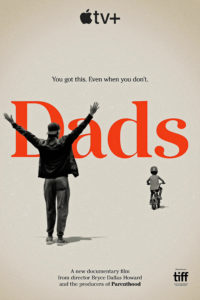
‘Dads’ lovingly celebrates fatherhood via 19 papas, including celebrities
 By Steve Crum
How much more apt than to title a documentary about dads, Dads? Okay, so it could have been called Fathers as well. But Dads has a much more informal, loving inference.
That pretty much sums up this review of Dads: informal and loving. Of course, there is more to it.
In her directorial debut, actress Bryce Dallas Howard (Jurassic World) features 19 celebrity and non-celebrity fathers sharing experiences in raising their children. Representing real life, there are single and married dads, gay and hetero dads, and fathers of mixed ethnicity. In Howard’s words, the film “allows us to see the heart of a father.”
Indeed it does just that.
Some of the fathers reflect on their own fathers. The Tonight Show’s Jimmy Fallon labels his dad “a hero,” while director  Howard praises her dad, director/actor Ron Howard, with memories of inclusiveness and love. In turn, Ron vividly recalls his father, Rance (a professional actor), with appreciation. Rance is interviewed as well, but died before the film’s release.
Incidentally, it is no surprise that a good chunk of this 81-minutes movie is devoted to the Ron Howard clan, including his son Reed—who is also a father.
One dad, whose lifestyle is as a stay-at-home parent, shares that his situation “has given me a whole new identity.” Seeing one of these fathers trying to maintain control of two or three  toddlers at the same time seems pretty challenging. Make that harrowing.
Celebrity papas also include Judd Apatow, Neil Patrick Harris, Ken Jeong, Jimmy Kimmel, Hasan Minhaj, Conan O’Brien, Patton Oswalt, Will Smith, and Kenan Thompson.
The story line of one non-celeb dad covers participating in the pregnancy to birth days. Included is the announcement of pregnancy to water break/birth…to baby classes taken…to first time holding a baby…to installing the car’s baby seat…and to a parent’s sleep deprivation.
“There is this incredible realization you’re not the most important person in the world,” said Conan O’Brien.
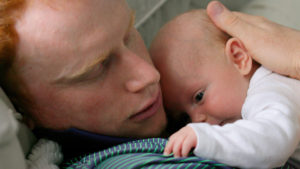 Then there is the child born with health issues, and the sacrifices of a father—indeed both parents.
One Brazilian father started a podcast with two other dads discussing fatherhood. In the process, he found his real dad.
“I think the house husband is still a minority,” said one single dad with a child. This is something I experienced nearly 40 years ago, when I was a single dad via divorce who spent a year in court fighting for my right to be the primary custodian of my 3 year-old daughter.
Thankfully, I won the case, if “won” is apropos. There are more single dads parenting kids today, but a stigma still exists.
“Having a kid is the meaning of life,” said Fallon. Indeed.
And Bryce Dallas Howard’s Dads is a joyful, tearful, happy discovery of the re-defining of fatherhood.
∞∞∞∞∞
GRADE on an A-F Scale: A
Protecting The North Atlantic during WWII with Tom Hanks & his destroyer(s)
 By Steve Crum
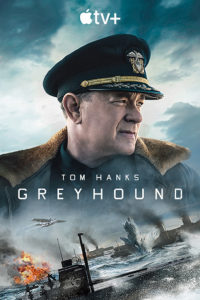
During WWII and for at least a decade thereafter, there were dozens of movies set aboard a submarine or destroyer—often featuring both as adversaries. Since then, 1981’s Das Boot is definitely the most celebrated U-boat film. Now comes Greyhound, a fact-based, above average WWII adventure pitting a destroyer vs a sub.
Based on C. S. Forester’s book, The Good Shepherd, Greyhound centers on the USS Keeling, a Fletcher-class destroyer (with radio call sign “Greyhound”), helmed by Commander Ernest Krause (Tom Hanks) of the U. S. Navy. Greyhound is one of four destroyers charged to escort and protect 37 Allied troop and supply ships heading to Liverpool. Commander Krause is also in charge of the other escort ships, even though this is his first wartime command. He accepts the challenge with humility, respect, and his Christian faith. (He often quotes scripture.)
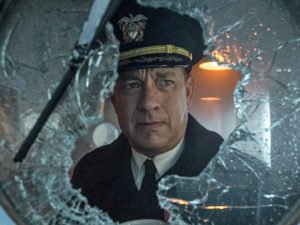 It is a fine performance which Hanks effectively underplays. Note that Hanks also wrote the screenplay adaptation. Aaron Schneider (Two Soldiers; Get Low) directed.
The unique visualization is credited to cinematographer Shelly Johnson, whose rather tricky balancing is realized by editors Mark Czyzewski and Sidney Wolinsky. By that I mean the obviously digitalized rough Atlantic waters with the convoy ships have to seamlessly blend with Krause and his crew onboard the Greyhound.  Critics have complained of the computer game look, but it works well. The far away overview of grim sky just adds to the flint-gray look of ships amongst churning sea water.
When the convoy enters the “Black Pit,” unprotected waters minus any air support, the film’s action ensues. It becomes the escorts versus the wolfpack of German submarines—seven of them. It is the proverbial cat and mouse game: depth charges, torpedoes, maintaining silence to avoid Sonar, heavy artillery, and widespread 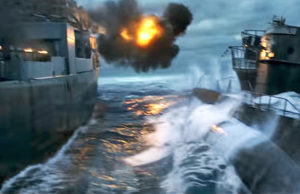 destruction. We have seen this before in naval war flicks, but Greyhound is an exception. We get to know the Greyhound’s officers and men. However, we never see anyone connected to the submarines.
Greyhound is a single-viewpoint tale. I kept thinking of 1957’s classic Robert Mitchum/Curt Jürgens destroyer/submarine film, The Enemy Below, wherein there is a juxtaposition of the American and German captains and crews. The two captains even meet face-to-face at the end!
 Featured in the Greyhound cast are Stephen Graham as Krause’s Executive Officer, and Rob Morgan as the Mess Attendant. Elisabeth Shue is briefly shown in a couple of flashback sequences, portraying Krause’s love interest back home.
Running a tight 91 minutes, Greyhound is a tense, nearly non-stop actioner.
∞∞∞∞∞
GRADE on an A-F Scale: B