
Cowboy flick ‘The Harder They Fall’ bizarrely mixes western cliché with hip hop
 By Steve Crum
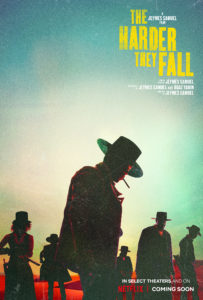
I know western movies. Believe me. The Harder They Fall is unlike any western ever produced. Yet, it is LIKE so many of the westerns. What a paradox. That is because this revisionist work takes so much from a slew of the genre’s memorable moments. To say The Harder They Fall is cliché is putting it kindly. It is upfront and in your face a parody of Sergio Leone oaters, particularly The Good, The Bad and The Ugly and Once Upon a Time in the West.
And a virtually all black cast is featured.
Don’t get me wrong, this film is no comedy spoof. Outside of a couple of humorous touches, it is not even tongue in cheek clever. Blatant mirroring is more like it. THTF is big budget production that obviously spent a ton of money on gunshot squibs and digital graphics—buckets of blood splatter, an obvious take from 1969’s The Wild Bunch carnage.
Let’s consider the plot line before exploring more nuances. The Harder They Fall opens some time in the late 1800’s in an undisclosed western town. The local preacher sits down for Sunday dinner with his wife and young boy. Bad guys invade his residence, killing the reverend and his wife in front of their traumatized son. Years pass, and the grown son, Nat Love (Jonathan Majors), is on a quest to hunt down and kill his family’s killer, gang leader Rufus Black (Idris Elba).
Enter REVENGE, a basic cowboy movie plot device. Remember Harmonica’s (Charles Bronson) vengeance in Once Upon a Time in the West (1968) as he pursues Henry Fonda’s Frank for killing his father? Look for closeups of squinty eyes in THTF too.
As Act II progresses, the primary characters multiply to the point of confusion. Love, 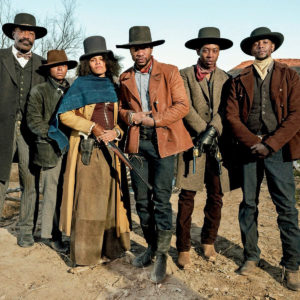 now an outlaw, teams with Bill Pickett (Edi Gathegi) and Jim Beckwourth (RJ Cyler) in more robberies and ambushes. They stop by the saloon of Stagecoach Mary Fields (Zazie Beetz), Love’s ex-lover. And on and on it goes as more characters are introduced. The convoluted plot includes the elder Marshal Bass Reeves (the always good to see Delroy Lindo), who arrests Love. Add to that the town boss, Escoe (Deon Cole); Regina King’s Trudy Smith; Cherokee Bill (Lakeith Stanfield); Cuffee (Danielle Deadwyler); and Damon Wayans Jr. as Monroe Grimes.
It is a hefty cast of capable actors—and they are all portraying Old West, African American heroes, heroines and outlaws who actually existed. (However, they probably never crossed paths, having lived in different time periods and locations.) That alone makes the movie unique.
THTF rapidly turns into a faction vs faction, gang vs gang flick. To drive the point home, why not include “mother f” dialogue with references to “Crips and Bloods”? Why not add a character sporting gold teeth as in 1980s’ 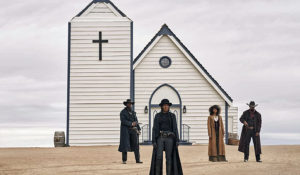 inner city gangster? At least Love chews on a cigarillo a la Clint Eastwood.
The shootouts, knifings, and beatings go on and on for 139 minutes…accompanied by a mixed music score of Hip-Hop, gospel choir, semi-classical majesty, and pop. Style half of it by way of copying Ennio Morricone, Sergio Leone’s favorite composer.
Stir in a big pinch of religion to the batter with Nat Love’s quest for revenge tempered by a crucifix that has been carved into his forehead.
A strange amalgam is The Harder They Fall.
The film’s creator—in nearly all aspects—is Jeymes Samuel. He wrote the story basis, co-wrote the screenplay, co-produced it, and directs. Egad, Samuel outdoes does Orson Welles by also composing the score—and what a bizarre combo of sounds he has created!
Camp or otherwise, The Harder They Fall is more so a Guinness Book inclusion than a significant western film.
——-
GRADE on an A-F Scale: C
Must-see ’No Time To Die’ packed with James Bond spectacle, melodrama
 By Steve Crum
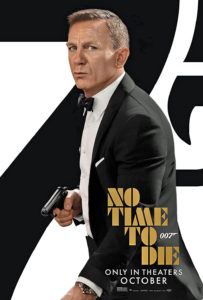
Writing a review of the latest and arguably the greatest James Bond filming ever, No Time To Die, easily qualifies as an exercise in exclamatory adjectives. Stunning, yes. Memorable, indeed. Add a near nonstop adrenaline rush. Whew, yes.
This Bond, #25 since the franchise began in 1962 with Dr. No, is a treat for so many reasons. That includes a multitude of spoilers, making it difficult review fodder. I aim not to give away too many plot twist jolts.
That is not to say that the screenplay (Neal Purvis, Robert Wade, and Phoebe Waller-Bridge) is entirely off limits to revealing many of its pleasures and nuances. (First time Bond director Cary Joji 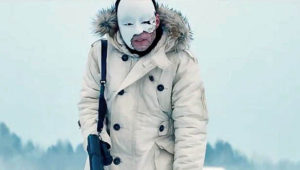 Fukunaga also receives screenplay credit.) Might as well also applaud Hans Zimmer’s score, Linus Sandgren’s stunning cinematography, and the editing (Elliot Graham and Tom Cross). More on these facets later.
No Time To Die’s opening sequence should give us a clue that this is not a typical James Bond escapade. Instead of Bond in pursuit or parachuting off a mountainside, he is nowhere in sight. Instead we get a flashback of young Madeleine Swann witnessing the brutal murder of her mother by terrorist Lyutsifer Safin (Rami Malek)—who is the featured villain of this film. Bad guy Ernst Stavro Blofeld (Christoph Waltz), last seen in 2015’s Spectre, also has a daunting appearance later in NTTD.
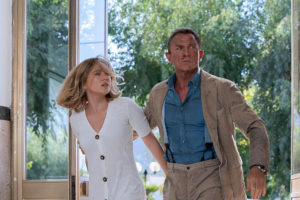 To play catch-up, the adult Madeleine (as in Spectre) is portrayed by Léa Seydoux. She was Bond’s love interest in that film, and remains so here.
Much has happened since James Bond and Madeleine were together. Commander Bond is contentedly living in Jamaica, retired from Her Majesty’s Secret Service, seemingly enjoying bachelorhood. Madeleine is living elsewhere with her five year-old daughter. (James and Madeleine do reunite soon after.)
In the meantime, there are contracts out for Bond’s demise by both Blofeld (now in prison) and Safin. Bond is forced back into action as an agent, despite the fact that he 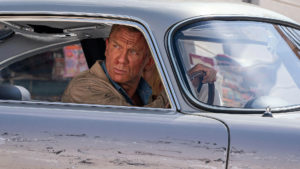 no longer has a “license to kill”; and another agent, Nomi (Lashana Lynch), has assumed not only Bond’s place in M16, but his 007 moniker.
Add to the nefarious plot that Safin’s plan is to dominate the world with a lethal DNA compound that is spread by touch.
The typical Bond movie stunt work is on hyper here, from a car and motorcycle pursuit…to tiptoeing through a remote island “poison garden”…to Bond’s spectacular onslaught of what seems to be 50-plus of Safin’s goon squad. Kudos to the editing, direction and cinematography. The pace is exhausting but awesome. As usual, Daniel Craig’s impressive physicality exceeds any previous Bond actor.
Returning for this final Craig outing as Bond are Ben Whishaw as Q, Naomie Harris as Eve Moneypenny, Jeffrey Wright as Felix 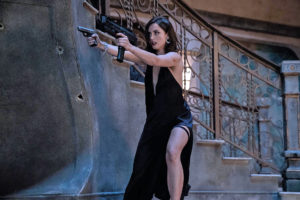 Leiter, and Ralph Fiennes as Gareth Mallory/M.
Noteworthy for her acting chops, beauty and fighting prowess—as she assists Bond, is Ana de Armas as Paloma, a CIA agent.
No Time To Die grabbed this Bond fan from the opening music, which is surprisingly not by Hans Zimmer. Instead it is John Barry’s theme (his best Bond theme), “We Have All the Time in the World,” from On Her Majesty’s Secret Service. The end credit roll replays Louis Armstrong’s vocal from the same 1969 flick!
While it is damn near impossible to top 2012’s Skyfall as the ultimate Bond film, No Time To Die equals it. Deep breath. OK, exceeds it. The grandiose, super spoiler finale carries it over the line into Ian Fleming legend.
——-
“James Bond Will Return,” says the familiar scribe following the end roll. This time, that line will provoke serious discussion on the way to the parking lot.
——-
GRADE on an A-F Scale: A
Putting the squeeze on & pulling apart tacky TV networks
 By Steve Crum
GROUSE TIME.
Randomly clicking through my many cable channels the other day, I decided to revisit a (classic) rerun on a Johnny Carson “Tonight Show” episode. I had not been there for the last couple of years, since I think I watched all of them during their first run on ANTENNA-TV. I hit a jackpot of an episode: guest Jimmy Stewart reading a poem about his old dog.
It took me three seconds to figure out what was wrong with this episode since I saw it originally on NBC-TV as well as on Antenna years ago. JAMES STEWART AND JOHNNY CARSON HAD GAINED 30 POUNDS EACH! Their old TV width images were now stretched to fit the wide  screen ratio of our large flat screens! Unfrickingbelievable!
More remote clicks brought me to other channels, essentially free-to-air broadcasts, but also carried on Spectrum. BOUNCE-TV, a decade-old station targeting Black Americans, also stretches its non-widescreen  images of “The Bernie Mac Show” and other sitcoms.
On the flip side, LIGHT-TV (aka THE GRIO-TV) & THIS-TV use the wrong lenses,  vertically squeezing the movies and TV shows to make everyone appear at least 30 pounds thinner! Egad, to say the least! Their heads appear to have been victimized by a vice.
The popular old folks channel, ME-TV, has been slightly stretching original image widths via chopping off the tops and bottoms of classic sitcoms and dramas for years in an effort to fill the viewers’ widescreen TVs. In any event, the viewer does not truly see the original images. But does it matter to most ME-TV viewers? I have  a sad feeling it does not. I know many viewers who care only about
“filling up the screen,” no matter if anything is edited or stretched.
But it does matter to me! I am a purist. I also do not appreciate colorizing black and white movies and TV shows.
Yes, one can readjust the new flat screen TVs to compensate for the disparities in aspect ratios. BUT you lose picture sharpness and quality. Plus it is a hassle.  A solution is to write or e-mail the stations’ owners and protest how they are undermining their viewers.
OR just do not watch these technologically lame channels. They will get the hint, maybe.
Sadly, as long as their multitude of advertisers keep supporting them, nothing else probably matters.
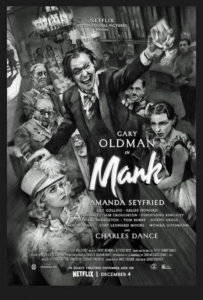
‘Mank’ brilliantly covers movie history via ‘Citizen Kane’ & Hollywood politics; Gary Oldman stuns
 By Steve Crum
Herman J. Mankiewicz aka “Mank” (1897-1953), the titular focus of the fascinating film Mank, was a major writing force in Hollywood—even though not always credited as such. It was almost that way with his Oscar winning screenplay for 1941’s Citizen Kane. The classic movie’s backstory is covered with penetrating detail in Mank.
The only drawback is the film covers Hollywood history unfamiliar to most moviegoers. It’s pretty inside. Others—like yours truly—will savor every minute.
The 131-minute film, directed by Oscar nominated David Fincher (The Curious Case of Benjamin Button, The Social Network), pays considerable homage its plot focus, Citizen Kane. That includes frequent flashback sequences, some attention to the Orson Welles use of camera angles and closeups, and shooting in black and white. As with Citizen Kane and other era films, night scenes were shot during the day (called “day for night”) and darkly filtered to imply night. Modern digital cameras have made it possible to film in near darkness.
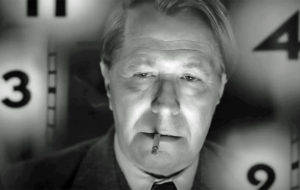 Fincher and his cinematographer, Erik Messerschmidt, were painstaking in the their successful effort to simulate/duplicate the visuals of Citizen Kane’s 1941 look.
In this respect, bravos go to editor Kirk Baxter and screen scribe Jack Fincher. Interestingly, Jack Fincher wrote the screenplay in the late 1990s, when his son David was originally planning to produce Mank. Sadly, Jack died in 2003.
But now Mank is finally produced, telling the fascinating and often disturbing story of Herman Mankiewicz’s association with Orson Welles in the production of what many consider the greatest film of all time, Citizen Kane. As depicted in Mank, Welles (Tom Burke) has been complete freedom to film whatever he so desires at RKO. (Oddly, there is little if no mention of why he has such carte blanche. It was because he had made international news with his War of the Worlds radio sensation.) Welles was the “boy genius,” and he chose Mankiewicz to write a scathing, brilliant epic about publishing magnate William Randolph Hearst—disguised as Charles Foster Kane.
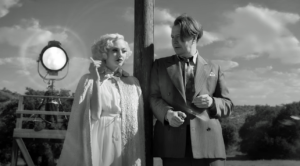 After all, as told in flashbacks, Mankiewicz had been a friend of Hearst’s lover, Marion Davies, for years. He was also a frequent guest at Hearst Castle, so he knew the man quite well. (Davies is portrayed by Amanda Seyfried; Charles Dance plays Hearst.)
It was no surprise that Hearst fought against the release of Citizen Kane, and even had a ban on advertising the film in his newspapers and magazines. (It suffered financially, but not critically—in non-Hearst media.)
Mank’s focus is on the struggles of Herman Mankiewicz as he constantly deals with alcoholism while trying to meet script deadlines. In the process, he encounters the likes of MGM’s head, Louis B. Mayer (Arliss Howard),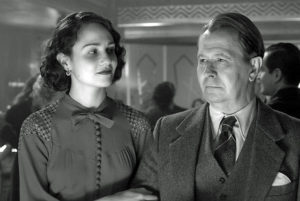 producer (and much later actor) John Houseman (Sam Troughton), and Irving Thalberg (Ferdinand Kingsley). On a lighter note, look for Bill Nye (“The Science Guy”) as writer and political activist Upton Sinclair.
Very closely involved with Mank’s health and well being are his wife Sara (Tuppence Middleton) and brother, writer/director Joe Mankiewicz (Tom Pelphrey).
A particularly memorable scene involves a drunken Mank crashing a costumed dinner party in the great dining 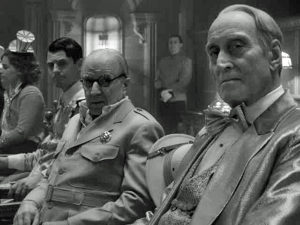 hall at Hearst Castle, and creating a scene that includes broken glass, embarrassment, anger, and vomiting. How much this sequence is based on fact is speculative unto itself. However, it is believable.
Above all else in Mank, super kudos go to the remarkably talented Gary Oldman, who stuns as Herman Mankiewicz. Oldman has never gotten the deserved credit for his ability to convincingly portray a wide range of personalities. From Count Dracula to Winston Churchill to Beethoven to Sid Vicious to Lee Harvey Oswald, the Oscar winning Oldman became them in total. In 106 movies and TV shows, he gets my vote for the most transformational artist in movie history. That includes the brilliant work of Lon Chaney Sr., Christian Bale, Paul Muni, and Daniel Day-Lewis.
At the very least, when Mank is released on DVD, it should be paired with Citizen Kane in a boxed set. Each would complement the other.
∞∞∞∞∞
GRADE on an A-F Scale: A-
‘The Life Ahead’ showcases Loren & Gueye in intense human drama
 By Steve Crum
The other day I rewatched a favorite Sophia Loren film, Boy on a Dolphin, a literally colorful 1957 flick in which she co-starred with Alan Ladd. Loren was 23 then, and an emerging Hollywood star. Four years later, she had emerged big time with her Best Actress Oscar for Two Women. Now, after decades of accolades and awards for her movie work, Loren stars in The Life Ahead, her first feature since 2009’s Nine.
At 86 years, Sophia Loren returns in a triumphant, Oscar worthy performance.
In a rework of 1977’s Madame Rosa with Simone Signoret in the title role (based upon The Life Before Us by Romain Gary), Loren portrays Rosa, a 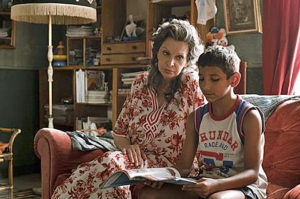 Jewish Holocaust survivor and former prostitute. Unlike Signoret’s French take, this Rosa is Italian—with English subtitles, by the way.
Loren’s son, Edoardo Ponti, both directed and co-wrote the screenplay.
The story involves the elderly Rosa, referenced as “Madame Rosa,” who has for years retired to a rather meager life of caretaking the children of local Bari, Italy prostitutes. (Filming was in Bari.) But she is content, and helps raise her wards with strict, often religious, conviction. In fact, one of her current two children is a Jewish boy Rosa teaches Hebrew.
 The plot focuses early on to a 12 year-old street thief/drug pusher named Momo, vividly played by Ibrahima Gueye. Madame Rosa crosses his path when he steals her bag in the plaza, and knocks her down. It is beyond a challenge when she reluctantly agrees with her kind Dr. Cohen (Renato Carpentieri) to take him into her home. Momo is an orphaned Senegalese immigrant child who has hardened to living on the streets.
Momo’s stubbornness to Rosa is adamant: “I don’t want to be like other kids!”
Various conflicts and hourly challenges occur as Momo maintains his street smarts behind the stern but loving  back of Rosa. Momo becomes comfortable around his new “family,” which includes a boy his age as well as a toddler girl. The girl’s mother, Lola (Abril Zamora), is Rosa’s best friend as well as a working woman of the street.
Rosa’s health takes a downturn, putting her in frequent catatonic states…and Momo’s stead slowly changes to caretaker. The transformation does not occur easily. Thanks to an incisive screenplay and sensitive direction, realism prevails.
Mention must be made of Babak Karimi’s sensitive portrayal of Hamil, a local shop owner who befriends Momo at 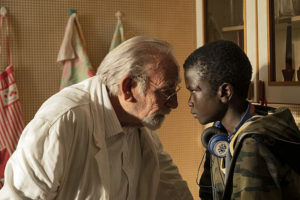 Rosa’s insistence.
The Life Ahead is a wonderfully crafted character study of Rosa and Momo, both of whom fight the inevitable sad truths of the world.
∞∞∞∞∞
GRADE on an A-F Scale: A-