
‘The Time Machine’: Is this trip really necessary?
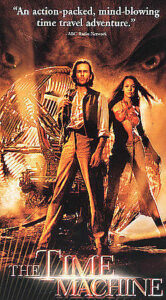 My review of the disappointing The Time Machine (the second version) was published in The Kansas City Kansan on March 9, 2002.
By Steve Crum
It does not take a time traveler to realize that the newest take on The Time Machine, which opened yesterday, will be forgotten in the very near future. And that is too bad, because on the surface, this production has a trio of pluses.
•First of all, Simon Wells, the real life great-grandson of H. G. Wells, directs. The elder Wells, of course, wrote the classic science fiction novel upon which this movie is based. This is Simon’s first live action effort, having helmed four animated features, including The Prince of Egypt. Interesting trivia: Gore Verbinski (The Mexican) took over the last 18 days of shooting when Wells collapsed due to “extreme exhaustion.”
•Second, the star is one of the notable young actors in Hollywood, Guy Pearce. His work in 1997’s L. A. Confidential is terrific. But he is nowhere near the necessary beefy and emotional presence of Rod Taylor, who starred in the 1960 original—directed by George Pal.
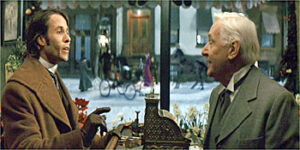 •The third plus involves a personal kudo—the inclusion of Alan Young. Young co-starred in the far superior ’60 version—in two different roles, no less. (Yes, this is the same Mr. Ed Young who played Wilbur.) Young does technically appear in this remake, and that is about all. He has a couple of lines of dialogue delivered in his unnamed character’s dimly lit flower shop. He did not own a flower shop in the earlier movie. The fact that neither of his original two roles is worked into this script is a grievous mistake. Why then include him at all? For old times sake? Please. For viewers who remember him with Rod Taylor, good luck in the confusion.
So what does The Time Machine, circa 2002, have going for it? There is a slight save when Orlando Jones’ Vox character appears as a 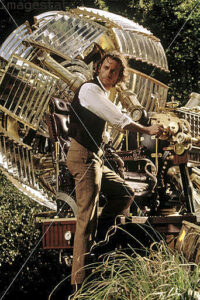 holographic librarian, a virtual encyclopedia. If only the rest of the film had any similar depth or humor.
Oh, there are the state-of-the-art special effects. The time machine itself is larger, has more valves and knobs, zaps concentrated light, and encompasses itself in a power sphere en route. (Remember that the machine never moves; the world moves around IT.) Is all this impressive? Not really. Give me the simplified original of 42 years ago. Then there are the digitals included in very dark sequences, set underground in the land of the Morlocks. (Morlocks are ape-like villains.) Scenes of the creatures being disintegrated are cheesy looking even in the semi-darkness.
Let’s continue to assume you are familiar with the 1960 plot. Both movies are set at the turn of the 20th Century when cars were far outnumbered by horses. This version’s central character, Alexander Hartdegen (Pearce), is a nebbish genius/inventor whose life seems changed when he falls in love. After his fiancé is killed in a botched robbery, he uses his untested time device to change history. Without spoiling too much, just realize there are complications.
Alex eventually decides to gyrate into the future, only a few years a time at first. As in Pal’s original, there are cool looking passage of time 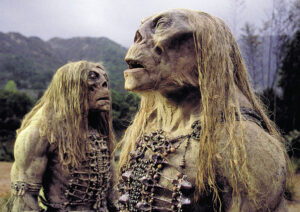 scenes of the sun and moon rising and setting in quick time. There are rapid fire dress changes on mannequins in a local shop’s window. Buildings rise, expand, fall, are rebuilt, and destroyed. There is an impressive overview shot of the entire city in metamorphosis over many, many years.
An accident causes the machine to veer some 800,000 years into the future, a time when fragments of an exploding moon have wiped out most of the earth. Alex lands in a country inhabited by passive cliff dwellers, the Eloi, and the underground cannibals, the aforementioned Morlocks. Amazingly, Professor Nerd morphs into Mr. Macho, and single-handedly lowers himself into Morlock city to rescue his begotten Eloi babe, Mara (Samantha Mumba). By the way, the vicious Morlocks in this version are not lumbering and green as in the original. These brown things leap and run on all fours like the apes in last year’s Planet of the Apes.
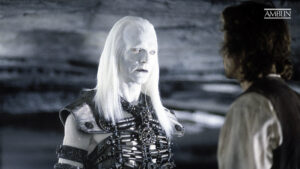 And what should one make of the underdeveloped and far too brief inclusion of Jeremy Irons as the albino Uber-Morlock? Looking and acting like a reject from the X-Men (or Johnny Winter on a bad day), this baddie even has super strength. He also has the ability to read and bend minds. Yet somehow he lets Pearce’s character outwit him. But I thought…that he thought….
Just don’t think.
Before you know it, this confusing and empty-hearted Time Machine has clocked on by. Consider it a bit of disappointing movie history that could easily be remedied by going back in time, and scrapping the very idea of a remake.
∞∞∞∞∞
GRADE on an A-F Scale: D
∞∞∞∞∞
‘We Were Soldiers’: Into the valley of death
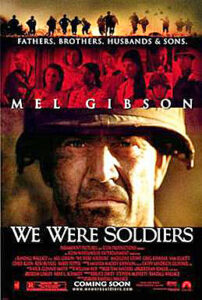 My review of “We Were Soldiers” was published in The Kansas City Kansan on March 2, 2002.
∞∞∞∞∞
By Steve Crum
Following a bloody battle, Mel Gibson’s Lt. Col. Hal Moore grimaces, “I’ll never forgive myself—that my men died…and I didn’t.” The heroic Moore is the central focus of We Were Soldiers, which opened yesterday. Expect a no-punches-pulled war movie, set in Vietnam, that will make even a ‘Nam veteran cringe at the violent realism. (I speak as a Vietnam era vet.)
War film realism was forever reshaped after Spielberg’s Saving Private Ryan, much as science 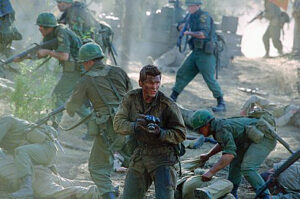 fiction movies since Star Wars have been influenced. The recent Black Hawk Down is an example of the former.
In director-writer Randall Wallace’s We Were Soldiers, based on a factual book, Lt. Col. Moore leads 400 Rangers into the first American battle of the Vietnam War. They have underestimated the North Vietnamese enemy strength, which is five times theirs. The ensuing fight is horrifyingly blood and, at times, seems destined to be a Little Big Horn for Wallace and his men. The fact is that Moore’s assignment is with the First Battalion of the Seventh Cavalry, the same regiment once led by Gen. George Armstrong Custer.
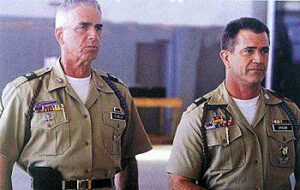 Early on, Wallace has nightmares that his destiny is akin to Custer’s, but is verbally slapped back into the reality that “you aren’t Custer, sir!” by his stern sidekick, Sgt. Major Plumley (Sam Elliott). Elliott, by the way, is superbly gruff in this film.
There is a lot to like about We Were Soldiers. Gibson’s inspired performance was chiseled from the real life Hal Moore, and the still very much alive Moore even oversaw all aspects of the filming—in person. Battle scenes are reportedly carbon copy true. I believe it; and thank God I was not there during the 1965 original.
Another plus of the film is the use of juxtaposition. At various times during battle, Randall jumps the story—in quick time—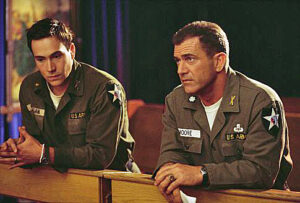 to the home front at Ft. Benning, Ga. We see Moore’s wife, Julie (Madeleine Stowe) who is literally her husband’s counterpart. It is her chosen (and wrenching) duty to personally deliver the telegrams fo death notification to the wives of the soldiers serving under her husband.
Those scenes, along with opening sequences of Moore playing and praying with his young children, as well as showing his obvious love for his wife, set the tone of the story. We are talking love of God, family and country.
Moore is everyone’s daddy in this film, and I don’t say that in a negative way—even though the movie is so clearly manipulative in its patriotism. Based on Joseph L. Galloway and Moore’s best seller, We Were Soldiers Once…and Young, Wallace’s screenplay is full of lump-in-your-throat hero-speak.
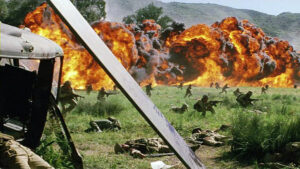 Moore, to his men before departure to Vietnam: “This I swear, when we go into battle, I will be the first to step on the field and I will be the last to step off. And I will leave no one behind…dead or alive. We will all come home together.” John Wayne would have fought a regiment to play Moore.
And won’t Moore’s words be remembered in movie history as much as the opening speech in Patton?
As in the book, the film humanizes the North Vietnamese…to a degree. They are given distinguishing personalities, like the soldier who looks at a picture of wife before battle begins. Scenes jump to and fro during the fighting, showing what strategies are discussed by both sides.
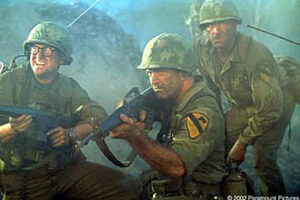 We Were Soldiers is not the first realistically violent movie about the Vietnam War. Platoon takes that dubious honor. Neither is it a jingoistic treatment like The Green Berets. And it is not a psychological, artsy Apocalypse Now spectacular.
It is gritty and moving. It is the best Vietnam War movie ever.
∞∞∞∞∞
RATING on an A-F Scale: A
∞∞∞∞∞
Arnold suffers damage beyond repair in ‘Collateral Damage’
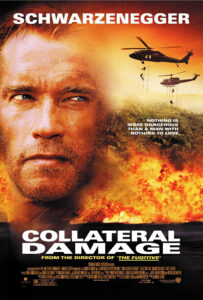 Published Feb. 9 of 2002 in The Kansas City Kansan newspaper, my review speaks unkindly of this Arnold Schwarzenegger flick.
By Steve Crum
It is uncanny timing, this Schwarzenegger movie.
Collateral Damage, which opened yesterday, parallels the Sept. 11, 2001 tragedy in so many ways that it is incredulous to swallow the claim that this movie was in the can PRIOR to the Twin Towers attack. But it was.
Screenwriters David and Peter Griffiths did base their tale on an actual incident—the Pan Am Flight 103 that exploded over Lockerbie, Scotland in 1988. Their wonderment over the reactions of the victims’ relatives is embodied in Arnold Schwarzenegger’s Gordy Brewer.
Brewer is a Los Angeles firefighter who, we observe at the film’s opening, is dedicated to his dangerous job as well as his family. Shortly 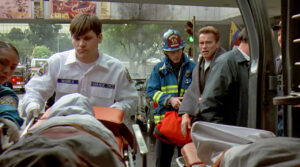 after driving downtown to pick up his wife and young son, he witnesses a bomb explode in a nearby vehicle. Among those killed are his wife and boy. Injured and hospitalized, Brewer soon yanks out his I.V. and barrels onward in revenge mode.
Things occur in rapid progression at this point: Brewer has lined the walls of his living room with giant blowups of Colombian maps…a CIA link has given him info about the head terrorist, known as El Lobo…Brewer has somehow financed (via the Fireman’s Fund?) an armed, one-man trek on foot through the Colombian jungles to find the terrorists’ compound. Brewer not only finds it in quick time, but infiltrates it, is taken prisoner, and befriend the leader’s wife and kid. Think of what he could do in the caves of Afghanistan!
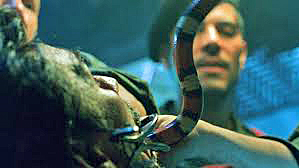 I won’t spoil the fun of Brewer’s further journey through Vengeance Valley, but Arnold fans will see plenty of their hero taking on two, three and more at once, in the process lobbing and igniting an arsenal of explosives.
Incidentally, what other movie in our lifetimes can claim the hideous sequence of a man being force-fed a live, poisonous snake?
I will say this for Arnold, I should look that good when I am 54 years old. What a minute, I AM 54. And I don’t.
Director Andrew Davis has proven himself with The Fugitive that he can do great things with a good script and cast. Unfortunately, this 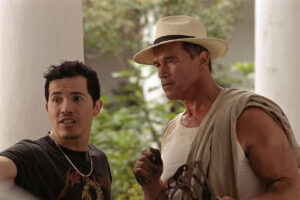 effort is no Fugitive. Even his use of potentially interesting characters disappoints. Extended cameos by gifted actors John Turturro and John Leguizamo are wasted.
As for the similarities between Collateral Damage and the events of Sept. 11, just start with the fireman angle.
“I can be a hero on the screen, but the real heroes are these guys who are there every day, bravely doing their jobs.” So goes Schwarzenegger’s press released comment about firmen—post Sept. 11 words.
And speaking of firefighters, a controversy exists because of Arnold’s persona in the film. Many firemen object to his vengeful-hero depiction. The fact that Gordy Brewster’s character abandons his job, ignoring the helpful pleas of two fellow firemen, probably sparks even more complaints.
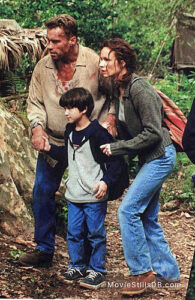 It is widely known that Collateral Damage is the high profile movie that was delayed from release for four months, fearing a backlash due to Sept. 11 public sentiment. In a somewhat cleansing way, Collateral Damage soothes the revenge we have felt as the irritating search for Bin Laden continues. That is because Arnold nabs HIS bad guy within a couple of hours.
What does Collateral Damage have to offer, entertainment-wise? This is an Arnold movie, solidly. The revenge formula has worked for him before in Commando, and he even gets to to bare his rippling pecs a couple of times. Just use brawn over brain in accepting the logical order of events in this film.
Early this week, Schwarzenegger baited the press about his desire to run for public office, possibly Governor of California. Hmm. Married to a Kennedy. A staunch Republican. And now THE timely movie hero, a terrorist-hunting firefighter.
Run that up the flag pole, and watch the salutes.
∞∞∞∞∞
RATING on an A-F scale: D
∞∞∞∞∞
PEGGY LEE: She gave us fever
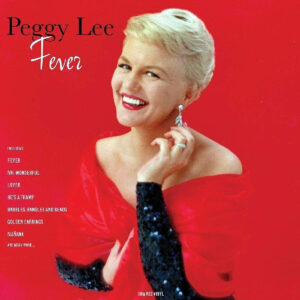 Peggy Lee’s death at 81 on January 21, 2002 prompted my tribute to her. It was published in The Kansas City Kansan on February 2, 2002.
By Steve Crum
When news of Peggy Lee’s death at 81 last week reached me, I was touched in several ways. She was not only a great singer, but a very good actress. Even though she seldom acted in 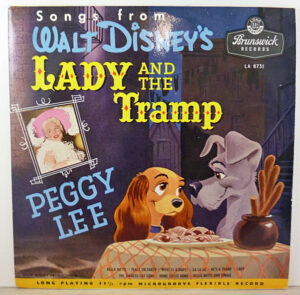 movies, when she did, it was an event. Her supporting role in Jack Webb’s wonderful Pete Kelly’s Blues (1955) brought her a well earned Oscar nomination.
Her movie links include voice work (singing and dialogue) in Walt Disney’s classic animated Lady and the Tramp (1952). Lee also co-wrote the movie’s songs, including “She’s a Tramp” and “We Are Siamese (If You Please).”
Lee made 700 recordings and 79 record albums. Speaking of her song writing abilities, she is credited with having written more than 200 songs, mostly as lyricist. Anyone alive since 1940 will remember some of the other tunes she penned: “It’s a Good Day,” “Mañana” and “I Don’t Know Enough About You.”
Of course, the song that immediately comes to mind when mentioning Peggy Lee is her signature, “Fever.” “Fever” is unique in that her  accompaniment is solely a bass and drum. The arrangement, emphasizing Lee’s bluesy voice, is simply terrific.
Her other hits (“Golden Earrings,” “Big Spender,” “Lover,” “Them There Eyes,” “You’re My Thrill”) hardly compare to my favorite Peggy Lee sound, the unforgettable “Is That All There Is?” When I hear it, I think of a smokey bar in Lake Charles, La., during 1970 when I played it on the joint’s jukebox. It prompted another bourbon and Coke.
∞∞∞∞∞
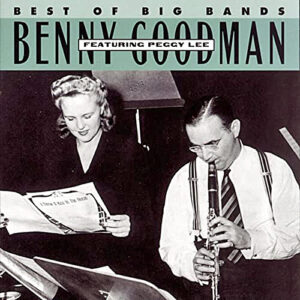 Most people do not realize that Peggy Lee wrote the music for the legendary Joan Crawford western, Johnny Guitar. She also wrote the lyrics to Duke Ellington’s “I’m Gonna Go Fishing” for the 1957 movie, Anatomy of a Murder. Although it was before my time, I have recordings of Lee as a big band singer for Benny Goodman. She was also the weekly singer on Jimmy Durante’s radio program throughout its late 1940s run.
After numerous physical problems, including stroke, broken spine, viral pneumonia, temporary blindness and diabetes, Peggy Lee performed as long as she could. It is reported that during the last few years, when she was bedridden, she loved to paint and grow roses.
She still listened to her favorite music—the sounds of Debussy, Chopin, Ray Charles and Frank Sinatra.
#
‘Black Hawk Down’: Heroics go hardcore
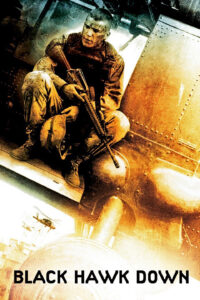 NOTE: Published in The Kansas City Kansan newspaper, January 18, 2002. At the screening a month earlier, several heroic veterans of the battle were in the audience. We critics got to meet them following the viewing. It was truly a privilege.
By Steve Crum
Based on the actual 1993 Battle of Somalia in Mogadishu, Black Hawk Down stars Pearl Harbor’s Josh Hartnett, as well as Ewan McGregor and Tom Sizemore. This is a movie that when your friends ask, “Who’s 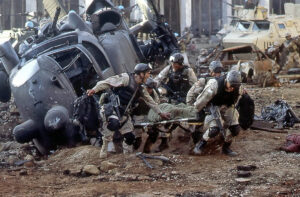 in it?”, you answer, “There are no big stars here, but this is a big movie.”
Superbly directed by Ridley Scott, the film serves as a historical document of tragedy that occurred when U. S. Forces were sent to the region to aid the United Nations in the distribution of food and supplies to literally starving Somalis. Over 300,000 had already starved to death due to local warlords hoarding the food to assume control of the city.
As one Black Hawk helicopter is shot down over the heart of the city—and soon followed by another, the Americans are drawn into an unplanned battle, virtually with the entire city.
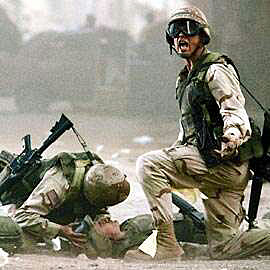 The storyline is segmented, focusing on many strings of happenings: a ranger falls from a copter, and is rescued under fire; a soldier has to reach barehanded into another’s insides to pinch off an artery—and there is no morphine available to cut the pain. A grunt is deafened when a buddy fires too close to his ear. A soldier picks up a fellow soldier’s severed hand, and dutifully stuffs it into his belt pack.
Ridley Scott’s excited camera juts to a rocket screaming toward two soldiers who crouch near a 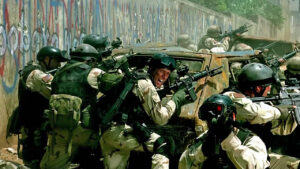 doorway. And the air is full of battle pollution, looking like volcanic ash, looking like the air images of New York City and the Twin Towers hell.
All the while, the cool-under-fire strategists, safely back at base camp, relay straight-on orders through ground leaders’ high tech head sets.
Black Hawk Down jerks you around, slaps the side of your head, and kicks your butt back up to keep moving on. It is as close to interactive as any movie…ever.
GRADE on an A-F Scale: A