
Viola Davis reigns in sweeping action-drama, ‘The Woman King’
 By Steve Crum
The Woman King is an immensely impressive historical action-drama film. To be honest, I was reluctant to watch it since the trailer smacked of it being nothing more than bloody battle scenes between African tribes.
The Woman King is much, much more.
Dana Stevens’ screenplay speaks to 1820s West Africa, warring tribes, slavers, power, trust, patriotism, and  love. The mix works—throughout the film’s 135 minutes.
Directed by Gina Prince-Bythewood (The Secret Life of Bees), filming took place in South Africa’s coastal province of KwaZulu-Natal—for jungle scenes. However, most of the movie was lensed in Cape Town.
The mostly fictional story involves the West African kingdom of Dahomey, circa 1823. General Nanisca (Viola Davis) leads an all-female troop of warriors trained to defend their territory from the  vicious Oyo Tribe. For years the Oyo have supplied Portuguese slave traders with abducted women, men and children to be chained and boated to slave auctions.
It so happens that the young women soldiers under Nanisca’s charge were rescued from Oyo’s slavers. Their incentive to fight is therefore a given. Dahomey’s King Ghezo (John Beyoga) is preparing for war with the Oyo, led by their general, Oba Ade (Jimmy Odukoya).
In the midst of impressive showings (really choreography) of Nanisca’s troops both training and doing battle, we get to know a handful of the young women prepping for combat. The primary character is the new recruit, Nawi (Thuso Mbedu), believably acted on a level equal to Davis’ general. In fact, the two are linked in complicated ways—which  directly shape the plot.
A subplot involves Nawi’s complicated romance with Malik (Jordan Bolger), one of the slave traders.
Overall, through the truly grand finale, The Woman King is a dazzler from Terence Blanchard’s symphonic score to Polly Morgan’s eye pleasing cinematography. Acting is A-1, particularly by Davis and Mbedu.
—————
GRADE on an A-F Scale: A
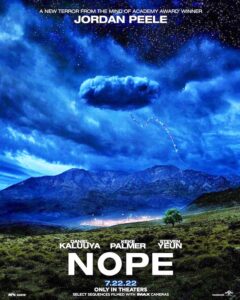
There is nothing like ‘Nope’ to fight bloodlusty aliens
 By Steve Crum
“It all means something” is an advertising catchphrase of Jordan Peele’s latest horror film, Nope. While the viewer tries to figure out what all the terrifying commotion is about, the movie’s 130 minutes escalates from a deadly “accident” to an unmoving cloud to mass murdering range war. Director-writer Peele clearly knows the business of suspending disbelief. I say “yup” to Nope.
Beginning with 2017’s brilliantly creepy Get Out, Jordan Peele has become this century’s horror movie king. Adding Us, released in 2019, justifies such praise.
In Nope, the alien types are again living near us. Specifically, the bad things are alive in the clouds over a small ranch located in the boondocks of Agua Dulce, California. That is where the Haywood family of three train
their horses for movies and TV shows. Then one day outdoors, father Otis is killed while sitting in the saddle of  one of his horses. Odd that he would die from a small object falling from the sky. As the story progresses, that oddity is explained multifold.
“Odd” could aptly be the subtitle of Nope, since there are a variety of weird—and often bloody—happenings. There is Ricky “Jupe” Park (Steven Yen), a former child actor on a TV sitcom who carries nightmarish memories of the time a supposedly trained ape savagely turned on cast members during a taping. Now Ricky owns a Western theme park, Jupiter’s Claim, not far from the Haywood ranch.
Then there is Angel Torres (Brandon Perea), a tech who sets up a security camera system at the Haywood’s home since strange things are occurring  on the premises.
Figuring in most importantly are the main stars, Daniel Kaluuya (Otis “OJ” Haywood) and Keke Palmer as Emerald “Em” Haywood. They are superb as siblings still dealing with their late dad’s 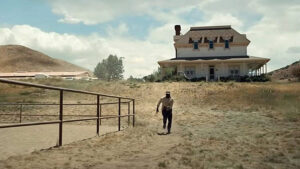 death. OJ is quiet and unassuming. Em is in-your-face talky and given to song.
There is obvious UFO activity afoot (actually a-sky, per se), and the trio wants to capture the culprit on video.
Meshing together the superb visuals of cinematographer Hoyte van Hoytema, Michael Abels’ score and editing by Nicholas Monsour, the end product is convincingly a nail biter. What was once hidden in the clouds finally shows itself. Chaos results. With a horse involved, it resembles an Old West showdown at 50 paces.
 By the way, at one point in the midst of attack (look for it), OJ wisely utters, “Nope.” Ah yes, the birth of a film title.
Throughout Nope, we never know the “why” of what is happening, but who cares. Just relax—if possible—and enjoy one of cinema’s all time thrill rides.
—————
GRADE on an A-F Scale: A
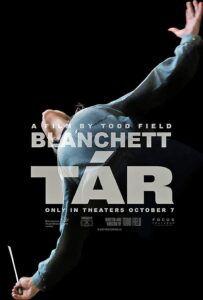
‘Tár’ spins saga of maestro’s unsympathetic fall from glory
 By Steve Crum
Tár is all about Lydia Tár, whose rise in the teaching and performance of classical music becomes her passion—a somewhat uncontrollable aspiration.
Lydia, played by the always believable Cate Blanchett as a person with unrelenting dedication to her job, is not an easy person to like personally. She and her wife and concertmaster Sharon (Nina Hoss) have a young daughter, Petra (Mila Bogojevic). While Lydia is an orchestra conductor of world renown, her duties as wife and mother are distant and humorless. Tender love? No way. Home life is not that far removed from being a demanding maestro.
Director-writer Todd Field paints a grim character study of a driven woman whose aspirations are multi-tasked. Lydia is planning to promote her autobiography via a book tour as well as her conductor’s dream, an upcoming live  recording of Mahler’s Fifth Symphony. Simultaneously, she is restructuring her professional surroundings. That means using politics to replace her assistant conductor Sebastion (well played by Allan Corduner).
We also witness her teaching music and judging recitals at Julliard. She is laser focused on her students’ seeming prejudices regarding certain composers, particularly Bach. This leads to my favorite scene wherein Lydia browbeats one particular student to the point he curses her and leaves class. Previous to his storming out of class, we notice his left leg increasingly jump out of anxiety. It is no surprise when the young man cannot take his teacher’s bullying any longer.
 Lydia Tár is unmoved, seemingly devoid of his feelings.
On Lydia goes, making enemies of a half dozen or so musicians and associates. Eventually, that includes her long-time assistant Francesca (Noémie Merlant). Still, her professional and private life remain privileged as she is beyond reproach. It is clear she is as talented as she is egocentric. Lydia’s flirting with young Olga Metkina (Sophie Kauer), a talented Russian cellist, has repercussions both at home and on stage.
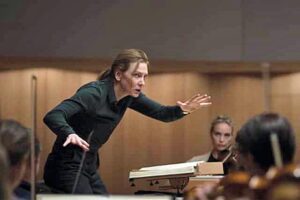 Without getting specific, the thickened plot is not pretty.
Jealousy, lying, innuendo, and revenge dominate during Tár’s third act. By the finale, we have witnessed a slow-moving 158 minutes of the life of Lydia Tár…from peak to crumbling depth.
—————
GRADE on an A-F Scale: B-
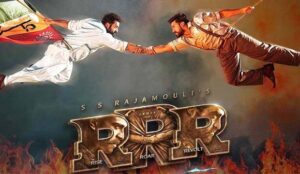
‘RRR’ packed with terrific action, music, adventure, love, courage & dance
 By Steve Crum
To say, as one source does, that RRR, dubbed in English, is a “Telugu-language, epic action drama film” limits the scope of this wowser of a motion picture. RRR is as described plus so much more. Factor in its love story, patriotism and originality. Then there are the spectacular CGI effects (particularly the wild animals) and the memorable music.
The singing and dancing were superb enough to elicit a deserved Oscar nomination.
AND we get two leading men (N. T. Rama Rao Jr. & Ram Chardan) who play superheroes. Forget Marvel and DC, these guys have abilities far beyond mortal…well, you know the line.
 Direction and screenplay is by S. S. Rajamouli, who helmed the film’s 182-minutes into a work that resulted in the most expensive Indian film of all time. However, it has already made a profit due to worldwide box office.
The film’s plot is somewhat complex, at least in the beginning. Bear with it. By that time, you should be used to Rajamouli’s rapid pace and surprises. For example, young Malli (Tinkle Sharma), is kidnapped by the British Governor Scott Buxton. Cut to Komaram Bheem as he is literally face to face with a ferocious (emphasis on ferocious) tiger in the woods. Like other sequences in RRR, the action is played out meticulously and to nail biting conclusion. I won’t say who wins the battle, but remember that Bheem IS one of the aforementioned  “superheroes.” He is on a trek to government headquarters to rescue said Malli.
So we do get a historical sense that RRR is at its core another story of the British Empire once again at odds with India during its notorious Crown Rule/Raja that lasted two centuries. In this case, the young girl is violently taken from her family because the Brit governor’s wife likes the girl’s painting talent.
Before Bheem arrives at the governor’s mansion, we get a sample of the supernatural physical power of Raju—a British officer who is actually Indian by birth. Let us just say he is a one-man army concerning violent crowd control. (See it to believe it.)
There are sequences wherein the opposing two meet and join forces (the brilliantly choreographed river rescue of a little boy). But the entire set-up we anticipate is when they have an ultimate confrontation. Who will win?
However, however, however—there are complications and coincidences at work. That is the heart and soul of this great adventure laden with fantasy.
Perhaps the strangest inclusion is when the two heroes team to lead an infectious dance of the Oscar nominated Naatu Naatu. Strange or not, it is awesome.
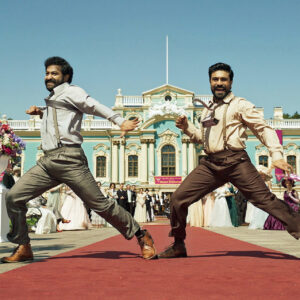 Bravo for the visionary work of S. S. Rajamouli.
∞∞∞
By the way, the film’s title signifies “Rise, Roar, Revolt.”
∞∞∞∞∞
GRADE on an A-F Scale: A
∞∞∞∞∞
Fascinating ‘The Fabelmans’ explores Steven Spielberg’s family, filmmaking inspirations
 By Steve Crum
Had Alfred Hitchcock filmed the story of how he got interested in films, there could have been some very revealing moments. Like his father locking the child Hitch up in a local jail to teach him a lesson. Maybe Hitchcock’s introduction to the element of fear?
Now refocus on Steven Spielberg’s semi-autobiographical (or “auto biopic”) drama, The Fabelmans, co-written and directed by Spielberg. It could well have been titled The Spielbergs, were it a documentary. But The Fabelmans is based upon Steven Spielberg’s childhood, in the process renaming his relatives, including himself.  (Steven is “Sammy.”) The project has been over two decades in the making, being green lit once his parents had passed on. He did not want to hurt any feelings.
The result is an absorbing, revealing motion picture.
As recounted by Spielberg in previous interviews, he was first impacted at the movie theatre as a young boy in 1952. So it is with Sammy Fabelman. After seeing Cecil B. DeMille’s The Greatest Show on Earth, Sammy is awestruck (particularly at the circus train wreck sequence), mesmerized and inspired to duplicate what he had just seen at home. Using his father Burt’s (Paul Dano) 8mm camera, Sammy (Gabriel LaBelle) films his own silent version of crashing his newly acquired train set. His mother, Mitzi (Michelle Williams) encourages Sammy to pursue his new hobby, while his father is discouraging.
Sammy’s filming continues on a larger scale, sometimes including his three younger sisters in the shooting.
After the family has to move to another state due to Burt’s job, Sammy continues his amateur filmmaking—even including his fellow Boy Scout troops as extras in battle scenes.
 Sammy makes filming family outings, such as a camping trip, an occasion wherein he directs the action with experimentation of lighting and angles. Also involved in family activities is his father’s best friend and associate, Benny Loewy (Seth Rogen), whose presence-particularly during Sammy’s teen years—segues from jocular “uncle” to disruptive interloper.
In the process, Sammy becomes more enamored with someday making a living creating movies. This is still much to his dad’s chagrin.
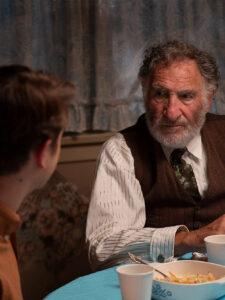 There is a wonderful performance by Judd Hirsch as Boris Podgorny, a granduncle and ex-film worker and circus lion tamer. He is a character for sure, but encourages Sammy to pursue his dreams with the realization of their conflict with family expectations. Such is the crux of The Fabelmans.
The film pivots when Sammy discovers a jarring secret while editing some family camping footage.
That said, a major change occurs when dad’s job forces him to move to Southern California—the land of sunshine and movies. Sammy’s dream world enlarges as the reality of his parents’ marriage is endangered.
The screenplay also covers Sammy’s encounters with anti-semitism, his college years, love life, and early TV production work.
Incidentally, a must-see is Sammy’s encounter with John Ford (played by director David Lynch), which is pretty much what occurred when Steven Spielberg first met the crusty director.
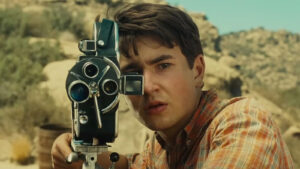 Overall, The Fabelmans is a unique telling by one of the most popular directors in cinema history.
∞∞∞∞∞
GRADE on an A-F Scale: A-
∞∞∞∞∞