
‘Disclosure Day’ delivers memorable yarn in top notch motion picture
 By Steve Crum
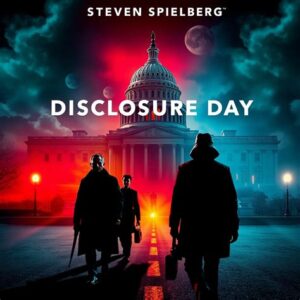
Paranoia, uncertainty and fear run rampant in Steven Spielberg’s sci-fi thriller Disclosure Day. Starring Emily Blunt, Josh O’Connor, Colin Firth and Colman Domingo, Disclosure Day’s 145 minutes has some of the most terrific daredevil chase sequences in film history. (And most are old film school, non CGI, performed by stunt people to perfection.)
 Based on a story idea by Spielberg, and screen scribed by David Koepp, the plot involves cybersecurity expert Dr. Daniel Kellner (Josh O’Connor) stealing proof that extraterrestrial life has existed on earth for years. Yes, Roswell, New Mexico is not only referenced but becomes a major crux in the storyline with the military’s actual footage of captured aliens. (It’s not real, but certainly looks real.)
Regarding Spielberg’s fascination with aliens, Roswell and the like have been his lifelong interest and passion. He’s explored alien possibilities in Close Encounters of the Third Kind, E. T., AI Artificial Intelligence, and War of the Worlds. In a recent interview, Spielberg refers to this as “my canon of extraterrestrial stories.” As such, Disclosure Day is most reminiscent of Close Encounters.
 The plot buzzes when a Kansas City TV meteorologist Margaret Fairchild (Emily Blunt) begins experiencing odd events at home—like a red cardinal flying into her kitchen. Segue to her workplace when Margaret begins speaking gibberish during a weather forecast, and collapses. Once the footage goes vital, Wardex, a
  government agency aware of alien existence, seeks out Margaret for experimentation. This also draws interest by Hugo Wakefield (Colman Domingo) the leader of an agency (the good guys) trying to seek the truth of government coverup and protect Margaret.
Essentially, Disclosure Day then becomes a chase film with Margaret and Josh teaming to elude Wardex leader Noah Scanlon (Colin Firth) and his team—essentially  the bad guys. (Is it coincidence they are reminiscent of ICE agents?)
En route by car to meet Wakefield and his team, enjoy the edgy action stunt work involving a car and a house. Even more spectacular is a car versus train event. Awesome and unforgettable.
 As time progresses, Margaret’s ability to mind meld increases, adding to the wild tension. By the way, the film’s cast is great; Emily Blunt is extraordinary.
Disclosure Day is surreal. It is also dreamlike and scary. Frequently, it is confusing. Like Close Encounters, the focus is on a chosen human prepped to link with alien beings.
But the fact is many humans buy into the existence of extraterrestrials…via a conspiracy theory that has existed for decades. Such is the gist of Disclosure Day.
__________
GRADE on an A-F Scale: A-
The Peter Falk Fiasco **or** The Thing About My Obliteration
 By Steve Crum
What should have been, could have been. I am talking about the celebrated actor Peter Falk (1927-2011).
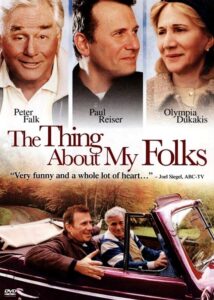
On Sept. 1, 2005, I sat with the personable yet guarded Falk for an hour-long afternoon interview held in a luxury hotel room on The Plaza in Kansas City, Mo. It was all about publicity for Falk’s soon to be released flick, The Thing About  My Folks. So a fun and revealing experience happened. Soon after, I hurried home to spend a few hours writing what I considered one of my best interview pieces—even better than the similarly styled feature I used in my 2002 interview with Shirley Jones–published in the Kansas City Kansan newspaper. [/?p=860] The Jones story had garnered my First Place Award plaque from the Kansas City Press Club as Best Entertainment Story of the Year in tri-state area newspapers.
By 2005, I was no longer working for the Kansas City Kansan. Neither was former Kansan assistant editor Mary Rupert. She now edited a far lesser weekly, The Wyandotte West. And I was its occasional writer mainly covering local theater.
Then came Columbo himself, Mr. Falk.
To put it ever so truthfully, Wyandotte West (Rupert and/or an assistant editor) butchered my story. What happened was far beyond mere editing. Without contacting me, my cleverly written feature story was choppily transformed into a one paragraph, dimwitted “news” story. Basically it gave the who and what of Falk’s movie—minus any information about Falk himself.
 I remain insulted about never being CONsulted—emphasis on the con. No courtesy about contacting me for anything regarding writing or editing. Shabby, unprofessional bullarky. Adding to my outrage was the fact I had not kept a copy of my original story. WWest had it. My mistake, my big mistake. Now I cannot post it here. (Their “edit” is not worth a reprint. Trust me.) I loudly complained by phone to an editor there, and quit writing for Wyandotte West immediately.
**********
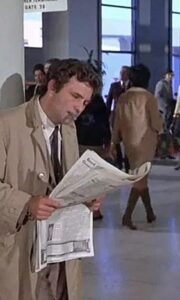 I will share some asides about the Falk experience, however. KC was part of a cross-country promotion for the The Thing About My Folks, in which Peter Falk portrays Paul Reiser’s father. I was supposed to have a separate half hour with each actor, but Reiser could not make it.
So Falk’s time was extended. I was seemingly blessed with getting to pick Falk’s brain for an unexpected 60 minutes. Questions ranged from Columbo to John Cassavetes to It’s a Mad, Mad, Mad, Mad World to his numerous movie and TV parts. Falk would start to answer, say, one about his work with John Cassavetes. Then he would catch himself, and say, “Naw, naw…let’s stay with the reason I’m here. Let’s only talk about The Thing About My Folks.” After a couple of mundane publicity questions and answers, I would stroll back into Don’t Ask territory. “Mr. Falk, your years on Columbo were….” And Falk would interject, “Er…that’s all covered in my upcoming book, Just One More Thing. Now let’s get back to The Thing About My Folks, which is one terrific motion picture, maybe my best performance.”
Back and forth we went, eventually netting a ton of interesting stuff. But Falk was savvy, and politely balked at answering anything outside of his current flick. It became a game of trickery, but I was up against Detective Columbo.
He could not lose.
STRANGE BUT TRUE CINEMA WITH ‘GONE FISHIN’
∞∞∞∞∞∞∞∞∞∞
 By Steve Crum
THROWING BACK to May 30, 1997, when the comedy Gone Fishin’ opened. My review appeared on Rotten Tomatoes. (It’s still there.) But until now I have never admitted that (gulp)…my take on the movie  stands alone as the ONLY positive review among all the nationwide film critics.
It is a dubious honor. In other words, the movie is deemed overwhelmingly Rotten, except for my singular Fresh reaction.
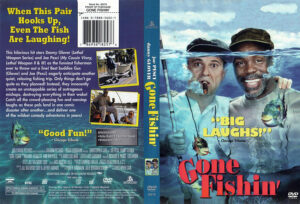
I can only surmise that 29 years ago, I had either overdosed on Diet Dr. Pepper OR was in the mood for a Dumb and Dumber type comedy. Alas, Gone Fishin‘ is too  dumb and beyond dumber for the masses. (It was a box office dud as well, making only $19 million on its $53 million cost.) Hey, at least two positive quotes via the Chicago Tribune are featured on the DVD cover!
Wikipedia describes the movie as “a 1997 American comedy film starring Joe Pesci and Danny Glover as two bumbling fishing enthusiasts. Nick Brimble, Rosanna Arquette, Lynn Whitfield and Willie Nelson co-star. It is the only collaboration between Glover and Pesci outside of the  Lethal Weapon franchise. Christopher Cain directed the film. J. J. Abrams and Jill Mazursky wrote the film’s script.”
Incidentally, the leading roles of Joe and Gus were first offered to John Candy and Rick Moranis. Both turned it down as they were busy with other projects.
What a break for Candy and Moranis!
__________
MY GRADE: 3/5
∞∞∞∞∞∞∞∞∞∞
‘Blood Diamond’ weaves complex plot
Published Dec. 7, 2006 in Kansas City’s Sun Tribune, Sun Gazette and Liberty Tribune newspapers.
∞∞∞∞∞∞∞∞∞∞
 By Steve Crum
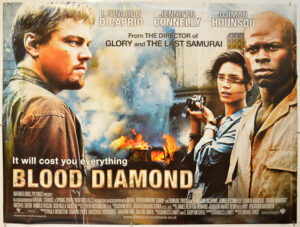
Movies set in Africa, telling of warring factions, poverty, genocide and corrupt governments, have proven to be both forceful political statements and strong box office. Last year’s Oscar-nominated Hotel Rwanda is an example. This year factor in the critically acclaimed The Last King of Scotland, Tsotsi and Catch a Fire. Now add director Edward Zwick’s Blood Diamond, a solid action-adventure tale set in 1994 Sierra Leone.
Zwick and screenwriter Charles Leavitt mount fiction upon fact via three central characters on their own personal quests who become webbed with diamond smuggling and terrorism. It all works well in a  complex, riveting and disturbing way. The film suffers only in pacing: it seems longer its 134 minutes.
Danny Archer (Leonardo DiCaprio) is an ex-mercenary from Zimbabwe who has been into diamond smuggling for arms over the past few years. In a role that Errol Flynn or Gary Cooper would have fit years back, Archer is a hard-drive con man who uses charm and muscle to achieve profit. His dream is to find a  golf ball sized pink diamond of the film’s title, which will buy him a new life outside of Africa.
Such a dream has nightmarish connections, as local fisherman Solomon Vandy (Djimon Hounsou) discovers. After his village is raided by government forces, he is taken to the diamond fields as a virtual slave. His wife and daughters end up in a refugee camp while  his middle school-aged son, Dia, is trained to be a murderous child soldier. His first kill task involves being blindfolded and forced to fire a machine gun straight ahead as a prisoner is pushed in front. Then his blindfold is removed as fellow soldiers cheer his first kill. The homicidal brainwashing has begun. Each young boy is also given a killer nickname, further shaping his new identity. (A postscript at film’s end chillingly states there are currently more than 200 thousand child soldiers in Africa.)
Meanwhile, Dia’s father has found and hidden a large gem. He is recaptured by opposition forces and imprisoned, which is where he meets cell mate Archer. Despite Vandy’s tight lips, news of his diamond spreads, followed by Archer arranging to free himself and his new cash cow friend. Archer, of course,  wants the diamond for himself; Vandy wants it to locate his family and finance a new life.
Into the foray enters American journalist Maddy Bowen (Jennifer Connelly), who equals Archer in getting what she wants—in this case the story of who is behind the diamond smuggling. The three soon team to help Solomon find his family, regain his son and locate the gem.
Zwick films typically have a textured, lush look to them—exemplified by Glory and The Last Samurai. Blood Diamond has it too. Credit Eduardo Serra’s Oscar-worthy camera. While passing out awards, both DiCaprio and Hounsou are likely candidates.
Above all, it is the film’s vital human message that lingers—the sacrificial “blood” of the title.
__________
GRADE on A-F Scale: B
__________
‘Casino Royale’ gives fans a retro Bond
Published Nov. 16, 2006 in Kansas City’s Sun Tribune, Sun Gazette and Liberty Tribune newspapers.
∞∞∞∞∞∞∞∞∞∞
 By Steve Crum
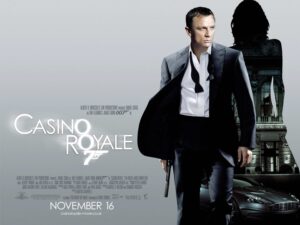
Good news—maybe—for 007 fans: James Bond is back in Casino Royale as a buff, no nonsense, licensed kiler as played by Daniel Craig. The maybe is for die-hard fans like yours truly who expect certainties in our Bond flicks. After 20 movies, why not? Then again, accept this 21st as truly retro Bond since the screenplay (Paul Haggis, Neal Purvis and Robert Wade) is closely based on Ian Fleming’s original Bond debut novel of the same name.
Many frills are missing, like Q’s ingenious gadgets. Don’t expect to see exploding watches, jet backpacks and car ejector seats. (However, 007 does drive a nifty Aston Martin DBS.) In fact, forget about inventor Q  himself. He is not even referenced. Very missed is a John Barry score, which greatly enhanced the mood and action in the Sean Connery and Roger Moore vehicles. Composer David Arnold, with his fourth Bond score, again suggests Barry’s music rather effectively. Grunge singer Chris Cornell sings the OK theme song, “You Know My Name,” over the animated opening, which he also scored.
Nearly absent is Bond’s smooth, ultra-sophisticated persona. He does appear in tuxedo, particularly  during the second act in the high stakes poker sequence. More often, Craig’s Bond is shirtless and bloody, usually after chasing a bad guy up and down endless structures. He is even tortured while bound and nude.
As for the animated opening, Casino’s is among the best of the series, and most surreal. It might be the most colorful, depicting images of 007 warding off gigantic playing cards that bleed.
Do expect healthy doses of Bond women, extraordinary stunt work, and international locales. Dame Judi Dench returns as M, head of the British Secret Service, who continues her love/hate relationship with her most trying agent. Speaking of agents, Jeffrey Wright does a fine turn as CIA 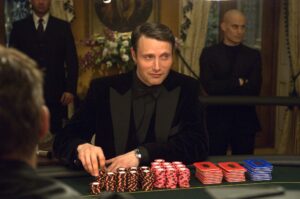 operative and Bond buddy Felix Leiter.
A James Bond movie must have a strong villain, and Casino Royale supplies one via Le Chiffre (Mads Mikkelsen), a terrorist banker and sadistic poker player who literally bleeds through his tear ducts. Now that is evil.
As mentioned, there are characters and gimmicks missing in Casino, since the story occurs at the  beginning of Bond’s secret agent career. Early in the story, he is told he cannot be a full-fledged 007 until he has had at least two clean kills, which he accomplishes with aplomb. M has misgivings about her fledgling agent,, and James is an unknown to his adversaries since he has zero reputation. Previous entries in the Bond series make one wonder how he could call himself a “secret” agent. Here, he truly is.
Although this marks the beginning of the Bond saga, practicalities of our world and current events 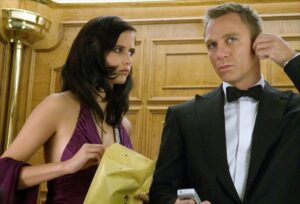 influenced the writers. Retro or not, this Bond uses a call phone, computers, and does his best to stop the funding of terrorism. Nothing really needs to be added to the plot overview except that our hero becomes romantically involved with treasury official Vesper Lynd (Eva Green).
Undoubtedly, having second-time Bond director Martin Campbell (GoldenEye) helps in franchise continuity. Casino Royale is a definite see for Bonders like myself who can accept the hard-hitting Craig…Daniel Craig.
__________
GRADE on A-F Scale: B
__________