
Angelina Jolie believable as eccentric opera singer Callas in ‘Maria’
 By Steve Crum
“PRIVILEGE.” It is an apt alternate title I would give to Maria, the fascinating biopic of world renowned opera singer Maria Callas, starring Angelina Jolie. To say that Maria Callas was spoiled is to put it, um, mildly. Accurately described as as a “biographical psychological drama,” the film’s production is the result of an international collaboration encompassing the United States, Chile, Great Britain, Italy and Germany. For example, Director Pablo Larrain (Jackie) is Chilean; Screenwriter Steven Knight is British.
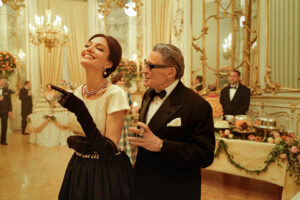 The story opens during the final day of Maria Callas (Sept. 16, 1977), and continues for the next 124 minutes in flashbacks…and flashbacks within flashbacks. To offset confusion, past incidents appear in black and white. The narrative is still confusing, particularly when Maria has distorted recollections (hallucinations) due to her ill health—influenced by drugs, fantasies, and memory loss. She suffers mental demons, viewed through her recollections. Expect lapses in truth and rumor like whether or not the young Maria was forced to sing for the Nazi SS…or her relationship with Aristotle Onassis (well portrayed by Haluk Bilginer).
Her need to be pampered and the center of attention is explored. As depicted, she stops by a favorite eatery in Paris. “I’m not hungry,” she tells the waiter. “I come to restaurants to be adored.”
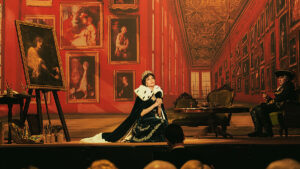 During her prime, Callas was considered THE prima donna opera singer. With a yet unequalled singing range, she exuded professionalism and showmanship on major stages around the world.
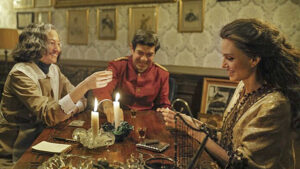 Yet, as shown in the film, she is fraught with vocal insecurity. Scattered memories surround her fear of never singing again as she grows older.
As the film slowly (too slowly) progresses, it reminded me in several ways of Albert and David Maysles’ 1987 documentary, Grey Gardens. Even though Maria is not a documentary, it has a similar feel in its mixture of grandeur and former grandeur. Sadness permeates both films.
That sadness is somewhat balanced with friendship via the dedicated and loving relationship between Callas and her longtime servants, expertly portrayed by Pierfrancesco Favino as her butler, Ferruccio—loyal to the hilt, and Alba Rohrwacher’s Bruna, the housemaid.
 Angelina Jolie shines as Callas, not only in terms of acting but expertly lip synching to the diva’s original recordings. It is Jolie herself superbly singing at the movie’s conclusion. Her seven months in vocal training paid off!
Kudos to the awesome location filming (in and outdoors) by cinematographer Edward Lachman.
And bravo to Jolie, whose acting (and singing) chops have risen to Oscar level since those long ago Tomb Raider days—not saying that she wasn’t an impressive action star.
—————
Supernatural elements negatively affect ‘The Piano Lesson’
 By Steve Crum
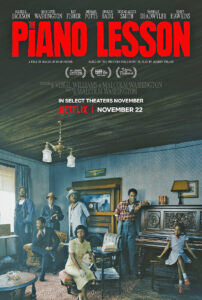
It was less than a delightful experience viewing The Piano Lesson. Based upon August Wilson’s Broadway play of the same name and directed-adapted by Malcolm Washington, The Piano Lesson is a study in family values and characterizations. Its strength is in the superb acting, supported by rich dialogue.
It is an ensemble piece, par excellence.
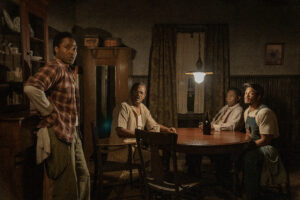
Umbrage has to be taken, however, with expectations. Specifically, TPL is advertised as a “drama”—which is valid. From the outset, the story “presents realistic characters who deal with realistic conflicts or struggles.” (Thank you, Mr. Webster.)
However, exploding during the third act of this 127-minute tale is a supernatural aspect best described as “horror.” Ghostly, violent things occur. It all pertains to the family and friends inside the house, which is the primary setting. So why isn’t The Piano Lesson truthfully promoted as drama/horror? A petty observation? I don’t think so.
Consider the plot line, which Virgil Williams co-adapted. Utilizing flashbacks to tell the history of the piano that centers the story, the tale opens on July 4, 1911 in Mississippi. The wealthy Sutter family is enjoying fireworks miles away from home as their estate is being ransacked. Specifically, their piano is stolen. The thieves include 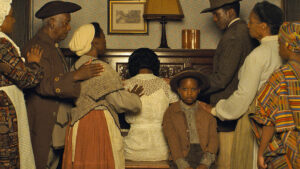 the Black ancestors of the Sutters’ former slaves, the Charles Family. It turns out that the piano has intricately carved faces across the front and sides. The faces are of the Sutter slaves.
Continuing in flashback, the Sutters eventually catch up with a perpetrator (Boy Charles) while the piano is separately transported by others up north—never to be returned.
In a flash-forward to 1935 Pittsburgh, Boy Charles’ son Boy Willie (John David Washington), rides a wagon to town to visit his sister Berniece 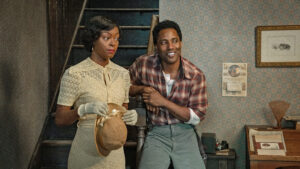 (Danielle Deadwyler). She is the single mother of daughter Maretha (Skylar Aleece Smith). Both live with Uncle Doaker, played by Samuel L. Jackson. They live in an impressive two-story house…with that gorgeously carved piano standing in the living room.
So goes the initial plot, as Boy Willie wants to sell the piano, which he claims as co-owner with his sister. His sister vehemently objects, and seemingly endless arguments ensue. A half dozen other characters get involved over time, including a wanna be preacher Avery (Corey Hawkins), who wants to marry Berniece.
As referenced earlier, the final third of TPL involves the ghost of Old Man Sutter seeking vengeance via apparitions, spooky sounds, and downright physical fighting—particularly with Boy Willie. As effective as the chills are, they seem trite to advance the story. And the story’s finality is a sugar-coated letdown.
 The Piano Lesson is the third of three August Wilson plays produced for films by Denzel Washington. Like Fences and Ma Rainey’s Black Bottom, it features Black characters fusing history with human values.
So why taint it with a partial reworking of The Amityville Horror?
—————
GRADE on an A-F Scale: C
‘Heretic’ terrifies as house of horrors tale starring well spoken, lethal Hugh Grant
 By Steve Crum
Of the dozens and dozens of movies about haunted houses ever produced, there are some standouts. (I am not counting the comedy hh movies, led by The Ghost and Mr. Chicken.) Still scary are House on Haunted Hill, The Amityville Horror, and The Others. The best of the bunch remains a tie between 1963’s atmospheric The Haunting and 1944’s The Uninvited.
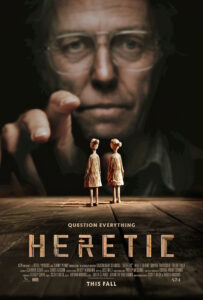
 Now we have 2024’s Heretic, a foreboding horror movie co-directed and written by Scott Beck and Bryan Woods. The duo have restructured the standard haunted house formula with the violence of Saw. Then add a huge dose of faith elements.
As opposed to Beck and Woods’ 2018 horror hit, the well named A Quiet Place, Heretic is packed with 111 minutes of nearly nonstop sounds of religious discussion (mainly by Hugh Grant’s character), as well as creaks, moans and screams. (Cue the sound effects!)
Mr. Reed (Grant) is the heretic of the title, a guy who claims he has studied Christianity and other religions. Yet he lives alone in this secluded old mansion, unable to discuss his knowledge. It turns out to be extremely biased “knowledge.” He yearns to share what he has learned with the front 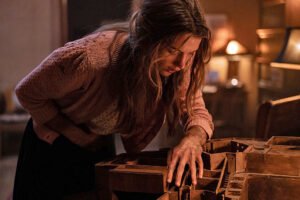 that he is interested in Mormonism. Naturally, Mr. Reed requests the Church of Jesus Christ of Latter-day Saints to send a couple of missionaries to his home. In quick time, the two missionaries, Sister Barnes (Sophie Thatcher) and Sister Paxton (Chloe East), are knocking at his door…at sundown on a rainy, windy day.
The two reluctantly come inside, even though Reed’s wife is nowhere to be seen. “She’s in the kitchen,” he says.
So begins a lethal game of wits, fear, and detective work on the part of the young ladies.
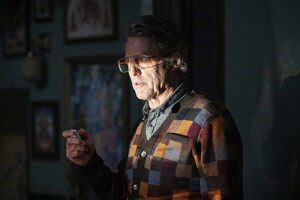 The story escalates into terror once it is discovered the front door is locked and now unusable. Creepy becomes CA-REEPY. The women are imprisoned.
Prepare for their wild ride of making a “Lady or the Tiger” choice; Mr. Reed’s unending mind games; a visit from a cloaked prophet (?); and touring the house mazes. It is all familiar territory for a haunted house story, held together by the extraordinary work of Hugh Grant.
Who knew he could be so hellishly manipulative and controlling?
—————
GRADE on an A-F Scale: B-
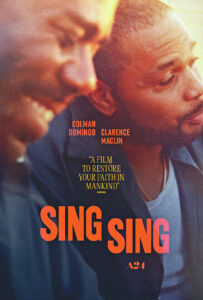
‘Sing Sing’, headlined by Colman Domingo, features unique storyline
 By Steve Crum
There has never been a prison movie like Sing Sing. However, Director-Screenscribe Greg Kwedar’s heartfelt drama perfectly fits within the sub-genre of American Prison Films. The traditional prison flick was established with 1930’s The Big House. (A year later, Laurel and Hardy hilariously parodied with Pardon Us.) Dozens of “Big House” stereotypes followed, including, egad, the wildly titled 20,000 Years in Sing Sing. More recent titles re-established the genre with Escape From Alcatraz and the widely regarded The Shawshank Redemption.
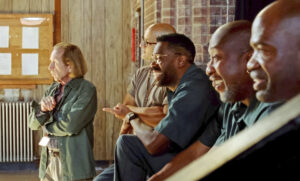
2024’s Sing Sing is cut from a different inmate cloth.
It looks and feels differently. Kwedar utilizes closer to a cinema vérité storytelling technique. In its documentary-reminiscent style, the focus is on stark characterizations rather than—say—planning for a breakout or violence involving the warden. The many facial closeups serve the purpose of knowing and caring about these cons.
The fact-based story’s main character is John “Divine G” Whitfield, brilliantly portrayed by Colman Domingo. He is an innocent man who has been wrongly found guilty of murder and now jailed at Sing Sing Correctional Facility (located in Ossining, NY). Divine G is also a driving force for the prison’s innovative RTA (Rehabilitation Through the Arts) Program. Plus he is the star actor and playwright. As such, he is the primary recruiter for new members to join the acting troupe. The very popular small group truly love 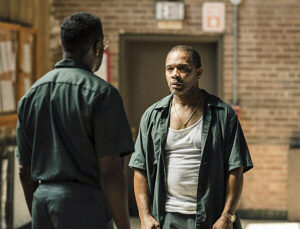 their theatrical work and regularly perform plays and cuttings by the likes of Shakespeare to Divine G. Add Brent Buell (Paul Raci) as a civilian who volunteers to direct and write many of the plays. Costuming, sound and lighting add to the mix. He works alongside Divine G. in getting the casting, rehearsals and presentations to the inmate population. This all occurs in the prison’s gymnasium, which includes a small stage.
Running 105 minutes, Sing Sing’s drama balances the member recruiting, particularly regarding the reluctant Divine Eye (Clarence Maclin), with the personal challenges of cast members—like parole issues  and stage fright. It often feels like we are witnessing a play within a play. Yet that irony is so compelling and believable.
Speaking of irony, most of the main cast members are actual former inmates at Sing Sing. That includes Maclin, who turns out to be a fine actor. And current convicts are seen as extras. The film itself becomes a rehabilitation influence. The cinema vérité technique also extends to the director’s use of a handheld 16mm camera; and utilizing Sing Sing and two other prisons as shooting locations. (The limited budget had much to do with those choices.)
Sing Sing is sensitive without being saccharine—sometimes elating, sometimes tearful. It deserves accolades.
—————
GRADE on an A-F Scale: A-
Colorful ‘Wicked’ explores Oz backstory, falling short
 By Steve Crum
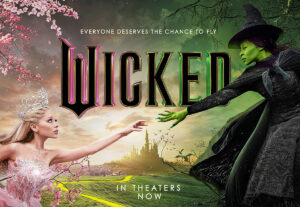
Although box office heralded, Wicked is troublesome as well as wondersome. At this writing, Wicked (aka Wicked: Part I) has just been Oscar nominated in multiple categories, including Best Picture. So what is “troublesome” about the movie? The screenplay alone is such. Winnie Holzman and Dana Fox have adapted the original, Tony winning Broadway production—also by Holzman, along with 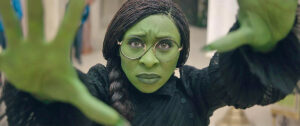 Stephen Schwartz and Gregory Maguire. (I have to confess that I have never seen the stage version.)
So what’s not to love about the 160-minute (it seems longer) Wicked movie? Although its co-star, Cynthia Erivo (who plays the green-skinned Elohaba Thropp/Wicked Witch of the West) is a talented singer, there is not one song she sings that is hummable enough to hum—let’s say—in the shower. 1939’s The Wizard of Oz, however, is packed with songs that are still sung today. OK, times have changed over the last 85 years. But Harold Arlen and Yip Harburg (The Wizard of Oz) created wonderful songs with MELODY.
Wicked’s Stephen Schwartz writes songs absent of substantial melody. He has only gotten worse at this since his days of composing music for Godspell and Pippin. Then again, recent Broadway and movie musicals can be accused of the same thing. Alas, the days of memorable songs by Irving Berlin, Cole Porter, and Rodgers & Hammerstein are ancient history.
We have what we have now, and are excited to lower the musical bar and jump to a standing ovation. I’m not among that audience, but many/most are. Consider me a grain of salt.
 Wicked has zero music and lyrics to even slightly compare with “Over the Rainbow” and “We’re Off to See the Wizard” from The Wizard of Oz.
My justification for spending so much time criticizing Wicked’s songs is a given: IT’S A MUSICAL! Call me both a fuddy and a duddy.
HOWEVER, there is still much to like about Wicked. The music is passable, but the visuals are awesome. It’s no spoiler to point out that the title itself is a giveaway. Assuming everyone has seen The Wizard of Oz, Wicked centers on the backstory of its scary, green-skinned, magical mistress of evil aka “The Wicked Witch.” HINT: She was not born evil. The story, told through flashbacks within flashbacks, follows the turn in her personality.
That flashback within flashback technique can be off-putting since it is sometimes confusing due to the non-linear storytelling.
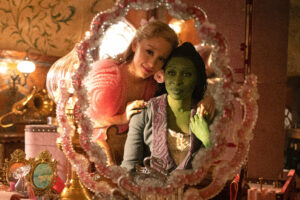
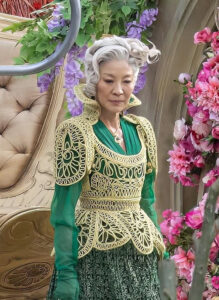
 But the cast is stellar. In addition to Erivo, there are Ariana Grande (Glinda), Jonathan Bailey (Fiyero Tigelaar), Ethan Slater (Boq Woodsman), Michelle Yeoh (Madame Morrible), and Jeff Goldblum (The Wonderful Wizard of Oz).
There is also a very cool surprise featuring two cameos by way of Broadway!
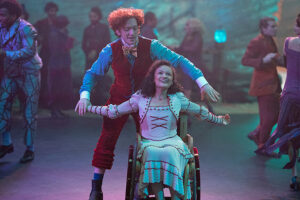 The overall production is glitzy, packed with singers and dancers in wowser costumes, hair and makeup. Set design highlights include the Wizard’s domain plus a training academy reminiscent of Harry Potter’s Hogwarts. (Love that rotating library!)
Perhaps most of all visual treats, we witness the origin of the evil Flying Monkeys.
Jon M. Chu (Crazy Rich Asians) impressively directs an elephantine production that succeeds despite lacking a score that could have made Wicked memorable for decades—even without Judy Garland.
—————
GRADE on an A-F Scale: B-
__________
The sequel, Wicked: For Good, which will cover the events of the musical’s second act, is scheduled for release on November 21, 2025.