
Up, up & away with 2025’s ’Superman’—heroism lives!
 By Steve Crum
I am solid with Superman—having grown up watching George Reeves as The Man of Steel during the first run of TV’s The Adventures of Superman in the 1950s. That evolved into spending my meager allowances on Superman comic books during the so-called “Silver Age.” Since then, I have DVDs of Kirk Alyn in two Superman serials from the 1940s. Add to that Fleischer Studios’ terrific animated Superman cartoons of the same period + the radio  programs. Love them all. Then came the Christopher Reeve starrer as Supie in 1978…and the sequels, followed by decades of more films with other actors portraying Kal-El (his Kryptonian name, of course). Great Caesar’s ghost!
And now comes 2025’s Superman. Non-stop action from the get-go, it proves that there is a still a whole lot of attraction and flying power left for this superhero of superheroes.
Written and directed by James Gunn (Guardians of the Galaxy), this reboot of the Superman franchise opens in battle turmoil as The Man of Steel (James Corenswet) fights the meta human “Hammer of Boravia.” Pretty much mortally wounded (yes, it even happens to him), Superman is  carried off to his Fortress of Solitude by none other than Krypto, the superdog. (In the comic books, Krypto was always part of the SuperBOY universe—never SuperMAN’s.)
Once there, Superman is nursed back to health by a staff of robots! This very cool inclusion of new DC characters includes Superman being given a healthy dose of the yellow sun to speed his healing.
 Meanwhile, back in Metropolis, it’s no surprise that Superman’s greatest foe, Lex Luthor (Nicholas Hoult), continues to wreak proverbial havoc on the world with his thugs Hammer and Ultra Man. That includes Metropolis Daily Planet denizens Lois Lane (Rachel Brosnahan), Jimmy Olsen (Skyler Gisondo) and Perry White (Wendell Pierce in a cameo). Look for the late Christopher Reeve’s son, Will, as a GBS reporter.
Without detailing too much, be aware that DC heroes The Green Lantern, Hawkgirl, Mister Terrific, and Metamorpho also appear to assist Superman. There is also a surprise superhero appearance near the film’s finale.
 Clark Kent’s adoptive parents, Ma and Pa Kent are featured too.
Then there’s that plot device dealing with a “pocket universe.” It’s all intriguing and built into workable, fantasy storytelling.
Formulaic to the max, Superman still exudes awesome fun and excitement to both old and young fans.
__________
GRADE on an A-F Scale: A
‘After the Hunt’ mostly fails on its clunky trek
 By Steve Crum
Without the hand-held shots and artsy framing, the overlong (139 minutes) After the Hunt would be left to its own mundane story, a confusing tale of mistrust and jealousy among university academia.
Director Luca Guadagnino weaves the campus-based psycho drama through mores, guilt and beliefs. In fact, Guadagnino’s storytelling, written by Nora Garrett, is unique in that not one character is either likable or involving.  Why even care about what is happening?
Consider the plot setup. Alma Imhoff (Julia Roberts), a respected Yale professor, is married to Frederick Mendelssohn (Michael Stuhlbarg), a psychiatrist. Alma’s close friend, Hank Gibson (Andrew Garfield), is accused of sexually assaulting Maggie Resnick (Ayo Edebiri), a top PhD student of Alma’s.
Then the plot is scattered with insinuations, clues as to Hank’s guilt, and the questioning of Alma and her  husband’s relationship. Oddly then, Alma becomes the detective of sorts as she pursues the truth about whether or not her young friend Hank is guilty. Or is Maggie framing him for some reason?
Roberts and Garfield are OK in their grim portrayals, as is Edebiri. But as mentioned earlier, there are distractions that get in the way of the storytelling. Add Trent Reznor and Atticus Ross’s score. Guadagnino has chosen to infiltrate the plot flow with incongruous snatches of music. The sporadic editing of such includes  clunky piano underscoring, evidently symbolizing minds in turmoil. The result is distraction instead of clarity. The same goes for the infrequent use of hand-held camera shots. Also drawing attention are the numerous closeups of body language, to punctuate action and talk. It does not help; it hinders. And what is with the metronome sound?
And what is it with the movie’s oddball conclusion, the last words? A joke?
If After the Hunt was trying to be different, it succeeded. That is not a compliment.
—————
GRADE on an A-F Scale: D
A yachting we will go…on a kill; shipboard with missing persons via ‘The Woman in Cabin 10’
 By Steve Crum
Investigative journalist Laura “Lo” Blacklock (Keira Knightley) decides to mix pleasure with business on board a luxury “super yacht” in The Woman in Cabin 10. The business entails the destination of the 3-day excursion, a fundraising event in Norway. She is going to write a feature covering it. The pleasure is relaxing on a cruise en route, hobnobbing with the rich and famous.
What could possibly go wrong? Plenty.
 Beginning the first night, Lo awakens to a woman’s scream, and immediately begins an investigation: a bloody handprint by Cabin 10 coupled with her witnessing someone fall overboard. Yet the clues lead to a dead end, per se. No one is staying in Cabin 10. No one knows anything about someone falling overboard. The ship’s captain does a headcount of everyone on board. And no one is missing.
Yet more oddities pop up, only discovered by Lo. Now her safety is seemingly at risk. And what about the wealthy, ill woman Anne Bullmer (Lisa Loven Kongsli)? How does her husband, the millionaire whose yacht has  become central to the plot, tie in to the chaos? After all, Richard Ballmer (Guy Pearce) seems supportive of Lo’s seemingly endless revelations.
Reminiscent of Alfred Hitchcock’s Lady on a Train (1945), The Woman in Cabin 10 is loaded with suspicions and danger. However, what director/screenwriter Simon Stone’s Cabin 10 comparatively lacks is pace, credibility, and editing. The first half tends to drag, while the payoff conclusion seems rushed and predictable.
It is also a negative when late in the story, the point of view shifts from the victim(s), Lo included, to the perpetrators.
Still, The Woman in Cabin 10 has its moments—nail biting as they are.
—————
GRADE on an A-F Scale: B-
Senior Living Reconsidered: ‘The Thursday Murder Club’ satisfyingly romps through grave digging, homicide
 By Steve Crum
What hath Agatha Christie (1890-1976) wrought when she first wrote about elderly amateur sleuth Miss Jane Marple in 1927? The fictional Miss Marple led to her being featured in numerous short stories, novels and motion pictures. It is no coincidence there have been a number of novels, TV shows and films since then that have included an aged citizen detective solving murders.
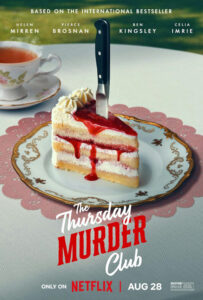
 Take the most recent movie, The Thursday Murder Club, currently streaming on Netflix. It is a terrific showcase for not one, but four senior citizens teaming up to solve a murder. Directed by Chris Columbus (Mrs. Doubtfire, Home Alone) and based on Richard Osman’s book of the same name. The Thursday Murder Club covers 118 minutes of a murder case that evolves into multiple murders. It is fortunate that the four inhabitants at Berkshire, England’s Cooper’s Chase Retirement Home have already formed their own sort of private club of murder solving enthusiasts. They focus on cold cases that have never been solved.
That the grimly fun film is headlined by four Hollywood names truly adds to the desire to watch it. (One name I did not know is Celia Imrie, who plays nurse Joyce Meadowcroft.) Her fellow residents and compatriots in sleuthing are Pierce Brosnan as Ron Ritchie, union leader; Helen Mirren as spy Elizabeth Best; and Ben Kingsley’s Ibrahim Arif, a psychiatrist.
 We find out about each of their backstories as Katy Brand and Suzanne Heathcote’s screenplay unfolds.
That progression begins as the film opens with a woman being pushed from her window, after which the four decide to investigate. As the local police investigate, so do the Thursdays.
In the midst, another person is killed—a prime suspect. Then another is mysteriously killed. At this point, our four detectives are working overtime via interviews and pursuing clues. It’s all pretty engaging and sometimes a bit confusing. Without giving away too much, it seems the future of Cooper’s Chase is a factor in all the doings.
 A plus to the film is the casting of David Tenant and Jonathan Pryce in major rolls.
True, the title and overall concept smacks of Hulu’s Only Murders in the Building, but The Thursday Murder Club has a unique spin that makes it well worth watching.
—————
GRADE on an A-F Scale: B+
My deadlines + newsprint began 70 years ago
 By Steve Crum
THROWING BACK to 1954, when 7 year-old Stephen Crum began his journey/destiny of journalism. In my 61st & Ann Avenue home in KCK, I loved reading The Kansas City Times and Star (both the morning and evening editions). So I published my own newspaper, really a one-pager, The Ann  Avenue News. Since I had no typewriter or copy machine, it was a laborious task. Every story was hand written by me…and included my single panel comic, Sammy Shoe. (It featured a dorky kid with huge feet.) I churned out maybe six copies of the same issue each week, and hand delivered them to a like number of neighbors. The stories were brief and gossipy. This enterprise lasted two issues.
My journalistic spirit rekindled big time when I was a junior and senior at Wyandotte High School. As a member of the Pantograph newspaper staff, I drew cartoons, took photos, and wrote news and features. Thirty-five years later, I was teaching journalism at Wyandotte, and advising the Pantograph.
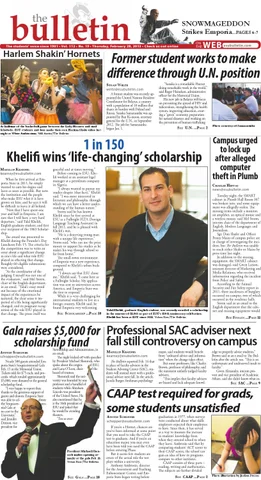
In between, I became associate editor of The Bulletin student newspaper at Emporia State (then Kansas State Teachers College). I also wrote news and features (play reviews, etc.), and drew cartoons.
After my stint in the Army, I briefly wrote for an arts and entertainment magazine, Greenhouse, distributed throughout Greater Kansas City. That was 1974.
 I surprised myself when I researched the number of high school newspapers I advised over the years following college. They include: Rosedale High School’s The Rosedalian, Harmon’s The Talon, Washington’s The Washingtonian, Schlagle’s Diachron, Wyandotte’s Pantograph, and Bishop Ward’s Outburst.
 In the midst of all the writing, teaching and deadlines, I proudly served as President of the Kansas Scholastic Press Association, 1985-87.
Factor in three city newspapers for which I wrote film and stage reviews and interviews, and drew cartoons: The Kansas City Kansan, The Wyandotte West, and Courier Tribune (Kansas City Missouri’s Northland).
_____
 Sadly, few local newspapers still publish. The Internet rules.
I miss those deadlines..sort of. I miss being able to actually hold a paper copy of one’s publication. I miss feeling the pride and accomplishment on distribution day.