
‘All the Old Knives’ is anything but cutting edge
 By Steve Crum
Does All the Old Knives make the cut? Like a dull edged butter knife, the answer is no.
Chris Pine and Thandiwe Newton star as long time CIA operatives who face conflicts aplenty when an eight year-old terrorist case is reopened. Both agents are at risk.
Based on the like named novel by Alan Steinhauer, who also penned the screenplay, All the Old Knives is directed by James Metz Pederson (an episode of TV’s True Detective). Prepare yourself for long stretches of mundane dialogue spoken in near whispers.
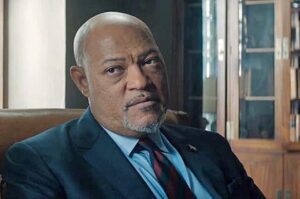 No wonder that when the 101-minute movie reached 50 minutes, I literally jumped a bit when Henry Pelham (Pine) slammed down some papers onto a desk. On the plus side, it kept me from dozing off.
To recap the plot basics, CIA boss Vick Wallinger (Laurence Fishburne) assigns Agent Pelham to investigate former fellow Agents Celia Harrison (Newton) and a handful of others as being the mole who cooperated with terrorists who hijacked a packed Turkish airplane. Subsequently, everyone aboard was killed. To complicate matters, Celia (now retired) once had a romantic relationship with Henry.
 From this point on, All the Old Knives is a structural challenge to comprehend. Flashbacks, and even flashbacks within flashbacks, are generously utilized. Red herrings are everywhere, as if we really, really care. Better pacing and editing would be improvements. If only.
On location cinematography by Charlotte Bruus Christensen is fine—when the film stops lingering on dark night sequences. In short, Knives drones along.
 Explaining the meaning of the All the Old Knives title, Steinhauer says his inspiration was through the 1st Century Macedonian fabulist, Phaedrus: “All the old knives that have rusted in my back, I drive in yours.”
Right, that explains…nothing.
∞∞∞∞∞
GRADE on an A-F Scale: D
Villeneuve dazzles with literary and sensory sci-fi treat, ‘Dune: Part One’
 By Steve Crum
Who would have thought I would at all be fascinated by an epic movie based on a 1965 sci-fi novel, written by Frank Herbert, that spins an involved tale that begins with Duke Leto of House Atreides—of the ocean planet Caladan—being assigned to replace House Harkonnen as fief ruler of Arrakis…to control the lucrative (awk!) SPICE production?
Neither had I ever read the essential (for true sci-fi fans) Herbert novel, Dune, NOR watched the reportedly disappointing 1984 film adaptation….also titled Dune. So why am I now driven to wildly applaud this 156-minutes of otherworldly, ultra escape—a flick I have been purposely avoiding since its inception?
ANSWER: Because this movie version of Dune (aka Dune: Part One) directed and co-written by Denis Villeneuve, has so enveloped my thoughts and dreams (at least one night, anyway) that I now give up. It has grabbed me in ways never felt since the first time I saw Star Wars during the summer of 1977. Let’s call Dune: Part One a deeply thinking person’s Star Wars.
Maybe I just love the giant sandworms of Dune because I groove on the sarlacc in Revenge of the Jedi. But there must be more to my Dune  “thing” than one scary creature.
Indeed, there are other reasons.
The paramount attractions, the visuals, connect immediately. The landscapes, costuming, sets, makeup, creatures, and wild special effects are stunning. So awesome are they that of Dune’s 10 Oscar noms, four won for Cinematography, Visual Effects, Production Design and Editing. Factor in two more wins for the Sound and Hans Zimmer’s Score.
Kudos to screenwriters Jon Spaihts, Eric Roth, and Villeneuve for balancing the challenging work with a cohesive story line.
 Basically, the epic tale is one of political power and corruption set way into the future. (Egad, have we no hope of someday living in a society devoid of such strife?) Families are pitted against families, and planets against planets. Good and evil exist as do loyalty and deception. These are themes common to any literary structure in which—of course—conflict must exist. In Dune, the conflicts are often spectacularly shown (huge battles) or shadowy (Paul Atreides, played by Timothée Chalamet, being groomed as a potential leader).
Mysticism and foreboding are major ingredients as well.
Topping or at least equalling it all, is an international cast of impressive actors. Some of their characters will not make it to Dune: Part Two, to  be released Oct. 20, 2023. (That is, unless they are somehow brought back from death.) Of course, I will not divulge who survives here.
Representing the lengthy list of actors, their characters are included to represent the complex and transcendental language.
The relatively brief list includes a Spell Check nightmare of Rebecca Ferguson as Lady Jessica Atreides, the ducal heir; Oscar Isaac (Duke Leto Atreides); Josh Brolin (Gurney Halleck); Stellan Skarsgård (Baron Vladimir Harkonnen); Stephen McKinley Henderson (Thufir Hawat, the Mentat); Zendaya (Chani, a mysterious Fremen woman); Javier Bardem (Stilgar, Fremen leader);  and Jason Momoa (Duncan Idaho, sword master of House Atreides).
It’s a far, far cry from Luke and Leia.
∞∞∞∞∞
GRADE on an A-F Scale: A
‘Val’ paints challenging life of Val Kilmer in absorbing documentary
 By Steve Crum
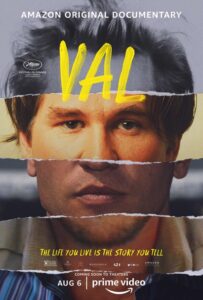
What a privileged, adventuresome, sad, creative, and now challenging life Val Kilmer has lived. His autobiographical documentary, Val, is a fascinating look about the actor whose life and times took a tragic turn in 2014.
“My name is Val Kilmer,” he says in the film’s opening. “I was recently diagnosed with throat cancer.” That was then—8 years ago. Now he speaks through a computerized voice placed in his throat.
Most of the 108 minute documentary is narrated, using his dad’s words, in a well modulated voice by Val’s son, Jack—who sounds so much like his father that it both puzzled and fooled me.
But when Val does speak, as he frequently does in this story, it is via robotic-sounding, neck box sound. Of course, that does not reference Val’s distinctive speaking voice in old film clips of him from his childhood through motion picture roles.
It so happens that the numerous video footage is supplied by Val himself—whose family took many reels of 8mm footage to document their early family history. That mindset has continued to this day as he and his adult kids (son Jack, daughter Mercedes) now digitally film dad Val at work and play.
 “I have thousands of hours of tape, being the first to own a video tape recorder (in the world),” the now 62 year-old Val says. “I’ve wanted to tell a story about acting for a long time. Now that it’s more difficult to speak, I want to tell my story even more.”
Indeed he does just that, quite thoroughly. Val is the journey of an actor from childhood to formal training at Juilliard to success in Hollywood.
So it goes. Home movies showcase Val and his brothers Wesley and Mark in hammy mini-movie productions shot in their house and backyard. Living a somewhat privileged life thanks to his real estate investment father, Eugene, the Kilmer house was located “down the street from Roy Rogers’ ranch.” The Rogers property was eventually owned by Dad Kilmer.
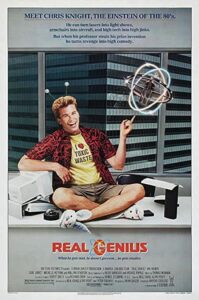 Cut to amateur footage of Val in plays from elementary through high school. After being the youngest kid ever accepted into Juilliard Drama School in New York, Val’s brother Wesley dies at 15. Then, for a while, no more plays. The Kilmer Family “was never the same again.”
Val then focused on playwriting, and moved into a NYC apartment. He focused on Shakespeare and the like…easing back into acting. Insert even more home movie footage on video, including Val and friends acting silly around the apartment, stage rehearsals, and showing off.
The Second Act of Val surveys his movie years, from his first hit film, Top Secret (“To this day I have trouble explaining what it is about”) to portraying “Ice Man” in Top Gun to the wildness of Real Genius. Swatting flies by his pool, Val explains the problem of eating and talking with his “throat hole” and breathing tube. He also speaks of his mother’s new husband, divorce, and his disdain for hometown Chatsworth, California.
Val’s candor is revealing about the relationship with his late father, increasingly financial, and his marriage to Willow co-star Joanne Whalley.
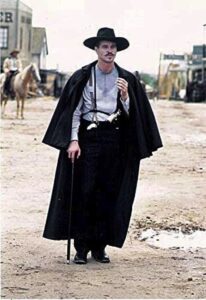 He reveals the movie role he fought to have, but never got. Then there are the parts that made him memorable: The Doors and Tombstone. Remarkably, Val Kilmer was not Oscar nominated for the latter (“I’ll be your Huckleberry”), giving a stunning performance as Doc Holliday.
Kilmer calls his wearing the clunky Batman costume in Batman Forever “a struggle,” and his Caped Crusader acting “soap opera.” He lauds working with Pacino and De Niro in HEAT as “great.” Then there is his work in The Saint, which he did for a surprising reason.
Sandwiched between the movie excerpts, Kilmer glazes over his thoughts of death…and life. These days life can be tough for him.
The Final Act of this true story focuses on what Val’s life is like now. He laments his depression of flying around the world to meet fans and sign autographs, picking up some cash in the process at comic and celeb conventions. One sequence shows fans lined up to meet, greet and get Kilmer’s signature, but that has to be put 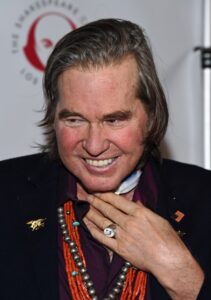 on hold as Val takes a break to head backstage to clear his breathing/speaking tube.
It’s a necessary part of the life he now has.
That life includes a tearful Val missing his late mother; and the disappointment of not being able to finish his tour portraying Mark Twain because of his voice problem. While hospitalized, Val began painting as part of his healing. As well, he has become fascinated with church and religions.
Co-produced and written by Val, the direction is by Leo Scott and Ting Poo. But it is the genius of Scott, who edited the many hours of footage, that makes Val so impactful.
∞∞∞∞∞
GRADE on an A-F Scale: A
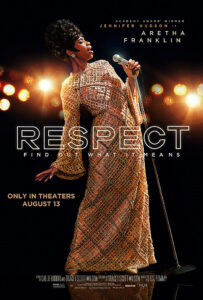
Aretha Franklin’s “Respect” dazzles with Jennifer Hudson’s singing, but is tempered by disturbing personal sequences
 By Steve Crum
Some of my favorite movies are biographies. Make that MANY. I am talking Hollywoodized versions of a celebrity’s life. The musical bio is a particular fav sub-genre. Respect, the Aretha Franklin saga, is a comfortable fit. It’s pretty much cookie-cutter predictable. (Hey, we all know Aretha’s songs…and there are 18 of them sung here by Jennifer Hudson over the 145-minute running time.) So the bottom line is if you are an Aretha Franklin fan, you will love Respect. The musical sequences are great.
That said, fans and others will have to withstand some pretty grim realities of Aretha’s abusive upbringing and adult personal life. Regarding the latter, think of Tina Turner’s marriage to Ike…as depicted in 1993’s What’s Love Got to Do With It? Respect’s screenplay, by Tracy Scott Wilson, effectively punches literally and figuratively, yet leaves out some key facts—probably because they are just too shocking.
Opening in 1952 Detroit, 12 year-old “Reth” (played by Skye Dakota Turner) is awakened by her Baptist minister father to once again get out of bed to entertain the loud party in the living room, whereupon she is told to dazzle the crowd by her adult-like singing. (Reth/Aretha and her two sisters live with their dad, who is divorced from an alcoholic mom she truly misses and loves.) Tragically, Reth is raped during one of her father’s parties—in her own bedroom—and gives birth to her first son when she is 13.

What Wilson’s screenplay fails to mention is the same thing occurs again when she is 14, resulting in her second son. The double whammy is that her pious father, Rev. C. L. Franklin (Forest Whitaker), raped a friend’s 12 year-old as well. And she gave birth too. These episodes were conveniently edited out.
Reth’s life if further devastated when her mother, Barbara Siggers Franklin (Audra McDonald), suddenly dies. Now she has no one who understands her, and no adult to confide in. Her father is anything but sympathetic or personable.
As Reth grows older, with her own children being taken care of by her grandmother (?), she becomes 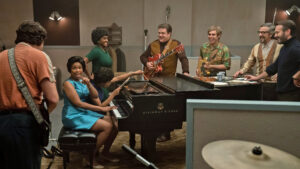 more active in her father’s church and political aspirations. Her father’s close friends become her’s, including Dr. Martin Luther King Jr. (Gilbert Glenn Brown).
It is not surprising that much of these early sequences include gospel songs—obviously a major influence on Aretha Franklin’s singing style. Early on, dad C. L. began planning her career as a recording artist. He is her agent/manager. Surprisingly, at least to me, C. L. encourages Reth to sign with Columbia Records in NYC, and is introduced to the legendary jazz authority John Hammond. The moderately successful jazz records lead to several albums of pop standards. At this point Aretha is only doing cover material, and nothing original.
Aretha’s career then fluctuates until she breaks from her father’s supervision to old friend Ted White (Marlon Wayans), who establishes a 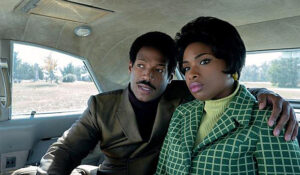 successful career with original songs. She is on her way up in show biz, guided by an aggressive and very physically abusive husband, Ted.
And so it goes with Respect, a sadly appropriate movie title which reflects both Aretha’s strife and one of her biggest songs.
Much more develops between Aretha and Ted, Aretha and C. L., Aretha and her sisters, and Aretha and her addictions. (Not much is said about her children, however.)
There are some surprisingly good performances by Marc Maron as record producer Jerry Wexler, and Tituss Burgess and gospel  singer/pianist/composer James Cleveland.
While much of the script focuses on the recording studio and creative process, it is Jennifer Hudson’s treatment of Aretha Franklin’s songs that sparkles here. Hudson was the late Aretha’s personal choice to portray her.
A wise choice indeed.
GRADE on an A-F Scale: B
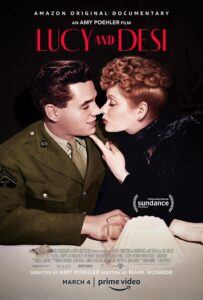
Amy Poehler’s ‘Lucy and Desi’ definitively covers the breadth of the ‘I Love Lucy’ stars, publicly & privately
 By Steve Crum
Lucy and Desi is not the first documentary about the famed Lucille Ball and Desi Arnaz, but it is the best—the definitive. This fine work is comedian Amy Poehler’s baby via her directing. Her professionalism behind the camera is impressive. The superb editing, so vital in any documentary, is by Robert A. Martinez.
Still, what makes Lucy and Desi essential viewing even though at least three or four thematically similar documentaries preceded over the past decades?
First of all, the 102 minutes is loaded with both loving and realistic dialogue and footage. A great deal of the words and pictures have never been seen or heard before. Featured commentator Lucie Arnaz Luckinbill, Lucy & Desi’s daughter, has truly opened the family “secrets,” making public many private cassette recordings made by Lucy and Desi (organized by Lucy—maybe for a future autobiography?) that have some revelations about their feelings and motivations. Thanks to Martinez’ skillful editing, these recordings are shown with the family’s privately shot silent home movies—most of them in color.  The factors perfectly enhance each other.
A fraction of the home movie footage has popped up in previous documentaries, but most is new and fascinating. For example, there is the story of Lucy’s very early years visiting her grandfather on his farm. That includes the near fatal rifle shooting on his property that caused him and the family to move to another state. Her grandfather’s later involvement with the Communist Party is also covered, as well as Lucy’s reason for “joining” the Party.
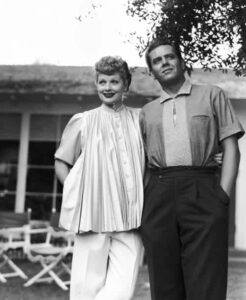 This incident covers familiar territory exploited in Aaron Sorkin’s recent bio-drama, Being the Ricardos. Lucie Arnaz indirectly notes in this docu that Sorkin’s recreated sequence about J. Edgar Hoover defending Lucille Ball is factual! Many critics have disputed that claim.
Lucy and Desi runs the gamut of the duo’s incredible career and private life, from their “mixed marriage” to Desi’s alcoholism and philandering to the rise of Desilu Productions. It also digs back into Lucy’s early movie years at RKO and MGM, refugee Desi’s Cuban ancestry (with some incredible footage of his Havana family and home), and the fact that Lucy and Desi were actually married twice. (See the documentary for details.)
There is footage of the pre-I Love Lucy couple guesting on a 1949 TV Ed Wynn Show, and their touring stage show (a precursor to their own TV program). The familiar is repeated here as well: I Love Lucy’s use of a live studio audience and the 3-camera filming innovation; the hiring of Vivian Vance and William Frawley; and Lucy and Desi’s divorce and new  spouses—yet the two continued to love each other.
I think I had heard about Lucy attributing Buster Keaton for her use of props in comedy, but it seemed fresh to realize her credit. She really did utilize props well to get big laughs.
What Lucy and Desi does NOT mention (even though I wanted to hear about such) is/are the two starring movies they made: The Long, Long Trailer (1953) and Forever Darling (1956). The former is particularly hilarious, even though one might call it an extended I Love Lucy episode.
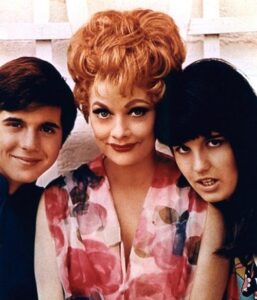 Guest speakers include Bette Midler, Carol Burnett, Charo, Norman Lear, Desi Arnaz Jr., Gregg Oppenheimer, and Laura Laplaca.
I was happy to hear Lucille Ball’s comment about herself in this documentary, “I’m not a funny person.” For years I have said Lucille Ball was not a great comedian, but instead a great comedy actress.
Lucy and Desi is a sublime documentary for fans. For all of us it is cherished early TV history. And it is a poignant love story.
GRADE on an A-F Scale: A