
Would YOU like to read about ‘QUEEN for a DAY’?!
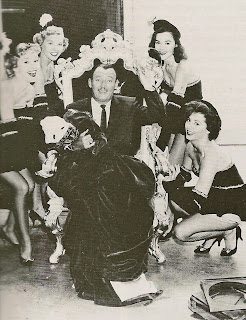
Jack Bailey is flanked by his TV hostesses as he regally sits on the throne occupied by hundreds of needy women through “Queen for a Day’s” long run.
By Steve Crum
On Sept. 24, 1959, JACK BAILEY got the on-the-air signal and yelled to the camera, “Would YOU like to queen for a day?!” My aunt and grandmother both responded “YES!” in unison with hundreds more ladies in the audience at the Moulin Rouge in Hollywood as NBC-TV’s QUEEN FOR A DAY, “the Cinderella Show,” kicked off another daily foray into enthusiastic fun, extravagant prizes, and heart breaking stories of tragedy and despair.
By the time my Aunt Ada (Holley), Grandma (Jo) Axtell, and Grandpa (Hugh) Axtell, had been seated at the then famous Moulin Rouge theatre-restaurant located on Sunset Blvd. near Vine Street, Queen for a Day had been broadcast for nearly 15 years. Beginning on radio in 1945, the show had yet another five years airtime following my relatives’ incursion. In its initial run on both radio and TV, Queen for a Day mopped up gallons of tears and delivered refrigerators by the ton. The half hour show was so popular and financially successful, the network increased the running time to 45 minutes, just to jam in more commercials at the then astronomical price of $4,000 per minute.
The show’s format was simple. Each woman in the audience filled out a card, describing why she should be chosen as a contestant. The more emotional and needy the reason, the better. “My son needs an iron lung and my husband I can’t afford to pay for one,” said one woman. Another might write, “My husband has been out of work for a year, and is disabled. We need a new stove to help feed our 12 children.” The four best–or really, worst–stories were chosen by the 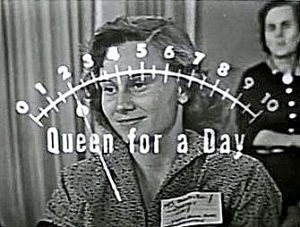 Queen staff, and these four women were the day’s contestants. This was the ultimate sympathy show, a daily dose of pathos and pride swallowing. By the way, this was a woman’s show with only women as participants, not counting emcee Jack Bailey or the smattering of men sitting in the audience.
Queen staff, and these four women were the day’s contestants. This was the ultimate sympathy show, a daily dose of pathos and pride swallowing. By the way, this was a woman’s show with only women as participants, not counting emcee Jack Bailey or the smattering of men sitting in the audience.The four women were each given about five minutes to tell their stories, guided by Bailey’s pseudo-sympathetic questions. Toward the end of the show, it was time to vote on which lady should be crowned queen. And crowned she was. Bailey held his hand over each lady’s head, as the studio audience applauded. An “applause meter” would appear in the corner of the screen, registering 1-10 on the audio scale. The one with the highest applause rating won. Bailey would then shout, “Number….TWO!” (Or One, Three or Four.)
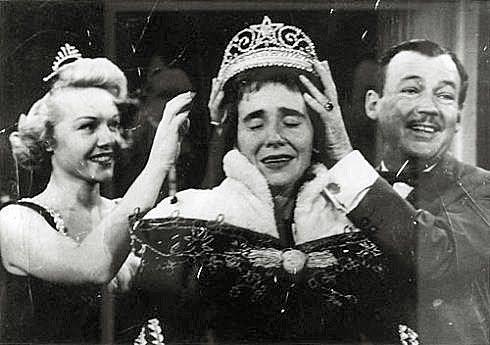 Outfitted in a sable-trimmed, red velvet robe and jeweled crown, the “Queen” would parade around the stage as Pomp and Circumstance (the old graduation march) blasted. She would then be led to her velvet covered throne, and accept a dozen long-stemmed roses, moistened by her dripping tear ducts. She was then told of what the show was providing to fulfill her wish, like a new iron lung. (This iron lung thing is one I particularly remember seeing.) In addition, she received a king’s…uh, queen’s ransom in gifts, including a mink coat, a vacation trip, frozen food, appliances, etc. While all this occurred, the camera avoided showing the three contestants who lost, as they were escorted off stage.
Jack Bailey, in his best carnival pitchman voice, ended each show thusly: “This is Jack Bailey, wishing we could make EVERY woman a queen, for every single day!” This is not meant to put Jack Bailey down. He was perfect for the show, and probably meant what he said.
By 1964, when the show ended, perhaps the country had changed enough to move on and away from exploited poor souls in what was really the earliest reality-based show ever broadcast. It was the time of Civil Rights and Vietnam. One critic labels Queen for a Day as “tasteless and demeaning.” Another calls it “one of the most ghastly shows ever produced.” Sounds like the Jerry Springer Show of its time. Unlike the Springer vulgarity, however, Queen for a Day did maintain propriety and decorum amidst its human indignation.
——————–
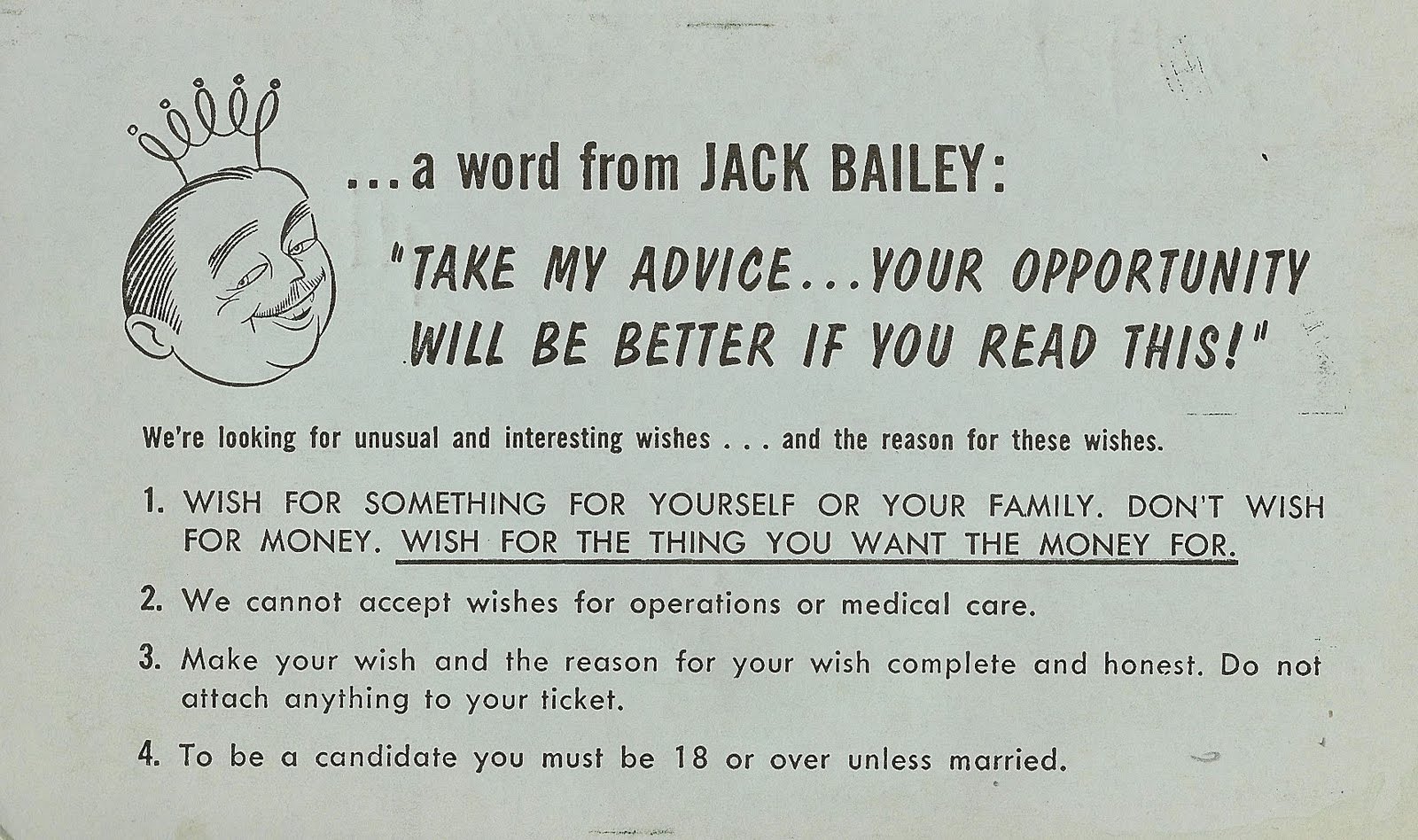 An addendum: Both Grandma Axtell and Aunt Ada WERE picked from the audience to come up on stage for final contestant consideration. Unfortunately, their wishes did not stack up against another contestant’s need for a hearing aid, or that lady whose electricity had been shut off for the past month. My aunt and grandmother did not make the final cut. Aunt Ada’s Cinderella wish was to have a mother-in-law bed. Grandma just wanted her own pool table so she could finally learn Minnesota Fats’ game. Neither request would have spiked the applause meter. Pictured above is the back side of Aunt Ada’s ticket to the show. Jack Bailey’s “word” regarding one’s wishes is particularly choice. Where is the rule prohibiting the use of an onion to evoke tears? [from Steve Crum’s showbiz memorabilia collection]
——————–
Try not to sob while watching this unusual Queen for a Day clip that opens like The Jackie Gleason Show: http://www.youtube.com/watch?v=ggV8Uwhnmq8
Worth 1,000 Words: Hot Lips’ dream sequence from ‘M*A*S*H’

By Steve Crum
Arguably, THE best series in television history is M*A*S*H. From Sept. 17, 1972-Feb. 28, 1983, its superbly written stories were played out by an ensemble cast par excellence. Set at the 4077th Mobile Army Surgical Hospital (MASH) in South Korea during the Korean War, stories dealt with the violence and insanity of war as well as military doctors and nurses, saving lives while coping through both zaniness and compassion. No matter how wild and ribald the jokes, these folks truly cared.
Several TV series have tried to duplicate at least portions of the M*A*S*H chemistry with varying success. HOUSE, another doctor series, mostly succeeds. It is definitely from the M*A*S*H mold, though set in current day.
 The finale episode of M*A*S*H, aired Feb. 28, 1983, holds the record as the most watched TV episode in U.S. TV history (105.97 million viewers). The TV series was adapted from Robert Altman’s 1979 film of the same title. Frankly, in 1971, when I heard that there would be a TV series based on the classic dark comedy movie, I immediately prejudged it to bomb big time. However, from the first episode I knew this was something special, both entertaining and important to watch. I never missed an episode.
——————–
Can you guess the M*A*S*H episode in the CBS publicity photo at the top of this piece? If you are a true M*A*S*H fan, you should know it immediately. It is one of seven dream sequences depicted in the award winning Dreams episode, aired Feb. 18, 1980, the 22nd episode of the eighth season. Directed and co-written by Alan Alda (shown here portraying Maj. Hawkeye Pierce), the story deals with surreal dreams, actually nightmares, experienced while each cast member tries to sleep between dealing with wounded and dying soldiers. The episode won The Humanitas Prize, and was nominated for a Writers’ Guild of America award in the dramatic category, a first for a comedy series. In this, the Margaret Houlihan dream, Loretta Swit’s Major Houlihan dreams of a wedding that segues into wounded soldiers and her blood-spattered wedding gown.
The CBS caption on the photo’s reverse merely states: SUBJECTS: ALAN ALDA, LORETTA SWIT…PROGRAM: M*A*S*H…ON AIR: MONDAY, AUG. 4, 9:00-9:30, ET. It was obviously promoting the airing of a summer rerun. The date of photo press release is 7/11/80. [from Steve Crum’s showbiz memorabilia collection]
——————–
A tribute to M*A*S*H: http://www.youtube.com/watch?v=_LBWDbTN9pE
Don’t quiver, but ‘Robin Hood’ at least hits target’s edge

By Steve Crum
Robin Hood, directed by Ridley Scott (Gladiator), should be titled Robin Hood: The Prequel. Indeed, this Robin Hood is unlike most of the previous 20 or so movie and TV Robins I have seen over a lifetime in that it is the backstory, covering the history of Robin before he was a Hood. Of course, there is that Sean Connery sequel, Robin and Marian, chronicling Robin’s later years; Disney’s animated, foxy Robin; and Mel Brooks’ spoof, Robin Hood, Men in Tights, which pretty much arrow-headed the Robin Hood myth.
Metaphorically, Scott’s Robin Hood misses the bulls-eye, but at least hits the edge of the target.
Russell Crowe brings low key, solid reserve to the lead role, but is far from Errol Flynn charismatic. Then again, screenwriter Brian Helgeland has purposely fashioned this take on the mythological hero as more of any everyman who rises to the occasion of leading his not so merry men against tyranny in 13th Century England. Opening toward the end of the already decade-long Crusades, King Richard the Lionheart (Danny Huston) heads the charge against a fortified castle, against arrows, spears and scalding oil pouring from the turrets. A couple of events occur that involve both Robin aka Robin Longstride and King Richard. Without adding a spoil, let’s just say both occurrences adversely affect the legendary story told in previous films. The King Richard turn of events, particularly, really floored me.
Soon Robin is mustered out of service (for reasons not divulged here), along with a handful of pals who have names like Little John (Kevin Durand) and Will Scarlet (Scott Grimes), monikers familiar to Robin Hood fans of old. It must be added that Robin and his friends are shown to be fearless and aggressive in battle, so the heroic angle is established early on.
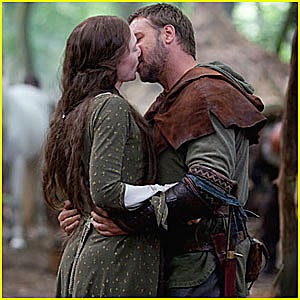 Holding to a dying man’s promise, Robin detours to the hamlet of Nottingham to relay a message to his family. There he meets (Maid) Marion Loxley (Cate Blanchett) and her father-in-law, the sightless Sir Walter Loxley (Max von Sydow). It turns out the dying man was Sir Robert Loxley (Douglas Hodge), Marion’s husband. The story line detours from tradition yet again. The Loxleys are in danger of losing their land to the tyranny of the Sheriff of Nottingham (Matthew Macfadyen) who is only following orders from the despicable King John (Oscar Isaac), Richard the Lionheart’s younger brother. Marion talks Robin into posing as her late husband to prevent automatic seizure of their property. Is it surprising a love story subplot develops?
The remainder of the film, which runs 2 hrs., 20 mins., but seems longer, is filled with government (both French and English) deceit, bloody battles, bows and arrows, and a lot of foot run rushes and horseback rides. And yelling, particularly during the battle scenes. Those yelling inclusions, though necessary and totally expected, were either hampered by the inherent audio soundtrack or the sound system where this film was screened. Because the audio was turned up so loudly, 75% of the dialogue during the action sequences was incoherent. It doesn’t help either that Marc Streitenfeld’s forgettable music is full of flourishes and sweeps made deafening due to the sound system’s maxed out decibels. Aye, these are not positive enjoyment factors, Robin. Or I should say Ridley.
The pluses of Robin Hood are the landscape, castle, ships and battle scenes. Let me qualify that the long shots of battles are superb. However, the close-ups of hand-to-hand, sword-to-sword combat are of the hand-held, shaky, barf inducing-due-to-dizziness type. This way the filmmaker does not have to overly choreograph a fight, it is merely CGI enhanced with jerks and pans that imply fighting. Even an action video game triggers less headache than this.
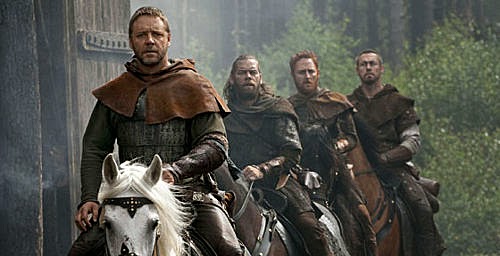 While Crowe’s bow and arrow expertise is obvious (the word is he spent endless hours practicing to perfection), his horseback riding is painful to view, probably because it is. He rides with grimace, bent over, and stiff, ill at ease in the saddle. (Why couldn’t this have been CGI enhanced?)
All actors are fine in their respective roles, including Crowe. Particularly effective is William Hurt’s William Marshal, a politician who changes loyalties as the story progresses. The story leads up to the time Robin and his men, including Will, Little John, Allan A’Dayle (Alan Doyle) and Friar Tuck (Mark Addy) are just beginning their well known encampment in Sherwood Forest.
While I applaud Ridley Scott for attempting to add to the legend of Robin Hood, it is doubtful this pre-story will be included in any future Robin Hood films. Please think Errol Flynn and the established legend only next time.
——————–
GRADE on an A to F Scale: C-
——————–
Worth 1,000 Words: JOHN WAYNE & JACK ELAM, seeking bad guys

By Steve Crum
In a familiar western scene with familiar western stars, JOHN WAYNE (as Cord McNally) is framed in a barn door as he walks the Wayne walk, rifle ready. JACK ELAM (Old Man Philips), McNally’s sidekick, watches both their backs over a dispensed outlaw. This is a scene from 1970’s RIO LOBO, directed by HOWARD HAWKS. If this particular scene looks like a signature JOHN FORD-framed visual from The Searchers (1956), which also stars Wayne, it surely must be coincidence. Ford had his John Wayne-Cavalry Trilogy (Fort Apache, Rio Grande, She Wore a Yellow Ribbon); and Hawks had his John Wayne-The Law Needs Community Support VS Outlaws Trilogy (Rio Bravo, El Dorado, Rio Lobo.) There obviously was a heap o’ plot and camera shot rustlin’ in the Ol’ West.
By this time in their careers, JOHN WAYNE (May 26, 1907-June 11, 1979) and JACK ELAM (Nov. 13, 1920-Oct. 20, 2003) were almost solely identified as cowboy actors, with Duke Wayne THE iconic western star of the genre. Elam had turned his acting life 180 degrees after supporting James Garner in 1969’s comedy-western Support Your Local Sheriff. Until then, he was cast as vicious outlaws and degenerates. After Support, Jack Elam was repeatedly cast as the zany, eccentric cowboy sidekick. This blossomed into three short-lived TV sitcoms starring Elam.
——————–
On the reverse of this original press kit photo, titled WAYNE’S IN THE WEST, the caption reads: Big John Wayne, fresh from his Oscar triumph, heads the cast in Cinema Center Films’ action-packed Western, “RIO LOBO,” directed by veteran Howard Hawks. The National General Pictures release stars Wayne as an ex-Civil War officer who frees a Texas town of carpetbaggers and settles an old score with a wartime informer. “RIO LOBO” stars John Wayne, Jorge Ribero and Jennifer O’Neill. Produced and directed by Howard Hawks. A National General Pictures Release in Technicolor. A Cinema Center Films Presentation. [from Steve Crum’s showbiz memorabilia collection]
——————–
Pilgrim, enjoy this action clip from RIO LOBO: http://www.youtube.com/watch?v=z7ygYmuqgVg
‘Iron Man 2’ delivers heavy metal, superhero thrills

By Steve Crum
Once you get past accepting comedian Garry Shandling as U.S. Senator Stern (hey, he’s a comic in a comic book movie), Iron Man 2 kicks in, turbos upward and fuses on into one spectacular action tale. What a dazzling way to launch the summer movie season. With all its pyrotechnics, maybe IM2 should be opening July 4.
Typical of most superhero franchises, the first Iron Man movie introduced the central hero by spending half the story on the character’s origin, before evolving toward the hero vs villain, clobberin’ time climax. IM2 cuts to the chase in quick time. A foreboding Russian villain is introduced, played by the foreboding looking actor Mickey Rourke. (Is extra makeup really necessary?) His Ivan Vanko character is hell bent on perfecting his own robotic suit with attached metal slicing, spark zapping, bullwhip strands.
Conversely, Tony Stark (Robert Downey Jr.) is reveling in his fame as world protector Iron Man. Remember, he willingly shouted out his secret identity in IM1. Now the earth, thanks to him, is safer, virtually crime free. (One would think this is also the case in the worlds of Spider-Man, Superman, Batman, etc.) This leaves Stark down time to exploit himself and his alter Iron ego on TV spectaculars. He eats up the attention. At the same time, in private, he frets about his declining health. Without divulging too much, this becomes a major plot element.
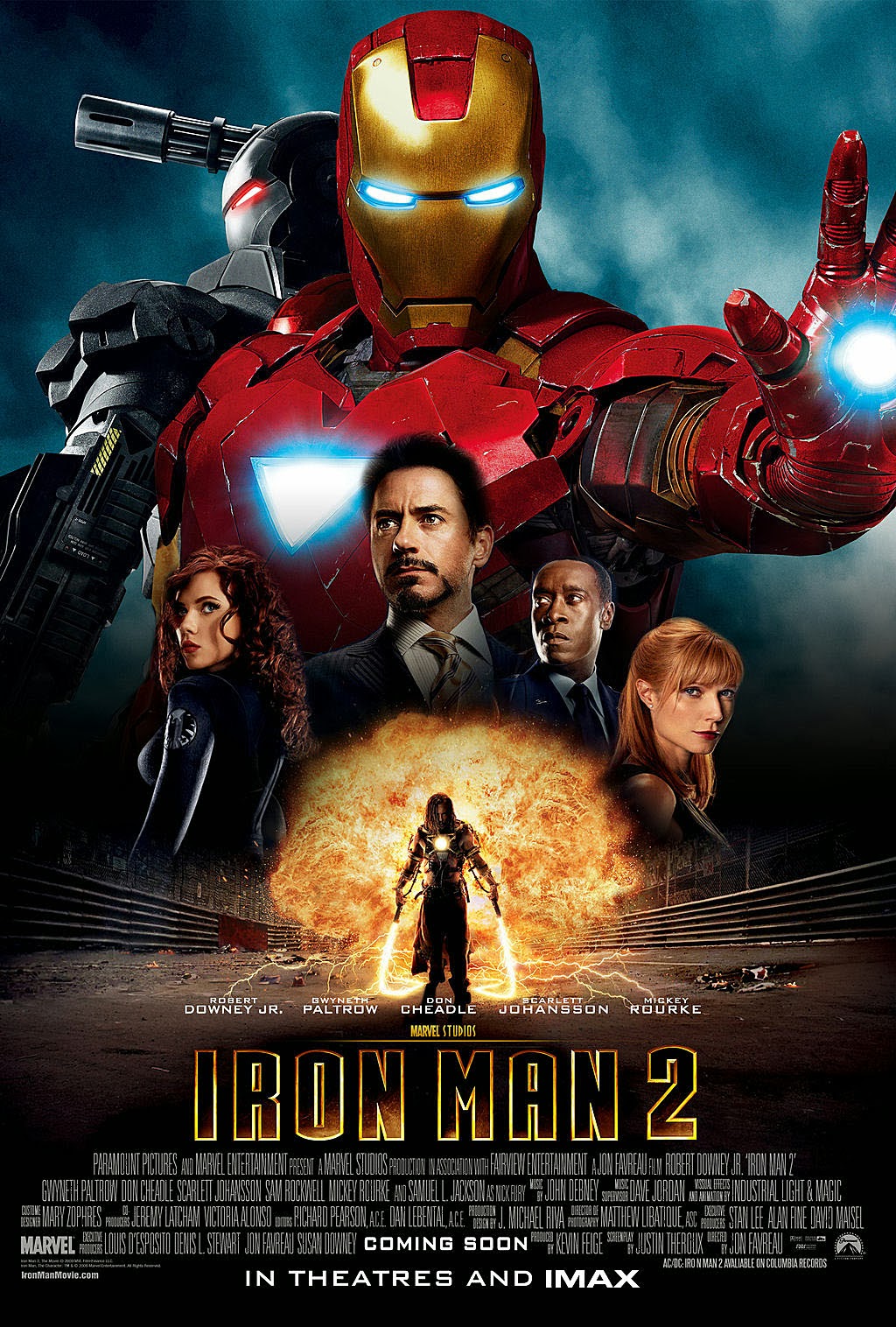 It is no secret that there are newly introduced (super)heroes in IM2. (Actually, they are long time, Marvel Comics characters.) Samuel L. Jackson’s Nick Fury was briefly shown in IM1, but occupies major screen time here. However, his scenes are of the static, non-action, confer-with-Tony Stark variety. This begs the question: What is the tough looking, eye-patched, man in black’s function in IM2? His protege, Black Widow/Natalie Rushman (Scarlett Johansson), certainly pays her entertainment dues via her sexy, kick booty action takes. Fury is a man of talk, not action.
 The surprise of IM2 is Don Cheadle’s Lt. Col. “Rhodey” Rhodes. Cheadle, who replaces IM1’s Terrence Howard, gets to suit up and play an Iron Man sidekick to THE Iron Man. Together, in one of the film’s highlights, the two Iron Men battle a circling army of Iron Man-like robots. It is an ironic moment.
Gwyneth Paltrow is back as Stark’s chief exec and confidant, Pepper Potts. Sam Rockwell’s backstabbing, superficial Justin Hammer is the Stark Corporation’s chief rival for weapons contracts with the feds. Hammer becomes even more formidable and threatening to Stark when he enlists Ivan Vanko as his chief robot designer.
The expected mix of good and evil robots eventually leads to the King Kong inspired finale involving monster robots, Vanko, and Iron Man. Within those 15 finale minutes lie some of the most thrilling action footage this side of Lucas and Spielberg. Factoring in the Nascar-like race sequence toward the beginning with Vanko’s awesome debut–electrical whips and all, multiplies the reasons to experience IM2. Forgive my gush, there must be more comic book geek in me than I thought.
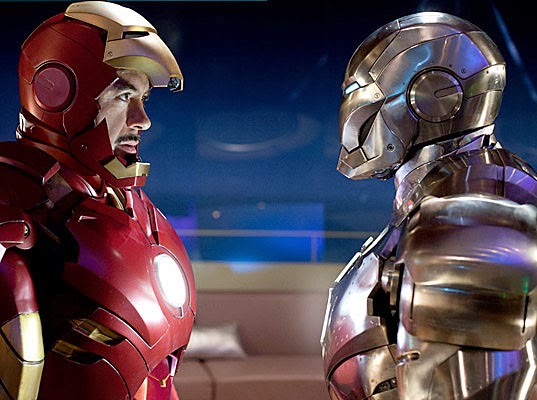 I’ve saved my comments about director Jon Favreau and his writer Justin Theroux until now. Theroux has perfectly captured Tony Stark’s egocentricity as well as his drive to live life over the top out of fear of impending death. It is never clear whether Stark is driven by fame and hero worship alone. He talks patriotism and peace for mankind, but delivers the message like a carnival pitchman. Theroux makes this complexity believable.
 Favreau continues to do Marvelous things with the Iron Man franchise. The look and feel of the action sequences and use of restrained humor (again thanking Theroux) make this superhero one of the best of them all. Favreau also plays the continuing, non-super hero Happy Hogan, who is a comedy relief sidekick to Tony Stark. (During one choice sequence, Hogan spends six minutes in fisticuffs with one bad guy, while the nimble Black Widow takes down a dozen.) Including the Hogan character is a welcome touch, nicely realized by Favreau’s acting.
IM2 is as solidly super as the first Iron Man movie, and in spectacle alone surpasses IM1.
A hint: Stick around after the credits. There is a three minute teaser regarding the next installment…or perhaps a hint of another franchise in the wings.
——————–
GRADE on an A to F Scale: A-
——————–