It makes for a bad day to see ‘A Good Day to Die Hard’

By Steve Crum


Mr. Willis has done wonders to redefine the word “Bruce.” But his name and presence in the latest and surely last Die Hard franchiser, A Good Day to Die Hard, directed by John Moore, is a no-gainer. It is not his fault he has grown more than a tad too old to play John McClane (for the 5th time since 1988), but he can be blamed for signing on to such a script-shallow, decibel-deafening blast-fest. What a disappointment for die-hard fans of Die Hard, yours truly among them.

This time police detective McClane heads off to Moscow, no less, to check on or rescue (it’s never clear which) his estranged son, Jack (Jai Courtney), who has somehow gotten himself convicted of high crimes and is pending a very public trial. By the way, Papa John’s daughter, Lucy (Mary Elizabeth Winstead), briefly appears at the beginning and end of the film. (She was more prominently featured in the last Die Hard movie, so she has had her minutes of fame.) 

Soon after McClane arrives outside the Russian court building, all hell breaks loose as explosions ensue, making a literal shambles of everything and everyone inside. As luck would have it (and there is a myriad amount of luck and coincidences in this movie), Jack and political prisoner Komarov (Sebastion Koch) escape. All this leads to a seemingly two hour, frantic chase (actually it takes about eight minutes) through downtown Moscow’s jammed streets. 


A Good Day to Die Hard is not the first, nor will it be the last, action movie to feature rock’em, sock’em car chases through downtown streets. By now, the bar has been raised so high in stunt and CGI driving and crashing that one wonders where do we go from here? In Good Day, that means including three humongous transports in the chase, a destructo truck rally gone mad. 


Prepare to put your disbelief in overdrive suspension, because not once is there indication of any bystander actually being hurt, let alone obliterated, during the explosions and chase scenes. Oh, but there are cars upon cars crunched and mangled big time. Absent too are any emergency vehicles like paramedic or fire trucks. And it is alarming that Russian police are non-existent. What a country!

Skip Woods’ cliched screenplay involves the CIA, corrupt Russian politicos, good guys who are bad, bad guys who are good, and spies who will do anything for the sake of loyalties. That is, some operate that way. It’s way too convoluted for my critical brain. 

Like Stallone, Schwartzenegger, and similar genre movies, A Good Day to Die Hard features (in this case) two heroes, father and son, who withstand explosions, car wrecks, falls through multiple floors in buildings, beatings, and gun shots with nary a bruise. The hero might be bloody from stem to stern in one scene, and then patched with a Band-Aid in the next. I always marveled at Kiefer Sutherland’s resilience to do likewise in TV’s 24. These guys go far beyond their fellow men in fighting evil and remaining unscathed. John McClane is such a mythical being.


Incidentally, there is neither an appearance nor mention of Mrs. McClane, significantly portrayed in the first couple of Die Hard flicks by Bonnie Bedelia. I had hoped for a happy reunion featuring the entire McClane clan at the conclusion. Maybe she couldn’t make it due to her incarceration in India or somewhere. Look for her rescue in A Good Delhi to Die Hard. 

———-
GRADE on a Scale of A to F: D
——————–
Hopefully it’s a good day to see this flick’s trailer: https://www.youtube.com/watch?v=oW9uT2wQFC0

Share:

Hoffman’s ‘Quartet’ charms with last hurrahs of elderly opera singers

By Steve Crum

 
Director Dustin Hoffman’s charming musical drama (with some comedy), Quartet, spotlights the terrific Maggie Smith. The ensemble star of two recent films (The Best Exotic Marigold Hotel being the other) and a TV series (Downton Abbey), she is again playing an elderly woman of feisty spirit. As the celebrated opera diva Jean Horton, she is the driving force in this story of former opera singers and musicians who deal with their pasts and present situation while living at Beecham House, a stately senior citizen residence in the English countryside.
 
Before she arrives at Beecham, however, we meet an array of talented eccentrics, including the three who were her friends and fellow singers, Reginald Paget (Tom Courtenay), Wilfred Bond (Bill Connolly), and Cecily Robson (Pauline Collins). Reggie, it seems, has his own set of memories since he and Jean were once married. Their reunion via living in the same residence sparks the central conflict in Quartet. Both try to avoid each other, but inevitably it is not possible. After breaking up with the quartet, as well as her marriage, Jean became a solo star with ego extreme. Her egomania accompanies her to the new surroundings. 
 

However, Jean’s snootiness does not deter old friends Wilfred and Cecily from trying to reignite their friendship with her. The reserved Reggie, no surprise, mulls about and takes long walks to avoid any confrontation with his ex. Wilfred maintains his reputation as an outspoken wit and womanizer, not that he has any attraction other than friendship with Jean. His daily rowdiness consists of flirting and sexual innuendo with the waitress and Beecham manager. Billy Connolly is perfect for the role, and really the needed comic relief for this otherwise bittersweet love story. On the other hand, Cecily is rather dowdy and suffering from bouts of dementia. 

 
Adding to the mix are the other residents, particularly Michael Gambon’s Cedric Livingston, who sing and play instruments around the house grand piano almost constantly. A few appear to be more so English music hall performers than opera singers. This is particularly evident during the film’s last act when the annual Beecham House gala concert occurs. 
 
That is also the crux of the subplot which begs the question: Will Jean re-team with her quartet to perform at the gala? 
 
Based on Ronald Harwood’s play of the same name, Quartet explores relationships, the world of music, and the challenges of growing old. It makes for fascinating plot elements that mesh well. Harwood also penned the screenplay. 
 
Director of Photography John de Borman, who shot Dustin Hoffman’s movie Last Chance Harvey), shared Hoffman’s motivation for choosing Quartet as his directorial debut. At 75, Hoffman “is so reflected in (Quartet) itself,” says de Borman. “Here’s a man who was the most well-known and the best actor of his generation, and he’s very human. He has a huge sense of humor and he’s life enforcing. And those are the elements of this film. It reflects Dustin completely. This could only have been done as it is now with Dustin.” 
 
While Quartet seems to be part of a double feature with The Best Exotic Marigold Hotel, Maggie Smith’s other recent feature about living in a retirement home, it does lack Exotic’s breadth of characterizations and humor. Yet Quartet has its element of music, which can also be used metaphorically. After all, life is about being on the same page. 
——————–
GRADE on an A to F Scale: B
——————–
Share:

Masterful ‘The Master’ headlines Kansas City Film Critics awards

By Steve Crum
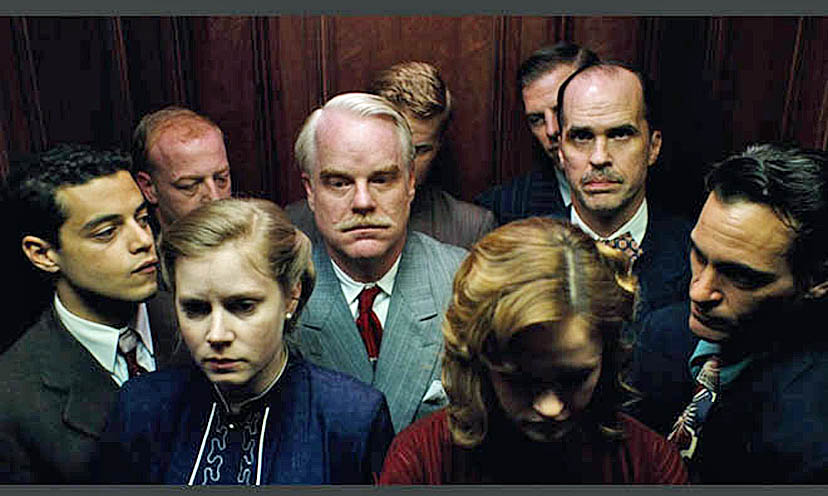
 
Director Paul Thomas Anderson’s The Master was chosen Best Picture of 2012 at yesterday’s (Dec. 16) KCFCC awards voting. In fact, the film garnered a trifecta, with Philip Seymour Hoffman’s Best Supporting Actor as well as Anderson’s Original Screenplay. 
 
Ang Li received Best Director for Life of Pi, which prompted my groaner-quip, “Pi r won.” I was among 32 vote-casting film critics, representing KC mass media outlets, who are members of the Kansas City Film Critics Circle, the oldest major city film critic organization in the nation. 
 
The complete slate of winners at the 46th Annual Loutzenhiser Awards, named for the late founder of the KCFFC, Dr. James Loutzenhiser:
 
BEST PICTURE…The Master
 
ROBERT ALTMAN AWARD FOR BEST DIRECTOR…Ang Li [Life of Pi]
 
BEST ACTRESS…Jennifer Lawrence [Silver Linings Playbook]
 
BEST ACTOR…Daniel Day-Lewis [Lincoln]
 
BEST SUPPORTING ACTRESS…Anne Hathaway [Les Miserables]
 
BEST SUPPORTING ACTOR…Philip Seymour Hoffman [The Master]
 
BEST ADAPTED SCREENPLAY…Chris Terrio [Argo]
 
BEST ORIGINAL SCREENPLAY…Paul Thomas Anderson [The Master]
 
BEST FOREIGN LANGUAGE FILM…Amour [Austria/France]
 
VINCE KEOHLER AWARD FOR BEST SCIENCE FICTION, FANTASY OR HORROR FILM…The Cabin in the Woods
 
BEST ANIMATED FILM…Frankenweenie
 
BEST DOCUMENTARY…The Imposter
——————–
Share:

While not masterly, ‘Hitchcock’ is fun, fascinating ‘Psycho’ telling
By Steve Crum

The cliche “crowd pleaser” applies to Hitchcock, which dramatizes a crucial time in the professional life of Alfred Hitchcock, when he made Psycho. That 1960 film marked the artistic and commercial peak of Sir Alfred’s career, and was one of the biggest crowd pleasers in the history of motion pictures. 

If only Hitchcock the movie had focused solely on Psycho’s behind-the-scenes production, which would have made it even more pleasing. Instead, there is a makeshift subplot involving Hitch and his wife Alma’s marriage bond, or lack thereof. Make that two subplots, the second referencing Hitchcock’s psychological fixation on real-life, sicko serial killer Ed Gein, the inspiration for Psycho’s central nutcase, Norman Bates. No doubt John J. McLaughlin’s screenplay, which is based on Stephen Rebello’s Alfred Hitchcock and the Making of Psycho, includes the peripherals to appeal to a wider, non-movie buff audience. In the process, the story is muddled and somewhat alienates those who ARE Hitchcock fanatics. 

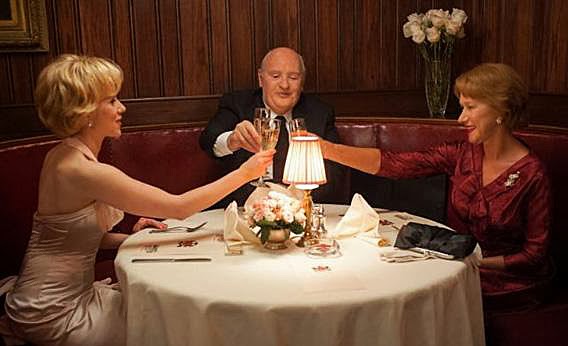
Director Sacha Gervasi does an impressive, if not campy, job with numerous profile shots of Hitchcock (Anthony Hopkins) in stereotypical pose. The Ed Gein dream sequences that show some of the atrocities he committed, particularly toward his mother, echo Psycho scenes featuring Norman and his mama. While it is documented that Hitch did base his Norman Bates on grim Gein stories he had read, there is no proof he obsessed about Gein to any extent. The film strongly implies Hitchcock was himself psychotic about the Gein saga, dreaming about it at night, and imagining Gein himself is advising for authenticity during the actual direction of Psycho. By the way, Gein’s murderous ways formed the basis for The Texas Chainsaw Massacre, a heinous 1974 movie directed by Tobe Hooper that spawned several sequels and copycat horror flicks.
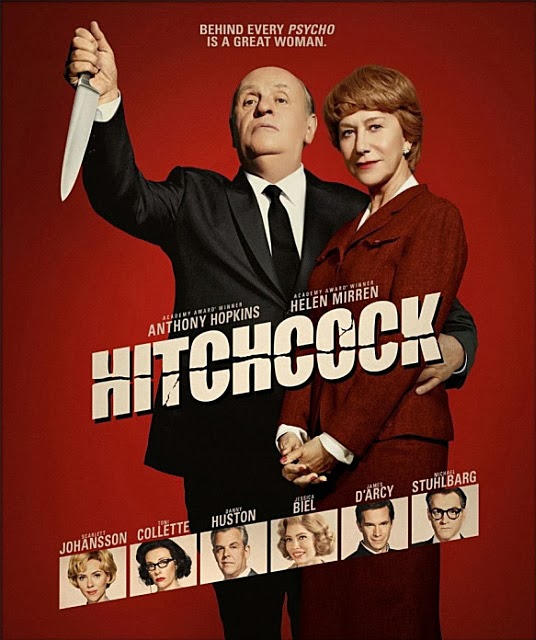

Hitchcock’s relationship with his wife and film collaborator Alma Reville (Helen Mirren) clearly suggests that by the time Psycho was being planned, their marriage was more so one of convenience and uncertainty. Using a great deal of artistic license, Gervasi and McLaughlin fill in relationship unknowns with a quasi-love story. Although the two respect each other for their personal and professional history, Hitch himself feels he can tackle Psycho virtually alone, which alienates Alma to collaborate on close friend Whitfield Cook’s screenplay. As the two take extended trips to Cook’s beach house to edit and write, Alfred becomes jealous. 

Of course, Hitch continues his womanizing on and off the Psycho set, flirting with and leering at Janet Leigh (Scarlett Johansson) and Vera Miles (Jessica Biel). Such Hitchcock escapades are facts that have taken legendary proportions. See the recent HBO movie, The Girl, which shows Hitchcock literally pouncing upon Tippi Hedren in the backseat of his limo. While that incident may be exaggerated, Hitchcock’s lust for his blonde actresses is a given. It is assumed he never channeled Ed Gein during those moments. 

The meat and most fun of Hitchcock, however, is the making of Psycho scenes themselves, on and off the set. Casting Anthony Perkins (James D’Arcy) as Norman was influenced by Perkins’ own mother fixation. We also learn of Hitch’s near disgust at Vera Miles for ruining his plans of making her a star by getting pregnant. Funny that in Psycho, Miles has more screen time than the top-billed Leigh, with Leigh’s character killed off early in the movie. 

Integral to the Psycho production story is Hitchcock’s fight early on with financing at Paramount Pictures, which (as shown) ended with Hitch himself financing the film. To me, Bernard Herrmann’s Psycho score contributes to at least half the impact and success of the movie. Happily, thanks to a very telling sequence involving a preview audience, Hitchcock verifies what I have realized all along.  

Even though Anthony Hopkins is not a Hitchcock clone, his makeup, body language, and speech mannerisms are convincing enough to accept him as “The Master of Suspense.” Add to it enough appropriately dark humor, and the illusion works. 

Despite the Ed Gein and love story MacGuffins, Hitchcock makes for a “good evening.” 
——————–
GRADE On an A to F Scale: B
——————–

Presenting the trailer to Hitchcock: https://www.youtube.com/watch?v=3rQuRLERl6A

Share:

Mathew Brady tintypes seemingly come to life in fascinating ‘Lincoln’

By Steve Crum

 
Eighteen years ago while walking to the parking lot after screening Jurassic Park, my then 12-year-old daughter said to me, “Dad, I feel like l’ve just been with real dinosaurs.” She was referring to what she saw in the movie, not me and fellow movie critics. I felt much the same after seeing Steven Spielberg’s recent other work, Lincoln. I had been in the presence of our 16th President for 150 minutes, a unique experience, certainly. Figuratively, at its visual core, Lincoln is a collection of Mathew Brady photos come to life. 
 
That is not meant to imply Lincoln is a documentary. It isn’t, but the incredible thing about it is its credible realism. Certainly, Spielberg gets enormous credit as director and co-producer, but as in any artistically successful film, his team deserves kudos as well. Tony Kushner’s screenplay, adapted from the book Team of Rivals: The Political Genius of Abraham Lincoln, by Doris Kearns Goodwin, is laced with sharp wit and stirring rhetoric. The script includes documented speeches and conversations by Lincoln and his associates. After all, how do we really know everything said behind closed doors? Here is where Kushner and Goodwin fictionalize, but believably.
 

Another component vital to the success and atmosphere of Lincoln is the cinematography of Spielberg’s longtime collaborator, Janusz Kaminski. For Shindler’s List (1993), Kaminski photographed in newsreel-like black and white, adhering to our perception of WWII. For Lincoln, the look is bleached or amber-hued color, resembling 19th Century tintypes. Kaminski and Spielberg also chose to shoot indoor scenes with available light, via candle or kerosene lamp. The use of color seems more a lack thereof, and extremely effective for realism. K/S used a similar look for 1997’s Amistad.  

 
Lincoln is not a biography of Abe Lincoln’s entire life, but it vividly portrays the man during a critical period in our country’s history, nearing the end of the Civil War, and on the brink of abolishing slavery. In fact, during the course of the movie, we witness (per se) Lee’s surrender to Grant and, after belabored efforts–to say the least, the passage of the Thirteenth Amendment. This encompasses the final four months of Lincoln’s presidency and life, in 1865. During all the bickering and figurative backstabbing of Congressional members over both ending the war and passage of the amendment to end slavery, Lincoln himself stays focused on achieving both goals. The story is  enhanced by the inclusion of his badgering wife Mary, finely portrayed by Sally Field, shown to be both a thorn and driving force in her husband’s political efforts.
 
Of the 100-plus speaking roles, surely a record for any recent motion picture, it is Daniel Day-Lewis who dominates. I am neither the first nor last to note such. His Oscar worthy performance encompasses greatness. Day-Lewis IS Lincoln. Henry Fonda and Raymond Massey will forever be revered for their takes on The Great Emancipator, but the acting benchmark has now been set with Day-Lewis, our greatest living film actor. His body of film work is stunning. 
 
In addition to Day-Lewis and Field, there are at least a dozen noteworthy actors. Among them, Joseph Gordon-Levitt plays Lincoln’s eldest son, Robert, who tries to persuade his parents to let him enlist as a soldier. Tommy Lee Jones, as Pennsylvania Representative Thaddeus Stevens, delivers one of the two best performances of his career, the other being Coal Miner’s Daughter. Others deserving mention include David Strathairn, James Spader, Hal Holbrook, and Jackie Earle Haley. 
 
Scenes cover the Lincolns in bedroom talk, wherein Mary Todd relentlessly blames her husband for the death of their youngest son, Willie. On a lighter note, Lincoln’s tendency to both humor and manipulate fellow politicians by segueing into one of his homey, backwoods parables, even in the midst of advising a battle, adds to his unique characterization. 
 
Incidentally, do not expect elaborate scenes of Civil War battle. There is a sobering scene of Lincoln on horseback, stovepipe hat and all, slowly maneuvering through a battle’s aftermath of hundreds of dead soldiers. I was taken more with the fact President Lincoln is on horseback, an image never photographed–at least to my knowledge. 
 
There is a lot of flourish and pomp in Lincoln, as well as humanism and intimacy. Spielberg’s superb storytelling, like his classic Schindler’s List, is a must-see. 
——————–
GRADE On an A to F Scale: A
——————–
Share: