
Savoring delicious ‘Julie & Julia’ means no lean cuisine
By Steve Crum
 Channeling Julia Child had to be a challenge for Meryl Streep, and I do not mean just getting that distinctive voice down. Streep not only nails the voice, but the body language as well. Most importantly, and amazingly, she embodies the great chef’s spirit. In the vastly enjoyable Julie & Julia, Streep is Julia Child. And Amy Adams’ portrayal of Julie Powell, upon whose book the center of the film is based, is pretty superb as well. Prediction: Both will be nominated as Best Actress, with Streep winning…again.
I could not help but channel Julia Child myself, having watched her TV cooking shows over the years, and seen her spoofed by comedians like Dan Aykroyd on Saturday Night Live–which is actually shown in Julie & Julia. Surely anyone who ever heard Child has one of her lines (i.e. “Save the liver!”) to imitate in that deep, quavering, New England voice. I still have Child’s unforgettable narration of Tubby the Tuba on a Boston Pops album. Think Child, and punch, “Tubbbbby.”
Director Nora Ephron’s brilliantly realized screenplay blends two best selling books: Child’s My Life in France, written with Paul Prud’homme, and Powell’s Julie & Julia: 365 Days, 524 Recipes. Julia & Julia exceeds Efron’s best directorial work, You’ve Got Mail and Sleepless in Seattle included. She is, as Child might exude, on a Croissant roll.
The film opens in 1949 Paris. The Childs, Paul (an Oscar caliber turn by Stanley Tucci) and Julia, are moving into their new abode, a comfortable and attractive downtown apartment which Julia immediately praises as being “Versailles.” Cut to 2002, and Julie Powell’s small Queens, N.Y. apartment. Small is key here, since she and her husband Eric (Chris Messina) immediately have issues about space in regard to kitchen area.
 Soon into flipping from Julia to Julie and back, it is apparent both women face self crises. Both have willingly moved to support their respective husband’s careers. Now that the guys are content and living near their new jobs, the gals feel empty, and pursue their own career paths. For Julia, it means enrolling in cooking school; Julie starts a new receptionist job downtown, and to blog on her computer. Julia has a great line early on when her husband Paul is trying to help her decide on something to do to occupy her time. “What do you really like to do?” he asks. Julia’s answer: “Eat!” Cooking seems to be her destiny.
 It is also Julie’s. Utilizing her favorite cookbook, Child’s Mastering the Art of French Cooking, Julie decides to make it the basis of her new blog. In one blog entry per day, for an entire year, she will give an account of creating each and every recipe in Child’s book. That means she will have to cook, bake or grill at least one of the 524 dishes every day. Then she, her husband, and friends will get to eat each meal. That also means Julie has to meet her self imposed deadline of chronicling each day. Generally, she and her husband do OK with the new regimen, but it eventually wears on their relationship. It impacts Julie’s full time job as a phone receptionist as well. There are only so many hours in one day.
Meanwhile, several decades earlier, Julia progresses in her French cooking classes at the celebrated Le Cordon Bleu school in Paris. Despite a language challenge and being the only female student enrolled, her positive drive and intelligence elevate her to the top of the class. Her love for food is shared by her husband, who also loves and, frankly, lusts for Julia throughout the film. And vice versa. Somehow Julia’s catchphrase, “Bon, appetit!” fits here.
 The two ladies’ side careers take major turns. Julia Child will eventually write the humongous Mastering the Art… cookbook (734 pages), co-authored by Louisett Bertholle (Helen Carey), and become world famous for it. The frustrating years of publishers rejecting the book are depicted as well. (There is a choice sequence of a meeting with the author of what was then and remains the number one cookbook in the U.S., The Joy of Cooking.) Once Child’s book is published, and heralded as the “seminal culinary work” of all time, Child will find world fame as star of her own TV show(s) as The French Chef. Her personality, as well as her recipes, sells.
 In a somewhat parallel vein, Julie’s blogs have garnered enough faithful readers that The New York Times features her. This leads to a best selling book, Nora Ephron, and this film.
“All I can think about every day is food,” says Child. “Shopping for food is as interesting as buying a new dress.” Certainly Julie & Julia is about food and the delights of eating. But it is also about love between spouses, and between two authors. Although Julia never met Julie, Julie loved Julia, in a respectful, culinary way.
Ephron’s love for them both is obvious.
——————-
On an A to F Grade Scale: A
——————–
Don’t forget Red, George, ZaSu, Gunther, Dayton, Crazy & Pinky
By Steve Crum
 Not so fast, NBC and the Nielsen survey. Last night’s TV’S 50 FUNNIEST PHRASES left out some prime, and prime time, classics. Sure there were memorable phrases uttered by the likes of Bea Arthur’s Maude [“God’ll get you for that one”], Henry Winkler’s Fonzie [“Sit on it!”] and Redd Foxx’s Fred Sanford [“I’m comin’, Elizabeth!”]. And sure, last night’s program was just Part 1, with the second half airing next week.
 I should wait another week, but I can’t. Judging from last night’s list, few of the programs represented go as far back in TV history as THE JACK BENNY SHOW [1950-65]. While it is great Benny is among the chosen with his “Now cut that out!,” his inclusion is a bit of a fudge. Years before his TV stardom, his radio program was among the top 10. Catchphrases like “Well!” and “Now cut that out!” were spoken way back then.
My memory bank, which needs bail-out, includes a deposit box jammed with comic catchphrases. [No withdrawal jokes, please.] A couple of them might be included in the Top 50; I doubt the rest will. Here are my choices. Can you match them up with the photos above?
——————–
 THE RED BUTTONS SHOW [1952-55]: Red created a national sensation when he repeatedly uttered the immortal, “Strange things are happening.” Another Buttons catchphrase was “Ho-Ho!” [He’d say this as he cupped one ear, and hopped around the stage.] The two sayings were so popular that Buttons’ best selling single record included Strange Things Are Happening on one side, and The Ho-Ho Song on the other.
THE GEORGE GOBEL SHOW [1954-60]: “Lonesome George” Gobel made tales about his “mean ol’ wife Alice” even funnier when he punctuated them with phrases like “Well, I’ll be a dirty bird” and “We don’t hardly get those no more.” The dirty bird line is still spoken by many of the 50+ bracket today.
THE PINKY LEE SHOW aka THOSE TWO [1950-57]: There were two great, but silly, lines: “Yoo-Hoo, it’s me, my name is Pinky Lee” [his theme song] and “Game time, Pinky, game time!” The latter was yelled at him by one of his cast members as he squeezed and slapped Pinky’s cheeks. This was hilarious to me, an eight year-old.
THE STEVE ALLEN SHOW [1956-61]: Allen’s stock company of talented comedians is legendary. Among them, great catchphrases were born:
DON KNOTTS, always portraying a nervous guy, had his line. Each week, Allen would invariably ask him, “Are you nervous?”, to which Knotts would quickly reply, “Noop!”
 DAYTON ALLEN, later famous as the voice of Deputy Dawg, would answer a Steve Allen question with an upraised index finger and the surreal, “Why not?!” By the way, he and Steve were not related. •Enjoy this bit which does not include his catchphrase, but it is typical Dayton Allen: http://www.youtube.com/watch?v=t9SYfUPGCCQ
TOM POSTON’S schtick was to answer Steve Allen’s Man on the Street interview the same way week after week, year after year. The audience loved it, anticipated it. The simple bit was Steve asking Poston’s character his name. Then Poston would not know the answer, looking bewildered. Call it an anti-phrase, but it is catchy.
LOUIS NYE, before his stint on The Beverly Hillbillies as Banker Drysdale’s spoiled son, played Gordon Hathaway on the Allen program. Gordon’s wispy and hip delivery was punctuated by “Hi-Ho, Steverino!”
 CHARLEY WEAVER aka CLIFF ARQUETTE was best known as guest comedian on THE JACK PAAR SHOW, THE STEVE ALLEN SHOW, and THE HOLLYWOOD SQUARES. Besides reading his fictional letter from his mother, which he preceded with “I got a letter from Mama!,” his most famous saying was always directed to his audience: “These are my people!”
 THE JIMMY DURANTE SHOW [1954-57] introduced perhaps [see Red Skelton below] the most touching catchphrase from any comedy show. At the close of each program, the curtains opened to a bare, unlit stage as Durante would put on his coat [his hat was always on]. Large light circles from six spotlights led from stage center to the distance, and Durante would walk to each, turn, and tip his hat to the audience. Before taking the weekly finale, he would say sincerely, slightly tilting his head up, “Goodnight, Mrs. Calabash, wherever you are.” It was later learned he was referring to his late, first wife. •Here is that memorable closing: http://www.youtube.com/watch?v=yp7r0j4XrO8
THE RED SKELTON SHOW [1951-71] certainly had its throat catching phrase which Skelton said at the close of each show: “Goodbye for now, and may God bless.”
JACKIE GLEASON’S AMERICAN SCENE MAGAZINE [1962-66] featured catchphrases Gleason had introduced in his early TV days of the 1950s, “How sweet it is!” and “And away we go!” among them. A regular comic on his show, CRAZY GUGGENHEIM, portrayed by FRANK FONTAINE, brought down the house each week during the Joe the Bartender sketch. Each time Joe (Gleason) would call Crazy from the back room, Crazy would enter with that goofy face, hat pulled down tight, and say, “Hiya Joe, Hiya Mr. Dunahee-hee-hee!” His delivery, which included a half-witted laugh, was everything.
THE MANY LOVES OF DOBIE GILLIS [1959-63] introduced MAYNARD G. KREBS, the beatnik played by BOB DENVER, and his expected response to anyone offering his a job: “Work!” He said it with shocked expression. •Follow this link to some Maynard and Dobie: http://www.youtube.com/watch?v=o5yvMExqKNA
 MR. ED [1961-65] gave us the only memorable catchphrase uttered by a horse, the Mr. Ed of the title: “Wilbur!” Wilbur was his owner, played by Alan Young. Ed’s voice was ALLAN “ROCKY” LANE’S, a top B-western cowboy star.
THE GALE STORM SHOW [1956-60] had its own famous catchphrase…sort of. This is a bit of a fudge like the Jack Benny inclusion. Co-star ZASU PITTS, who played Gale Storm’s sidekick Nugey Nugent, would utter, “Well, forevermore,” during most episodes, when faced with a dilemma. Pitts actually used this phrase as far back as the early 1930s when she co-starred with Thelma Todd in Hal Roach 2-reel comedies. •For a very rare clip of ZaSu, selling Corn Flakes with Superman no less, follow this link: http://www.youtube.com/watch?v=iOT20LddFOo
CAR 54, WHERE ARE YOU? [1961-63] seems like a spin-off from THE PHIL SILVERS SHOW. Nat Hiken created both series, and when Silvers’ Sgt. Bilko show ended, he brought many cast members to the streets of New York, playing funny cops. Even though their names were different and they were dressed for new occupations, some of the catchphrases stayed. JOE E. ROSS’ Officer Gunther Toody, for example, would say, “Oooo, Oooo,” whenever he was excited. His Sgt. Ritzik did the same thing on the Silvers program. It was a catchphrase that stuck with Ross until his death. But Toody did say an originally-written-for-Car-54-Where-Are-You? line at least once per episode, directed at his partner, Officer Francis Muldoon [Fred Gwynne]: “Francis! Francis!” Imagine this with “Ooo, Ooo!” bookending it.
——————–
Tune in to next week’s second half of the TV’S 50 FUNNIEST PHRASES [Wed., Aug. 12, 7-8 p.m. Central Time] to see if any or all my choices make the cut.
IT’S CRUMMY TRIVIA TIME…with ROD STEIGER!
By Steve Crum
Make-up! We all know, don’t we, that Boris Karloff had to sit still for four hours every production day as he was made up as Frankenstein’s creation in Frankenstein [1932]? And that Lon Chaney’s grotesque make-up in 1923’s The Hunchback of Notre Dame took 4-1/2 hours a day to apply? The suffering artiste, indeed.

ROD STEIGER [1925-2002], however, is the all-time, marathon, make-up champ. Steiger withstood 10 hours of torso tattooing [actually painting to resemble tattooing] for his 1969 starring role in The Illustrated Man. It took a separate full day to finish his hands, legs, and lower body. Warner Brothers make-up guru Gordon Bau and eight assistants were responsible.
At least that is the skinny.
——————–
Things are fine in Mt. Idy [she goes on]


By Steve Crum
Although organ grinders are a long lost part of Americana, they used to set up their temporary street sites in large cities. As a child, I recall seeing one entertaining on a sidewalk during the 1950s at the Country Club Plaza in Kansas City. It consisted of a man, stereotypically an Italian, cranking a stand-up organ while his monkey would entertain passersby with somersaults and makeshift dancing. The music he played was always one tune, perhaps Pop Goes the Weasel, which would sound repeatedly.
A crowd would gather, the monkey [a small, capuchin type] would take his cute little hat off, tip it, and then pick up a tin cup and hold it out to the watcher(s) for donations. This meant a sparse living for the grinder. No doubt PETA, the ASPCA, and other animal rights groups had much to do with the end of the organ grinder and his monkey as an occupation. All this I say for those under 50 who probably never personally experienced an organ grinder, except maybe in vintage cartoons and movies. [A clip of a more recent organ grinder with monkey: http://www.youtube.com/watch?v=57fhOePVRFE ] That said…
 Segue to CLIFF ARQUETTE [1905-74], a funny guy whose act consisted of dressing in slovenly, old man clothing, including crushed hat, and talking about growing up in [fictional] Mt. Idy. [He is the grandfather of Arquettes Patricia, Rosanne, Alexis, Richard and David–all actors.] Assuming the comedy persona CHARLEY WEAVER, his appearances on The Jack Paar Show, The Steve Allen Show, and The Hollywood Squares kept him a leading comic for 20 years. He made record albums, starred in a couple of TV shows, guested on dozens more, and wrote several best selling books. Two of the books were compilations of his Letters from Mama routines, in which he would pull a folded letter from his back pocket, climb up, say, on Paar’s desk, and proceed to read his latest “letter” from his mother. Full of corn and surrealism, the letters told of eccentric Mt. Idy denizens Elsie Krack, Leonard Box, Grandpa Ogg, and other odd folk. A favorite Letter from Mama includes this wild tale regarding an organ grinder [hence the previous explanation and build-up]. It is, in monkey speak, bananas:
“Will you ever forget the time Ludlow Bean fell into the hay bailer, and from then on had to have all of his clothes made square? We’re all proud of Ludlow. When he first came to Mt. Idy, he started out in a small way. He started as an organ grinder, with one small monkey. He worked hard and saved. Two years later he expanded–now he has a pipe organ and a gorilla. He doesn’t have any trouble with people putting money in the cup now.”
Loved that Mama; loved that Charley.
Saying the secret word, or not, with Groucho
By Steve Crum
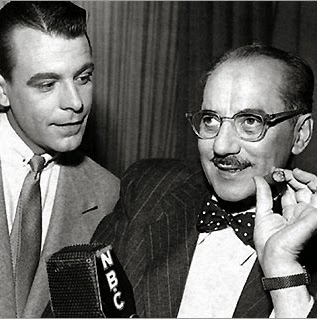 Groucho Marx met Fr. John Bremner during the 1958 season of You Bet Your Life, Groucho’s popular TV comedy-quiz show. The show began on NBC radio in 1947, and transferred to television for a successful run from 1950-61. Groucho, accompanied by his announcer George Fenneman, would chat and joke with guests. Most guests were non-celebrities.
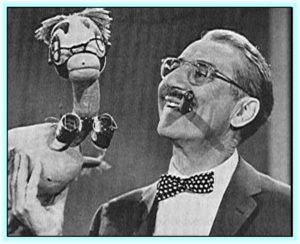
 After five minutes of cajoling, it was time for the quiz. Prize money was not that much, compared to big time quiz shows of the mid-1950s like The $64,000 Challenge. A winning couple on You Bet Your Life usually cashed in for several hundred bucks. But they could take home $10,000. A gimmick was to reward contestants with $100 if the “secret word” were spoken. As Groucho would say each time a couple would enter the stage, “Say the secret word, and divide an extra $100 between you.” If either contestant would say the unknown word in regular conversation, like “soap,” a gangly looking, toy duck [with a Groucho mustache and cigar] would drop by wire from above. Two $50 bills were attached.
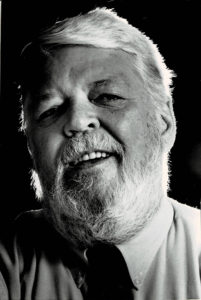
Enter John Bremner. In 1958, Bremner was a Roman Catholic priest, and had finished a stint as political columnist for The Tidings, a Los Angeles Catholic newspaper. He would spend 25 years as a priest before devoting his career to teaching the importance of words. From 1969-85, Bremner served as professor of journalism at The University of Kansas. He was Dr. Bremner then, and one of the most respected names in journalism not only on campus but throughout the United States. His two books, Words on Words and HTK are still required reading in journalism schools and by newspaper and magazine writers and editors. When he died from cancer in 1987, students and colleagues were stunned. I was among them.
During my 21 years of teaching journalism at J. C. Harmon High School in Kansas City, Kansas, my students and I were fortunate to sit in on lectures and seminars at KU featuring Dr. Bremner. Many of my students later had him as an instructor at KU. He was an imposing figure at 6’ 5” with white hair. He intimidated students with theatrics and purpose. He cared about the use of words, and he wanted others to care. His students and colleagues knew that, and respected him for it. He certainly changed my writing for the better.
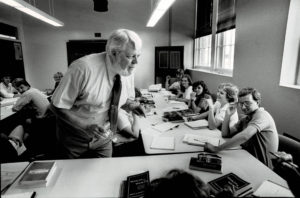 That Bremner agreed to appear as a contestant with host Groucho Marx is somewhat apt. Groucho also loved words. Marx’s quips and puns were central to his lightning wit. Remember these were the pre-journalism professor days of Bremner. He was appearing on the show with the hope of raising money for his church. Groucho knew him only as a priest, and Bremner was dressed as such.
 You Bet Your Life has not been rerun for at least 15 years, and that is a shame. But when I chatted with Bremner while he was preparing to lecture my students in 1978, the show, called The Best of Groucho in reruns, had for years been regularly broadcast at various times nationwide. He seemed to know I was going to ask him about his appearance on the show that had just aired locally. For the umpteenth time over the last 20 years it had aired.
“I get calls from friends, relatives and former students all over the world every time that show airs,” Bremner said with forced smile. “Sometimes they call me in the middle of the night while I am asleep. I always tell them, ‘Yes, it was really me,’ and, ‘Yes, I was a priest then’.”
 The shocker that sticks with me regarding our conversation is neither that Groucho was both funny and a nice guy nor that the several hundred dollars Bremner made was given to the Catholic Church.
 The scoop is that Bremner was tempted to cheat. He and his partner had already won the initial cash, and were waiting backstage to reenter later in the show to answer questions for the big bucks. A producer told him he was so popular with the studio audience that they would like him to win the jackpot. “Since a charity would get my winnings,” Bremner said, “I was told it would work out well for everyone. All I had to do was read the questions, supplied with correct answers, before going back on stage.” He refused to cheat. As it turned out, Bremner and his partner lost during the final round, but left with decent winnings nonetheless.
A question begs: Was this the only time a contestant on You Bet Your Life was offered the answers? The quiz show scandals of 1958 involved widespread cheating on such programs, yet Groucho’s show kept running to 1961. By then, virtually all other quiz shows were absent from TV, and remained so for years. Had Bremner gone to authorities and told them of what the Marx show had offered him, maybe Groucho’s reputation and career would have suffered. However, You Bet Your Life remains a legendary quiz show that stayed on the proverbial up and up, without scandal.

“To love words, you must first know what they are,” Bremner later wrote. No doubt he would have a field day editing this piece.
——————–
Unfortunately, the Bremner/Groucho show is not available, but here is a clip from another You Bet Your Life episode from Dec. 5, 1957…featuring opera singer John Charles Thomas: https://www.youtube.com/watch?v=askyshysvbw
John Bremner tributes: a wonderful piece, The Legend of John Bremner, hosted by Edwin Newman, that includes rare footage of Bremner lecturing: https://www.youtube.com/watch?v=7Wgi1rJK5gU