
Author: Steve Crum
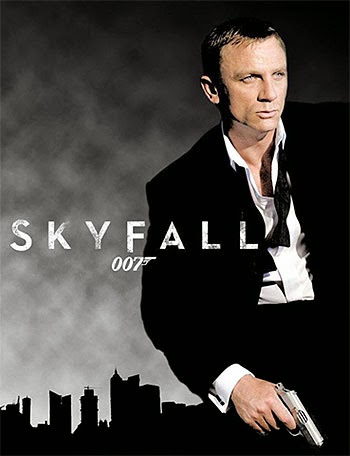
‘Skyfall’: THE best James Bond movie…ever
 By Steve Crum

As the story (by Neal Purvis, Robert Wade, and John Logan) develops, it is clear that British spy headquarters M16 is under explosive attack because of its leader, M (for the final time played by Judi Dench). Something or someone is targeting her agency to get to her. Unfortunately, at a crucial time like this, M’s foremost agent, 007, has some issues of his own, interfering with duty to M and country.
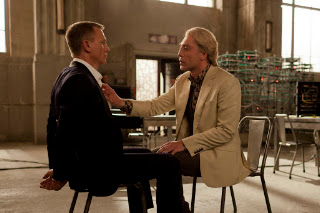 This development does give ultra-psychotic Silva, played by Javier Bardem in blond wig, opportunities to display his viciousness, making him the most formidable and dangerous Bond villain of them all. Just try not to think of his similarities to Hannibal Lecter when he is (temporarily) jailed. Each and every Bond bad guy is dangerously eccentric, but the relentless Silva, an ex-M16 agent, is vastly more conniving and driven, fueled by personal vendetta. Bardem’s bloodthirsty villain Anton Chigurh in No Country For Old Men in many ways registers as a kissin’, er, killin’ cousin to Silva.
 By mid-movie, M is both in danger of being killed and losing her job (through forced retirement) in the process. However, there is always 007 to her rescue, along with his sometimes able assistant, Eve (Naomie Harris). Even M’s second in command Gareth Mallory (Ralph Fiennes) proves himself as no slouch in heroics. She and M16 get able support from the newly designated and very young Q, played by Ben Whishaw, who looks like he just stepped off The Big Bang Theory set.
 The trailer previews a goodly number of Skyfall’s thrills: https://www.youtube.com/watch?v=6kw1UVovByw
‘Flight’ will undoubtedly garner Oscar nomination for Denzel
 By Steve Crum
The wrenching story (penned by John Gatins) follows a would-be heroic commercial airline pilot and his ongoing decent into the hell of drug and (particularly) alcohol addiction. Washington portrays veteran pilot Whip Whitaker, whose cocky worldliness masks a lonely, driven soul. We perceive him first as a carefree, cool ladies man, but Whitaker‘s persona rapidly changes to disgusting irresponsibility. It is the acting challenge of a lifetime, and Washington triumphs.

Flight’s harrowing first 15 minutes features one of the most white knuckled plane crash sequences in film history. What begins as a routine morning flight from Orlando, with 88 passengers aboard, quickly turns deadly. Captain Whitaker, assisted by Co-Pilot Ken Evans (Brian Geraghty), tensely maneuvers through stormy skies only to encounter one engine malfunction after another. The plane nose dives out of control.
 Here is where the real story of Flight begins, as Whitaker’s personal life spirals to a devastating crash due to his alcoholism. His union rep, Charlie Anderson (Greenwood) and union attorney Hugh Lang (Cheadle) struggle to cover up Whitaker’s inebriation while flying as well as keep him sober as he testifies before feds at an NTSB hearing. Unfortunately, Whitaker’s addiction now directly affects his ex-wife, his teen son, and a new girlfriend (Reilly). The same goes for his old friend, Nadine Velazquez (Katerina Marquez), a flight attendant.
——————–
Take flight with this trailer: https://www.youtube.com/watch?v=MlFMZ5D8FNc
‘Cloud Atlas’ is supremely complex, stunning epic
 By Steve Crum
 But as long as one is very patient, and willing to ride with six separate story lines that dart back to forth to forth to back and in between, then there is no problem. Otherwise, Cloud Atlas is problematic. With a narrative that seems at first to be all over the place, the multiple stories are sometimes hard to grasp. Stories are joined in disjointed ways. The good news is everything gets clearer as the film progresses. Patience is indeed the virtue here.

 A figurative time capsule captures the complex story lines: in 1849, a San Francisco lawyer protects a runaway slave on a ship in the Pacific Islands…in pre-WWII Great Britain, a poor but gifted composer commits an act which influences the creation of a lifelong work he calls “Cloud Atlas Sextet”…a 1973 journalist tries to avert an industrial disaster…a present day publisher faces unjust imprisonment as he nears great success…in 2144, a genetically engineered young lady, bred to follow orders without thought like a robot, begins adopting human emotions, and acting upon them…and in 2300 or thereabout, a goat herder faces both his conscience and violent surroundings in an evidently post-apocalyptic world. Hanks, Berry, and cast all act in key roles of each segment, and do so quite gloriously. I will not muddle the mind explaining or even listing all their characterizations.
——————–
Maybe the trailer will help clarify: https://www.youtube.com/watch?v=ByehYal_cCs
Factual, ultra tense ‘Argo’ is one of 2012’s top films
 By Steve Crum
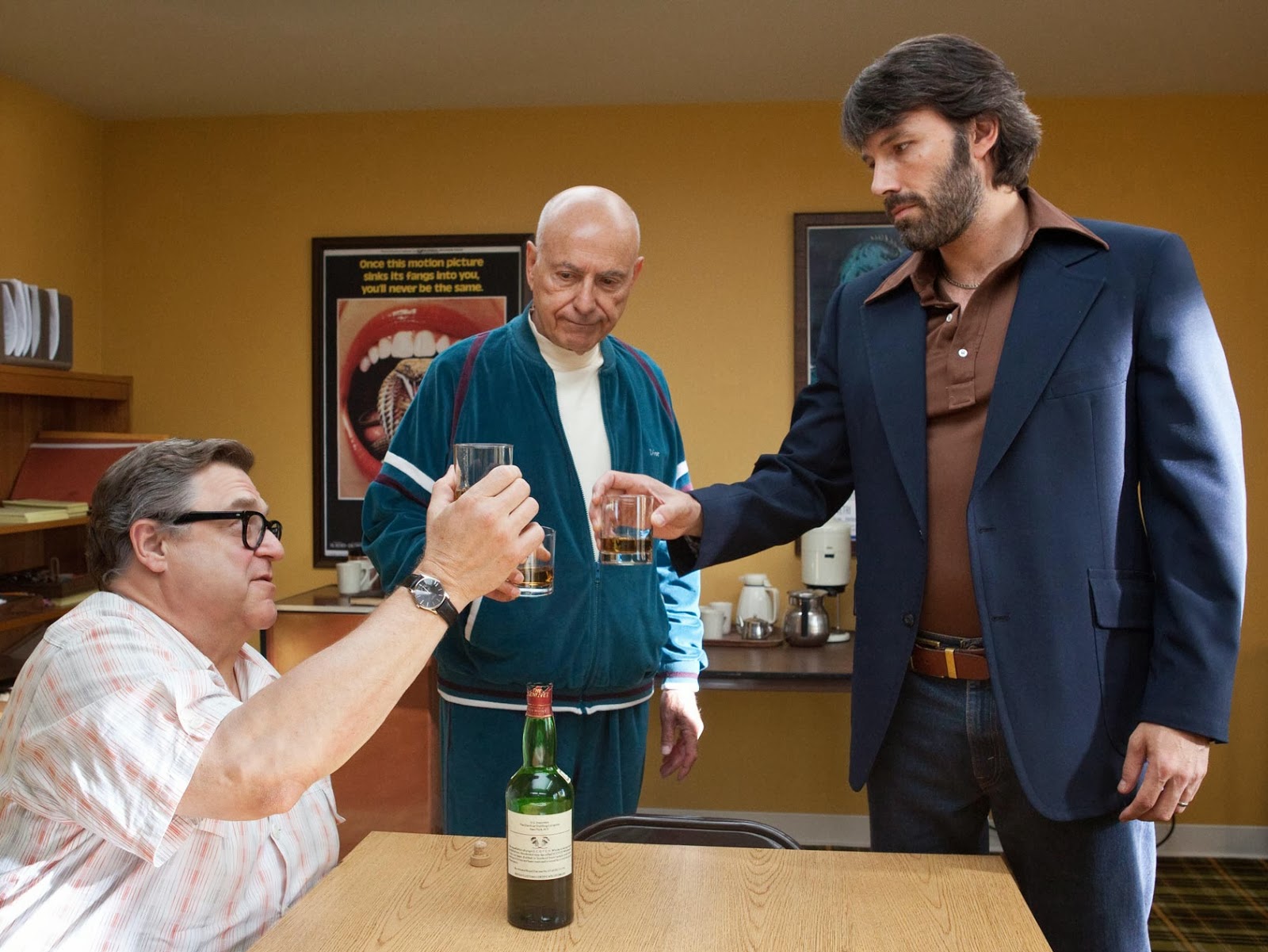
 Chris Terrio’s script, based on writings by Antonio J. Mendez (yes, the same Mendez depicted in the film) and Joshuah Bearman, opens in near documentary style, on Nov. 4, 1979. Militants storm the walls surrounding the U. S. Embassy in Tehran, and take 52 Americans hostage. (They will remain captives for over a year.) But that is not Argo’s real story. Argo focuses on the six Americans who barely escaped and hid out in the Canadian Embassy, also located in Tehran. They are given sanctuary in the home of Canadian Ambassador Ken Taylor (Victor Garber).
Argo is a lesson in near perfect pacing with the first 2/3 in slow, temperate gate with light humor supplied by the characters of Goodman, Arkin, and Bryan Cranston (as CIA honcho Jack O’Donnell). The groundwork is specifically laid out. The film’s final 20 minutes are some of the most seat-edged, harried moments of this or any film. Bee-rother.
Overlong ‘Bourne Legacy’ features dazzling chases, convoluted plot
 By Steve Crum
Fans of the first three Bourne movies will want to see this fourth franchise installment, The Bourne Legacy, which–as the title implies–is a kind of homage. Those who have never seen the previous films (The Bourne Identity, The Bourne Supremacy, The Bourne Ultimatum) will definitely want to see those movies before seeing Legacy. Otherwise, the complex plot, which references the previous films, will be confusing to the point of exasperation. I did see and greatly enjoy the previous Bournes, but was dizzied at what the heck was going on in this new take. No doubt this is the end of the franchise.
 Replacing Jason Bourne as the central character, without a “new” Jason Bourne, is the daunting task here. Instead of Matt Damon in the lead, we have a kind of Bourne wannabe, since Cross has been trained and chemically programmed by the same nefarious, CIA connected government agency that previously shafted Jason five directions. To supposedly make matters clearer, which made matters even more muddled to me, there are constant references to Jason Bourne along with flashing his 8 x 10 Matt Damon photo a half dozen times throughout the story. Hopefully, Damon received payment for his product placement.
  A planned, tragic incident at the government’s secret spy lab triggers a chase involving both Cross and chemist Shearing (Weisz), with CIA operatives in pursuit. It all has to do with Shearing helping Cross deal with his (CIA) drug dependency. I won’t spoil the plot with specifics. By the way, the on location filming in Manila is spot on and worth the reported hassle filming in that extremely crowded downtown locale. Much of Legacy’s best action bits were shot there, with the motorcycle chase finale the most breathtaking of them all. Forgive my hedging, but the early on sequences of wolves attacking Cross as well as the drone firing missiles at our hero are impressive too. Kudos to editor John Gilroy and composer James Newton Howard for heightening the suspense and action. It is a shame similar accolades cannot be given to the film’s dialogue and plot.
 ——————–
At least the trailer is brief: https://www.youtube.com/watch?v=jSzy9qQ3mDE