
Author: Steve Crum
THE KANSAS CITY JOLSON STORY…Part 2: Jolie Joins Dockstader
By Steve Crum
NOTE: All illustrations are copied from The Kansas City Times & The Kansas City Star, and accompanied the preview stories and reviews.
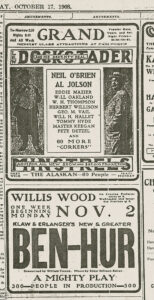 Al Jolson’s tenure with Lew Dockstader’s Minstrels began Aug. 10, 1908. A couple of months after the troupe began their national circuit tour, they stopped at Kansas City’s Grand Opera House, from Oct. 18-24. Notice the display ad touting its “$25,000 production.” The minstrels are listed as “Corkers.” I found it interesting that the long forgotten Neil O’Brien gets top billing over Jolson. (Notice Neil O’Brien’s image in the advance story at left.) Still, Jolson’s name is in larger typeface than the rest of the company. Interesting also is that the Oct. 17 advance advertisement is placed next to an ad for the “mighty” play, “Ben-Hur.”
Here is how KC’s newspaper promoted it:
Lew Dockstader has something really new this season. The usual first part has been abandoned in favor of the Possum Hunt club. When the curtain rises the members of the club are in social session, which means jokes, singing and dancing. During the session the president of the club calls attention to the fact that the white man has failed to reach the North pole, and suggests that the colored race make the attempt. The motion is carried and Lew Dockstader is appointed chief explorer. This theme is carried through the entire entertainment and the finale of the show pictures the Arctic regions with the aurora borealis as a frame for Dockstader a la Roosevelt, triumphantly holding the North pole in one hand. A mammoth polar bear is in meek 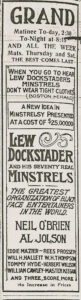 submission at his feet, while the great
 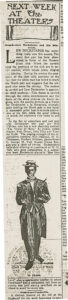 iceberg on which the explorers ride rocks to and fro.
In the list of comedians and end men with Dockstader this year are Neil O’Brien, who has a new absurdity entitled “The House of Rest,” Al Jolson, Eddie Mazier, Pete Detzel, John Daly and Tommy Hyde. The singing strength of the organization contains Will Oakland, W.H. Thompson, Herbert Willison, James Bradley, George M. Vail, Master Pierce Keegan and a choir of twenty. Dockstader’s individual offering is a portrayal of W.H. Taft, who goes campaigning in a submarine boat. Dockstader shares in “Boo Hoo Land,” also a spectacular number in which Dockstader and a companion fall from an airship and land among cannibals on an island in some far away sea.
∞∞∞∞∞
A year later, May 22 & 23, 1909, Dockstader’s Minstrels returned to KC with their 70 minstrels. Love that ad wherein a Boston Herald critic states: “WHEN YOU GO TO HEAR LEW DOCKSTADER’S MINSTRELS, DON’T WEAR TIGHT CLOTHES.” The show must have had some seam-busting laughs. According to an advance blurb, Al Jolson leads the performers in “a new absurdity entitled, ‘The House of Rest.’”
The Kansas City Times preview story:
Lew Dockstader and his minstrels will be the last attraction at the Grand Opera house this season. Dockstader was at the 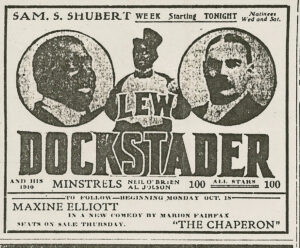 Grand last October, and the warmth of the public’s welcome then is the inducement for return so soon. Those who saw the Dockstader show last fall know how much fun it contained; those who did not see it then may be interested in knowing that the company number seventy people, including Neil O’Brien, Al Jolson, Eddie Mazier, Pete Detzel, John Daly, Tommy Hyde and a corps of twenty singers, among whom are W. H. Thompson, George M. Vail, Herbert Willison, Wilson Miller, James Bradley and Master Pierce Keegan, with Will H. Hallett as interlocutor.
The introductory part presents the Possum Hunt club, a colored organization. in social session, during which the club decides to send Dockstader at the head of an 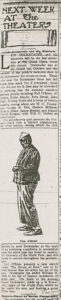 exploring expedition to accomplish what the white man has failed in, namely, the discovery of the North Pole. and this theme is carried throughout the performance.
Neil O’Brien presents a new sketch called “The House of Rest,” said to be even funnier than his street car act of the past. Dockstader has added William H. Taft to his list of famous caricatures of great men. The finale of the evening show Dockstader, made up a la Roosevelt, captor of the North Pole, which he has under his arm, and leading a great Polar bear.
∞∞∞∞∞
A few months later, the Dockstader Minstrels returned to KC. It was during the week of Oct. 11, 1909 when this brief preview blurb ran in the local newspaper:
Lew Dockstader has turned aviator and is using an aeroplane for his chief specialty this season. Al Jolson and Neil O’Brien also have new stunts, all of which will be shown at the Shubert this week, beginning tonight. The change from the Grand Opera House to the Shubert is due to the fact that Dockstader now is under the booking agency of the Shubert independents. The Dockstader show is said to be the largest and most expensive the minstrel man has ever had.
A separate blurb:
At the theaters this week is a diversified line of attractions ranging from minstrelsy to extravaganza. Lew Dockstader is at the Shubert Theater with his black face company, which includes Al Jolson, Eddie Mazier, Neil O’Brien and Peter Detzel in a new feature–a frolic of the Aero Possum Club. There are many good songs.
SEE Part III of THE KANSAS CITY JOLSON STORY, covering Al Jolson’s transition to a Single Vaudeville Act. You ain’t read nothin’ yet!
Get your dinosaur fix with ‘Jurassic World Dominion’—the perfect summer movie
 By Steve Crum
If Jurassic World Dominion doesn’t tease your Pterodactyl…doesn’t bend your Brontosaurus…doesn’t rattle your Raptor, you have no business calling yourself a dinosaur movie fanatic. That established, I AM a dinosaur movie fanatic. Here is a nearly non-stop, sci-fi action flick that is on prehistoric overload.
Think of it as a glorious 146-minutes packed with every creature that has ever appeared in the previous five films of the Jurassic franchise…plus a few new creepies. (Say hello to destructive locusts the size of small dogs.)
Be assured that JWD is in good hands. This is Colin Trevorrow’s third Jurassic World film as director, 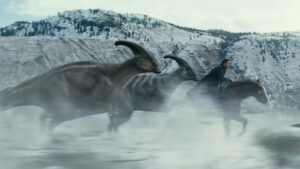 as well as his third time writing the screenplay. Dominion is the sequel to Jurassic World Fallen Kingdom (2018), set four years later. Now the myriad number of creatures are no longer confined to a remote island or theme park. (Isla Nublar has been destroyed.) The creatures reside worldwide, living with humans as pets and even cattle—not unlike steers.
However, all is not ideal. For example, the film includes a sad scene, set in Malta, in which dinosaurs are sold and forced into combat with other dinosaurs, a la cockfighting.
Segue to the opening sequence wherein Owen Grady (Chris Pratt) is shown at his remote ranch on horseback, ridin’ & ropin’ with a herd of Parsaurolophus. It is now part of accepted ranch life. There are also subplot surprises involving Grady’s favorite Velociraptor—who happens to live in the woods nearby.
 In fact, there are so many primary characters featured that screen scribes Trevorrow and Emily Carmichael had to divide the colorful tale into two concurrent plots, allowing the viewer to get dizzyingly involved. It is a fun ride.
Add those aforementioned characters with three from the first Jurassic Park trilogy: Dr. Ellie Sattler (Laura Dern), Dr. Ian Malcolm (Jeff Goldblum), and Dr. Alan Grant (Sam Neill). All are  well played. The latter unites to solve the impending worldwide food shortage brought on by an evil, money grubbing Biosyn CEO billionaire, Dr. Lewis Dodgson (Campbell Scott).
Dodgson is also behind the kidnapping of teen Maisie Lockwood (Isabella Sermon), who is the adoptive daughter of Grady and his girlfriend Clair Dearing (Bryce Dallas Howard).
Along the way are helpful encounters with a couple of good folks: DeWanda Wise’s Kayla Watts, a rough and tumble former Air Force pilot…and Mamoudou Athie’s Ramsay Cole, Biosyn’s Head of Communications.
The Jurassic World music is once again handled well by composer Michael Giacchino—with John Williams’ original Jurassic Park theme weaved in.
It has been rumored that Jurassic World Dominion is the grand finale of all the Jurassic movies. The fact is Dominion is Part 3 of the World 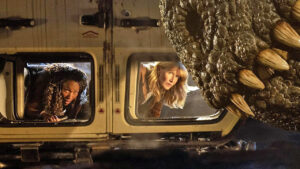 trilogy. But is it the very last film? Is there another trilogy in the plans? Stay, as they say, tuned.
∞∞∞∞∞
Just a personal addendum: My favorite dinosaur, Dilophosarus, shows up a couple of times in JWD. That curious, homicidal guy/gal, last seen in the very first Jurassic Park film, is the one who spits blinding, tar-looking venom into one’s eyes. How quaint.
∞∞∞∞∞
GRADE on an A-F Scale: A
‘All the Old Knives’ is anything but cutting edge
 By Steve Crum
Does All the Old Knives make the cut? Like a dull edged butter knife, the answer is no.
Chris Pine and Thandiwe Newton star as long time CIA operatives who face conflicts aplenty when an eight year-old terrorist case is reopened. Both agents are at risk.
Based on the like named novel by Alan Steinhauer, who also penned the screenplay, All the Old Knives is directed by James Metz Pederson (an episode of TV’s True Detective). Prepare yourself for long stretches of mundane dialogue spoken in near whispers.
 No wonder that when the 101-minute movie reached 50 minutes, I literally jumped a bit when Henry Pelham (Pine) slammed down some papers onto a desk. On the plus side, it kept me from dozing off.
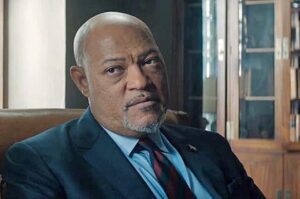
To recap the plot basics, CIA boss Vick Wallinger (Laurence Fishburne) assigns Agent Pelham to investigate former fellow Agents Celia Harrison (Newton) and a handful of others as being the mole who cooperated with terrorists who hijacked a packed Turkish airplane. Subsequently, everyone aboard was killed. To complicate matters, Celia (now retired) once had a romantic relationship with Henry.
 From this point on, All the Old Knives is a structural challenge to comprehend. Flashbacks, and even flashbacks within flashbacks, are generously utilized. Red herrings are everywhere, as if we really, really care. Better pacing and editing would be improvements. If only.
On location cinematography by Charlotte Bruus Christensen is fine—when the film stops lingering on dark night sequences. In short, Knives drones along.
 Explaining the meaning of the All the Old Knives title, Steinhauer says his inspiration was through the 1st Century Macedonian fabulist, Phaedrus: “All the old knives that have rusted in my back, I drive in yours.”
Right, that explains…nothing.
∞∞∞∞∞
GRADE on an A-F Scale: D
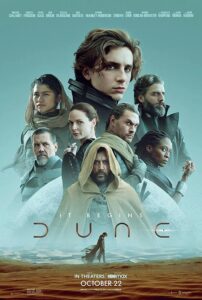
Villeneuve dazzles with literary and sensory sci-fi treat, ‘Dune: Part One’
 By Steve Crum
Who would have thought I would at all be fascinated by an epic movie based on a 1965 sci-fi novel, written by Frank Herbert, that spins an involved tale that begins with Duke Leto of House Atreides—of the ocean planet Caladan—being assigned to replace House Harkonnen as fief ruler of Arrakis…to control the lucrative (awk!) SPICE production?
Neither had I ever read the essential (for true sci-fi fans) Herbert novel, Dune, NOR watched the reportedly disappointing 1984 film adaptation….also titled Dune. So why am I now driven to wildly applaud this 156-minutes of otherworldly, ultra escape—a flick I have been purposely avoiding since its inception?
ANSWER: Because this movie version of Dune (aka Dune: Part One) directed and co-written by Denis Villeneuve, has so enveloped my thoughts and dreams (at least one night, anyway) that I now give up. It has grabbed me in ways never felt since the first time I saw Star Wars during the summer of 1977. Let’s call Dune: Part One a deeply thinking person’s Star Wars.
Maybe I just love the giant sandworms of Dune because I groove on the sarlacc in Revenge of the Jedi. But there must be more to my Dune  “thing” than one scary creature.
Indeed, there are other reasons.
The paramount attractions, the visuals, connect immediately. The landscapes, costuming, sets, makeup, creatures, and wild special effects are stunning. So awesome are they that of Dune’s 10 Oscar noms, four won for Cinematography, Visual Effects, Production Design and Editing. Factor in two more wins for the Sound and Hans Zimmer’s Score.
Kudos to screenwriters Jon Spaihts, Eric Roth, and Villeneuve for balancing the challenging work with a cohesive story line.
 Basically, the epic tale is one of political power and corruption set way into the future. (Egad, have we no hope of someday living in a society devoid of such strife?) Families are pitted against families, and planets against planets. Good and evil exist as do loyalty and deception. These are themes common to any literary structure in which—of course—conflict must exist. In Dune, the conflicts are often spectacularly shown (huge battles) or shadowy (Paul Atreides, played by Timothée Chalamet, being groomed as a potential leader).
Mysticism and foreboding are major ingredients as well.
Topping or at least equalling it all, is an international cast of impressive actors. Some of their characters will not make it to Dune: Part Two, to  be released Oct. 20, 2023. (That is, unless they are somehow brought back from death.) Of course, I will not divulge who survives here.
Representing the lengthy list of actors, their characters are included to represent the complex and transcendental language.
The relatively brief list includes a Spell Check nightmare of Rebecca Ferguson as Lady Jessica Atreides, the ducal heir; Oscar Isaac (Duke Leto Atreides); Josh Brolin (Gurney Halleck); Stellan Skarsgård (Baron Vladimir Harkonnen); Stephen McKinley Henderson (Thufir Hawat, the Mentat); Zendaya (Chani, a mysterious Fremen woman); Javier Bardem (Stilgar, Fremen leader);  and Jason Momoa (Duncan Idaho, sword master of House Atreides).
It’s a far, far cry from Luke and Leia.
∞∞∞∞∞
GRADE on an A-F Scale: A
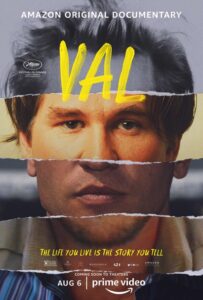
‘Val’ paints challenging life of Val Kilmer in absorbing documentary
 By Steve Crum
What a privileged, adventuresome, sad, creative, and now challenging life Val Kilmer has lived. His autobiographical documentary, Val, is a fascinating look about the actor whose life and times took a tragic turn in 2014.
“My name is Val Kilmer,” he says in the film’s opening. “I was recently diagnosed with throat cancer.” That was then—8 years ago. Now he speaks through a computerized voice placed in his throat.
Most of the 108 minute documentary is narrated, using his dad’s words, in a well modulated voice by Val’s son, Jack—who sounds so much like his father that it both puzzled and fooled me.
But when Val does speak, as he frequently does in this story, it is via robotic-sounding, neck box sound. Of course, that does not reference Val’s distinctive speaking voice in old film clips of him from his childhood through motion picture roles.
It so happens that the numerous video footage is supplied by Val himself—whose family took many reels of 8mm footage to document their early family history. That mindset has continued to this day as he and his adult kids (son Jack, daughter Mercedes) now digitally film dad Val at work and play.
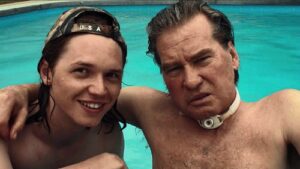 “I have thousands of hours of tape, being the first to own a video tape recorder (in the world),” the now 62 year-old Val says. “I’ve wanted to tell a story about acting for a long time. Now that it’s more difficult to speak, I want to tell my story even more.”
Indeed he does just that, quite thoroughly. Val is the journey of an actor from childhood to formal training at Juilliard to success in Hollywood.
So it goes. Home movies showcase Val and his brothers Wesley and Mark in hammy mini-movie productions shot in their house and backyard. Living a somewhat privileged life thanks to his real estate investment father, Eugene, the Kilmer house was located “down the street from Roy Rogers’ ranch.” The Rogers property was eventually owned by Dad Kilmer.
 Cut to amateur footage of Val in plays from elementary through high school. After being the youngest kid ever accepted into Juilliard Drama School in New York, Val’s brother Wesley dies at 15. Then, for a while, no more plays. The Kilmer Family “was never the same again.”
Val then focused on playwriting, and moved into a NYC apartment. He focused on Shakespeare and the like…easing back into acting. Insert even more home movie footage on video, including Val and friends acting silly around the apartment, stage rehearsals, and showing off.
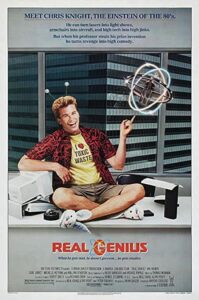
The Second Act of Val surveys his movie years, from his first hit film, Top Secret (“To this day I have trouble explaining what it is about”) to portraying “Ice Man” in Top Gun to the wildness of Real Genius. Swatting flies by his pool, Val explains the problem of eating and talking with his “throat hole” and breathing tube. He also speaks of his mother’s new husband, divorce, and his disdain for hometown Chatsworth, California.
Val’s candor is revealing about the relationship with his late father, increasingly financial, and his marriage to Willow co-star Joanne Whalley.
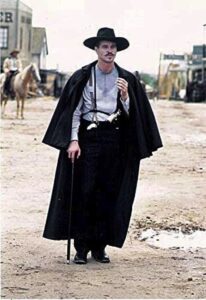 He reveals the movie role he fought to have, but never got. Then there are the parts that made him memorable: The Doors and Tombstone. Remarkably, Val Kilmer was not Oscar nominated for the latter (“I’ll be your Huckleberry”), giving a stunning performance as Doc Holliday.
Kilmer calls his wearing the clunky Batman costume in Batman Forever “a struggle,” and his Caped Crusader acting “soap opera.” He lauds working with Pacino and De Niro in HEAT as “great.” Then there is his work in The Saint, which he did for a surprising reason.
Sandwiched between the movie excerpts, Kilmer glazes over his thoughts of death…and life. These days life can be tough for him.
The Final Act of this true story focuses on what Val’s life is like now. He laments his depression of flying around the world to meet fans and sign autographs, picking up some cash in the process at comic and celeb conventions. One sequence shows fans lined up to meet, greet and get Kilmer’s signature, but that has to be put 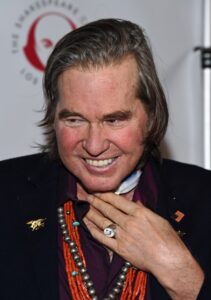 on hold as Val takes a break to head backstage to clear his breathing/speaking tube.
It’s a necessary part of the life he now has.
That life includes a tearful Val missing his late mother; and the disappointment of not being able to finish his tour portraying Mark Twain because of his voice problem. While hospitalized, Val began painting as part of his healing. As well, he has become fascinated with church and religions.
Co-produced and written by Val, the direction is by Leo Scott and Ting Poo. But it is the genius of Scott, who edited the many hours of footage, that makes Val so impactful.
∞∞∞∞∞
GRADE on an A-F Scale: A