
Author: Steve Crum
‘Tár’ spins saga of maestro’s unsympathetic fall from glory
 By Steve Crum
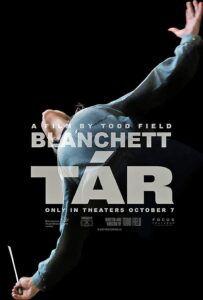
Tár is all about Lydia Tár, whose rise in the teaching and performance of classical music becomes her passion—a somewhat uncontrollable aspiration.
Lydia, played by the always believable Cate Blanchett as a person with unrelenting dedication to her job, is not an easy person to like personally. She and her wife and concertmaster Sharon (Nina Hoss) have a young daughter, Petra (Mila Bogojevic). While Lydia is an orchestra conductor of world renown, her duties as wife and mother are distant and humorless. Tender love? No way. Home life is not that far removed from being a demanding maestro.
Director-writer Todd Field paints a grim character study of a driven woman whose aspirations are multi-tasked. Lydia is planning to promote her autobiography via a book tour as well as her conductor’s dream, an upcoming live  recording of Mahler’s Fifth Symphony. Simultaneously, she is restructuring her professional surroundings. That means using politics to replace her assistant conductor Sebastion (well played by Allan Corduner).
We also witness her teaching music and judging recitals at Julliard. She is laser focused on her students’ seeming prejudices regarding certain composers, particularly Bach. This leads to my favorite scene wherein Lydia browbeats one particular student to the point he curses her and leaves class. Previous to his storming out of class, we notice his left leg increasingly jump out of anxiety. It is no surprise when the young man cannot take his teacher’s bullying any longer.
 Lydia Tár is unmoved, seemingly devoid of his feelings.
On Lydia goes, making enemies of a half dozen or so musicians and associates. Eventually, that includes her long-time assistant Francesca (Noémie Merlant). Still, her professional and private life remain privileged as she is beyond reproach. It is clear she is as talented as she is egocentric. Lydia’s flirting with young Olga Metkina (Sophie Kauer), a talented Russian cellist, has repercussions both at home and on stage.
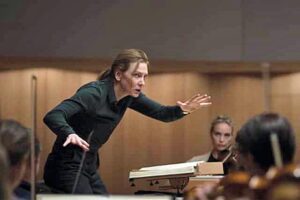 Without getting specific, the thickened plot is not pretty.
Jealousy, lying, innuendo, and revenge dominate during Tár’s third act. By the finale, we have witnessed a slow-moving 158 minutes of the life of Lydia Tár…from peak to crumbling depth.
—————
GRADE on an A-F Scale: B-
‘RRR’ packed with terrific action, music, adventure, love, courage & dance
 By Steve Crum
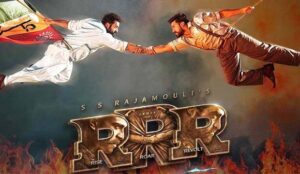
To say, as one source does, that RRR, dubbed in English, is a “Telugu-language, epic action drama film” limits the scope of this wowser of a motion picture. RRR is as described plus so much more. Factor in its love story, patriotism and originality. Then there are the spectacular CGI effects (particularly the wild animals) and the memorable music.
The singing and dancing were superb enough to elicit a deserved Oscar nomination.
AND we get two leading men (N. T. Rama Rao Jr. & Ram Chardan) who play superheroes. Forget Marvel and DC, these guys have abilities far beyond mortal…well, you know the line.
 Direction and screenplay is by S. S. Rajamouli, who helmed the film’s 182-minutes into a work that resulted in the most expensive Indian film of all time. However, it has already made a profit due to worldwide box office.
The film’s plot is somewhat complex, at least in the beginning. Bear with it. By that time, you should be used to Rajamouli’s rapid pace and surprises. For example, young Malli (Tinkle Sharma), is kidnapped by the British Governor Scott Buxton. Cut to Komaram Bheem as he is literally face to face with a ferocious (emphasis on ferocious) tiger in the woods. Like other sequences in RRR, the action is played out meticulously and to nail biting conclusion. I won’t say who wins the battle, but remember that Bheem IS one of the aforementioned  “superheroes.” He is on a trek to government headquarters to rescue said Malli.
So we do get a historical sense that RRR is at its core another story of the British Empire once again at odds with India during its notorious Crown Rule/Raja that lasted two centuries. In this case, the young girl is violently taken from her family because the Brit governor’s wife likes the girl’s painting talent.
Before Bheem arrives at the governor’s mansion, we get a sample of the supernatural physical power of Raju—a British officer who is actually Indian by birth. Let us just say he is a one-man army concerning violent crowd control. (See it to believe it.)
There are sequences wherein the opposing two meet and join forces (the brilliantly choreographed river rescue of a little boy). But the entire set-up we anticipate is when they have an ultimate confrontation. Who will win?
However, however, however—there are complications and coincidences at work. That is the heart and soul of this great adventure laden with fantasy.
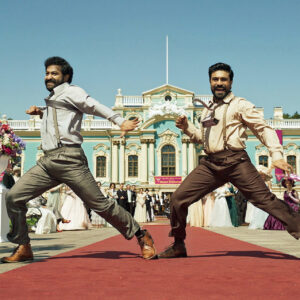
Perhaps the strangest inclusion is when the two heroes team to lead an infectious dance of the Oscar nominated Naatu Naatu. Strange or not, it is awesome.
 Bravo for the visionary work of S. S. Rajamouli.
∞∞∞
By the way, the film’s title signifies “Rise, Roar, Revolt.”
∞∞∞∞∞
GRADE on an A-F Scale: A
∞∞∞∞∞
Fascinating ‘The Fabelmans’ explores Steven Spielberg’s family, filmmaking inspirations
 By Steve Crum
Had Alfred Hitchcock filmed the story of how he got interested in films, there could have been some very revealing moments. Like his father locking the child Hitch up in a local jail to teach him a lesson. Maybe Hitchcock’s introduction to the element of fear?
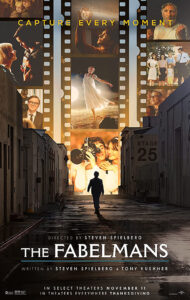
Now refocus on Steven Spielberg’s semi-autobiographical (or “auto biopic”) drama, The Fabelmans, co-written and directed by Spielberg. It could well have been titled The Spielbergs, were it a documentary. But The Fabelmans is based upon Steven Spielberg’s childhood, in the process renaming his relatives, including himself. 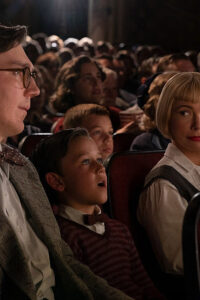 (Steven is “Sammy.”) The project has been over two decades in the making, being green lit once his parents had passed on. He did not want to hurt any feelings.
The result is an absorbing, revealing motion picture.
As recounted by Spielberg in previous interviews, he was first impacted at the movie theatre as a young boy in 1952. So it is with Sammy Fabelman. After seeing Cecil B. DeMille’s The Greatest Show on Earth, Sammy is awestruck (particularly at the circus train wreck sequence), mesmerized and inspired to duplicate what he had just seen at home. Using his father Burt’s (Paul Dano) 8mm camera, Sammy (Gabriel LaBelle) films his own silent version of crashing his newly acquired train set. His mother, Mitzi (Michelle Williams) encourages Sammy to pursue his new hobby, while his father is discouraging.
Sammy’s filming continues on a larger scale, sometimes including his three younger sisters in the shooting.
After the family has to move to another state due to Burt’s job, Sammy continues his amateur filmmaking—even including his fellow Boy Scout troops as extras in battle scenes.
 Sammy makes filming family outings, such as a camping trip, an occasion wherein he directs the action with experimentation of lighting and angles. Also involved in family activities is his father’s best friend and associate, Benny Loewy (Seth Rogen), whose presence-particularly during Sammy’s teen years—segues from jocular “uncle” to disruptive interloper.
In the process, Sammy becomes more enamored with someday making a living creating movies. This is still much to his dad’s chagrin.
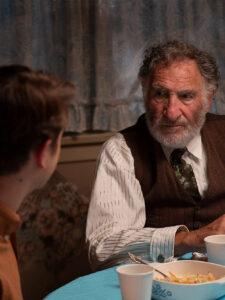 There is a wonderful performance by Judd Hirsch as Boris Podgorny, a granduncle and ex-film worker and circus lion tamer. He is a character for sure, but encourages Sammy to pursue his dreams with the realization of their conflict with family expectations. Such is the crux of The Fabelmans.
The film pivots when Sammy discovers a jarring secret while editing some family camping footage.
That said, a major change occurs when dad’s job forces him to move to Southern California—the land of sunshine and movies. Sammy’s dream world enlarges as the reality of his parents’ marriage is endangered.
The screenplay also covers Sammy’s encounters with anti-semitism, his college years, love life, and early TV production work.
Incidentally, a must-see is Sammy’s encounter with John Ford (played by director David Lynch), which is pretty much what occurred when Steven Spielberg first met the crusty director.
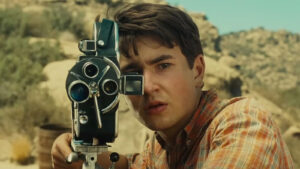 Overall, The Fabelmans is a unique telling by one of the most popular directors in cinema history.
∞∞∞∞∞
GRADE on an A-F Scale: A-
∞∞∞∞∞
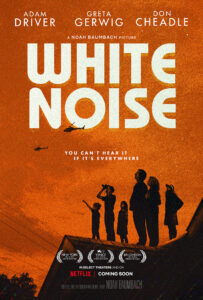
Memorably messy ‘White Noise’ makes it must-see-to-believe
 By Steve Crum
The plot is both the least to worry about as well as the least to understand in White Noise. After sitting through its 136 minutes, I am mesmerized. To call White Noise unconventional is to put it, well, mildly. It is a fragmented mess of a plot, yes. It is wildly a spectacle, yes.
See it.
 One need only check Noah Baumbach’s film credentials to nod yes to describing White Noise. He is pretty much the auteur behind it. Baumbach directs, produces, and writes the screenplay. He has cast past collaborators Greta Gerwig and Adam Driver as the leads. Even though Wes Anderson is not part of the production team this time, White Noise has Anderson overtones.
Baumbach has been compared to Woody Allen in individualizing his movies, and so goes this film. Yet it maintains the distinctive Baumbach stamp. Consider his stylistic works The Squid and the Whale and Marriage Story.
 A plot description paints a quirky picture of the way off kilter central family that evolves into a dark comedy full of whacky characters behaving under multiple life or death circumstances.
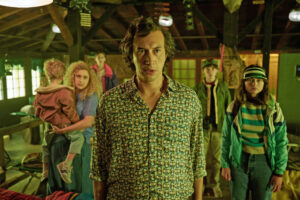
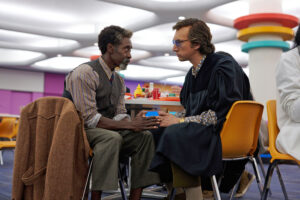
Where to begin? Why not start in 1984 with Jack Gladney (Adam Driver), a professor of “Hitler Studies” at a small college in Ohio. By the way, Jack does not speak German—a growing concern since he is scheduled to give a speech at an upcoming conference where he is expected to sprechen Deutsch. It makes Baumbach sense that Jack’s best friend is his colleague, Prof. Murray Siskind (Don Cheadle), who is encouraged by Jack to develop a course in “Elvis Studies.”
Back on the home front, Jack is married to his fourth wife, Babette (Greta Gerwig). They are raising a very blended family of four children.  Older daughter Denise (Raffey Cassidy) catches her mother using a secret prescription of Dylar, a “mysterious drug,” as the story segues into nightmarish dreams of death experienced by Jack.
Death is literally in the air when a nearby train derailment casts a cloud of toxic fumes over the quaint college town, and the entire city is forced to evacuate. Cut to long traffic lines inching along, including the car of Jack, Babette and family. There is also a potential tragedy in the works here. (There is also a memorable sequence wherein the Gladney car is converted to a water raft.)
During the third movie’s wild third act, things have moved on to paranoia, death anxieties, and murder threats at a motel.
 But never fear? Without divulging too much, be advised to pay attention to the entire credit roll, which includes some checkout lanes at a vintage store…and a singable-danceable tune by Danny Elfman. Strangely, this finale sequence really sold me on White Noise.
∞∞∞∞∞
GRADE on an A-F Scale: B
A sad remembrance of Louisiana’s Polk Theatre & ‘GWTW’
 By Steve Crum
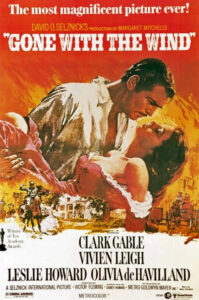
A few months into 1970, after being drafted into the Army, I found myself stationed at Fort Polk, Louisiana. Basic Training at Leonard Wood in Missouri was history. It was summer. I heard that the local Leesville movie theatre, the Polk, was running a re-release of a movie I had never seen before, Gone With the Wind. The 1939 film is legendary, having won multiple Academy Awards.
Even then I was a true movie buff, yet I had missed seeing GWTW all my life. The only way to see it those days was via an MGM re-release, a booking at select theatres across the country—for a limited time of perhaps one week. Then the 35 mm reels would be shipped back to the MGM vault for yet another release in maybe five years. And so on.
These were the days of no DVD, no VHS, no cable TV, and no streaming channels. We had only small screen TVs operating on tubes. So I decided to see it where it was made to be seen—on a large screen.
 Alone I drove to the Polk (none of my buddies cared about the movie), paid my admission, and sat in a half-full house in a main floor aisle seat, center section. In front of me, a junior high history teacher and her 15 or so students sat. She reminded them that what they were going to see is a history of the South, and to pay attention quietly. A “history of the South”? I was amused. GWTW is a documentary?!
The Polk was a typical neighborhood theatre showing its age. But it had a large screen and OK speakers. I watched the lengthy movie, and enjoyed it. MGM had supplied a very good print.
Most of the audience, including the history class, had exited by the time the finale music ended. Then I left.
Walking to my car, I noticed a somewhat long line waiting a few yards away at a different door than I had entered. I asked someone what was going on. “Oh, they’re in line to see Gone With the Wind. That’s the Colored line. They sit 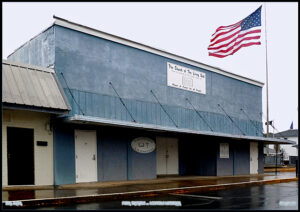 upstairs in the balcony.” Hmm. Come to think of it, there were only Whites seated around me. I did notice there was a small balcony, but then paid it no attention.
Note that there was no sign posted like “Whites Only” or “Coloreds Only.” This was more subtle, more locally understood…
Racism.
I never returned to the Polk Theatre. Nor will I ever forget it.
∞∞∞∞∞
The Polk Theatre closed a few decades ago, and is now a church. (See photo.)