Absorbing ‘Social Network’ is high profile, fascinating

By Steve Crum
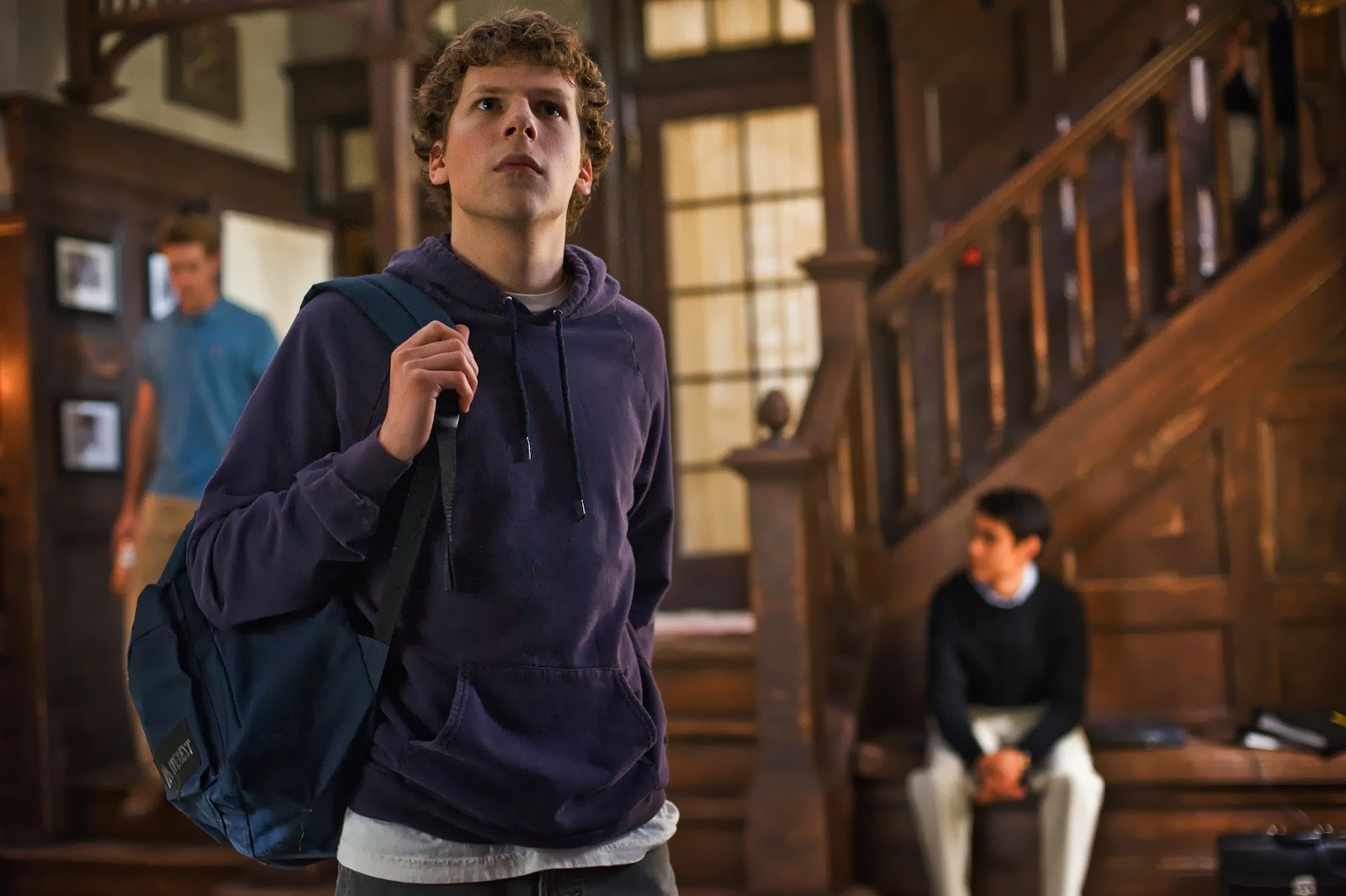
Ironies abound in The Social Network, a fact-based, fictional film about the creation, impact, and financial gold strike of Facebook. The first irony is that I had to tear myself away from Facebook at home to drive to a screening of a movie about the very addictive site I just left. Irony 2 involves the story’s main character, Mark Zuckerberg (Jesse Eisenberg), who conceived the idea for the world’s largest Internet chat room, yet has scarce public social mores himself. In fact (Irony 3), virtually everyone involved with the technical and business parts of Facebook appears to have negligible one-to-one communication skills.

The Social Network is a fascinating, absorbing film well worth friending.

Opening at a Boston bar in 2003, the story focuses on nerdy Harvard sophomore Zuckerberg as he repeatedly, dare say intellectually, insults his girlfriend (Rooney Mara). After she sharply tells him off and leaves, he storms back to his dorm room, determined to revenge himself by posting negatives about her on his blog. It turns out to be a near lethal move on his part. His displeasure then turns to rampage against all female students. Zuckerberg hacks into Harvard’s main frame to access sorority photos he then exploits via “Hot or Not” beauty contests posted on Harvard’s network. Feedback is immediate and lasting; thousands of Harvard students are viewing his postings.

A couple of steps down the line, Zuckerberg’s genius computer skills further refined, the origins of Facebook emerge. Like Facebook, the plot is about the step-by-step connections that led to its creation and popularity.
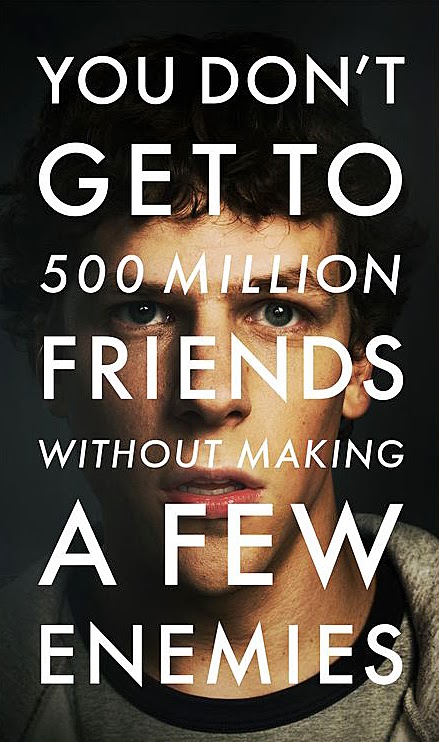
The Social Network’s credentials are stellar. Director David Finch also helmed Zodiac and The Curious Case of Benjamin Button, two superb films noted for their innovative, precise storytelling. Screenwriter Aaron Sorkin penned Charlie Wilson’s War as well as 154 episodes of TV’s The West Wing. Sorkin has taken Ben Mezrich’s book, The Accidental Billionaires, and structured TSN around the numerous lawsuit hearings that occurred as Facebook grew to worldwide popularity. For example, litigant Zuckerberg and his attorney face off behind closed doors against former Facebook partner Eduardo Saverin (Andrew Garfield) and his counsel. Flash back to the origin of their conflict when the two were Harvard roommates just beginning their website.

The flashbacks reveal the growing problems, many of them ego-based, that led to to mistrust and legal backstabbing. Amongst the fray is Sean Parker (Justin Timberlake), who befriends Zuckerberg not long after Facebook launch, and immediately causes more rifts within the growing Facebook empire. Timberlake, incidentally, does a fine job as the Napster music site entrepreneur.

The two leads, however, give the film its credible base. Saverin portrays Garfield as an insecure, constant whiner, contrasted to Eisenberg’s rapidly speaking, distant, and pretty much emotionless egghead, Zuckerberg. He comes across as a close cousin of The Big Bang Theory’s Sheldon Cooper, minus the humor.

It is difficult to feel empathy when the lead characters are millionaires beset by lawsuits threatening their megabucks. An on-screen tag informs us that Zuckerberg is the youngest billionaire in the world.

Witnessing their ego-based tantrums certainly does not trigger our tear ducts either. It is sort of like observing a fender bender between two Rolls-Royces. However, the attraction of wealth colliding with wealth is unique voyeurism. Fincher and Sorkin understand that tableau quite well, being very good storytellers.

GRADE on Scale of A to F: A-
——————–
Trailer of The Social Network: http://www.youtube.com/watch?v=lB95KLmpLR4

Share:

Affleck’s direction, not acting, makes ‘The Town’ watchable

By Steve Crum
Ben Affleck is a far better director (and writer) than he is an actor. Gone Baby Gone, the 2007 kidnapping drama wherein he directed his brother Casey, asserted such; The Town tries hard for confirmation. Affleck wrote, directed, and stars in The Town, an above average heist flick. Don’t be misled, however. The Town has exciting action sequences, including cleverly staged car chases and bank/armored car robberies. The down side is its long stretches of talk, talk pleading for edits. Just as we are beginning to nod off from a combination of Affleck’s slurring words and wordy dialogue, a cut to the bad guys dressed as nuns in fright masks awakens us again.
Affleck’s acting deficiency stems from his stiff body language and mumbling speech pattern. NOTE TO MR. AFFLECK: Ben, e-n-u-n-c-i-a-t-e. Project a bit, actually a lot more. You’ve written yourself a slew of intimate dialogue scenes in “The Town,” yet you could barely be understood. Your rigid, tight lips make reading them impossible. Regards, A Wannabe Fan of Your Acting.
The Town’s real acting honors go not to Mad Men’s Jon Hamm, who does an admirable, credible job as the lead FBI agent, but to Jeremy Renner, last year’s Oscar nominee for The Hurt Locker, itself a Best Picture winner. You just cannot take your eyes off of Renner in any scene. He is a charismatic, dynamite performer. That he portrays a psychopathic killer, with a hint of Joe Pesci’s style, accentuates his presence even more.
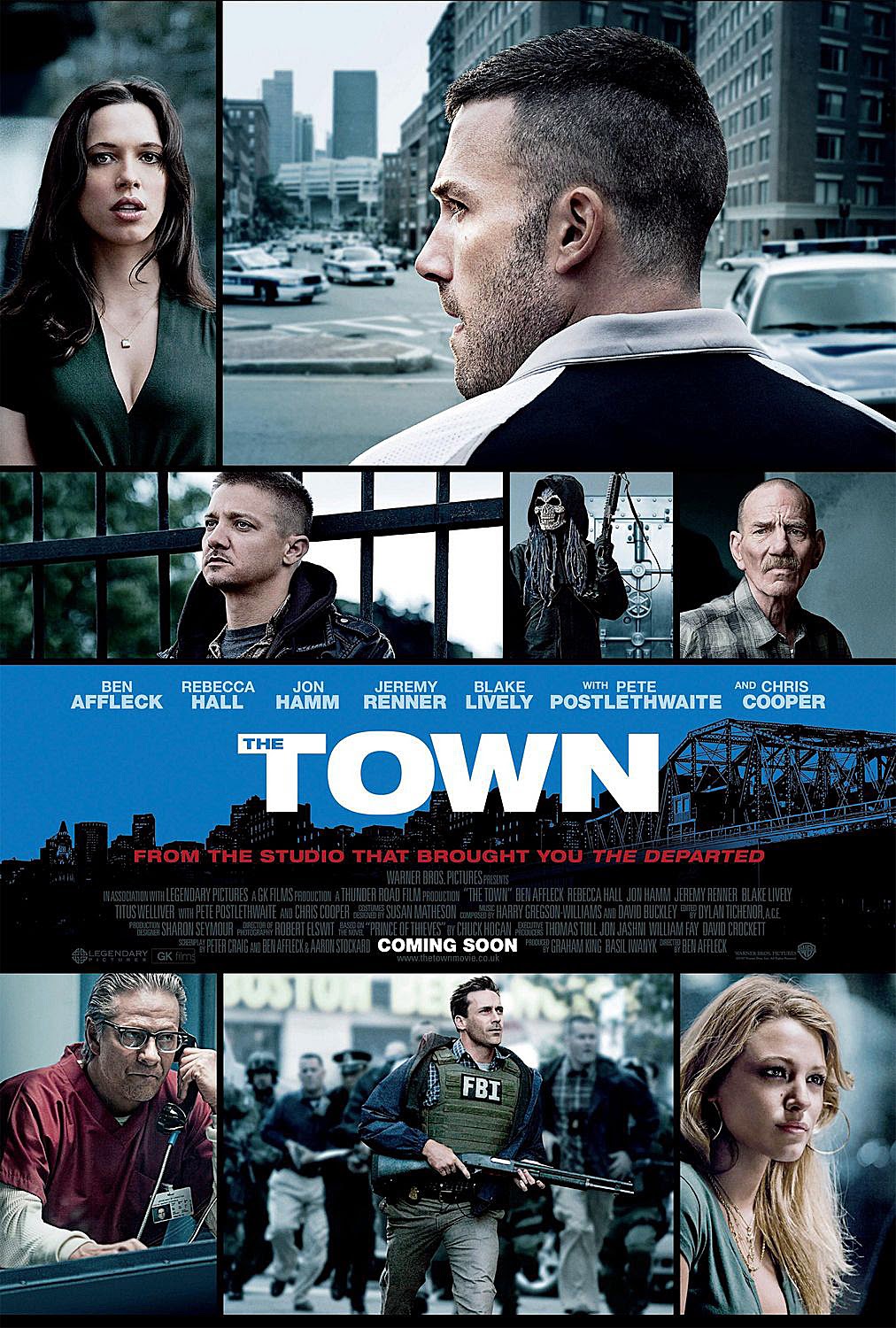
The movie’s preamble explains the setting, the Boston suburb of Charlestown, a neighborhood that accounts for most of the 300 bank and armored car robberies occurring in Boston each year. In fact (we assume it is actual fact), Charlestown leads the nation in bank robbers, per capita. The robbers are highly organized, efficiently operating like a family run, albeit mafia-type, business, One of its lieutenants, Doug MacRay (Ben Affleck), has tried to break out of the “family,” but is harkened back again and again. He is estranged from his father (Chris Cooper), who is serving prison time.
MacRay has a tenuous relationship with his closest friend since childhood, Jem (Jeremy Renner), despite Jem’s tendency to explode at virtually nothing. After a heist wherein Jem viciously kills a bank officer, a witness (Rebecca Hall) just happens to cross paths with McCray at a laundramat. Who would have thunk? Since he was masked during the robbery, she does not recognize him, but he soon recognizes her. No surprise they fall in lust and love, and that is where this plot revelation ends. Their relationship becomes more and more complicated, let’s say.
Cut to FBI agent Frawley (Jon Hamm), who is leading a task force to outwit and stop the slew of robberies. Each crime is planned and executed to the hilt, leaving behind zero clues. Robbery in this neighborhood has become precision art. Like most crime films, the back and forth interplay between police and criminals is key. Outwitting each other is the game.
The Town features powerhouse actors, besides those already mentioned, Pete Postlethwaite, Blake Lively, and Titus Welliver. Postlethwaite is always a presence, and particularly strong here.
Add to the pluses a riveting, action score by composers Harry Gregson-Williams and David Buckley.
GRADE on a Scale of A to F: B-
——————–
Top Photo: Ben Affleck directs Jon Hamm on location.
——————–

Share:

A morning conference with JERRY LEWIS

By Steve Crum
On Nov. 8, 1995 at 10 a.m., if memory serves, I was among 20 reporters awaiting the entrance of Jerry Lewis in the large dining room of the then Alameda Plaza Hotel, located on the Country Club Plaza in Kansas City, Mo. Folding chairs were set up, and TV cameras topped tripods, all facing the podium where Lewis would soon stand. My front row seat would provide close proximity to one of my show business idols.
Lewis was in town as part of the five year, cross country tour of his hit Broadway revival, the musical Damn Yankees. Lewis portrayed the glitzy dressed devil, the part Ray Walston had introduced four decades before. This press conference was undoubtedly an event repeated in city after Damn Yankees city. It was a hammy event, to be sure. Lewis entered from the back of the room, which gave sustained time for awaiting reporters to stand and wildly applaud. Lewis walked very much like Benny or Hope, his arms swinging in cadence, his walk an ego strut. He wore a dark sweater with large, yellow and red diamond shapes on front, both long sleeves pulled up to mid-arm. Chic casual. He looked very healthy then at 69. Fifteen years later, the contrast is stark.
Behind the rostrum, Lewis acknowledged our applause, shouting into the mike, “I’ll just stand here for a few minutes. I know you want to look at me.” And we did. The applause continued for another 30 seconds. Finally, he began the session with cordial remarks about his happiness at being in KC, particularly in a Broadway musical venue. The Q & A went on for about 45 minutes.

Lewis joked that playing the devil was perfect for him since he “has had years of experience with it.” He reminisced, speculated and philosophized about show business and his life. “I wake up every day and I’m a smash hit,” he said. He spoke of what fuels him, of his incentive and drive. Of his excitement to perform, even after 64 years, he said, “There is a misconception of boredom I feel fulfilled in a rush, and I don’t have turbulent innards.” As to why he was taking five years to tour, he answered, “I don’t believe in doing things half way.” His own favorite films are The Nutty Professor and The King of Comedy. His mentors are Stan Laurel and Charlie Chaplin.

Define laughter. “It’s a safety valve that shuts off everyting else for a moment.” What about your heir-apparent, Jim Carrey? ”If we’re not careful, we’re gonna lose him due to studio control and burnout.” Where do you get inspiration? “The information you take from people like Al Jolson is infinite.” When will you stop doing the MDA telethon? “When they lay me in the box. I started something and I plan to finish it.”
Lewis was surprisingly polite, reserved, and focused. When one reporter made a semi-intellectual observation about the persona of the Buddy Love character in Lewis’ classic comedy, The Nutty Professor, Lewis complimented him for asking “the best, most incisive question I have heard today.” I felt compelled to one-up the guy, and dazzle Jerry Lewis with an even better question, one that no one else had even come close to asking.
“Jerry, what is the possibility of your movie, The Day the Clown Cried, finally being released?” I know I heard a gasp from at least five reporters seated around me. THIS was a question that had not been asked because no one was supposed to ask it! I had not been clued in. The Day the Clown Cried had supposedly been completed overseas, possibly shot in Poland, some time back. No one asked about it because Jerry did not want to discuss it. Ever. I have learned since that it will never be shown. Supposedly, the only copy of it rests in Jerry’s vault, and only a handful of cherished pals have ever seen even a snippet of it. The film has become urban legend.
Here is why. In it, Jerry portrays a Jewish inmate in a Nazi concentration camp who is also a professional clown. His job is to dress as a clown and lead Jewish children to the gas chambers, giving them their literal last laugh. Supposedly, Lewis took the role to showcase both his dramatic and comedic skills. This would be the ultimate challenge for an artist, outdoing even Chaplin. Then the production ran short of money to finish the film. There were legal conflicts regarding who owned the property. Orson Welles had nothing compared to this fiasco.
It was an unmentionable around Lewis. So I unwittingly dropped it on him like a pregnant cassowary. He did not explode; he did not falter. He answered that the film will never be publicly shown, and that he has not even seen it. Lewis said the print was still in Sweden, and that he was legally fighting to own it. “It is like losing a child,” he said. That was that.
Incidentally, two things happened during and after the press conference that made me take Jerry’s reputation of being irrascible and prone to verbal explosions with a grain of Morton. First, there was the incident right in the middle of the press conference, when two numbskulls from a local radio station crashed the proceedings by rudely walking up to Lewis as he was answering someone’s question. They were holding a portable tape recorder, and kept pushing it into Jerry’s face, almost pressing his lips, demandingly asking, “Jerry, we want you to be our guest on Q-104 today. Will you answer questions about the telethon and your movies?” 

They kept shouting at him, yet Lewis remained calm as his people standing on the sidelines rushed to stop this madness. Lewis kept saying, “Just see my staff, and they will arrange an interview, fellas. There’s no need to interrupt here. Please leave.” Suddenly, the two lame brains stopped pressing Lewis, and left. Within an hour, I later heard, a doctored audio clip of Jerry Lewis was heard, and then repeated, on that radio station via their shock jock. They had edited what Jerry had said, down to, “No interview…Leave,” “No interview…Leave,” “No interview…Leave.” The words, out of context, were looped and played throughout the day to show what a rude dude Lewis is. Jerry Lewis has always beaten his own image to the ground enough without having some radio jerks falsify it. This time Jerry was on extremely good behavior, and did not deserve the negatives.

The second thing that endeared me to Jerry occurred after the press conference. He stayed around for autographs. About half the press stuck around to get his signature. I brought the two Decca record albums I had owned since I was in high school. He looked at the second, more rare, of the two, and asked, “WHERE did you find this one?” As he signed it, I had to open my idiot mouth and say, “I’m getting a Jerry Lewis autograph.” I said this in mock Lewis voice, a terrible impression, but close enough for him to realize I was doing his “kid” voice. What did he then do? He stopped signing, glanced up at me, and said, “Ahem,” unsmilingly. Then he finished his signature.

To me, suffering from temporary insanity, it was a mini standing ovation. I am lucky he didn’t take me to the back of the hotel and beat me over the head with my record albums for bringing up the clown movie.
——————–
Share:

Crummy Art, Crummy Laughs: ‘THE JAZZ SINGER’

Share:

Worth 1,000 Words: JOHN CHARLES THOMAS of The Metropolitan Opera


By Steve Crum

For nearly 30 years, JOHN CHARLES THOMAS [Sept. 6, 1891-Dec. 13, 1960] was widely regarded as one of the most gifted operatic baritones of his day. Thomas sang in operas and operettas, as well as in concert recitals, and on records, radio and film. (Well, he appeared in one obscure movie, a silent movie, no less. No singing even in the subtitles.) His repertoire included works by Gilbert and Sullivan, Victor Herbert, and Sigmund Romberg. Sort of a pre-Nelson Eddy, Thomas performed on Broadway in Maytime and Naughty Marietta. His venues included the Washington National Opera, Carnegie Hall, and finally, the Metropolitan Opera in New York City (1934-43). Two years after touring Australia and New Zealand, from 1947-48, he retired.


Thomas was also a rigorous sportsman whose interests were golf, yachting, speedboat racing, and deep sea fishing.
——————–
The autographed photo of JOHN CHARLES THOMAS is one of my prized possessions, and it is partially because of Bing Crosby and Al Jolson. I admit I am neither an opera nor operetta fan, but I am a huge fan of Crosby and Jolson. About 40 years ago, I first heard John Charles via a taped Philco Radio Time show broadcast on Armed Forces Radio, Germany, where I was stationed. The show had originally aired April 2, 1947. Crosby’s guests were Thomas and the great Jolson.

The show’s format was unusual, since the entire half hour was performed as an old time minstrel show. This gave Jolson a chance to sing a rousing “My Mammy”; Crosby soloed on Bert Williams’ immortal “Nobody”; and Thomas performed the semi-spiritual, “Gwine to Heaven.” All three told corny jokes, kidded each other in the process, and teamed for a grand finale of “Alabamy Bound.” Heard today, as 40 years ago and originally, the program is absolutely sensational. Three of the most charismatic performers of all time teamed for arguably the best Crosby radio show ever. THIS is why I purchased the John Charles Thomas signed photo many moons ago, and this is why I still treasure it. Sure the Thomas voice is great, but he also has an infectious laugh and sense of humor. It was all showcased that April evening, 63 years ago, a month before I was born. [from Steve Crum’s showbiz memorabilia collection]
——————-
After he officially retired, John Charles Thomas joked and sang on You Bet Your Life with Groucho Marx…1957: https://www.youtube.com/watch?v=askyshysvbw
Share: