
Recalling ‘Beau James’ with high Hope for DVD release
 By Steve Crum
My favorite of the few dramas Bob Hope made is 1957’s Beau James, wherein Hope portrays New York’s mayor of the Jazz Age, Jimmy Walker. Although I revere my LP of the movie’s soundtrack, which features Hope, Jimmy Durante and Jack Benny, the film itself has never been issued on DVD. Nor are there plans to do so, even though it is a very entertaining, albeit tragic, story. Beau James is seldom shown on TV. Go figure.
 An atmospheric highlight of the film is Walter Winchell’s narration heard at the beginning and end. His voice, evocative of the Roaring Twenties, fits perfectly…much as it did in TV’s The Untouchables. However, the British release of Beau James substituted Alistair Cooke’s voice for Winchell’s. Good evening, Mr. and Mrs. England!
A trivia bit: Vera Miles lip synchs Imogene Lynn in the song sequences. FYI, Miles’ scream in the basement discovery scene in Hitchcock’s Psycho was dubbed by actress Jeanette Nolan.
——————–
——————–
Mae West: a visual pioneer in show business
 In 1912, a Variety review of Mae West’s act described her as “one of the many freak persons on the vaudeville stage where freakishness often carries more weight than talent, but Miss West should be coached to deliver the full value of her personality.” Mae might have misinterpreted those last few words. When she appeared later at the American Roof with the Girard Boys, she wore a trick dress with a strap that broke easily, delivering the full value of her personality.
 The manager of the Roof would yell, “Don’t you realize I’ve got a family audience?” Mae would calmly shrug and insist she couldn’t help it when her strap broke. Said Variety, “The gal was always making a dress adjustment.”
——————–
It would be great to see a video of Mae West on stage with the Girard Boys, but instead enjoy her with Rock Hudson, dueting on “Baby, It’s Cold Outside” during the 1958 Oscars: https://www.youtube.com/watch?v=mZUVP_nsRjw
Truly ‘The World’s Greatest Entertainer’
 By Steve Crum
Al Jolson performs for the troops in Korea, 1950. Alistair Cooke wrote, “He [Jolson] had one last hour of glory. He offered to fly to Korea and entertain the troops hemmed in on the United Nations precarious August bridgehead. The troops yelled for his appearance. He went down on his knee again and sang Mammy, and the troops wept and cheered.”
——————–
Enjoy some rarely seen footage of Jolson singing for our troops during both WWII and Korea: https://www.youtube.com/watch?v=IDtSVhe6FN4
——————–
Enjoy some rarely seen footage of Jolson singing for our troops during both WWII and Korea: https://www.youtube.com/watch?v=IDtSVhe6FN4
Capitalizing on ‘the worst’ to make some bucks…
By Steve Crum

The Cherry Sisters had an act in the early 1900’s that toured in vaudeville for 10 years before hitting Broadway at Hammerstein’s Victoria. While billed at Hammerstein’s as “America’s Worst Act,” a net was spread in front of the stage to catch the vegetables and hen fruit tossed from the audience. It’s a show biz tradition to this day to term a nadir act “a road company of the Cherry Sisters.” (from Show Biz from Vaude to Video…1951)
——————–
No known footage of The Cherry Sisters exists.
——————–
No known footage of The Cherry Sisters exists.
Check into ‘The Grand Budapest Hotel,’ Wes Anderson’s funniest yet
By Steve Crum
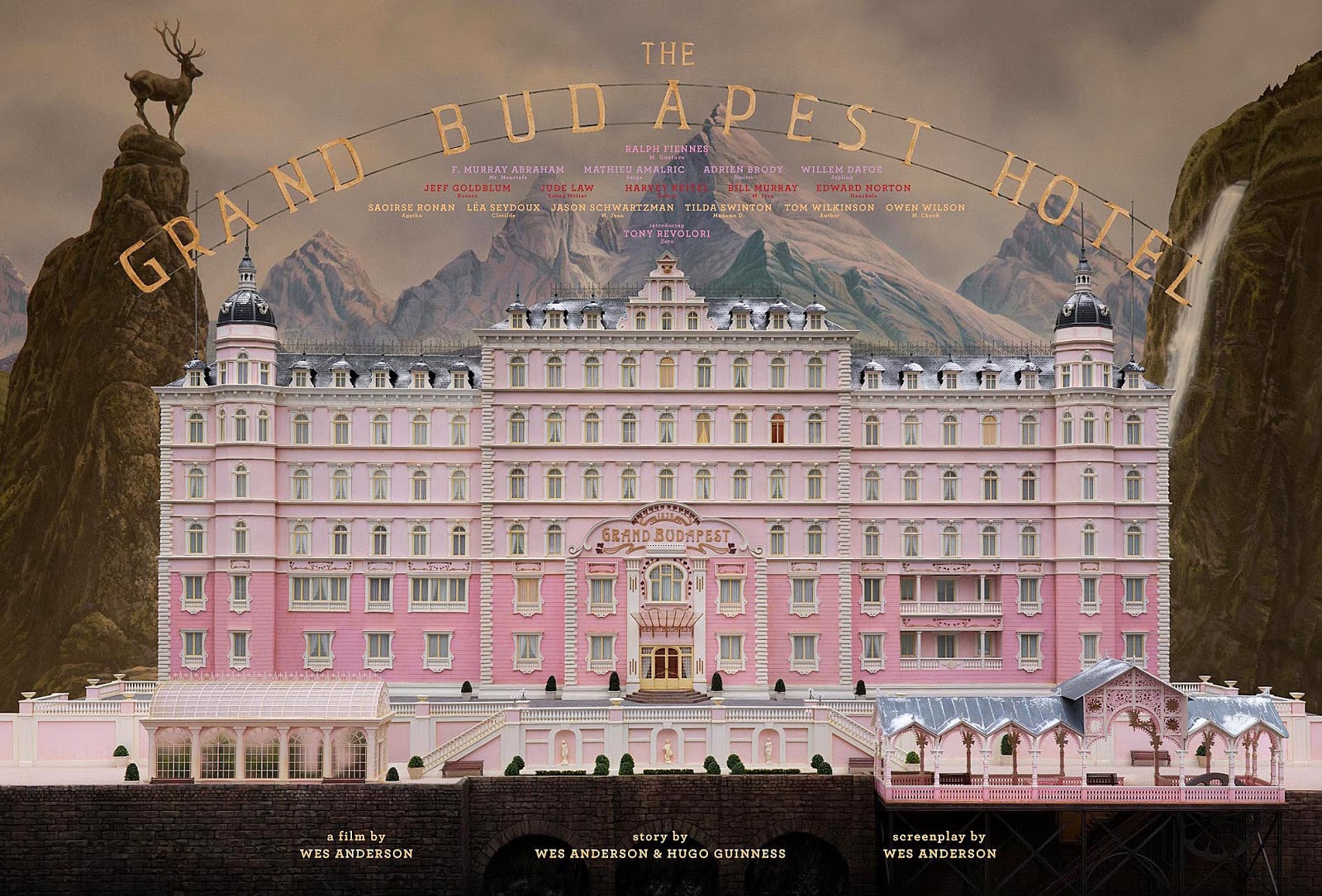 It has to be some kind of a Guinness record that I held a smile for all 100 minutes of The Grand Budapest Hotel’s running time. From Tom Wilkinson’s astute-turned-askew opening to the cute end credit addendum, the movie is indelibly Wes Anderson. In fact, it’s the best of his lot. And that hilarious lot includes the impressive Moonrise Kingdom, Rushmore, and The Fantastic Mr. Fox.
 Wes Anderson fans already know his body of work, but names are included for future viewing by newbies for whom Grand Budapest is a first exposure.
One not only watches a Wes Anderson-directed and written (as is this one) comedy, but gladly hops aboard for the ride. That ride includes a loopy story filled with eccentric characters, set in unexpected environments, and a myriad number of subplots that careen back to the opening premise. Expect the bizarre and surreal. Go with Anderson’s flow.
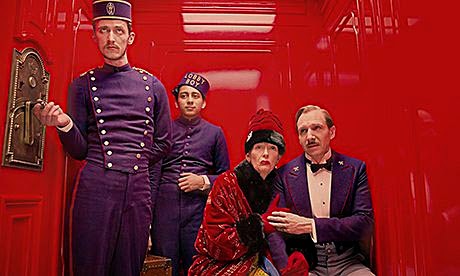 Add takes and double-takes in the tradition of silent film comedy, Buster Keaton in particular, as well as deadpan, face on delivery. Again think of Keaton. Also think of Bill Murray, pretty much a Wes Anderson regular, whose own stone faced style is tailor made for The Grand Budapest Hotel and a half dozen other Anderson flicks. Then imagine another dozen actors doing the same Murray schtick. By the way, Murray’s sequence in Budapest comes during the fourth act of this five parter. He plays M. Ivan, a support character involved with helping Ralph Fiennes’ M. Gustave, the central guy in the story, during a major chase. Let me add that the entire film, typical of a Wes Anderson film, includes one chase after another.
 Movement becomes the punch line, set up by dialogue, and prompted by anxiety. For example, a meticulously planned jailbreak leads to car chase, which eventually ends on an incredibly lengthy, crazy ski chase. It is hilarious, made more so by Anderson’s use of stop-motion miniatures. The use of miniatures is yet another Anderson trademark. Exteriors of the Grand Budapest Hotel, including surrounding mountains and ski lift, are miniatures morphed with what appears to be real people in long shots. Real or animated, it all makes for pleasingly surreal visuals.
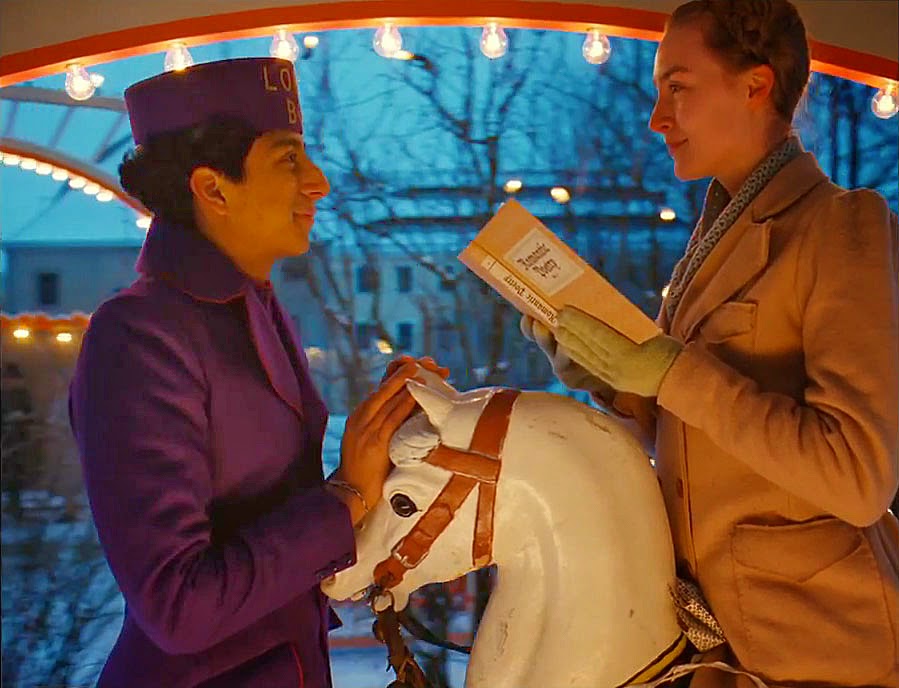 Set in present day Europe in the make believe alpine Republic of Zubrowka, the story is a story within a story that begins with Tom Wilkinson as, simply, “The Author,” relating his younger days at The Grand Budapest Hotel, when the hotel was in its waning years. The younger writer (Jude Law now) befriends Mr. Moustafa (F. Murray Abraham), who agrees to tell him of his association with the hotel in its glory days, circa 1932. At that time, we discover, he was the lobby boy known as Zero (played by Tony Revolori). Without either spoiling or complicating the tale, just know that Fiennes’ M. Guastave H. is the hotel’s concierge, intimately involved with many of the guests. His character is the crux of the plot, and Fiennes carries it superbly in a very uncharacteristic comedy role.
 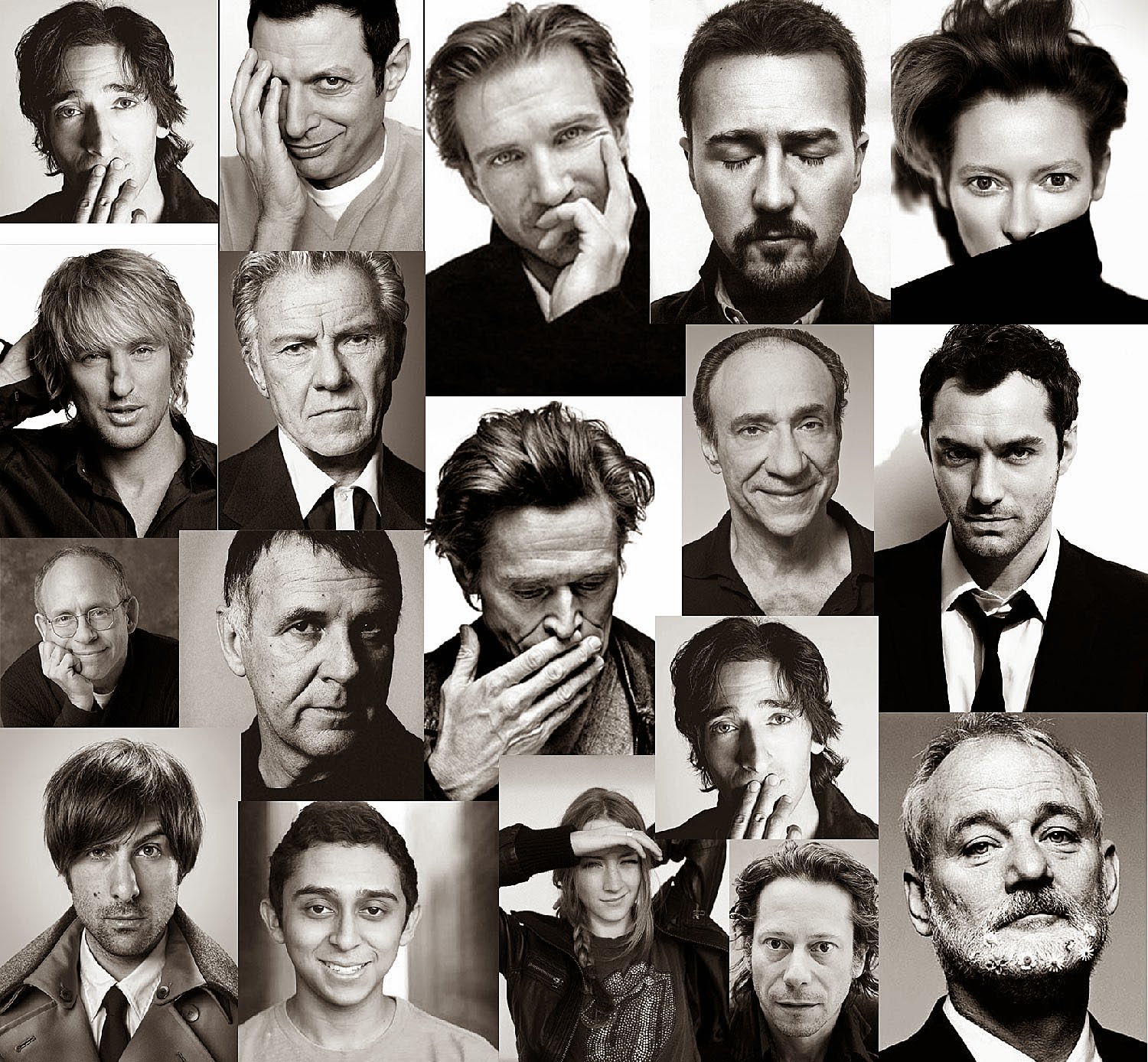 Sure the movie is brimming in other star names (Adrien Brody, Willem Dafoe, Jeff Goldblum, Edward Norton, and Tilda Swinton amongst), but it is Anderson’s story telling that uses them so effectively. Their presence is not primarily as star value as, say, in 1974’s Murder on the Orient Express. Instead, each part is plum and comedically necessary. Who would have even thought of casting Tilda Swinton or Ralph Fiennes in a wild comedy? Voilà, they seem perfectly cast.
 Besides Anderson’s expected use of wide-angle shots and of characters running from right to left and vice versa, there are his endless track shots. Pacing is key. Orson Welles once said, and I paraphrase, that a sign of a great director is not noticing the direction. Yet we do notice Wes Anderson’s direction, and feel better entertained because of that awareness.
——————–
GRADE on an A to F scale: A
——————–