
Depp + 3D visuals are ‘Alice in Wonderland’ draw power

 But visually, which is where this Alice really radiates, there are many riches. Ken Ralston’s visual effects are stunning and surreal; Colleen Atwood’s costumes are dazzling; and Dariusz Wolski’s photography is spot on. However, all suffer because most scenes are so darkly shot. How can one fully appreciate their good work when even the brightest days seem like sundown or dusk? Either Burton and Wolksi purposely took the visual design from Arthur Rackham’s sepia-tone illustrations for the 1907 publishing of Alice’s Adventures in Wonderland (which includes dimly lit imagery) or the problem was at my screening. Perhaps the 3D projector had an under-watted bulb?
 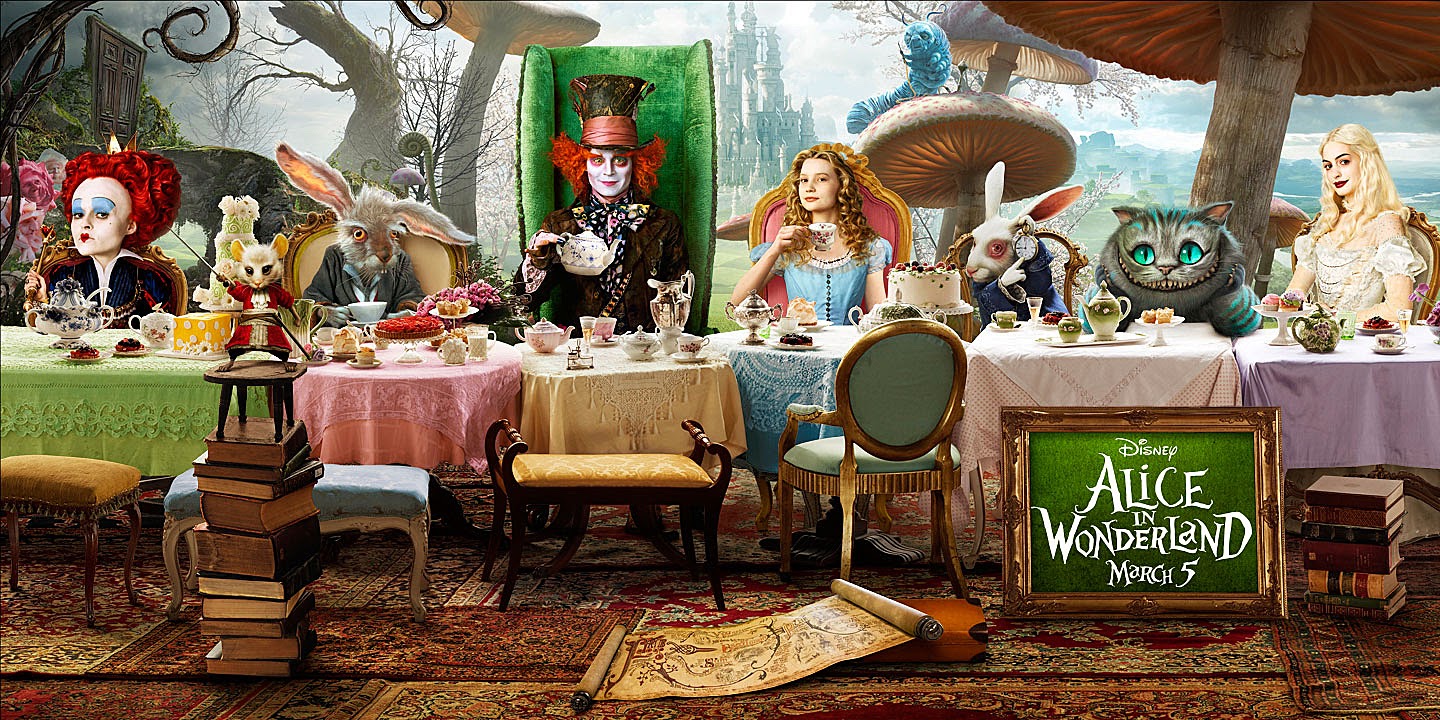 For the record, Helena Bonham Carter sneers as Red Queen; Anne Hathaway is sweet goodness as White Queen; Crispin Glover’s head digitally sits atop a tall and evil knight called Stayne, Knave of Hearts; and Matt Lucas has his face morphed on the roly-poly, identical twins Tweedledee and Tweedledum. There is fine voice work by Stephen Fry (Cheshire Cat), Alan Rickman (Blue Caterpillar), Michael Sheen (White Rabbit), Paul Whitehouse (March Hare), Timothy Spall (Bayard), and Barbara Windsor’s Dormouse.
 Worth 1,000 Words: ‘SPANKY’ McFARLAND at Harmon

By Steve Crum
HAS IT REALLY BEEN nearly 22 years since “SPANKY” McFARLAND spoke to a packed house of 1,000+ students and faculty members at J.C. Harmon High School in Kansas City, Kansas? Sure enough. It was mid-morning on Monday, Sept. 12, 1988, when I introduced Spanky at a special assembly in the auditorium. (I was teaching journalism, mass media and English at Harmon then.)
Earlier that morning, I had driven to the Doubletree Hotel in Overland Park to pick up Spanky, along with his golf clubs and luggage. He was in town as one of the celebrity players at the Peter Marshall (The Hollywood Squares) Celebrity Golf Tournament in K.C. Spank was drinking a cup of coffee, and waiting on the hotel sidewalk when I drove up.
On the drive to Harmon, Spanky complimented me on my safe driving in between talking about Alfalfa, his growing up in Texas, fellow “Rascal” Scotty Beckett, and show business in general. Regarding his memory of Scotty Becket, with whom he was paired in numerous Our Gang shorts, Spanky said, “Oh God, Scotty Beckett. Poor, poor Scotty. What a sad story. What a talent. So sad. He left us far too soon.” (Beckett had a relatively brief but illustrious career in film, radio and TV, but died at age 38 in a nursing home. Drugs, alcohol, martial problems and depression factored into his tragic circumstances.)
 It was all prearranged by my good pal Jim Peters, the leader and founder of our Hog Wild Tent, which is the local chapter of the Laurel and Hardy, Sons of the Desert organization. (All the fan club’s branches are called tents, and each is named after one of Stan and Ollie’s classic comedy films.) Spanky met Jim at a Laurel and Hardy convention, and agreed–for a price–to appear at both of our schools. Jim was teaching at Eisenhower Middle School, a few miles away.
 So Spanky introduced clips (on 16mm) of vintage Our Gang/Little Rascals to an appreciative audience. At that time, the students were very aware of Spanky, Alfalfa, Buckwheat, Darla and the gang thanks to repeated showings on TV. Spanky talked and fielded questions about himself and other cast members for an hour. Then he was off to do likewise at Eisenhower. (Jim then drove him to the airport so Spanky could fly home.) He received $500 for each gig; students paid $1-$2 per admittance. Both Spanky and our schools profited. It was absolutely a very cool experience. Before the show, I introduced Spanky to the principal and his secretaries. All were thrilled.
 BORN GEORGE ROBERT PHILLIPS McFARLAND on Oct. 2, 1928, SPANKY began his show biz career as a very young child, modeling clothes and appearing in print Wonder Bread ads. A reliable source says he was first nicknamed “Buddy.” Another source claims he was called “Sonny.” Nonetheless, it was “Spanky” that stuck when he auditioned for Hal Roach’s Our Gang series at age 3. Spanky was immediately a sensation, and became the virtual on-screen leader of the Gang, later renamed The Little Rascals in TV syndication.
 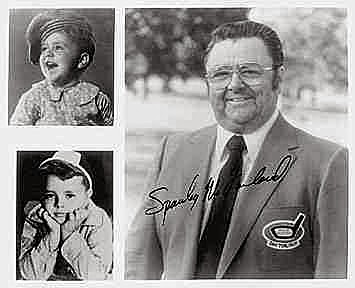 After 95 film shorts, Spanky retired in 1942. Typecast forever, and always looking very much like he always did in movies–thanks in part to his shortness, Spanky could not get work in Hollywood. He worked at various businesses, finding success as National Sales Director of Philco-Ford in Texas. For a time, he hosted a local kids’ TV show (featuring Little Rascals movies) in Texas, and participated in celebrity golf tournaments (as well as his own). On June 30, 1993, Spanky died of a heart attack at age 64 in Grapevine, Texas. The more recent photo of Spanky was taken at the Harmon assembly in 1988. [from Steve Crum’s showbiz memorabilia collection]
‘The Wolfman’ respects Chaney’s original, features state-of-art effects

 About the only contrived element missing from the Siodmak original is wolfbane. Siodmak used it as a plant that had mystical, preservation powers affecting the creature. It was a featured element of the six Chaneys; it is sorely missed in this new version (except for brief mention) only because of the faithful inclusion of most other werewolf legend. To the vast numbers of younger viewers who have never seen any Chaney Wolf Man, it should matter not. As the ad promos say, The Wolfman is “inspired by the classic Universal film.” It is not a Xerox redo.
 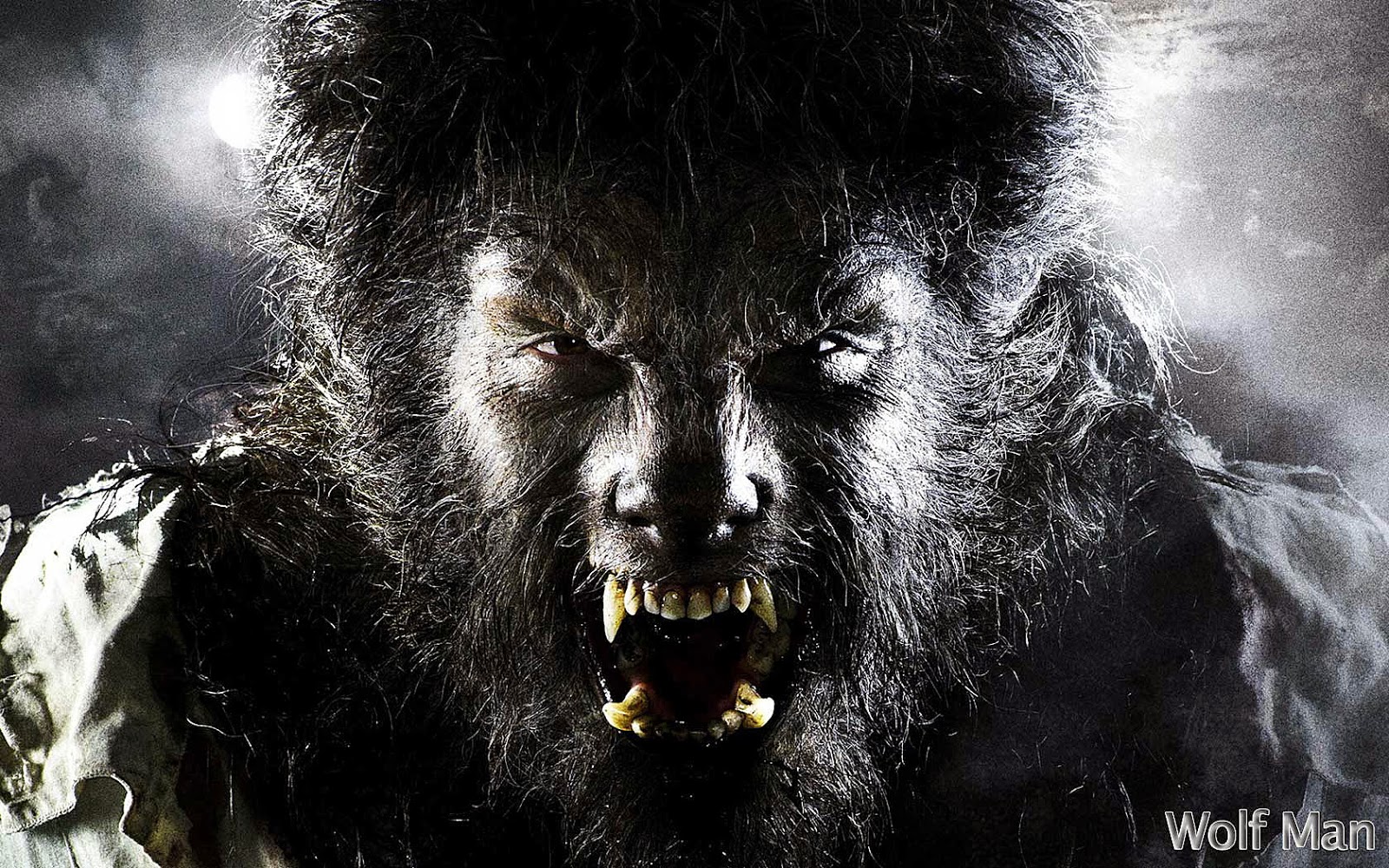 How can there be a werewolf loose before Lawrence even arrives home? Ah, the twist of the story surfaces, but will go without much explanation due to ruining it for viewers. When Lawrence is indeed bitten by the creature, and is transformed himself into a werewolf, then the story takes unique turns as there is double trouble in the woods.
 Worth 1,000 Words: AL JOLSON ready for takeoff

By Steve Crum
SUPERSTAR AL JOLSON takes the “pause that refreshes.” More is now known (as of an hour ago) regarding this UNPUBLISHED photo of The World’s Greatest Entertainer, Al Jolson. Thanks to input from Jolson scholars as well as my own web research, it is thought the pic was taken during a flight to Sacramento, California in January, 1947, to attend the second inaugural of Earl Warren as Governor of California.
Others, possibly Friars Club members, on the plane included Bud Abbott and Lou Costello. The unidentified gentleman with Jolie is an executive with American Airlines, so says the accompanying caption. And Coca Cola bottles are product placement-like displayed hither and yon. As far as I know, Jolie never did any Coke ads. Is Jolson traveling coach? [from Steve Crum’s showbiz memorabilia collection]
Worth 1,000 Words: JEAN HARLOW in KANSAS CITY

By Steve Crum
JEAN HARLOW, MGM’s “Blonde Bombshell,” poses with an unidentified Kansas City, Kansas neighborhood child (one of her grandmother’s neighbors) at Kansas City, Missouri’s Union Station in 1933. Harlow was preparing to board a train for her return trip to Los Angeles. (A couple of porters are barely visible at left in the background.) Feast your eyes, since this is a heretofore unpublished photo of the famous Harlow, who died far too young four years later at age 26. For more on Harlow’s visit, please scroll down a couple of stories or so. [from Steve Crum’s showbiz memorabilia collection]