
‘Cloud Atlas’ is supremely complex, stunning epic
 By Steve Crum
 But as long as one is very patient, and willing to ride with six separate story lines that dart back to forth to forth to back and in between, then there is no problem. Otherwise, Cloud Atlas is problematic. With a narrative that seems at first to be all over the place, the multiple stories are sometimes hard to grasp. Stories are joined in disjointed ways. The good news is everything gets clearer as the film progresses. Patience is indeed the virtue here.

 A figurative time capsule captures the complex story lines: in 1849, a San Francisco lawyer protects a runaway slave on a ship in the Pacific Islands…in pre-WWII Great Britain, a poor but gifted composer commits an act which influences the creation of a lifelong work he calls “Cloud Atlas Sextet”…a 1973 journalist tries to avert an industrial disaster…a present day publisher faces unjust imprisonment as he nears great success…in 2144, a genetically engineered young lady, bred to follow orders without thought like a robot, begins adopting human emotions, and acting upon them…and in 2300 or thereabout, a goat herder faces both his conscience and violent surroundings in an evidently post-apocalyptic world. Hanks, Berry, and cast all act in key roles of each segment, and do so quite gloriously. I will not muddle the mind explaining or even listing all their characterizations.
——————–
Maybe the trailer will help clarify: https://www.youtube.com/watch?v=ByehYal_cCs
Factual, ultra tense ‘Argo’ is one of 2012’s top films
 By Steve Crum
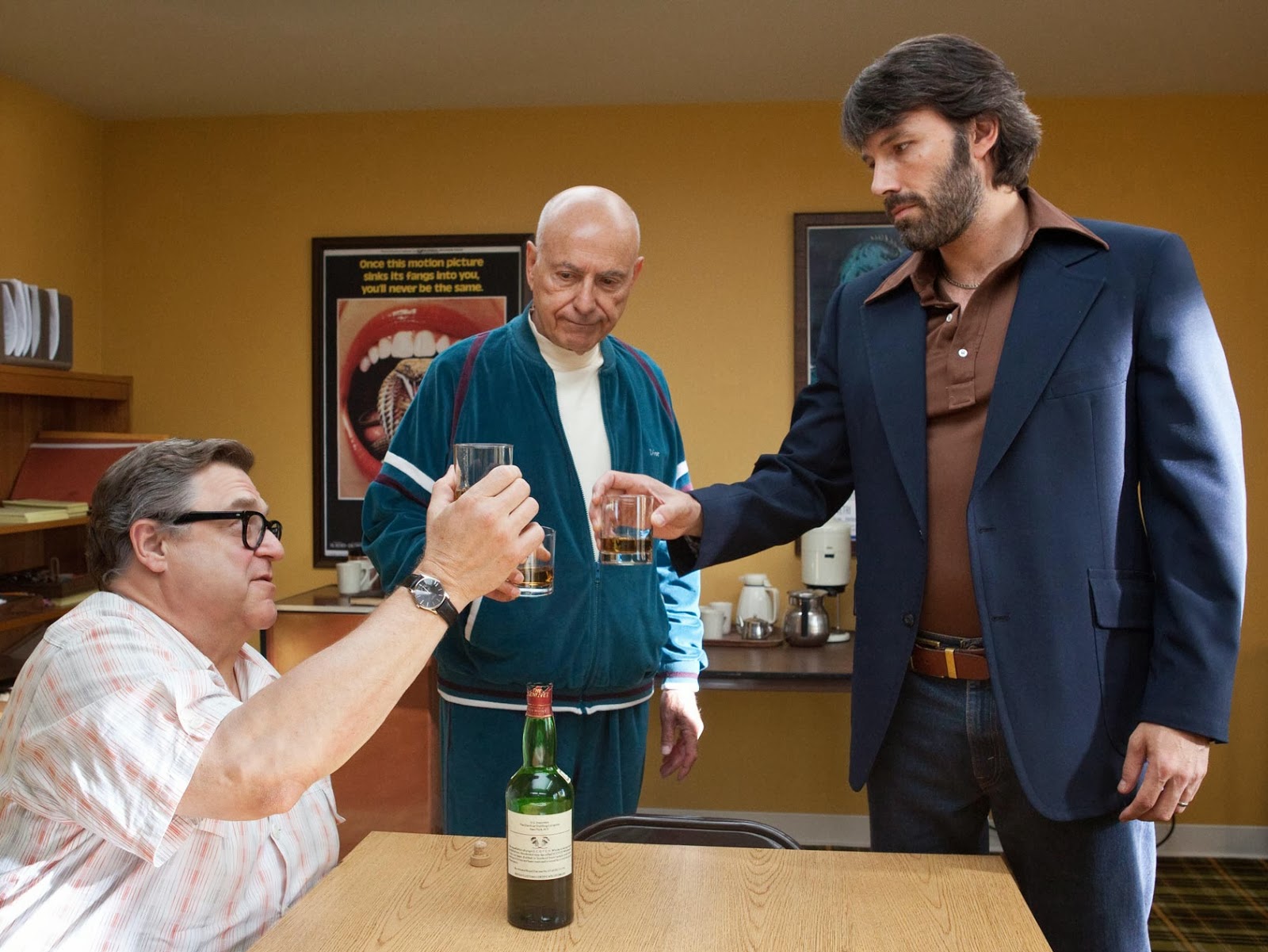
 Chris Terrio’s script, based on writings by Antonio J. Mendez (yes, the same Mendez depicted in the film) and Joshuah Bearman, opens in near documentary style, on Nov. 4, 1979. Militants storm the walls surrounding the U. S. Embassy in Tehran, and take 52 Americans hostage. (They will remain captives for over a year.) But that is not Argo’s real story. Argo focuses on the six Americans who barely escaped and hid out in the Canadian Embassy, also located in Tehran. They are given sanctuary in the home of Canadian Ambassador Ken Taylor (Victor Garber).

Argo is a lesson in near perfect pacing with the first 2/3 in slow, temperate gate with light humor supplied by the characters of Goodman, Arkin, and Bryan Cranston (as CIA honcho Jack O’Donnell). The groundwork is specifically laid out. The film’s final 20 minutes are some of the most seat-edged, harried moments of this or any film. Bee-rother.
Overlong ‘Bourne Legacy’ features dazzling chases, convoluted plot
 By Steve Crum
Fans of the first three Bourne movies will want to see this fourth franchise installment, The Bourne Legacy, which–as the title implies–is a kind of homage. Those who have never seen the previous films (The Bourne Identity, The Bourne Supremacy, The Bourne Ultimatum) will definitely want to see those movies before seeing Legacy. Otherwise, the complex plot, which references the previous films, will be confusing to the point of exasperation. I did see and greatly enjoy the previous Bournes, but was dizzied at what the heck was going on in this new take. No doubt this is the end of the franchise.
 Replacing Jason Bourne as the central character, without a “new” Jason Bourne, is the daunting task here. Instead of Matt Damon in the lead, we have a kind of Bourne wannabe, since Cross has been trained and chemically programmed by the same nefarious, CIA connected government agency that previously shafted Jason five directions. To supposedly make matters clearer, which made matters even more muddled to me, there are constant references to Jason Bourne along with flashing his 8 x 10 Matt Damon photo a half dozen times throughout the story. Hopefully, Damon received payment for his product placement.
  A planned, tragic incident at the government’s secret spy lab triggers a chase involving both Cross and chemist Shearing (Weisz), with CIA operatives in pursuit. It all has to do with Shearing helping Cross deal with his (CIA) drug dependency. I won’t spoil the plot with specifics. By the way, the on location filming in Manila is spot on and worth the reported hassle filming in that extremely crowded downtown locale. Much of Legacy’s best action bits were shot there, with the motorcycle chase finale the most breathtaking of them all. Forgive my hedging, but the early on sequences of wolves attacking Cross as well as the drone firing missiles at our hero are impressive too. Kudos to editor John Gilroy and composer James Newton Howard for heightening the suspense and action. It is a shame similar accolades cannot be given to the film’s dialogue and plot.
 ——————–
At least the trailer is brief: https://www.youtube.com/watch?v=jSzy9qQ3mDE
Finale of Christopher Nolan’s Batman trilogy rises, dazzlingly
 By Steve Crum
Forget about Batman himself appearing just yet. That comes even later in the story. It is worth the wait.
 The third of Nolan’s Batman trilogy, The Dark Knight Rises is once again laced with grimness, despair, and a heinous villain. Although 2008’s The Dark Knight features an Oscar winning turn by Heath Ledger as the most memorably psychotic of all Batman villains, The Joker, Tom Hardy’s vicious Bane comes in a strong second. As all good DC and Marvel geeks (like yours truly) know, a superhero is only as good as the super villain. This makes or breaks the central conflict. Bane looks like a WWE wrestler with a Hannibal Lector mask attached to his face as a breathing mechanism. As such, he breathes–deeply, a la Darth Vader. And his voice sounds like Sean Connery’s. James Bond never, ever broke guys’ necks, at least not like Bane does.
 Add to the mix another Batman nemesis, Catwoman aka Selina Kyle, here played less sympathetically than in previous movies and TV episodes, by Anne Hathaway. Hathaway enhances the role physically and emotionally. Her real life dancing skills have segued into gymnastic moves that make her lady burglar sequences credible. Backward flips out a window might have been accomplished by a double, but why–when Hathaway is capable.

 Once Batman finally gets back to action, with the audience’s dander by that time primed to the max, the film explodes in scene after dazzling scene of air to street attacks and counter attacks. Highlights include Batman’s newly designed airplane, The Bat, which can hover in mid-air or fly at supersonic speed. It is impressive that so many battle scenes occur in broad daylight, which means the digital effects must be flawless. They are indeed. There is an awesome, yes that adjective is overused–but not here, sequence during a jam packed football game at a huge stadium. It is not the Red Sea parting, but close.
 ——————–
Enjoy the trailer of this trilogy conclusion: https://www.youtube.com/watch?v=g8evyE9TuYk
It’s six times superhero in marvel-ously mounted ‘The Avengers’
 By Steve Crum
 Nick Fury (Samuel L. Jackson), Director of the international peace keeping agency S.H.I.E.L.D., is forced to recruit each hero into a special task force to fight earth’s annihilation using the Tesseract, an untested energy source that will open a portal to Chitauri forces guided by Thor’s demented half-brother, the exiled Loki (Tom Hiddleston). Loki immediately invades S.H.I.E.L.D.’s headquarters and kidnaps, using mind control, several of its key scientists, including super archer Hawkeye/Agent Clint Barton.
  Even though Act 3’s spectacular invasion sequence in downtown NYC brings to the mind’s eye reminiscent images from Transformers movies, the key missing from those giant toy robot movies is The Avengers, the most bizarre, flashy, and patriotically driven heroes ever conceived. When the tardy Hulk finally joins the foray (there is good reason he is late), the hellish bashing really explodes. Sorry, bad guys.
Don’t even tell me to wait another year or so for the next Avengers escapade. I might start turning green.
The action-laden Avengers trailer: https://www.youtube.com/watch?v=eOrNdBpGMv8