
Winsor McCay left us animated Gertie the Dinosaur, surreal comics
(NOTE: The following feature was originally published in The Kansas City Kansan on June 2, 2000.)
 By Steve Crum
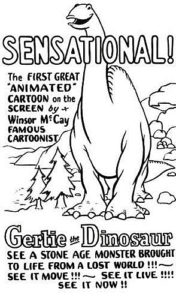
It all began with Gertie.
Gertie, the very first movie dinosaur, has evolved through various The Lost World and One Million B.C. remakes and variations, stomping on in Fantasia, The Land Before Time, and sundry animated features including Spielberg’s Jurassic Park pair. Now, Dinosaur lumbers in. Opening weekend take for the Disney animated feature tallied almost $40 million. Is there a pterodactyl in the house?
Dinosaur, in its seemingly 3-dimensional surroundings, stuns. It raises the bar once again for computerized art, something that Gertie’s creator, Winsor McCay, would have appreciated. All he had were pencil and ink 91 years ago.
McCay did not create his Gertie at the very beginning of his career; first there were his comic strips featuring wildly surreal characters and plots. Born in 1869 at Spring Lake, Michigan, McCay always loved drawing. Never formally schooled (a grade school dropout), he moved to Chicago at 17, drawing posters for a meager living. McCay grabbed any art lessons he could. He later designed murals in Cincinnati for a local museum. McCay also drew for various local newspapers.
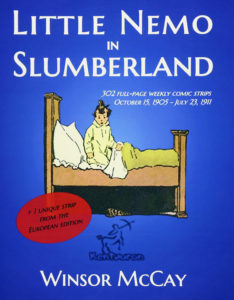 His comic strip career was launched in 1903 after newspaper mogul James Gordon Bennett learned of McCay’s talents. The fledgling artist was contracted as a strip artist on The New York Evening Telegram. Under the pseudonym “Silas,” McCay created several strips, the most remembered being Dreams of a Rarebit Fiend, in 1904. The dream angle was carried on in various ways throughout his career. An argument could be made, in fact, that Gertie could be construed as a dream-like trip back in time.
The real turn in McCay’s career, however, came in 1905 after he created Little Nemo in Slumberland. Using his real name now, McCay drew with surreal abandon. Each strip episode focused 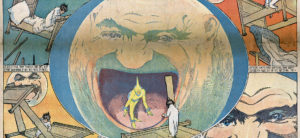 on the imaginative dreams experienced
nightly by little boy Nemo as his bed elevated, alternately zooming and floating through the cosmos and never-never-lands. McCay’s Nemo world was a shadowless one of distorted dimensions. Characters included Impy the Cannibal, Flip the Dwarf and Morpheus, the King of Slumberland.
Would this strip be ahead of its time now, almost a century later? The late and wonderfully great Calvin and Hobbes strip comes to mind as the nearest to Little Nemo that anyone has come.
Gertie, the silent and friendly Brontosaurus, stomped onto the scene four years later, while Nemo was continuing its national syndication. At this time, McCay had begun a parallel career dabbling in the infant art of animation. He created animated versions of Little Nemo in Slumberland and experimented with a fascination of his, the dinosaur. Realize that in those silent film days, each individual cell was photographed one frame at a time. And each cell, drawn on paper  then, had to be hand drawn separately. That meant McCay and his assistants had to create some 3,000 separate drawings by hand for a typical three-minute film. (Silent speed was 18 frames per second.)
Nonetheless it was worth it for McCay and the history of animation. Gertie was a sensation, spewing numerous other Gertie cartoons. Plot lines were similar. In the original, actually named Gertie the Trained Dinosaurus, a flat plained area near a water line is shown as Gertie ambles from the distance to screen front. Gertie then stares at the screen, no doubt amazing 1909 audiences. (These films were shown in vaudeville houses and at trade meetings.) Gertie moves her neck from screen left to right, still staring and seemingly smiling. She witnesses a tug of war between a sea monster and a woolly mammoth. The monster has latched onto the hairy elephant’s long trunk. As Gertie watches, a small monkey crawls on Gertie’s back, sliding up and down her neck. Finally, Gertie grabs the pest and, after winding up 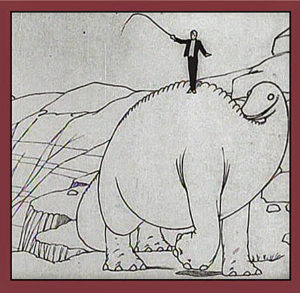 her long neck, tosses the monkey into oblivion.
A cartoon version of McCay then appears walking from right screen front. Dressed in a tuxedo, he takes a bow, presumably for the creation we have just witnessed. Gertie picks him up by his collar and politely puts him back off screen. Then Gertie sits back, lifts her huge right leg, and waves at the audience. The End.
But that is not all. During public exhibitions of this movie, as well as his other Gertie flicks, a live McCay would stand beside the screen and interact with Gertie. At one point in one of the films, McCay would throw an actual ball to Gertie, which she would then seem to catch via animation. (McCay would throw it to an assistant behind the screen.) 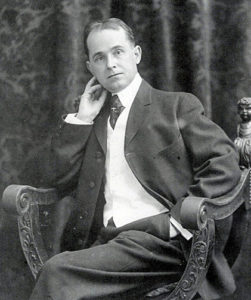 The showmanship was an awesome, magical blend of the live and the animated.
At one point in his vaudeville career, McCay and Gertie shared the bill with W. C. Fields and Houdini. McCay’s influential career on stage, celluloid and paper flourished until his death in 1934.
His epitaph: “Simply, I could not keep myself from drawing.”
FILM VIGNETTES and ASIDES ∞∞ Part 1 ∞∞
By Steve Crum
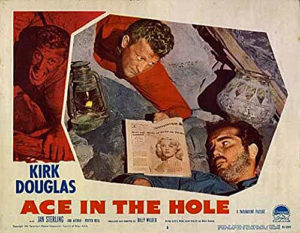 •ACE IN THE HOLE (1951): The first time I saw it, I regretted not having seen it decades earlier. I would have shown it to my high school journalism students as part of their ethical training. But alas, I was retired from teaching. Billy Wilder’s jarring movie about an exploitive, corrupt journalist (Kirk Douglas) still teaches all of us.
•THE ADVENTURES OF MARK TWAIN (1944): After first viewing this majestic  biographical movie during my grade school years on our Philco TV, I was struck by the incredible acting of Frederic March in the title role. Max Steiner’s classic score continues to stay with me. Then there is the concluding scene of Twain-Clemens dying in bed while Halley’s Comet darts across the night sky. Sam Clemens, you see, was born the last time the comet was seen, 74 years to the day. Amazing.
•THE ADVENTURES OF ROBIN HOOD (1938): Perfect storytelling, if for 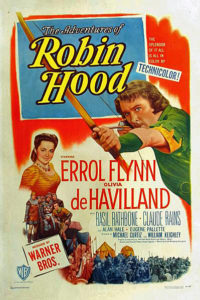 nothing else than the Technicolor, Erich Wolfgang Korngold’s music, the brilliant set pieces, the actors, and even the specifically recorded sound of arrows rocketing to their targets. Heroism vs tyrants has never been told better.
•THE AFRICAN QUEEN (1951): It was the leeches that imprinted on my 4 year-old mind when 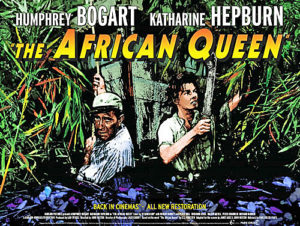 my parents and I first saw this movie. I think it was at a drive-in. I probably fell asleep before it all ended, but when Bogart had Hepburn help him peel one leech at a time from his body…what a slithering memory.
•AIRPLANE! (1980): I do so love puns, and this picture is chock full. Shirley you also love the non-stop parody and sight gags running rampant.
•AIRPORT (1970): Alfred Newman’s thematic music underscores this all-star, mainly airborne soaper. I loved its soundtrack so much I bought the German version (different cover art) when I was stationed in the Army near Kaiserslautern in 1971.
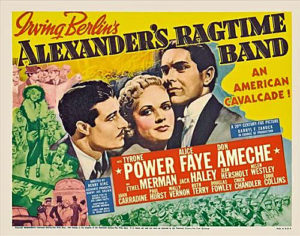 •ALEXANDER’S RAGTIME BAND (1938): It has all those Irving Berlin songs sung by Merman, Faye, and Ameche…but what lingers most is a socko song and dance routine by Wally Vernon, “This Is the Life.” He was thereafter sadly underused as a lame sidekick in B-westerns.
 •ALIEN (1979): First seeing this terrifying classic sci-fi/horror movie with my younger sister is fixed in memory. The thing is, my sister Becky was 29 years old in 1979. I invited her to an evening screening, and neither of us knew the terrors awaiting. Realize that Becky loathes scary movies because…they really scare her. And Alien really scared me too. The combination of suspense and graphic violence still shocks.
•ALL THE PRESIDENT’S MEN (1976): This wonderful film about truth and courage was released at a good time since I was just beginning my journalism teaching career. The landmark movie was inspiring to me and my students. No doubt it had much to do with increasing class sizes in j-classes nationwide.
Nightmarish imagery, great acting highlight horror that persists in ‘The Lighthouse’
 By Steve Crum
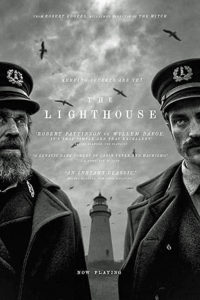
After spending 109 minutes watching The Lighthouse, the film’s message persists: “It’s bad luck to kill a seabird!” I so believe it now, as it is uttered early in the movie by Thomas Wake (Willem Dafoe). Wake’s warning to Robert Pattinson’s Ephraim Winslow tragically goes unheeded.
Directed and co-written by Robert Eggers (along with co-writer/brother Max), The Lighthouse is a highly original but grim motion picture on several levels. This psychological horror drama, released last October, is jammed with nightmarish imagery and tour de force acting (Dafoe and Pattinson are its only two actors). Both actors perform awesomely.
Besides the actors, there are enough auditory devices to fill several films. I speak of surround sound effects such as seagulls, heavy rain, and the damned foghorn that nearly affected me as much as it does the pitiful Winslow character. Both he and Wake are lighthouse keepers, arriving at the story’s opening to replace two others we see departing. The job calls for four weeks tending the remote lighthouse, whereupon they will be replaced. It is telling that neither duo says anything to the other as they pass by. Not even a nod or gesture.
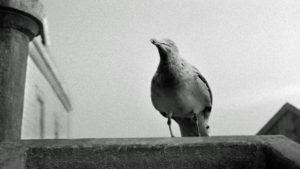 Once settled in, it becomes clear these two are total strangers who now have to work together for a month. The emphasis here is the “strange” in strangers. Dafoe’s older, bearded Wake immediately takes charge as sole keeper of the lighthouse, while delegating all menial labor chores to Pattinson’s Winslow. To make it worse, his hard work is repeatedly criticized by his new boss. Wake repeatedly orders that the floor scrubbing be done over and over. He is rarely satisfied with the results. It does not take long before Winslow revolts at his slave labor treatment.
Four months into their job, Winslow is still not permitted to even step into the beacon tier of the lighthouse. Wake keeps it locked tight.
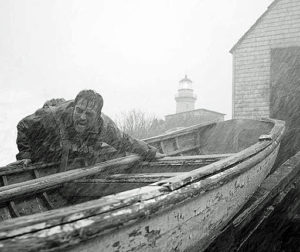 All this said, and without divulging more plot development, things hit the proverbial fan when their relief ship fails to show up with replacements. By that time, their booze-filled world of isolation is compounded by a terroristic seagull, bloody water, and a scary mermaid.
This study in paranoia, terror and insanity is somewhat adapted from the unfinished short story, The Light-House, by Edgar Allen Poe.
Mention must be made that it was shot in gorgeous black-and-white, enhancing the atmosphere. And it is not in widescreen. Realizing the movie is set in the late 19th Century, let us hope the pandemic quarantine we are all going through now never results in what occurs in The Lighthouse.
 Plaudits to Jarin Blaschke’s stunning cinematography, which was Oscar nominated earlier this year.
The wild finale brought to mind three classic films: Kiss Me Deadly (1955), 2001: A Space Odyssey (1968), and The Birds (1963). See The Lighthouse to believe it.
=====
GRADE, On A to F Scale: A-
‘Bombshell’ brilliantly exposes behind-the-scenes, scandalous Fox News
 By Steve Crum
Back in the old days—during my youth in the 1950s, a movie like Bombshell would be touted in newspaper ads and movie trailers with such terms as “SENSATIONAL” or “RIPPED FROM TODAY’S HEADLINES.” Bombshell, released in 2019, is definitely worthy of that ilk.
I have watched this factually-based movie twice, and still have trouble distinguishing between all three blonde women characters. This is particularly troubling during the first quarter of the film, before each Fox News character/bimbo is more clearly defined. The hodgepodge mix of cookie-cutter female images—all about body sexuality—really confuses.
In that regard, Charles Randolph’s screenplay includes a sequence set in the dressing room at Fox News. Dozens of matching blue and red dresses are on racks for female commentators to wear on air. Of course, sizes vary—slightly, but each is equally styled with shortened hemlines. That is because Roger Ailes, network chairman and CEO, has ordered such so. That is repeatedly stressed on numerous 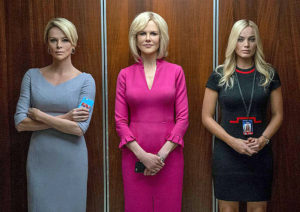 occasions in Bombshell when Ailes (John Lithgow in fat makeup) references female employees’ legs…and the necessary need to show as much gam as possible during a broadcast. To Ailes, according to the movie and in real life, any woman is a sex object—particularly young blondes.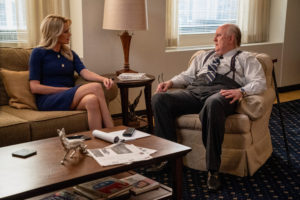
Incidentally, that Fox News look includes/included a kind of Stepford Wives blonde hair persona.
Bombshell really chronicles the beginning of the Me Too movement when two female Fox broadcasters, Gretchen Carlson (Nicole Kidman) and Megyn Kelly (Charlize Theron) begin pushing back against not only Ailes but President Donald Trump. Trump was tweeting rude and sexist remarks about Kelly because of her questioning his insulting remarks about women during the 2016 Republican debate.
About the same time, Carlson was fired by Ailes because of her on-air support of an assault weapons ban. She countered by suing Ailes for sexual assault.
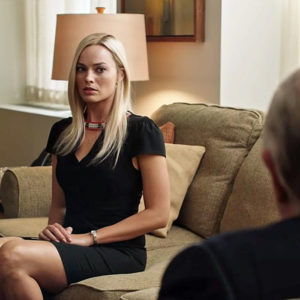 Director Jay Roach (Austin Powers movies) does a fine job in navigating the criss-crossing story lines. The third major thread involves a current, upwardly mobile wannabe newscaster who succumbs to Roger Ailes’ tried and true sexual assault methods. That means the old casting couch method behind closed doors in his office. Margot Robbie portrays Kayla Pospisil, the assaulted. The sequences are not graphic, but suggestive.
Incidentally, Saturday Night Live’s Kate McKinnon is a plus in the cast, portraying composite character Fox News writer Jess Carr.
I am not giving away a spoiler to remind everyone that Roger Ailes eventually resigned because of 23 lawsuits against his reputed sexual crimes; and his lecherous  ways are a major part of Bombshell’s central conflict. He had ruled at Fox News for 20 years.
Although it may seem otherwise, I am not sure that Lithgow is playing the infamous lout over the top at all. Seems incredibly credible, folks.
=====
GRADE, On A to F Scale: B-
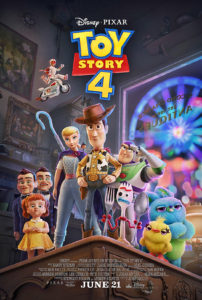
‘Toy Story 4’ continues/concludes memorable animation series brilliantly
 By Steve Crum
Question: Has it really been 25 years since the first Toy Story movie was released?
Answer: Yup. (Incidentally, that cowboy language “yup” is nowhere near the King’s English spoken by the film’s main character, Woody, the cowboy doll. Tom Hanks has voiced him since the beginning.)
Since Toy Story 4, directed by Josh Cooley, was released last June, fans and critics have once again gushed over every aspect of the CGI animated gem. It was no surprise that it soon won the Oscar for Best Animated Feature. It is doubly an accomplishment since after the first Toy 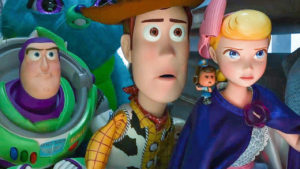 Story in 1995, plans were shelved to produce Toy Story 2 to theaters. Execs thought it better/safer to release it in direct-to-DVD form. But they gambled, and won. The second Toy Story was a sensation that led to Toy Story 3 and now #4.
And what sensation exists in Toy Story 4!
The screenplay, by Andrew Stanton and Stephany Folsom, takes up where 2010’s Toy Story 3 left off. Bo Peep (voiced by Annie Potts) and her close friend Woody are rescuing the human Andy’s remote-controlled car. Segue into a major catastrophe as Bo herself is donated to a new owner. Woody is crushed because he has been in 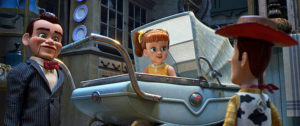 love with Bo forever—or at least in maximum doll years. Jump to years later when Andy is a young man, and all his toys are given to a little girl, Bonnie (Madeleine McGraw).
Enough of early plot details! Just realize that in the midst of Woody and his toy buddies (Rex, Hamm, Slinky Dog, and Mr. & Mrs. Potato Head among them) adapting to a new environment, a major plot change occurs. It involves a reunion of Woody with Bo Peep, a carnival, and some very creepy toys therein.
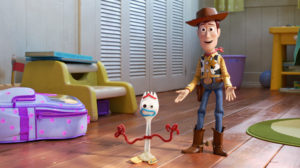 But the most memorable of all the new characters is a simply created toy, a plastic fork, called “Forky” (Tony Hale). Forky has proven to be so popular that Pixar has already created a Forky CGI short.
TS4 was supposedly the grand finale of the franchise. But, hey, money speaks. Even Tim Allen (the voice of Buzz Lightyear) has recently said that Toy Story 5 is a possibility. The public demand is undoubtedly there. Pixar Animation Studios/Walt Disney Pictures will have to decide.
=====
GRADE, On A to F Scale: A