
Despite its stellar cast plus Broadway credentials, big budget ‘The Prom’ disappoints
 By Steve Crum
The Prom is based on Broadway’s The Prom, and is all about going to the prom. That is simply and repetitively put. While it is reminiscent of high school-set musicals like Grease and even Hairspray, The Prom is a lesser, distant cousin. Add to that disappointing.
Considering The Prom’s stellar cast and production credentials, it is doubly disappointing.
Check out the star roster: Meryl Streep, James Corden, Nicole Kidman, Keegan-Michael Key, Andrew Rannells, Ariana DeBose, and Kerry Washington. Despite their valiant tries, they are working with a predictable, mediocre script by Bob Martin and Chad 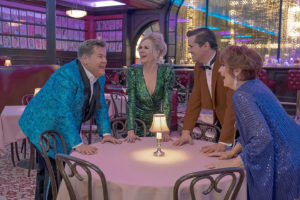 Beguilin, who also wrote the Broadway production. What does not help is a forgettable score by Matthew Sklar and David Klotz. The 131-minute running time belies expectations.
With a string of successful TV shows he created and produced (Glee, American Horror Story, Nip-Tuck among them), Emmy and Tony winner Ryan Murphy directed and produced The Prom.
So why does the film fall short? The answer is overproduction and slickness.
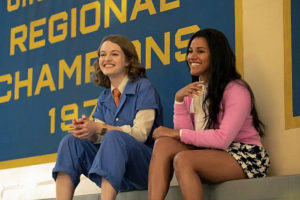 Using a plot device not so dissimilar to 1984’s Footloose, a midwestern small town (Edgewater, Indiana) prohibits a senior female student, Emma Nolan (Jo Ellen Pellman) of James Madison High School from taking her female girlfriend to the prom. In Footloose, the entire community banned any rock music and dancing from invading their high school territory. Although The Prom’s nemesis is PTA head Mrs. Greene (Kerry Washington), community parents hop on her bandwagon—emphasis on BANdwagon. No way will gayness be accepted. Although the principal (Keegan-Michael Key) supports Emma, he gives in to parental pressure.
Cut to Broadway. A pair of self-centered, aging stars who have seen better days are despairing over the opening night closing of what they both hoped to be a comeback musical. Their show, Eleanor! The Eleanor 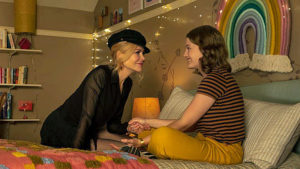 Roosevelt Story, is a super flop. For what it is worth, just the thought of an Eleanor Roosevelt musical amounts to the movie’s biggest laugh.
The two retreat to a nearby bar, and find solace in two out-of-work actors, played by Andrew Rannells and Nicole Kidman. The four soon discover the Emma story on Twitter, unite, and travel to Indiana as a self-serving publicity angle to take up her cause.
A whole lotta singing and dancing about love, acceptance, and sexual equality follows via enthusiastic production numbers performed by Streep, Corden, Kidman, Rannells, and company.
The song titles reflect such: Changing Lives, The Acceptance Song, Love Thy Neighbor, Tonight Belongs To You, and on and on. Nothing hummable.
Wow, The Prom glitters! But by its upbeat finale, we are reaffirmed that there is no gold amongst the glitter.
∞∞∞∞∞
GRADE on an A-F Scale: C-
George Clooney, Felicity Jones help make ‘The Midnight Sky’ plausible sci-fi
 By Steve Crum
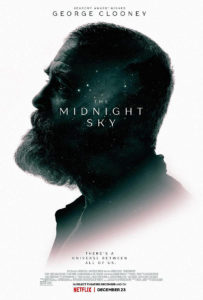
Of The Midnight Sky’s nearly two hour running time, George Clooney’s Augustine Lofthouse singly and brilliantly occupies over half. It is a task that speaks highly of Clooney the actor AND director. I say “singly” even though there is the inclusion of a preteen stowaway not long after the story opens. Let me clarify that he is the only one speaking. (This will be explained.)
Clooney gives a nuanced, somber performance which comes to life during a pair of action sequences that involve blinding snow, cracking ice, and frigid water. Be aware that the blizzard shooting occurred on location in Iceland during 50-mile-per-hour winds at 40  below 0. Call it enhanced, reactionary acting.
Mark L. Smith’s screenplay, based upon Lily Brooks-Dalton’s book, Good Morning, Midnight, tells the story of brilliant scientist Lofthouse in 2049. He is all alone on Earth after the surviving population has space-shipped out to Jupiter’s habitable K-23 moon for survival.
The gray bearded scientist is slowly dying, as shown by his daily health regimen. Through flashbacks of 30-plus years, we discover the young Lofthouse (Ethan Peck) had a romantic relationship with Jean Sullivan (Sophie Rundle), which ended due to choosing between career and marriage. As Lofthouse indulged in his professional passion, he became increasingly self-centered and unable to bond with other humans. Decades later, the loner is now truly alone.
 A plot turn drastically changes things when Lofthouse discovers a frightened little girl, later identified as Iris (Caoilinn Springall), hiding in his store room. Seemingly unable to speak, Iris reluctantly communicates with the old man through visual prompts like drawings and (gulp) peas. She becomes his sidekick of sorts, accompanying him throughout the Arctic structure as well as a terrifying snowmobile trip to a distant antenna shed. They grow fond of each other, and more dependent.
Act 2 focuses on the spacecraft Aether, which is nearing the earth after being away on an exploratory mission, unaware their planet is undergoing disaster. Crew members are having their own challenges, including an asteroid shower which imperils them as well as the ship’s structure. Add to that a newly discovered pregnancy.
It all adds up to much more than what might sound like an outer space soap opera. Earth is uninhabitable, except for  dying scientist Augustine. So now what to do? Clooney, as well as the entire Aether crew, make the implausible plausible. That is a credit to their acting. Kudos to Felicity Jones as Dr. Iris “Sully” Sullivan—on board the ship, and her fellow astronauts, played by David Oyelowo, Tiffany Boone, Demián Bichir, and Kyle Chandler.
A fine score, featuring reflective violin and piano, is by the great Alexandre Desplat. Martin Ruhe’s cinematography is stunning.
The Midnight Sky has a heartbreaking finale preceded by grief, melancholy, regret, isolation, and repressed love.
∞∞∞∞∞
GRADE on an A-F Scale: A-
Clever, fast-paced ’Palm Springs’ is no déjà vu of ‘Groundhog Day’
 By Steve Crum
I have to admit I disliked Palm Springs from the outset. How dare any film have the audacity to redo the classic 1993 Groundhog Day! How could the comparatively paltry Andy Samberg attempt 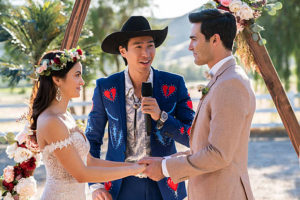 to outdo or even equal Bill Murray? After the first 15 minutes, I calmed down and accepted what was really happening in Palm Springs. It takes the Groundhog Day set-up, and branches out in a half-dozen zany, original directions. It becomes much more than a re-imagining.
And it is well worth seeing, folks.
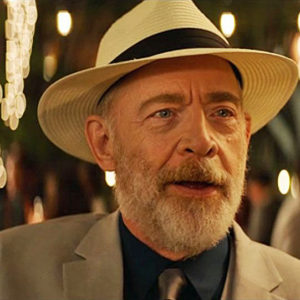
Palm Springs is accurately studio-described as a sci-fi romantic comedy. First of all, it involves three individuals stuck in a time loop that is linked to a cave in the California desert near downtown Palm Springs. (I suppose the location would also be considered Palm Springs.) That means the same day repeats itself for the three unfortunates. These three are: Nyles (Andy Samberg), Sarah Wilder (Cristin Milioti) and Roy Schlieffen (J. K. Simmons).
 The target date, the repeated target date, is Nov. 9. It is the wedding day of Tala Anne Wilder (Camila Mendes) and Abe Schlieffen (Tyler Hoechlin). Notably, Peter Gallagher and June Squibb are cast as family members. Present for the festivities is Nyles, the boyfriend of Tala’s bridesmaid, Misty (Meredith Hagner).
At the reception, Nyles interrupts the wedding speeches with an impromptu rambling that diverts attention from maid-of-honor Sarah’s speech—who is not only too shy to speak but drunk. It then segues to the desert, after Nyles and Sarah have become fast acquaintances if not friends.
So begins a time warp journey that at first only involves Nyles and Roy and bows and arrows. Thanks to a mysterious cave vortex nearby, the curious Sarah gets involved.
The cleverness of Max Barbakow’s direction blended with the originality of Andy Siara’s screenplay result in a fast-paced, extremely diverting 90 minutes. Although the love relationship between Nyles and Sarah seems inevitable from the get-go, it is fraught with problems as the same day is repeated—under  varying circumstances—over and over.
Samberg and Milioti make a great team, playing off each other superbly.
J. K. Simmons is up for the goofiness of it all, and adds fine support.
Matthew Compton’s jaunty title tune and score are a plus.
“Life can be a little less mundane with you in it,” Sarah tells Nyles. Palm Springs is anything but mundane.
∞∞∞∞∞
GRADE on an A-F Scale: A-
Well-named ‘First Cow’ is gritty, realistic, highly original western
 By Steve Crum
The aptly named First Cow has much going for it, including high likability. If it is not the most original screenplay of the year, it is definitely in the running. It is also a western by strict definition, set in Oregon, but by no means stereotypical of the genre. Consider First Cow a dark horse winner.
Make that dark bovine.
Although this is Kelly Reichardt’s first major theatrical film, her style of writing and directing shorter and more independent movies is branded throughout First Cow. Its 121 minutes is told  with minimalist direction, and set (like her previous, critically acclaimed work) in a rural Oregon community. The time is 1820. The central character is a short, dorky, and constantly harassed Otis “Cookie” Figowitz. “Cookie” (John Magaro—Orange is the New Black) is appropriately nicknamed since he travels with trappers through the wilderness, serving as their chief (and only) cook. He also has to bag the game he serves.
 <Let’s pause here to explain the 19th Century story is told in flashback after a modern day opening that involves a lady hiker discovering two buried skeletons in the woods. More later?>
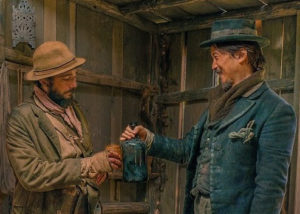
Cookie crosses paths during one night with King-Lu (Orion Lee), a Chinese immigrant on the run for murder. He is sheltered and hidden from the trappers until King-Lu can escape. Later reunited in a muddy settlement, the two decide to share a shack and plan for a moneymaking future. Their scheme involves cuisine cooking (Cookie has been chef trained Back East), with a plan to sell bakery items to settlement folks. It is all a well and tasty good plan except for the fact there is no available milk.
 Enter wealthy settlement Brit, Chief Factor (Toby Jones—Truman Capote in Infamous), who just happens to be the owner of THE only cow in the region. Stealing the cow’s milk late at night is the answer. Ironically, Factor becomes a fan of Cookie and King-Lu’s delicious biscuits that contain the mysterious “secret ingredient.”
The obvious comedic elements of the slow paced First Cow segue into drama and tragedy, all the while showcasing authentic looking period surroundings thanks to Reichardt and her cinematographer, Christopher Blauvelt. Costuming and set design are A-1.
 First Cow’s screenplay was co-written by resident Oregonian Jonathan Raymond, and based upon his book, The Half Life.
Reichardt’s previous films were earmarked for their ambiguous endings, and this one follows suit. First Cow both begins and ends with a mystery.
That might frustrate some viewers, but it works pretty beautifully.
∞∞∞∞∞
GRADE on an A-F Scale: A-
Slow paced ’On the Rocks’ is tailor-made for Bill Murray
 By Steve Crum
In her 2002 Lost in Translation, Sofia Coppola cast Bill Murray as Bob Harris in a midlife crisis role. The producer/director/writer has now recast Murray as a gray haired, wealthy divorcee in the dramedy On the Rocks. Murray’s Felix Keane is older but not much wiser as he doles out lovelorn advice to anyone who will listen. It is not a blessing when the object of such is now his adult daughter, Laura (Rashida Jones).
Specifically, Laura and husband Dean (Marlon Wayans) are an upscale Manhattan couple with two young kids, Maya and Theo. Laura is a struggling novelist while her husband is beginning to rise to  the top of his tech start-up. Since he is increasingly out of town for business trips, Laura assumes the role of stay-at-home mom. Things change when she sees a change in her husband as the passion seems to be dwindling from their relationship.
Her suspicions really rise after she confides her misgivings to her estranged father, who happens to stop by to visit when Dean is away. Of all people to offer marital advice, her father should be the last person to do so. He has a history of infidelity, yet he claims to know women (and men) better than anyone. Just ask him. It is here that Bill Murray really sparkles. He is Mr. Smooth, who dishes out advice and flirts with virtually every lady (including waitresses) he encounters. Yet he believably pulls it off in a way catered to Murray’s demeanor. It is pretty hilarious at times. Even his daughter, who ought to know  better, falls under his spell and goes along with him as he convinces her that husband Dean is cheating on her.
Coppola’s script is a tight 96 minutes, yet ambles on at a slow pace. It turns out that there isn’t really too much to the story, but Murray’s eccentric, charismatic presence sells it. The charming Felix will even arise and burst into song without the drop of any hat at a restaurant. The classic Theme to Laura is his fav. (Who else but Bill Murray could get away with harking back to his lounge singer schtick from his days at Saturday Night Live?)
What happens to Laura—as well as her father—involves pursuit and investigation. Consider them amateur detectives. Along the way, the pairing of introvert Laura and extrovert Felix nears explosion.
 Laura: ”Do you really have to make such a big entrance everywhere you go?”
Felix: “What happened to you? You used to be fun.”
There is obviously a multiple meaning to the title, On the Rocks.
∞∞∞∞∞
GRADE on an A-F Scale: B