
habesha sex telegram ✓ Join Top Adult Channels Now ➔ 2026
Join the Best Habesha Sex Telegram Channels for Adult Content
If you are looking for exciting and engaging adult content, joining the best Habesha sex Telegram channels is a great option. These channels are part of the vibrant adult Telegram channels that cater specifically to the Habesha adult community. Here, you can find a variety of adult content for Habesha that is both entertaining and informative.
The Habesha sex Telegram channels offer a safe space for individuals to explore their interests and connect with others who share similar desires. Whether you are looking for discussions, images, or videos, these channels provide a diverse range of adult content that is tailored to the Habesha audience.
By joining these channels, you can immerse yourself in a community that celebrates adult themes while ensuring a respectful and enjoyable experience. Don’t miss out on the opportunity to connect with like-minded individuals and discover the best adult content for Habesha.
Types of Content Shared in Habesha Sex Telegram Channels
In Habesha sex Telegram channels, you can find many types of content that cater to adult-themed interactions. These channels focus on Habesha adult interests and provide a platform for Ethiopian adult content.
Here are some common types of content shared:
- Images: Pictures that celebrate Habesha beauty and culture.
- Videos: Clips that explore adult themes in a fun way.
- Discussions: Conversations about preferences and interests in adult content.
Media Sharing for Adults in the Habesha Community
Media sharing for adults is a big part of the Habesha community. In these channels, you can find various forms of Habesha adult media. This includes:
- Photo Galleries: Collections of images that highlight adult themes.
- Video Clips: Short videos that entertain and inform.
- Live Streams: Real-time interactions that allow for engagement.
Adult media in Habesha culture is often shared in a respectful manner, ensuring everyone feels comfortable.
Adult-Themed Interactions and Discussions
Adult discussions in Habesha channels are lively and engaging. People share their thoughts on adult-themed Habesha interactions, which can include:
- Personal Stories: Sharing experiences related to adult content.
- Advice: Tips on navigating adult interests.
- Cultural Insights: Understanding Habesha culture discussions around adult themes.
These interactions help build a community where everyone can express themselves.
Habesha Cultural Adult Themes and Preferences
Habesha cultural adult themes are diverse and reflect the community’s values. People often share their Habesha adult preferences, which can include:
- Favorite Content Types: What people enjoy watching or discussing.
- Cultural References: How Habesha culture influences adult media sharing.
- Trends: Current popular themes in adult content.
This sharing helps to create a rich tapestry of adult Habesha media sharing that is both entertaining and informative.
Popular Habesha Sex Telegram Channels
Many people are interested in joining Eritrean adult channels and Habesha adult-focused Telegram groups. These channels provide a unique space for exploring Ethiopian and Eritrean adult interests.
Here are some popular channels to consider:
- Eritrean Adult Channel 1: Focuses on community discussions and content sharing.
- Habesha Adult Channel 2: Offers a variety of adult-themed media.
- Ethiopian Adult Channel 3: Engages users with interactive content.
Top Ethiopian Telegram Channels for Adult Content
In the world of Ethiopian adult content, several channels stand out. They focus on adult media in Habesha culture and cater to various Habesha adult interests.
Some notable channels include:
- Ethiopian Adult Channel A: Known for its diverse content.
- Habesha Media Channel B: Engages users with discussions and videos.
- Adult Content Hub C: A popular choice for sharing adult-themed media.
Engaging with the Habesha Community in Adult Chats
Adult discussions in Habesha channels are lively and engaging. Many users participate in Habesha adult group chats, where they can share their thoughts and experiences.
Here are some ways to engage:
- Join Group Chats: Connect with others who share similar interests.
- Participate in Discussions: Share your views on adult-themed interactions.
- Ask Questions: Learn from others in the community.
Habesha Girls Telegram: A Unique Space for Adult Content
Habesha girls Telegram channels provide a unique space for adult content for Habesha. These channels foster a sense of community among users.
Key features include:
- Exclusive Content: Access to unique adult media.
- Community Engagement: Opportunities to connect with others.
- Supportive Environment: A safe space for sharing interests and experiences.
How to Join Habesha Adult Telegram Channels
Joining Habesha adult Telegram channels is a simple process. You can easily find these channels and become part of the community that shares adult content for Habesha. Here are the steps to get started:
- Download Telegram: First, you need to have the Telegram app on your device. You can find it in the app store.
- Create an Account: Sign up with your phone number and set up your profile.
- Search for Channels: Use the search bar to look for Habesha adult channels. You can type keywords like “Habesha adult media” or “adult Telegram channels.”
- Join Channels: Once you find a channel you like, click on it and hit the “Join” button.
- Explore Content: After joining, you can start exploring the adult content shared in the channel.
Step-by-Step Guide to Accessing Adult Channels
To access adult discussions in Habesha, follow these steps:
- Find Relevant Channels: Look for channels that focus on adult-themed Habesha interactions.
- Read Channel Descriptions: Check what type of content is shared to match your Habesha adult preferences.
- Engage Respectfully: Participate in discussions and share your thoughts while respecting others.
Tips for Finding Specific Ethiopian Adult Content on Telegram
If you’re looking for Ethiopian adult content, here are some helpful tips:
- Use Specific Keywords: Search for terms like “Ethiopian adult content” or “adult media in Habesha culture.”
- Join Niche Groups: Look for groups that focus on Habesha cultural adult themes.
- Follow Recommendations: Ask for suggestions from other members in the channels to find the best content.
FAQ
What is Telegram and how is it used for adult content?
Telegram is a messaging app that allows users to send messages, photos, and videos. It is popular for adult-themed interactions because it offers privacy and security.
Many people in the Habesha adult community use Telegram to share adult content for Habesha. This includes discussions about Habesha adult interests and media sharing for adults.
How can I find specific Ethiopian adult content on Telegram?
To find Ethiopian adult content, you can search for channels that focus on Habesha adult preferences. Many channels have discussions about adult topics, making it easier to connect with others who share similar interests.
You can also participate in adult discussions in Habesha to learn more about what others enjoy and discover new content.
What are the main features of Habesha adult-focused Telegram channels?
Habesha adult-focused Telegram channels often include a variety of content that reflects adult media in Habesha culture. These channels may feature Habesha cultural adult themes, allowing users to explore different aspects of adult-themed Habesha interactions.
Some common features include:
- Content Variety: Different types of media, such as images and videos.
- Community Engagement: Opportunities to discuss and share preferences.
- Respectful Environment: A safe space for adult discussions and interactions.
Spielberg’s ‘West Side Story’ dazzles with Bernstein, Sondheim score as well as terrific ensemble cast
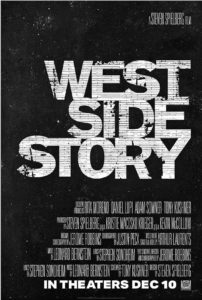 By Steve Crum
“It feels fresh,” said lyricist Stephen Sondheim about the new and in several ways improved West Side Story, shortly before he died on Nov. 26.
Sondheim is so correct.
It is undoubtedly a sacrilege to many fans saying that 1961’s musical film classic, West Side Story, is imperfect in any way. But casting actual ethnic actors and actual singers (Rachel Zegler and Ansel  Elgort) in the leads is smart and impactful. Sorry about that, Natalie Wood and Richard Beymer, whose voices were dubbed in the original. The fact that virtual unknowns Zegler and Elgort—notice their un-Hollywood-like names—can really sing AND act is double dose effective. They are terrific.
Just as impressive are Ariana DeBose as Anita and David Alvarez’s Bernardo. Dynamite talents.
The “freshness” Sondheim references also includes songs being sung in different settings and slightly more naturalistic choreography—adapted by Justin Peck. Reportedly, Peck’s choreography is not a replication of Jerome Robbins’ original.
 Before fleshing out the uniqueness of this Steven Spielberg-directed take, realize that the source material is still driven by Leonard Bernstein’s music, Sondheim’s lyrics, and Arthur Laurents’ book. (Screenwriter Ernest Lehman adapted the ’61 film.) Yet another adaptation is Bernstein’s original score, arranged by composer David Newman.
It all began with the 1957 Broadway show, which successfully transformed Shakespeare’s Romeo and Juliet into a story about two New York City inner city gangs in 1957. The Jets (whites) and the Sharks (Puerto Ricans) are enemies, and fiercely battle over their turfs. It is a simple premise given adrenalin  when Tony (Elgort) of the Jets and Maria (Zegler) of the Sharks fall in love with each other. It is a lethal no-no.
Spielberg and Kushner establish setting and time in the opening by showing ruins of tenement housing backing a sign declaring this is the future home of Lincoln Center. A particularly jarring camera shot is taken behind a large wrecking ball, as our view moves around it to see more distant rubble.
Cut to the Sharks as they invade Jet territory to do some paint vandalism, followed by a face-off with alerted Jets. The police soon arrive, led by Lt. Schrank (Corey Still), to stop the chaos. His speech to both gangs has 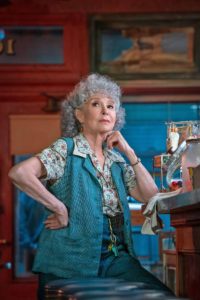 racist overtones (“spics”), clearly directed to the Puerto Ricans. Of course, police vs people of color is still a hot topic.
Overall, Kushner’s screenplay echos the Broadway script more than the 1961 movie. Rita Moreno, who won an Oscar for portraying Anita in the ’61 version, here plays Valentina, widow of Doc the candy store owner. (She runs it now.) Noticeable in this version is that many Puerto Ricans speak—now and then—in their native language, and without subtitles.
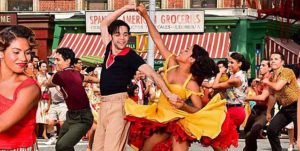 Two changes are really applause worthy, the first being that instead of performing the rousing “America” on a rooftop, it takes to the wide open streets of the Sharks’ neighborhood. The number is even more of a standout. Secondly, I loved the color and cleverness of setting the lively “I Feel Pretty” number inside Gimbels Department Store. (Maria and friends work there nights as cleaners.) Even Windex is part of the choreography!
Be aware that this is 2021, and the rumbles are more graphically violent.
But at its heart, West Side Story is a tragic love story. I still teared up at its poignant conclusion.
Spielberg’s reimagining is a must-see and a will-love.
——-
GRADE on an A-F Scale: A
Aaron Sorkin showcases endearment for Lucy & Desi via insightful ‘Being the Ricardos’
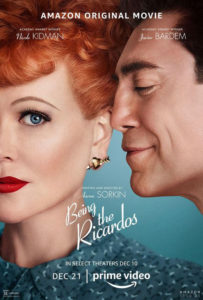 By Steve Crum
Lucille Ball and Desi Arnaz were great. Nicole Kidman and Javier Bardem are great portraying them. There. I have channeled what Lucy & Ricky fans want to know first about Aaron Sorkin’s wonderfully conceived Being the Ricardos.
The bittersweet film, written and directed by Sorkin, stands as not only a behind-the-scenes look at Mr. and Mrs. Arnaz, including how they met, but a testament to the gem among gems of early 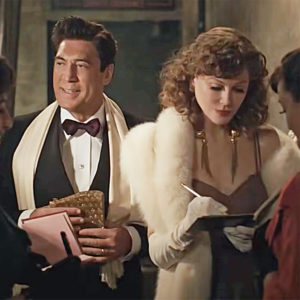 television. I Love Lucy (1951-57) influenced the technology and format of sitcoms, particularly, to this day. In that sense, Being the Ricardos is more historical than hysterical. The laughs are limited with an emphasis on drama.
Overall, Sorkin’s crisp and savvy dialogue dominates. But how did he successfully pull off this biographical ruse?
Aaron Sorkin’s screenplay and direction accomplishes the switch several ways. Before going further, realize that the audience for Being the Ricardos has to be I Love Lucy fans. (Compared to today’s popular TV shows that are considered a hit with 15 million viewers, I Love Lucy consistently played to 60 million per episode!) The viewer demographic, therefore, is middle-aged to Baby Boomer. That premise is totally reliant on the audience having seen at least the classic I Love Lucy episodes. That includes the Lucy stomping grapes, the Lucy pregnant 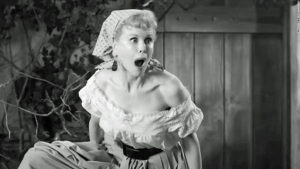 with Little Ricky, and the Lucy trying to reunite a quarreling Fred and Ethel.
The next given, which is pretty brilliant, involves not showing too much of, say, the hilarious winery/grape stomping sequence. Just set it up by duplicating the Italian winery set, and placing Kidman in matching Lucy costume. Then have her repeat the original TV dialogue as she steps into the grape vat. She does a pratfall, but that is all we see. It’s all we need to see because we have seen the original so many times. Our minds fill in the slapstick gaps.
There is no need for Nicole Kidman to fully duplicate the classic physical shtick, which is a plus since there is no way anyone could do so. She gives us enough to suggest the hilarity that will follow.
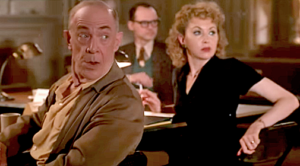 Also, Kidman’s makeup, body language, and voice are more than enough to suggest Lucille Ball. It is uncanny.
The same elements of suggestion are carried out by Bardem’s Ricky/Desi, Nina Arianda’s Ethel/Vivian, and J. K. Simmons’ Fred/William. Their channeling of the actual characters and actors quickly becomes our channeling of their transformations. Again a stretch, but it works.
Really, not even 1/4 of Being the Ricardos showcases the actual filmed episodes of I Love Lucy. That means Kidman and Co. are mainly realized as Lucille Ball, Desi Arnaz, Vivian Vance and William Frawley. Totally 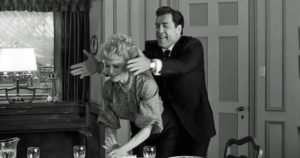 believable they are. Bardem is definitely not a Desi Arnaz double, but we accept him as Desi. Acting, ladies and gentlemen!
In that vein, an award for Best Ensemble should include Tony Hale as Producer Jess Oppenheimer, Alia Shawkat’s co-writer Madelyn Pugh, and Jake Lacy’s co-writer Bob Carroll Jr. Their interplay during the table readings is delicious—Sorkin at his best.
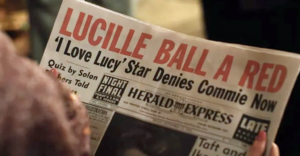 Appropriately covered are Desi’s philandering and Lucy’s distrust of him; William Frawley’s incessant digs at Vivian Vance; and Lucy’s being labeled a Communist.
As for scenes of Ricky belting out Babalu and Cuban Pete (Desi’s signature songs), it is Javier Bardem’s own voice, accompanied by his own conga playing.
Being the Ricardos amounts to a very enlightening and entertaining dramedy encased in a 20th Century time capsule.
——-
GRADE on an A-F Scale: A-
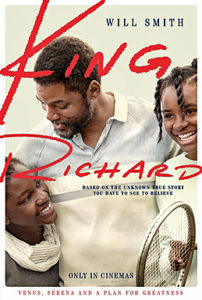
Will Smith is dynamic as Venus & Serena Williams’ overbearing father in ‘King Richard’
 By Steve Crum
“I’m in the champion raisin’ business,” says Will Smith’s Richard Williams, early on in the fascinating biopic, King Richard. The brash and presumptuous Richard did indeed “raise champions”—daughters Venus and Serena, arguably the greatest names in tennis. Who would counter that?
The aptly named title showcases dad Richard, but this story is a package deal that includes Serena, 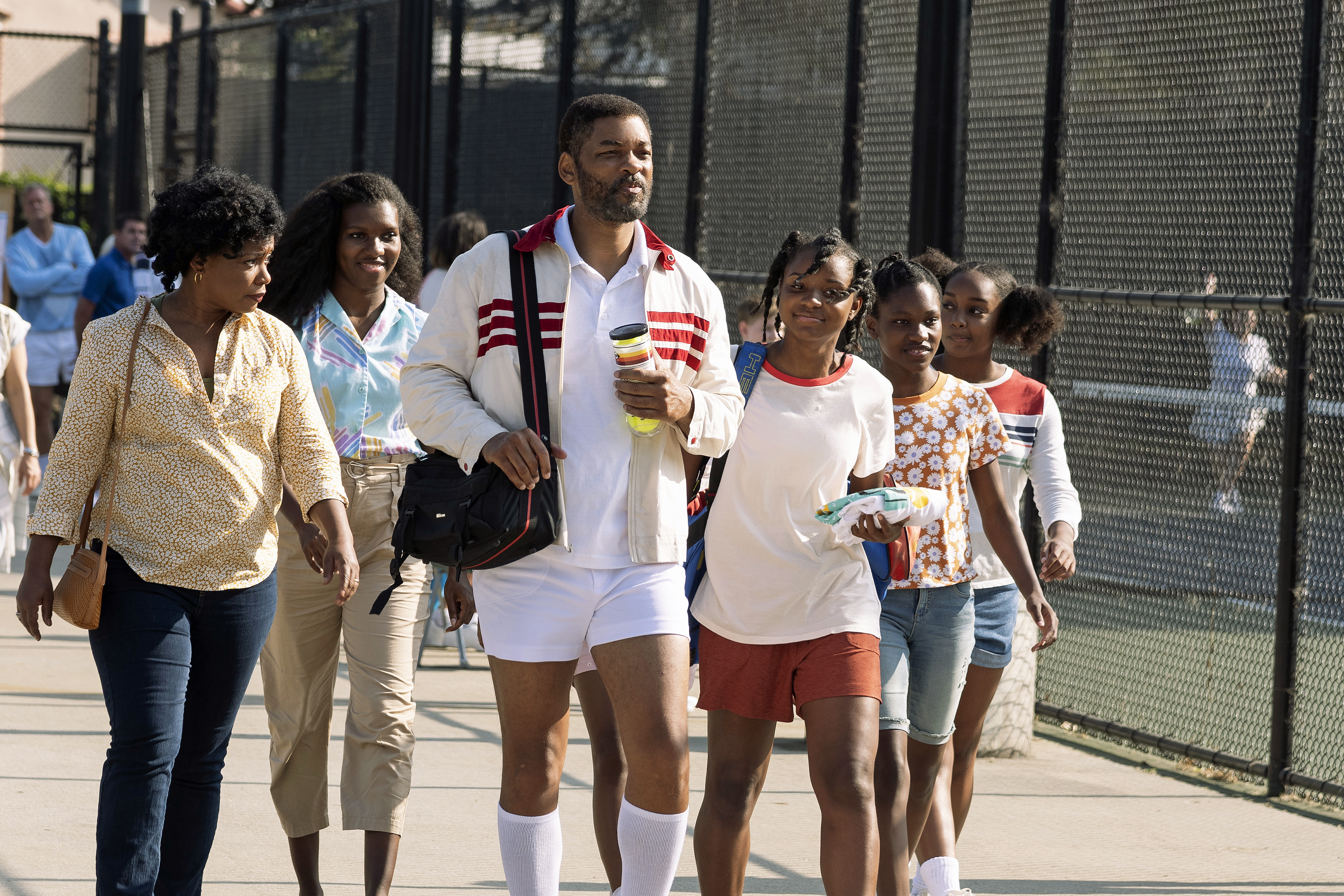
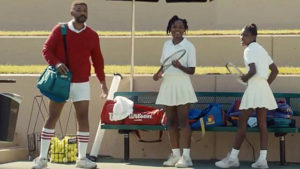 Venus, and the entire Williams family. It is a stunning debut for young actors Saniyya Sidney and Demi Singleton—as Venus and Serena, respectively.
For Will Smith it is surely an Oscar nomination. He goes above and beyond, starkly characterizing Richard Williams. He nails it.
Director Reinaldo Marcus Green has fashioned Zach Baylin’s screenplay into 138 minutes of family dynamics, fiercely competitive tennis scenes, and grueling practice sessions. Richard is a strict task master, 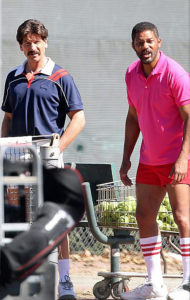 teaching his daughters tennis expertise much like a Marine drill sergeant as he drives his offspring to perfection. Labeling Richard as unorthodox as both a father and a coach is a truism.
The plot covers a 7-year period from the family’s roots in Compton, California. Even while Venus is in late elementary school, her father works on teaching and enhancing her tennis skills. She is older than Serena, so he focuses on her first. Serena tags along to practices as an observer. The rest of the family, including Mama Oracene (Aunjanue Ellis), most often serve as backdrops.
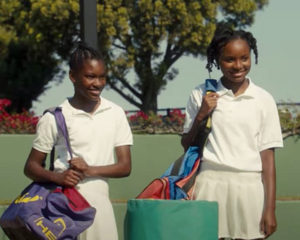 Episodic sequences include dozens of occasions when Richard pushes his daughters to the limit—from night practice in the rain to exhaustive tennis court drills. His reputation as a controller encompasses firing coaches and rejecting contracts. His methods are madness to many, making one wonder if Serena and Venus would ever survive let alone succeed.
But of course, succeed they did. (No spoiler.)
Notable others in the case are Tony Goldwyn’s Paul Cohen and John Bernthal’s Rick Macci.
Yes, the movie is about the incredible Venus and Serena Williams. But it is Richard, the King, who rules.
——-
GRADE on an A-F Scale: A-
Cowboy flick ‘The Harder They Fall’ bizarrely mixes western cliché with hip hop
 By Steve Crum
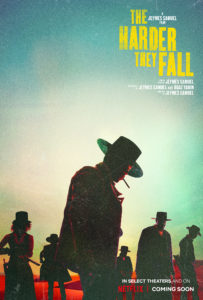
I know western movies. Believe me. The Harder They Fall is unlike any western ever produced. Yet, it is LIKE so many of the westerns. What a paradox. That is because this revisionist work takes so much from a slew of the genre’s memorable moments. To say The Harder They Fall is cliché is putting it kindly. It is upfront and in your face a parody of Sergio Leone oaters, particularly The Good, The Bad and The Ugly and Once Upon a Time in the West.
And a virtually all black cast is featured.
Don’t get me wrong, this film is no comedy spoof. Outside of a couple of humorous touches, it is not even tongue in cheek clever. Blatant mirroring is more like it. THTF is big budget production that obviously spent a ton of money on gunshot squibs and digital graphics—buckets of blood splatter, an obvious take from 1969’s The Wild Bunch carnage.
Let’s consider the plot line before exploring more nuances. The Harder They Fall opens some time in the late 1800’s in an undisclosed western town. The local preacher sits down for Sunday dinner with his wife and young boy. Bad guys invade his residence, killing the reverend and his wife in front of their traumatized son. Years pass, and the grown son, Nat Love (Jonathan Majors), is on a quest to hunt down and kill his family’s killer, gang leader Rufus Black (Idris Elba).
Enter REVENGE, a basic cowboy movie plot device. Remember Harmonica’s (Charles Bronson) vengeance in Once Upon a Time in the West (1968) as he pursues Henry Fonda’s Frank for killing his father? Look for closeups of squinty eyes in THTF too.
As Act II progresses, the primary characters multiply to the point of confusion. Love, 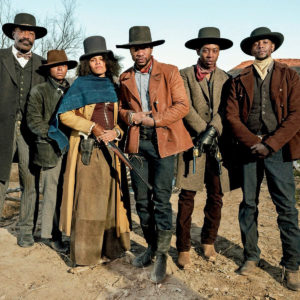 now an outlaw, teams with Bill Pickett (Edi Gathegi) and Jim Beckwourth (RJ Cyler) in more robberies and ambushes. They stop by the saloon of Stagecoach Mary Fields (Zazie Beetz), Love’s ex-lover. And on and on it goes as more characters are introduced. The convoluted plot includes the elder Marshal Bass Reeves (the always good to see Delroy Lindo), who arrests Love. Add to that the town boss, Escoe (Deon Cole); Regina King’s Trudy Smith; Cherokee Bill (Lakeith Stanfield); Cuffee (Danielle Deadwyler); and Damon Wayans Jr. as Monroe Grimes.
It is a hefty cast of capable actors—and they are all portraying Old West, African American heroes, heroines and outlaws who actually existed. (However, they probably never crossed paths, having lived in different time periods and locations.) That alone makes the movie unique.
THTF rapidly turns into a faction vs faction, gang vs gang flick. To drive the point home, why not include “mother f” dialogue with references to “Crips and Bloods”? Why not add a character sporting gold teeth as in 1980s’ 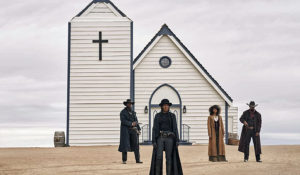 inner city gangster? At least Love chews on a cigarillo a la Clint Eastwood.
The shootouts, knifings, and beatings go on and on for 139 minutes…accompanied by a mixed music score of Hip-Hop, gospel choir, semi-classical majesty, and pop. Style half of it by way of copying Ennio Morricone, Sergio Leone’s favorite composer.
Stir in a big pinch of religion to the batter with Nat Love’s quest for revenge tempered by a crucifix that has been carved into his forehead.
A strange amalgam is The Harder They Fall.
The film’s creator—in nearly all aspects—is Jeymes Samuel. He wrote the story basis, co-wrote the screenplay, co-produced it, and directs. Egad, Samuel outdoes does Orson Welles by also composing the score—and what a bizarre combo of sounds he has created!
Camp or otherwise, The Harder They Fall is more so a Guinness Book inclusion than a significant western film.
——-
GRADE on an A-F Scale: C