
Absorbing ‘Social Network’ is high profile, fascinating

 A couple of steps down the line, Zuckerberg’s genius computer skills further refined, the origins of Facebook emerge. Like Facebook, the plot is about the step-by-step connections that led to its creation and popularity.
  The two leads, however, give the film its credible base. Saverin portrays Garfield as an insecure, constant whiner, contrasted to Eisenberg’s rapidly speaking, distant, and pretty much emotionless egghead, Zuckerberg. He comes across as a close cousin of The Big Bang Theory’s Sheldon Cooper, minus the humor.
 Affleck’s direction, not acting, makes ‘The Town’ watchable

 The Town’s real acting honors go not to Mad Men’s Jon Hamm, who does an admirable, credible job as the lead FBI agent, but to Jeremy Renner, last year’s Oscar nominee for The Hurt Locker, itself a Best Picture winner. You just cannot take your eyes off of Renner in any scene. He is a charismatic, dynamite performer. That he portrays a psychopathic killer, with a hint of Joe Pesci’s style, accentuates his presence even more.
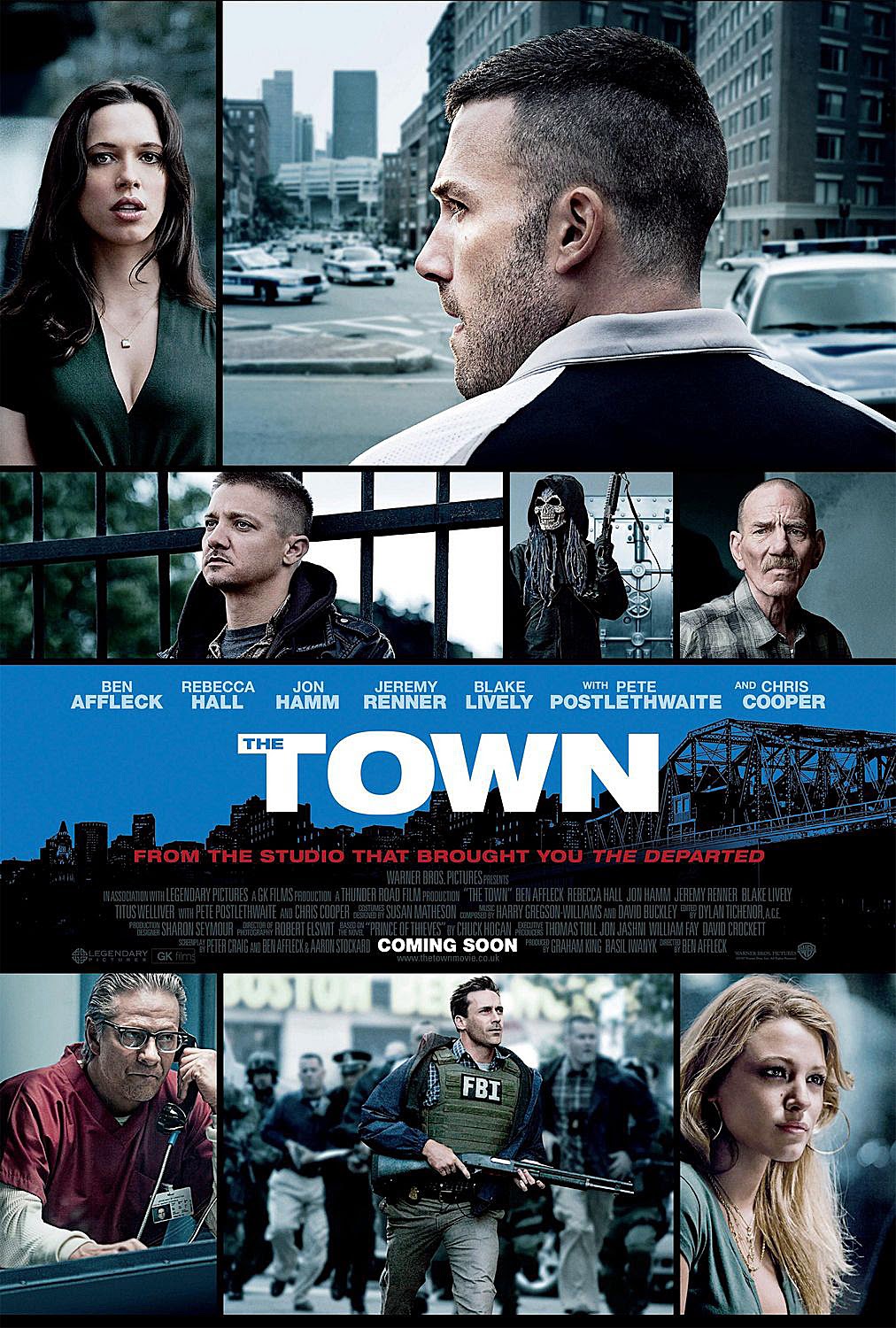 MacRay has a tenuous relationship with his closest friend since childhood, Jem (Jeremy Renner), despite Jem’s tendency to explode at virtually nothing. After a heist wherein Jem viciously kills a bank officer, a witness (Rebecca Hall) just happens to cross paths with McCray at a laundramat. Who would have thunk? Since he was masked during the robbery, she does not recognize him, but he soon recognizes her. No surprise they fall in lust and love, and that is where this plot revelation ends. Their relationship becomes more and more complicated, let’s say.
A morning conference with JERRY LEWIS


Lewis joked that playing the devil was perfect for him since he “has had years of experience with it.” He reminisced, speculated and philosophized about show business and his life. “I wake up every day and I’m a smash hit,” he said. He spoke of what fuels him, of his incentive and drive. Of his excitement to perform, even after 64 years, he said, “There is a misconception of boredom I feel fulfilled in a rush, and I don’t have turbulent innards.” As to why he was taking five years to tour, he answered, “I don’t believe in doing things half way.” His own favorite films are The Nutty Professor and The King of Comedy. His mentors are Stan Laurel and Charlie Chaplin.
 Here is why. In it, Jerry portrays a Jewish inmate in a Nazi concentration camp who is also a professional clown. His job is to dress as a clown and lead Jewish children to the gas chambers, giving them their literal last laugh. Supposedly, Lewis took the role to showcase both his dramatic and comedic skills. This would be the ultimate challenge for an artist, outdoing even Chaplin. Then the production ran short of money to finish the film. There were legal conflicts regarding who owned the property. Orson Welles had nothing compared to this fiasco.
  It was an unmentionable around Lewis. So I unwittingly dropped it on him like a pregnant cassowary. He did not explode; he did not falter. He answered that the film will never be publicly shown, and that he has not even seen it. Lewis said the print was still in Sweden, and that he was legally fighting to own it. “It is like losing a child,” he said. That was that.
They kept shouting at him, yet Lewis remained calm as his people standing on the sidelines rushed to stop this madness. Lewis kept saying, “Just see my staff, and they will arrange an interview, fellas. There’s no need to interrupt here. Please leave.” Suddenly, the two lame brains stopped pressing Lewis, and left. Within an hour, I later heard, a doctored audio clip of Jerry Lewis was heard, and then repeated, on that radio station via their shock jock. They had edited what Jerry had said, down to, “No interview…Leave,” “No interview…Leave,” “No interview…Leave.” The words, out of context, were looped and played throughout the day to show what a rude dude Lewis is. Jerry Lewis has always beaten his own image to the ground enough without having some radio jerks falsify it. This time Jerry was on extremely good behavior, and did not deserve the negatives.

The second thing that endeared me to Jerry occurred after the press conference. He stayed around for autographs. About half the press stuck around to get his signature. I brought the two Decca record albums I had owned since I was in high school. He looked at the second, more rare, of the two, and asked, “WHERE did you find this one?” As he signed it, I had to open my idiot mouth and say, “I’m getting a Jerry Lewis autograph.” I said this in mock Lewis voice, a terrible impression, but close enough for him to realize I was doing his “kid” voice. What did he then do? He stopped signing, glanced up at me, and said, “Ahem,” unsmilingly. Then he finished his signature.

Worth 1,000 Words: JOHN CHARLES THOMAS of The Metropolitan Opera

By Steve Crum
For nearly 30 years, JOHN CHARLES THOMAS [Sept. 6, 1891-Dec. 13, 1960] was widely regarded as one of the most gifted operatic baritones of his day. Thomas sang in operas and operettas, as well as in concert recitals, and on records, radio and film. (Well, he appeared in one obscure movie, a silent movie, no less. No singing even in the subtitles.) His repertoire included works by Gilbert and Sullivan, Victor Herbert, and Sigmund Romberg. Sort of a pre-Nelson Eddy, Thomas performed on Broadway in Maytime and Naughty Marietta. His venues included the Washington National Opera, Carnegie Hall, and finally, the Metropolitan Opera in New York City (1934-43). Two years after touring Australia and New Zealand, from 1947-48, he retired.