
No lie, ‘The Informant!’ has darkly brilliant Damon amid confusing plot
 By Steve Crum
To tell the truth, The Informant! is neither another funny Jim Carrey Liar Liar nor a take on the upcoming Ricky Gervais comedy-fantasy, The Invention of Lying. But The Informant! is definitely about a liar, and one can’t help laughing at it. Yet in retrospect, it is guilty laughter since the central lying character, Mark Whitacre (Matt Damon), has psychotic problems that influence the fibs. Factor in he is based on a real life guy. It is sort of like admiring Sandra Bullock’s humorous, love struck character in All About Steve when, in fact, she is pretty much a criminal stalker. Funny and pathetic intersect.
Using Kurt Eichenwald’s 2000 book of same name, director Steven Soderbergh (Ocean’s Eleven) and his scribe, Scott Z. Burns, pretty much meet the challenge of balancing darkly humorous aspects with base facts. Yet, due to very nature of the story, too often the plot befuddles the audience in its mix. This is a compliment to Damon, since his character’s pathological lying has to be so convincing that we are hooked into his schemes. In his best acting to date, Damon is this corporate leader who is also a family man. He is also scheming against his own company, stealing from it, and confessing to it for his own, warped self esteem. That his confession is peppered with exaggerations just makes the story more and more preposterous and funny. Telling the simple truth is simply not enough for Damon’s Whitacre.
 The story, told in Whitacre’s documentary-like narration (sounding like David Nelson of Ozzie & Harriet), opens at an Archer Daniels Midland (ADM) plant in Decatur, Ill., circa 1992. ADM is an agri-business super plant for which youngish Whitacre is employed as an executive particularly concerned with his company’s corn sales and lysine. The lysine, a food additive, is apparently tainted and ruining all the corn. Whitacre’s discovery and ensuing crisis is amplified through his vivid narrative: “It was like a Crichton novel….” Whitacre takes the news to his bosses, adding his concerns that there is sabotage by Japanese competitors involved. Boy, does he add his concerns. After riling his superiors up, he convinces them to send him to Japan to meet with someone who has been trying to bribe him to turn on ADM.
 Meanwhile, Whitacre tells his wife Ginger (Melanie Lynskey) of his fears that his life in in danger, embellishing his story even more, to the point of convincing himself to contact the FBI. Skeptical at first, the agents (Scott Bakula and Joel McHale) hook into Whitacre’s story when he escalates the millions of dollars involved, and his “facts” that ADM may be part of a global price-fixing conspiracy. Playing the proverbial both ends against the middle, Whitacre obviously enjoys the glamour and attention of espionage and intrigue. The “evidence” he keeps promising the FBI seems too fantastic to believe–with good reason.
Years go by with numerous phone taps. Whitacre is not only compliant to be wired at meetings with ADM executives, he is overjoyed. His excitement, in fact, nearly blows his cover in several instances. As Whitacre’s lifestyle now includes daily spy activities, he goes too far in trying to make a case that originally did not exist. Yet the FBI and ADM string along with him.
 Before giving away too much, I need to emphasize the complexity of the story line. From the beginning of The Informant!, we are led in narrative by Whitacre. When he tells us a conspiracy is afoot, we believe him, partially due to his colorful, Mickey Spillane dialogue. The problem with the film is really Whitacre’s affliction, the fact he is bipolar. Facts and events, through his eyes and words, skew left and right of truth central. Half way through the movie, I was confused, not really suspecting Whitacre had a serious truth telling problem. No doubt he loves attention, I thought, and needs to feed his ego, but don’t we all? That real crime is ultimately revealed just adds to audience confusion. But, again, our trusted narrator is unknowingly confused himself.
A beautiful tip-off to the film’s truth versus reality element is Whitacre’s subtle yanking back his toupee (we kind of suspected he was wearing such) while talking to his FBI pals. Damon pulls the scene off, and his hair back, superbly.
Other pluses include the Marvin Hamlisch score, which is quirky, jaunty, and fun–almost like tapping into Mark Whitacre’s psyche. Look for cameos, in separate and against type roles, by both Tommy and Dick Smothers. The entire cast is super, particularly Damon, who put on pounds, a mustache, and a hairpiece. This is his showcase.
The Informant! had to be a challenge to produce; it certainly challenges the audience. Soderbergh specializes in working multiple, layered plot lines toward intersection. It worked in his Ocean’s series, but did not in The Good German. It almost works in The Informant!
——————–
On an A to F Grade Scale: B
——————–
Laughing-In & Out with Henry Gibson
By Steve Crum
Thank you, Henry Gibson, who died Sept. 14, a week before his 74th birthday, for my getting many laughs at your talented expense. Back in 1969, when you popped in–long stemmed flower in hand–for your weekly bit of reciting one of your mini-verses on Rowan and Martin’s Laugh-In, I listened. And memorized. Forty years later, I still recite it whenever possible:

Spider, spider on the wall,
Ain’t you got no sense at all?
Don’t you know that wall’s been plastered?
Get off that wall, you stupid spider.
Oh yes, and Henry preceded it with a sincere, ‘The Spider’…by Henry Gibson.
——————-
Here’s Henry: http://www.youtube.com/watch?v=bS2RwO_bFgg
The Curious Case of ‘The Curious Case of Benjamin Button’
By Steve Crum
Time does have a way of changing things. Take Benjamin Button, please. Most of us know that in last year’s Oscar winning The Curious Case of Benjamin Button, the title character (marvelously played by Brad Pitt) is born as an elderly baby, gets younger as he grows up, and eventually (*spoiler*) regresses to childhood and babyhood, wherein he dies in the arms of his now elderly ex-wife.
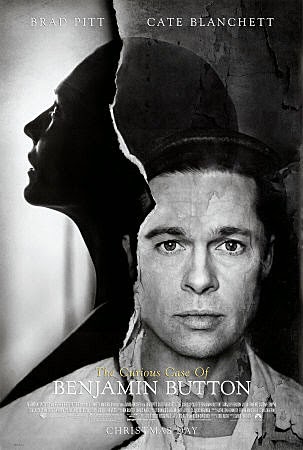 Director David Fincher received an Oscar nomination, as did Alexandre Desplat, who scored the memorable music. This was not the original plan, however.
 Nineteen years ago, The Curious Case of Benjamin Button was even more curious. Harry Garfield, Sr. Vice President of Music at Universal Pictures, spoke to me then of Steven Spielberg’s plans for making the picture. Nearly two decades passed before the film was produced, something common in Hollywood. In fact, many film projects are shelved and never realized. But Spielberg had high hopes and big plans for his version of Benjamin Button.
“Spielberg’s project,” said Garfield in 1990, “is an adaptation of (F. Scott Fitzgerald’s) The Curious Case of Benjamin Button–a man born at 80 years in 1920 Baltimore, who learns to play piano and gets younger on the outside, and older on the inside. By 1920, he looks 70, but knows all ragtime music.”
“By 1930,” Garfield said, “Benjamin and his father compete for attention, playing Ellington, etc. Time goes throughout the 1940’s, until eventually he plays rock and roll, and is younger–with a great musical background.”
This is all interesting and revealing, since in last year’s film (not directed by Spielberg) Benjamin does play the piano briefly, but the jist of the story is definitely not on his music expertise. In no way is his father musically inclined or competitive. In fact, he does not reunite with his father for several years.
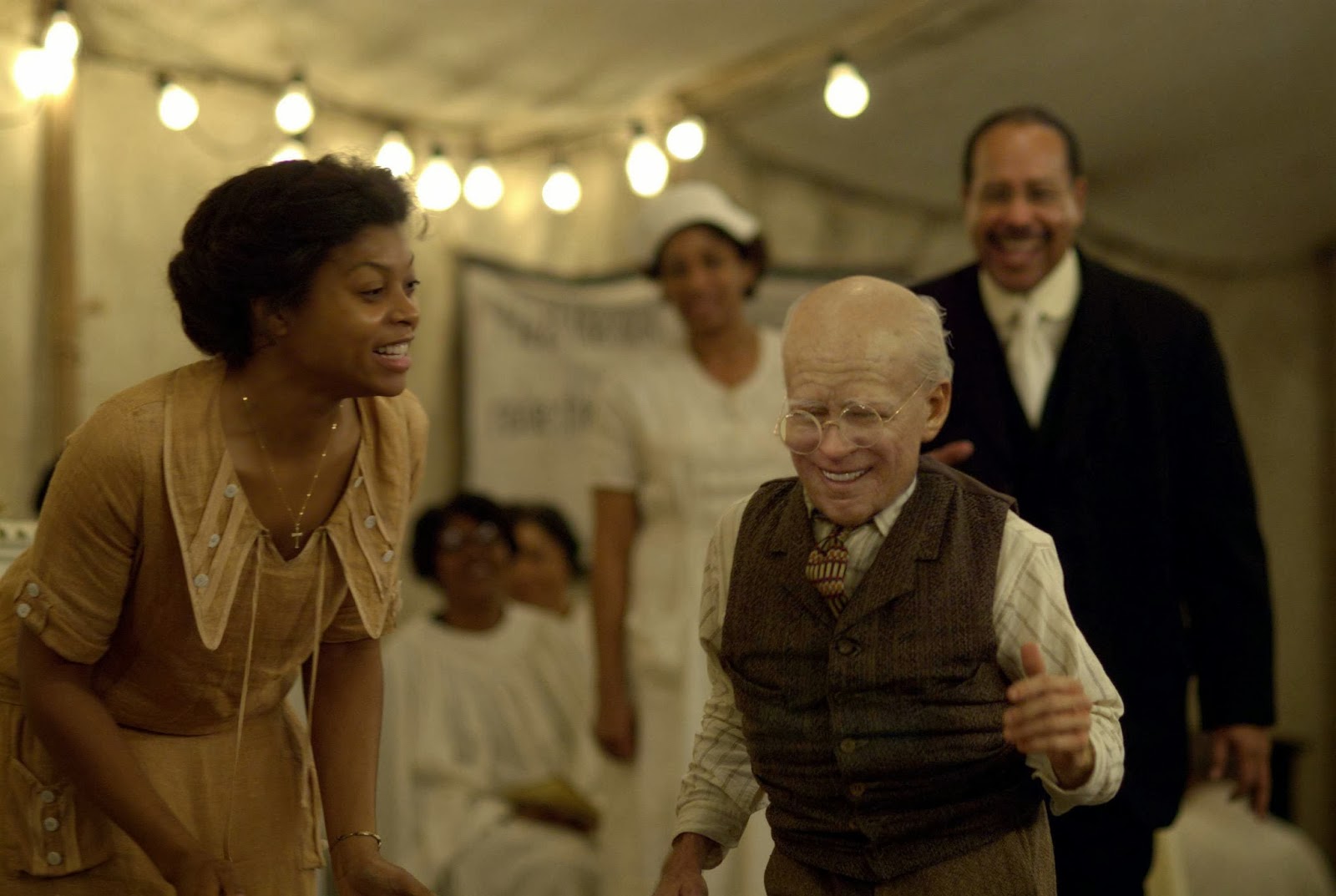 It is no surprise that Spielberg’s original choice of film composer was John Williams, since Williams had scored the bulk of Spielberg films since Jaws. Spielberg wanted either Tom Cruise or Robin Williams to play Benjamin.
“Spielberg knows he will need an actor who can play the spectrum,” said Garfield, “from 15 year-old to a five year-old who (at the end of the film) listens to Raffi (the then famous children’s composer-singer).” As it turned out, CGI effects placed Brad Pitt’s face on a short actor’s body during the childhood to teenage sequences. When Spielberg was making his plans nearly 20 years ago, pre-CGI, computerizing was in the prehistoric stage.
Then, Steven Spielberg was banking on The Curious Case of Benjamin Button, and big time. Undoubtedly, other movie gigs took precedence, and Benjamin was put on the proverbial back burner. It would be four years before Schindler’s List would garner Spielberg his first Oscar win.
But in 1990, Garfield said Spielberg had told him The Curious Case of Benjamin Button would be his first big winner: “It’s my Academy Award!”
Maybe it would have been, should have been.
——————–
Addendum: Benjamin Button’s road to finality includes a 1998 plan, soon scrapped, to produce the film with Ron Howard directing, and John Travolta starring.
——————–
Link ye to the trailer for The Curious Case of Benjamin Button: http://www.youtube.com/watch?v=VqeqaweXBV0
IT’S CRUMMY TRIVIA TIME…with DALE EVANS!
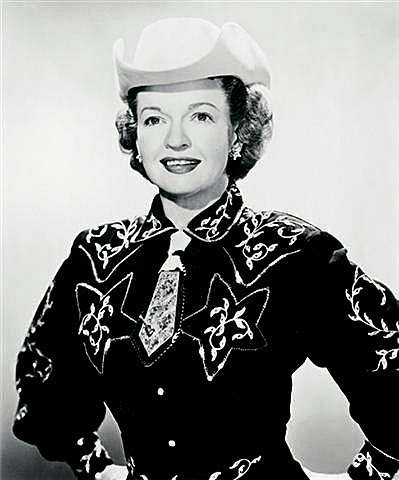
By Steve Crum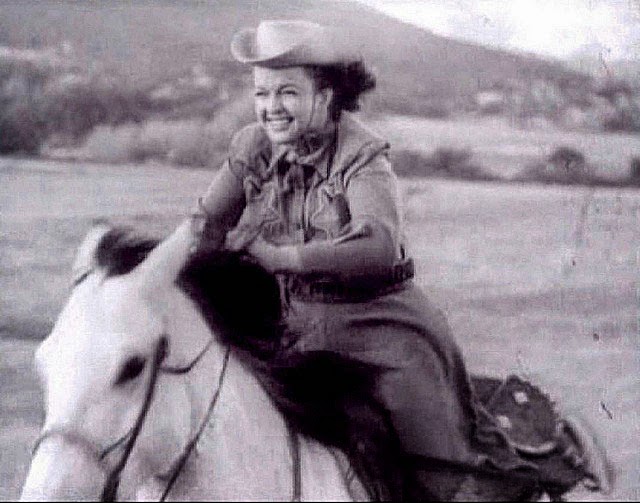 My childhood heroes were always cowboys–not a cowgal like Dale Evans. However, The Queen of the West, who died Feb. 7, 2001 at 88, was a contender. For over half a century, she was literally, in movies and real life, partnered with The King of the Cowboys, Roy Rogers. On top of that, she had her own famous horse, Buttermilk. And she could sing western songs just about as well as Roy. Like King Roy, she even starred in her own line of comic books. So to me and the neighborhood boys who teamed up to play our favorite western stars, Miss Dale only semi-qualified as honorary cowboy hero.
A dialogue never heard: “OK, Donald, you are Johnny Mack Brown. Bobby, you are Lash LaRue. And I’m Dale Evans.” Playing cowboy was never a drag.
But Dale Evans was more of a Renaissance person than her saddle pard Roy. In addition to acting and singing, she was an author and composer. The Queen of the West was well labeled. No other female outside of Annie Oakley is so identified as a positive role model of the West, albeit in Evans’ case the romanticized West of movies, recordings and TV.
Strap on those spurs and saddle up. Gallop down that canyon pass again with THE DALE EVANS TRIVIA TEST. Answers are either TRUE or FALSE, and are listed at the end of this piece, pardners!
——————–
1.] Unlike Roy Rogers, who hailed from Ohio, Dale Evans was actually born a Westerner.
2.] Evans made only 15 movies.
3.] She starred in three TV series.
 4.] Dale Evans wrote a song featured in a John Wayne classic movie.
5.] Roy Rogers was her first and only husband.
6.] The Roy Rogers and Dale Evans Museum is in Southern California.
7.] The song, (How Do I Know) The Bible Tells Me So, was written by Dale Evans.
ANSWERS
1.] True. Lucille Wood Smith was born Oct. 31, 1912 in Uvalde, Texas.
2.] False. Her 41 movies began when she played a girl at the soda fountain in 1942’s Orchestra Wives, starring Glenn Miller and His Orchestra, and ended in 1951’s Pals of the Golden West.
3.] True. Included are The Roy Rogers Show (1951-57); The Roy Rogers and Dale Evans Show (1962); and A Date with Dale (1996).
4.] True. For John Wayne’s Rio Grande (1950), Dale’s song Aha, San Antone, was sung by co-stars Ben Johnson, Harry Carey Jr., and Claude Jarman Jr. Carey recalls: “That thing about Aha, San Antone was a spur-of-the-moment idea. It was written by Dale Evans and wasn’t in the plans at all. The Old Man (director John Ford) just threw it in. Claude, Ben and I actually sang it ourselves. Ford would never overdub or pre-record, we did it live. It’s a little ironic that Victor Young (the film’s composer) picked it up for Ben’s theme.”
5.] False. He was Numero Four. A mother at 15, Dale was first hitched to Thomas Fox (1927-29); then August Johns (1929-35); Robert Butts (1937-46); and lastly to Roy (1947-Roy’s death in 1998).
.jpg) 6.] False. It’s no longer anywhere since it is nonexistent. It was for many years in Victorville, California before it was all moved, including the late Buttermilk, Trigger and Bullet, to Branson, Missouri. Son Dusty Rogers performed there, and ran the museum. Sadly, due to poor attendance, the museum closed a couple of years ago. (Roy would always become outraged when someone called his displayed animals “stuffed.” His horse Trigger, dog Bullet, and Dale’s horse Buttermilk are “mounted.” There is a difference, you know.) NOTE: When this article was first posted, the museum was still in Branson. I have done some updating.
6.] False. It’s no longer anywhere since it is nonexistent. It was for many years in Victorville, California before it was all moved, including the late Buttermilk, Trigger and Bullet, to Branson, Missouri. Son Dusty Rogers performed there, and ran the museum. Sadly, due to poor attendance, the museum closed a couple of years ago. (Roy would always become outraged when someone called his displayed animals “stuffed.” His horse Trigger, dog Bullet, and Dale’s horse Buttermilk are “mounted.” There is a difference, you know.) NOTE: When this article was first posted, the museum was still in Branson. I have done some updating.7.] True. As most of the world knows, she also wrote Happy Trails to You, the couple’s theme song.
——————–
If you scored at least four correct, you are Top Buckaroo, so treat yourself to a finger dip of saddle soap. Until we meet again, Dale and Roy.
——————–
For Mr. & Mrs. Rogers singing Happy Trails, follow this link down the pass: http://www.youtube.com/watch?v=XcYsO890YJY
IT’S CRUMMY TRIVIA TIME…with GLENN MILLER!
By Steve Crum
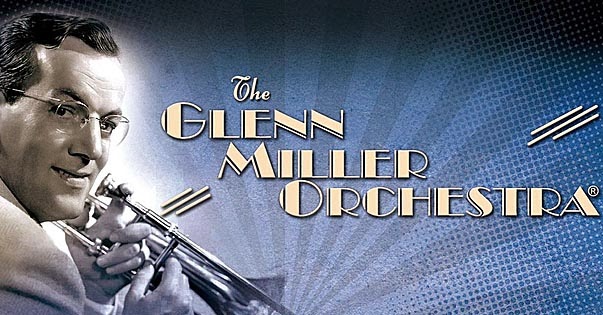 It was 1954’s The Glenn Miller Story that really got me into big bands. Although I did not see it until it was on TV when I was into young adulthood, hearing that great Miller sound was an immediate hook. Not that I was totally unexposed before that time. There were a handful of 45 rpm records I had purchased during jr. high years. The one I recall best, which I still have tucked away behind DVDs and CDs, is an RCA extended play 45 of Hoagy Carmichael’s Stardust performed by four big bands: Tommy Dorsey, Artie Shaw, Benny Goodman, and Glenn Miller. Shaw’s version remains my favorite. No doubt I originally got this record to please my parents and grandparents. In those days, most of my age group had long since gyrated into rock ‘n roll land, which I never did.
 For the most part, I actually preferred my past generations’ music. By the time I was 12 (in 1959), WWII big band music seemed a leap forward to me. That was because my #1 musical preference was the Elvis of the Stone Age, Al Jolson. All it took was one glance and a listen to The Jolson Story (1946), and I became Jolsonized. But that is another blog entirely. My only transition back to big bands is that I have a recording of Jolie, singing both April Showers and Ma Blushin’ Rosie, accompanied by the Tommy Dorsey Orchestra. That said and hummed…
——————–
What was the FIRST GOLD RECORD awarded for any song selling a million records? Hint: It was awarded to Glenn Miller. Choose one:
A. Moonlight Serenade
B. In the Mood
C. Chattanooga Choo Choo
D. Pennsylvania 6-5000
——————–
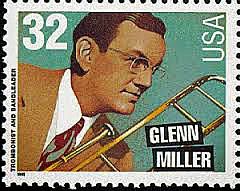 ANSWER: CHATTANOOGA CHOO CHOO. RCA Victor, Miller’s one and only recording company, gave him the symbolic gold record in 1942 when the 78 rpm disk reached 1,200,000 in sales. For the record, so to speak, Chattanooga Choo Choo was #1 on the Billboard charts for nine weeks. Its matrix code on the RCA Bluebird label is B-11230-B. More importantly, the recording features Miller regulars Tex Beneke, Paula Kelly, and The Modernaires. A rarely heard 2-Channel stereo track of the song played on-screen by the Glenn MIller Orchestra is a plus to the laser disk release of 1941’s Sun Valley Serenade. Unfortunately, no DVD version is yet available. Written by Mack Gordon and Harry Warren, Chattanooga Choo Choo was inducted into the Grammy Hall of Fame in 1996.
——————-
GLENN MILLER [March 1, 1904-Dec. 15, 1944] was serving as major, and heading his Army Air Force Band, when his plane evidently crashed over France during WWII. Neither his body nor the plane and its crew and other passengers were ever found.
——————-
Dedicated to my truly dear Aunt Ada Holley, who did indeed sing with a big band and is now the youngest 85 year-old ever and #1 Glenn Miller fan, please enjoy Glenn Miller and his Orchestra performing Chattanooga Choo Choo in this scene from Sun Valley Serenade: http://www.youtube.com/watch?v=-XQybKMXL-k