
Edie Adams was more than a Deep Fried Twinkie
 By Steve Crum
Originally published Sept. 15, 2004, the following interview with the vibrant and chatty Edie Adams is a high point of my life. I called Edie at her home in Los Angeles, and immediately found her to be friendly, funny, and talkative. It was 30 minutes into our conversation before I finally got a question in. One question I asked that did not make the final cut was, “Do you think if Ernie had lived, he would have co-starred with you in ‘It’s a Mad, Mad, Mad, Mad World’?” Her answer was brief without conjecture: “I don’t know.” I met her in person a week or so later at the Buster Keaton Celebration in Iola, Ks., where Edie was special guest in honor of her late husband, Ernie Kovacs. She chuckled throughout the surprise finale: a live performance in full gorilla mask costumes by The Nairobi Trio [made famous by Ernie on numerous TV shows]. Edie died almost exactly four years later on Oct. 15, 2008 at age 81 from complications of cancer and pneumonia.
 When Edie Adams talks about Ernie Kovacs her stories are so fresh, so today. Yet they are past tense, some 42 years after the legendary comedian’s death. Edie realizes decades have gone by. “Forty-two years?” She politely corrects me. “It’s been longer than that.” It must seem so to Edie, but the numbers stand. It was on Jan. 13, 1962 when Ernie, driving alone, wrapped his Corvair around a utility pole.
 Edie fondly talks–and frequently chuckles–about her Mad World co-stars Phil Silvers pulling pranks on a scene-stealing Milton Berle, and Jonathan Winters. “Ethel Merman was intimidated by Jonathan,” Edie recalls. “This loud, blustery Broadway legend was totally soft spoken around Jonathan (off camera), and would leave the area when Jonathan was coming near.”
For example, she explained that Jonathan Winters seldom sat around with other cast members outside in the heat when they were taking a break in filming on location in the desert near Palm Springs. Instead, he stayed in his air conditioned trailer. Edie and several other actors, including Ethel Merman, would wait between scenes in their chairs. One day they set Ethel up by excitedly telling her, “Here comes Jonathan!” Ethel literally got up and scurried away. Jonathan was still in his trailer, and everyone had a good laugh at Ethel’s expense. By that time, Merman was long gone in hiding. Edie said Ethel did not understand Winters’ humor, and thought him deranged.
 The shy Pennsylvania girl raised by “strict Hessian parents” hit big time in show business, despite a controlling mother who advised her daughter to seek nothing more than to “sing a pretty song and wear a pretty dress.” Of course her mother never intended that after graduating from the proper Juilliard School of Music and the Columbia School of Drama that Edie would carry that adage to Broadway in Wonderful Town (1953) and Li’l Abner (1956). Or that she would marry a mad Hungarian named Kovacs and become a household name performing comedy impressions of Marilyn Monroe and singing.
Edie and Ernie parody it up in this opera take-off: http://www.youtube.com/watch?v=rarkvZ4Cc0A
Depp, period flavor are draws for mediocre ‘Public Enemies’
 By Steve Crum
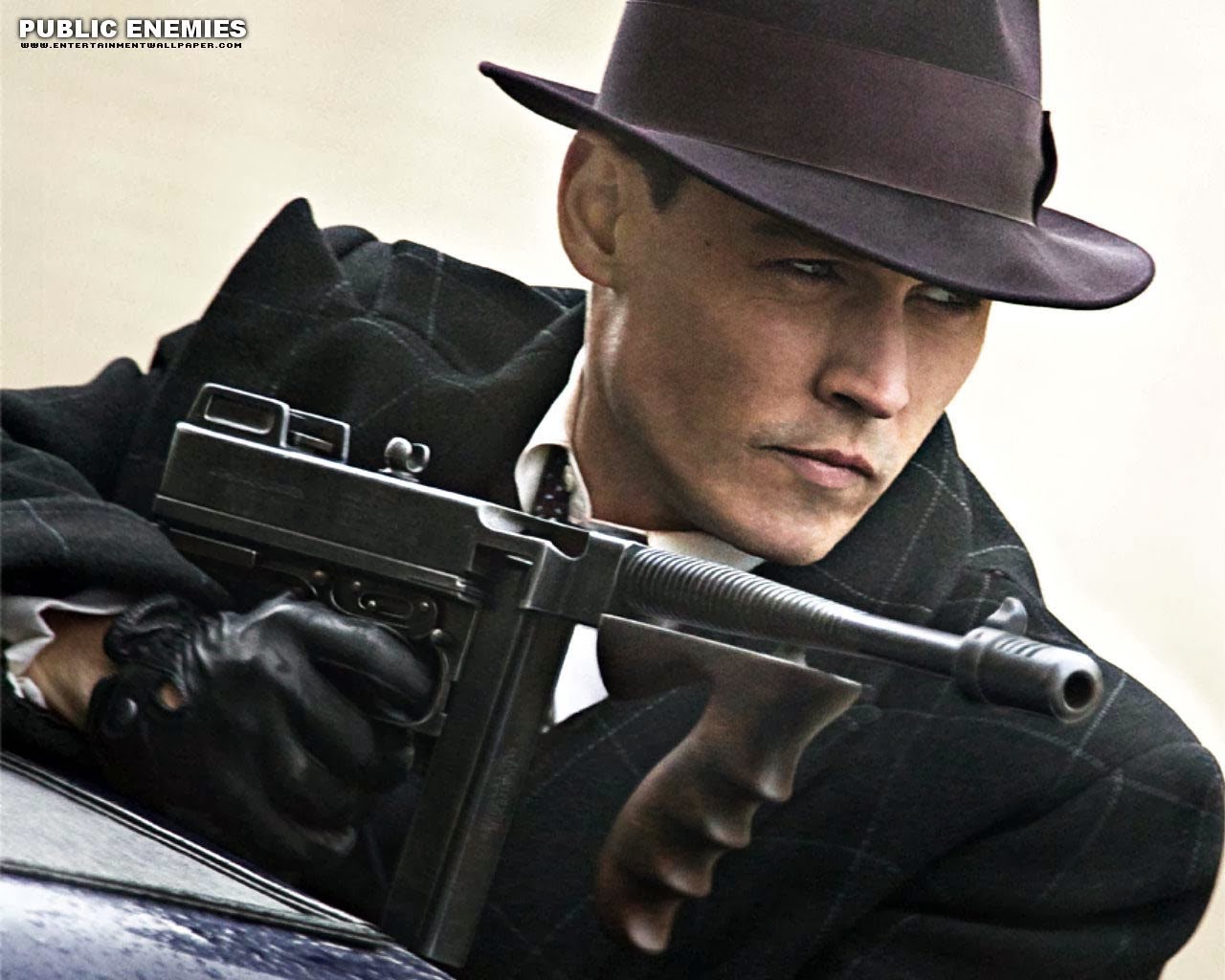
 Action director Michael Mann, who specializes in elaborate–and violent–crime drama, delivers a by-the-book story reminiscent of Mervyn LeRoy’s 1959 G-Man bouquet, The FBI Story. In that slickly entertaining flick, a Purvis-like FBI agent (Jimmy Stewart) encounters one big name ‘30s criminal after another: Ma Barker and her boys, Pretty Boy Floyd, and Dillinger amongst. In Enemies, writers Mann, Ronan Bennett and Ann Biderman have adapted Bryan Burrough’s best seller to primarily focus on Dillinger’s exploits. As subtext, they fictionally team him with Baby-Face Nelson and Pretty Boy Floyd, two of the many legendary bad guys featured in Burrough’s book. In other words, Hollywood has again enhanced a film’s script by altering historic fact for the sake of entertainment and, ultimately, box office. That makes Public Enemies like a History Channel special, but in a cosmetic way.
 Another realistic touch is the inclusion of Dillinger’s escape from an Indiana jail using a hand-carved, wooden gun. Certainly this sequence should be included. However, why is there no explanation as to how Dillinger carved the pistol? Suddenly, he pulls the “gun,” which the audience never clearly sees, and uses it to bluff his way out of jail. Does the audience already know the wooden gun story so well there was no need to set it up? Does all this matter? Yes, it does. Apparently the lead-up was snipped due to film length, but this is assumption.