
Disturbing documentary ‘Bully‘ will anger, inspire

By Steve Crum
There is nothing I had not seen before in Bully, a stark documentary about the sad reality of kids being picked on by fellow classmates in our public schools. No, I had not actually witnessed anyone committing suicide after being bullied, but haven’t we all read and heard about said cases over the years? Undoubtedly, the fact that children have been killing themselves due to persistent harassment has been a reality since the dawn of time. These days, however, we hear about it more often, and more specifically, due to mass media.
As a retired teacher in a major public school system in the midwest, I have witnessed bullying, but seldom acted upon it, unless it was so overt or blatant or inflammatory to result in physical harm to the victim. I am being honest, and not proudly admitting such. The culture of society during the time of my 35 year tenure (and long before) viewed bullying with a shoulder shrug, accompanied by, “Oh well, boys will be boys.” Similar adult response is seen in the movie, Bully. But as the film expresses, that attitude is finally changing, for the better. At last a proactive campaign of awareness and action to defeat bullying is afoot. This documentary has already been lauded as a step toward that goal.

In Lee Hirsch’s straight forward, compelling Bully, there is a school principal who actually dismisses bullying in her middle school by giving the parents of a continually harassed student the tired boys will be boys line–which is a non-solution. Then the principal is audacious enough to pull out pictures of her grandkids to share. This occurs during a parent conference requested by the mom and dad of a young boy who has been called names, punched, and once nearly crushed under a seat on a school bus by fellow students. (Much of this is seen in the film, caught on tape via hidden camera on the bus.)
Not all bully targets are males, as the film shows. Since a 16 year-old high school girl came out as a lesbian, her school life has often resembled a living hell. The one time star athlete was forced to quit her team, and even move to another city, due to homophobic slurs and threats by both students and teachers. A 14 year-old young lady, once on the brink of gaining a sports scholarship, was incarcerated at a juvenile facility after bringing a gun on the school bus in retaliation of bullying. Her future is dim now.
Bully surveys the lives of five students, from 11 to 16, who have suffered varying degrees of social pain. A 12 year-old, Sioux City boy endured the daily angst all his life, but as he grows into teen years, things have gotten even worse, beginning at the bus stop each morning.
After years of abuse by his classmates and indifferent school officials, a 17 year-old of Murray County, Georgia boy hanged himself in his bedroom closet. A bullying-related suicide also claimed the life of an 11 year-old, Ty. His parents then spearheaded a campaign against bullying, aptly named Stand for the Silent, which is the focus of the latter part of the film.
The central character of the film, however, is the 12 year-old, Alex (pictured), an extremely likable, humorous, lonely boy who desperately wants to be accepted by fellow classmates. He just wants to fit in, as we all do.
 We also see and hear the loving parents of these five kids, and the terrible stress that has befallen them over the years. Sometimes they do not make the right decisions, like the scene of one mother chiding her bullied child, “Why do you put up with this?!”
 Sorely missing from the foray are the faces and voices of the bullies themselves, including their parents. (Faces of the bullying kids on the infamous bus scene are blurred out.) Do they care that their behaviors have triggered suicides? Do mamma and daddy have a handle on the reality of what cruelty their sons and daughters are inflicting? Obviously not…or maybe not so obviously. No doubt legalities prevent interviews and clear images of the perpetrators and/or their parents.
The conflicts are clearly depicted in Bully. However, the resolutions are not there yet, but hopeful, thanks to awareness through organizations like the inspirational Stand for Silent. Viewing Bully should both anger and provoke one to positive action.
——————–
GRADE on an A-F Scale: B+
——————–
New Stooges movie loaded with nyuks, nose tweaks, bone-head hilarity

By Steve Crum
Being a long time Three Stooges fan has both everything and nothing to do with enjoying the Farrelly Brothers risky comedy, The Three Stooges: The Movie. Referencing the former, there is a legion of Stooges fans, particularly the 50+ demographic like myself, who prejudge any attempt at Stooges imitation as Stooges denigration. One has to understand we hold these knuckleheads in high esteem.
From the early 1950’s on TV, Curly, Larry, Moe (or sometimes Curly substitutes Shemp or Joe) were viewed on a daily basis. With great anticipation we watched them, after hurrying home from school to catch them and their “Three Blind Mice” opening theme every afternoon.
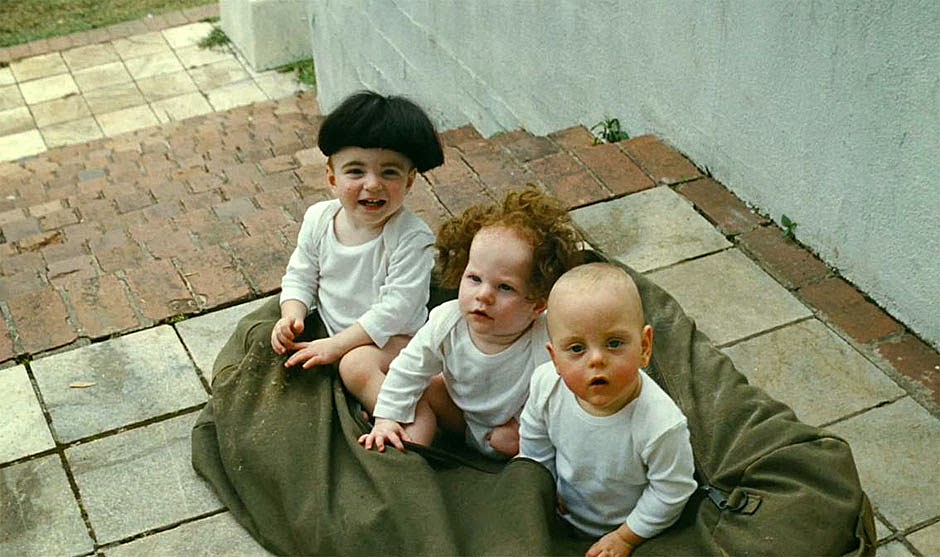 As for the “nothing to do” element, regarding today’s kids through the 20 and 30-somethings who possibly and incredibly have never seen or heard of the team, this feature film with actors playing the originals is another matter. Their historical reference points are the Jackass Movie (and TV shows), Jim Carrey, and Sacha Baron Cohen. Carrey even resembles Moe in Dumb and Dumber. Over the top physical comedy is definitely what The Three Stooges are all about as well. But will younger audiences take to them in clone form? I think they will, and big time. Speaking from an elder’s vantage point, the new Stooges movie is frequently hilarious. In fact, an imitation Three Stooges flick cannot possibly get any funnier than The Three Stooges: The Movie.
 I laughed, and laughed…to my surprise. Seeing and hearing Larry David as a nun is worth the admission price. Peter and Bobby Farrelly once again take charge of a film as directors, producers and screenwriters, a leadership formula that has succeeded in their Dumb and Dumber and There’s Something About Mary hits. Bona fide fans of Three Stooges shorts and features made from the 1930’s-’60s, the brothers wisely decided to cast the most spot-on imitators possible: Sean Hayes (Larry), Will Sasso (Curly), and the multi-syllabic surnamed Chris Dramantopoulos as the singular Moe. Along with superb makeup and dominant sound effects/foley (by One Step Up), Curly, Larry and Moe seem reborn. I have always said that the Columbia Pictures sound effects department was responsible for half the Stooges’ success.
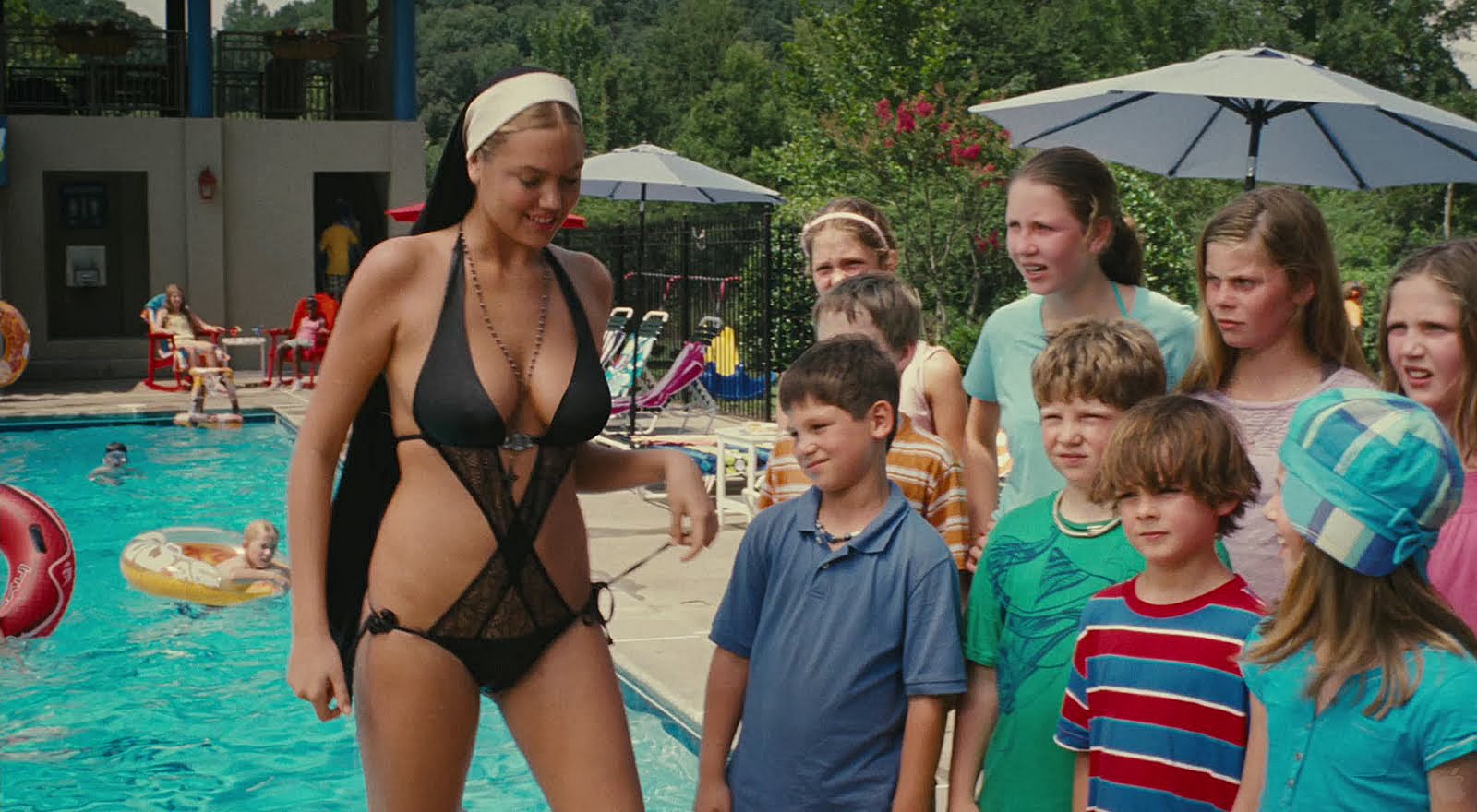
The Farrellys pay further homage by dividing the film into three, 24-minute sections, to resemble the original Columbia shorts. Each “episode’s” title echoes the originals as well, with pun laden silliness. Episode 3, for example, is “No Moe Mister Nice Guy.”
Unlike the original shorts, however, the Farrellys continue the base story line from episode to episode. This is perhaps understandable, given the feature film format, but I would have preferred three unrelated stories. As it is, the element of pathos is slightly included, something absent from the Columbias. Oh yes, the plot thread involves saving a Catholic orphanage from being shut down, a grab from the story line in The Blues Brothers Movie. No criticism, just an observation.
Guest stars take part in the hitting, gouging, and falling down mayhem as well. Look for Glee’s Jane Lynch as the Mother Superior, Modern Family’s Sofia Vergara (as Lydia, a babe who is trying to snuff out her husband), Jennifer Hudson (another nun), and most riotously, Larry David’s Sister Mary-Mengele. Does that name have a twisted cross reference or what?! Then there are Snooki and her Jersey Shore gang, who are treated with deserved slaps by Moe and his gang.
The Farrellys are known for pushing the comedic envelope, and this Stooges movie is subject. A honk sound effect when Sofia Vergara’s breast is stooge-handled? Nyuk, nyuk, yes! Flatulence and crotch attack jokes? Check. A free-for-all, boy baby pee fight in a maternity ward? Funny as an eye gouge. (By the way, no pies are thrown in this movie.) Add it to typical Stooge sledge hammer/head bonks and chain saw assaults. As in the Stooges’ classic shorts, it is all cartoonish, non bloody, scarless action.
The comedy of pain lives on. Just don’t try to analyze why.
——————–
GRADE on an A-F Scale: B+
——————–
Check out this featurette/trailer: https://www.youtube.com/watch?v=5Po0DMXCHk8
Streep as Thatcher makes ‘Iron Lady’ essential viewing
By Steve Crum
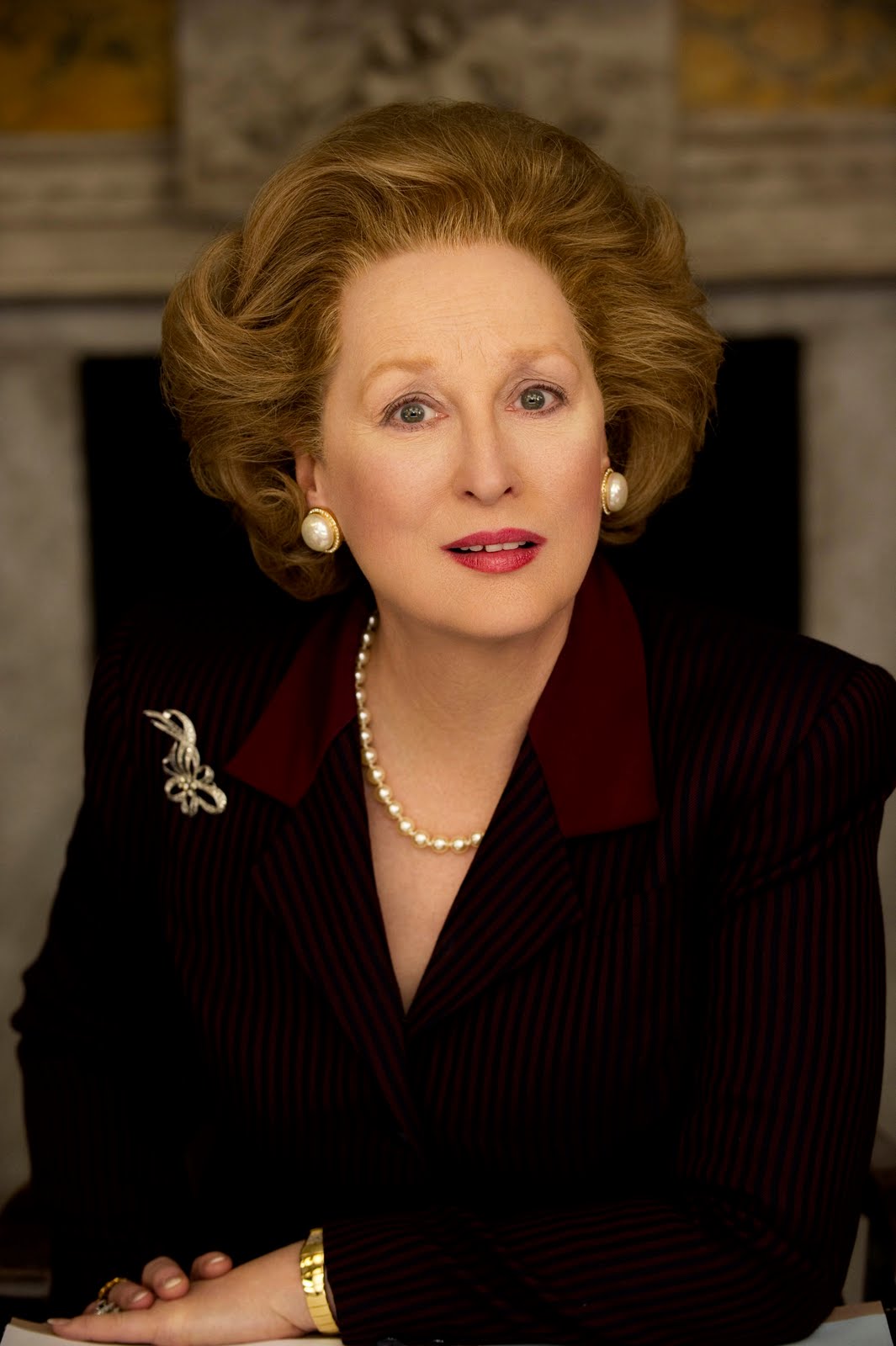
Had The Iron Lady been made with an actress less capable than Meryl Streep, it would have been a mediocre, passable movie. But Streep headlines, which makes this biography of Britain’s legendary prime minister a must see. The screenplay itself is problematic, but Streep dazzles.
Past holiday seasons have given us The Queen and The King’s Speech, two exceptional films featuring charismatic lead actors and compelling stories. In fact, The Queen’s backstage at the Royal Palace approach was an immediate hook since there has been so little known about the queen’s daily life over the past 50 years. Same goes for King George in The King’s Speech.
Margaret Thatcher, Great Britain’s prime minster from 1979-90, is another story–a less interesting story. Director Phyllida Lloyd (Mama Mia!) and screenwriter Abi Morgan are not entirely to blame for this failure. That is because Thatcher’s life lacks verve. If only her husband, the humorous and eccentric Denis (Jim Broadbent), were the sole focus of The Iron Lady. That would have been a far more interesting story. What a whimsical soul he evidently was, according to his depiction here. When Denis does (frequently) appear, the film bursts alive and fresh.
 A base problem is the very nature of Margaret Thatcher’s Conservative Party-based, political career. Add to that her persona, including a droll, tempered speaking manner. One plus one equals conservatism at its most orthodox.
 Specifically, the plot is told in flashbacks from the vantage point of 24 hours in the present day life of long retired Prime Minister Margaret Thatcher. It is obvious she suffers from dementia, but this is implicit via actions, and never actually said. (Baroness Thatcher, in fact, is still living at 86, and reportedly has dementia issues.)
Canvased in is Thatcher’s working class childhood, followed by challenges early on as a female breaking into male dominated politics of The Tory Party. (Alexandra Roach is fine as the young Maggie.) Echoing last year’s The King’s Speech, Thatcher is coached in proper speech techniques, particularly enunciation.
 More flashbacks recall her rise to the House of Commons as a Conservative, and her destiny as Great Britain’s first female prime minister. The story segues back to present and so on, with Jim Broadbent’s terrific portrayal of Denis shown in real time (the past) and as a wise cracking ghost (present) that only Margaret can see and hear through her skewed sense of reality.
 During her tenure of office, Thatcher initiated The Falklands War, and dealt with the sinking of the Belgrano. She was also burdened with her country’s economic and unemployment issues. These events are included in The Iron Lady, but not elaborated upon. In other words, there are no Falklands battle scenes, which is wise since that would detract from the gist of the story. Then again, this script could have used the adrenaline.
Yet we have Streep. More than just the greatest character actress of our time, she is the greatest, living film actress, period. Her Margaret Thatcher is no caricature, she becomes Thatcher.
It is a jolting, Oscar caliber portrayal amidst a mostly prosaic film, Jim Broadbent’s sequences being another exception.
———-
GRADE on a Scale of A to F: B-
——————–
‘The Descendants’ leads KC Film Critics’ winners

By Steve Crum
Alexander Payne’s serio-comic The Descendants was awarded Best Film among 25 nominees at Sunday night’s (Jan. 8) voting of The James Loutzenhiser Awards by Kansas City Film Critics Circle members. The movie, directed and co-written by Payne, stars George Clooney as a Hawaiian-based attorney dealing with a land development issue as well as his two daughters and comatose wife. Clooney was named Best Actor.
Terrence Malick’s controversial The Tree of Life garnered a Best Director win. Officially, it is named The Robert Altman Award for Best Directing, due to Altman’s Kansas City roots. The movie also won for Best Supporting Actress, Jessica Chastain.
The complete list of winners:
BEST FILM…THE DESCENDANTS
ROBERT ALTMAN AWARD FOR BEST DIRECTING…TERRENCE MALICK
BEST ACTOR…GEORGE CLOONEY (The Descendants)
BEST ACTRESS…KIRSTEN DUNST (Melancholia)
BEST SUPPORTING ACTOR…CHRISTOPHER PLUMMER (Beginners)
BEST SUPPORTING ACTRESS…JESSICA CHASTAIN (The Tree of Life)
BEST ANIMATED FILM…RANGO
BEST FOREIGN FILM…A SEPARATION
BEST DOCUMENTARY…CAVE OF FORGOTTEN DREAMS
BEST ORIGINAL SCREENPLAY…BEGINNERS
BEST ADAPTED SCREENPLAY…MONEYBALL
VINCE KOEHLER AWARD FOR BEST SCIENCE FICTION, FANTASY OR HORROR FILM…HUGO
The last award is in tribute to long-time KCFCC critic and sci-fi, fantasy, horror fan, the late Vince Koehler. The James Loutzenhiser Awards is named for the late Dr. James Loutzenhiser, founder of the KCFCC.
——————–
Epic ‘War Horse’ delivers love, loyalty, perseverance
By Steve Crum
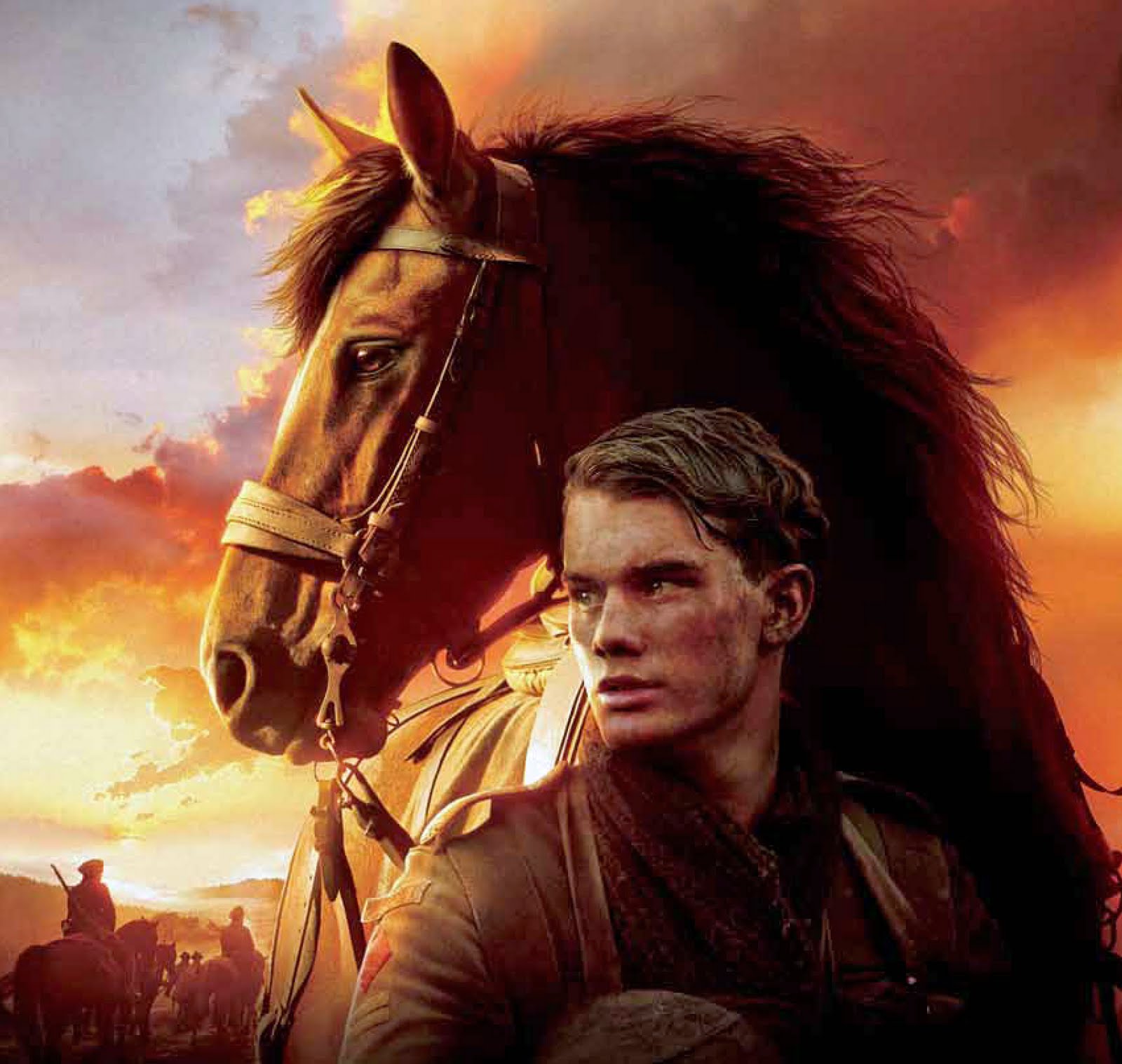
In the exhilarating drama War Horse, director Steven Spielberg neither aims for the sci-fi/fantasy heights of E.T. nor the starkness of man’s inhumanity (Schindler’s List). Thematically, War Horse straddles both genres, clocking in as a mixed breed of the reality of war’s brutality and animal lover fantasy. I say fantasy because the exploits of the title horse stretch beyond credibility. Hybrid or not, the movie is a thoroughbred winner.
Lee Hall and Richard Curtis’ screenplay could be described as thoroughbred as well since it is drawn from Michael Morpurgo’s best selling children’s book and the Tony Award winning play–both sharing the film’s title.
The story is reminiscent of Courage of Lassie (1946) since it involves a beloved pet, of sorts, that is thrust into a world war, and whose survival, let alone return to its home base, is fraught with impossibility upon impossibility. Of course, in War Horse, the “pet” is an English farm family’s horse named Joey. Ted Narracott (Peter Mullan) buys the hunter colt at auction despite the fact he cannot afford it. To make matters worse, he has to face his wife, Rosie (Emily Watson) who obviously realizes more than her husband just how tight their meager budget is. Ted has gone to town to purchase a much needed plow horse, but returns with a steed clearly bred for the race track. Their teenaged son, Albert (Jeremy Irvine) is pleased nonetheless, and vows to train the horse to pull a plow if only they will not resell it.

There is a marvelous sequence involving Albert’s desperate attempt to lead the painfully struggling Joey into plowing a field of rock-hard earth (amidst a number of actual rocks) as virtually the entire town observes. Included amongst is the landlord of the Narracotts’ farm, who plans to close on their property if Joey fails.
At the outbreak of WWI, Joey is sold to the military who, like the enemy Germans, used horses to carry supplies and pull wagons and artillery. It is hard to believe such animal mistreatment under modern standards, but it was very true then. The sale occurs despite Albert’s desperation. Here the story unfolds into realistically staged battle sequences in France, including horrific fighting in and out of the infamous trenches of “the war to end wars.” Through the confusion of battle, Joey journeys from British lines to German, pulling ambulances and becoming a loyal servant to both sides. For a time he is separated from battle altogether, and befriends a civilian French girl and her grandfather.
The film’s most memorable set piece is its most grueling, and involves the horse literally caught on its own during battle in No Man’s Land between the English and German trenches. I had to turn my head away due to the intensity. Spielberg does use an animatronic horse for parts of it, which will not lessen the extremely sympathetic impact. It is the stuff that bad dreams are made of.

Joey’s long journey does not end in the previously described scene, but does involve humans he has befriended along the way. That is enough said without destroying the film’s wonderment. It all makes for a tissue-to-eye finale. Incidentally, there were 14 Joeys used throughout the filming. Considering what this horse endures, it should be no surprise.
John Williams’ score is sweeping and, at times, heart wrenching. Janusz Kaminski’s photography, particularly in capturing the English countryside and French fields, has fine, oil painted color and texture. Accolades are deserved all around, marking another Spielberg triumph and, undoubtedly, Oscar contender.
———-
GRADE on a Scale of A to F: A
——————–
——————–