
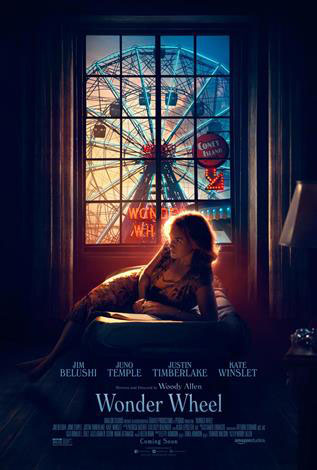
Though contrived, ‘Wonder Wheel’ has stunning color, Kate Winslet as pluses
By Steve CrumDespite stars Kate Winslet and Justin Timberlake, the real celebrities in Woody Allen’s Wonder Wheel are his cinematographer, Vittorio Storaro, and Suzy Benzinger, Allen’s longtime costume designer. Then there’s the fantastic filming location, Coney Island.
Storaro’s opening panorama shot of Coney Island in blazing color is awesome, as well as his stunning use of color hues during dramatic scenes.
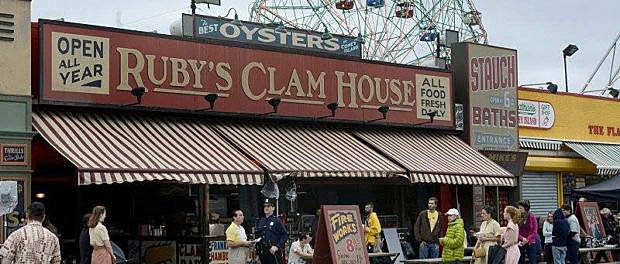 In this 53rd Allen-directed film (including his TV work), the focus is on a 1950 summer at Coney Island in Brooklyn. More specifically, it is a drama/character study whose central figure, Ginny (superbly played by Kate Winslet), is a lost soul married to Jim Belushi’s Humpty. (Yep, that’s his name.) He’s a carousel operator, and she waitresses at Ruby’s Clam Shop. Not only do they work at Coney Island, but live above the amusement park’s noisy shooting gallery. They and Ginny’s son from a previous marriage, Richie (Jack Gore), while away their days in unique ways.
 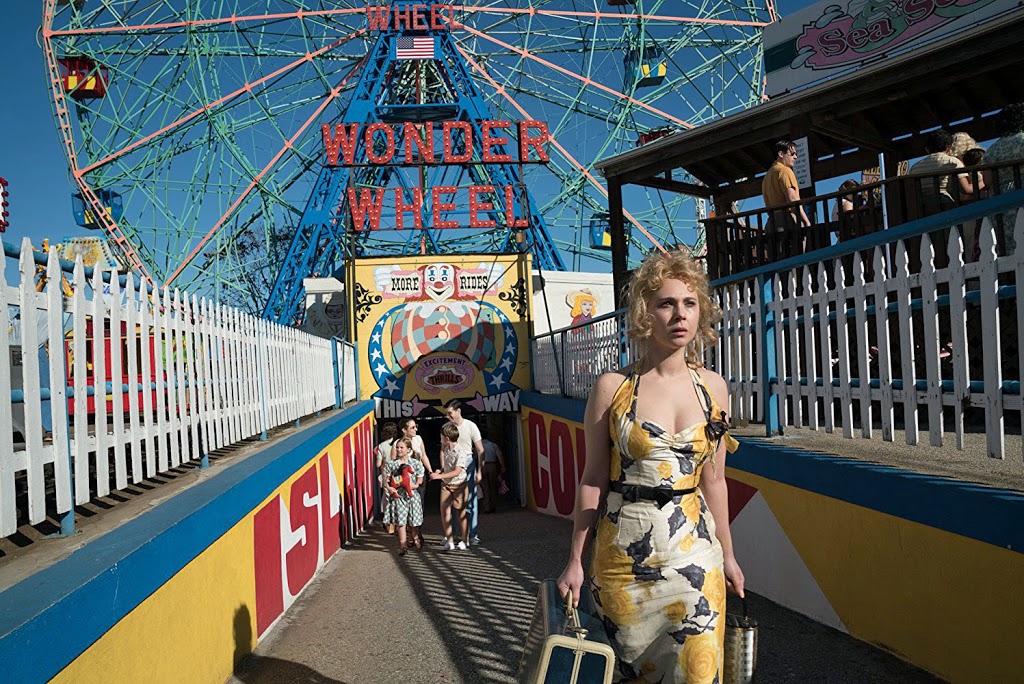 Humpty enjoys fishing off the pier with buddies. Ginny thinks she has found true love and lust in an affair with lifeguard Mickey, effectively realized by Justin Timberlake. And middle schooler Richie is fired up about…fires. The young pyromaniac starts them whenever and wherever he can. A unique family, indeed. So when Humpty’s estranged daughter Carolina (Juno Temple) knocks at his door after a decade, things change. That she is on the lam from the mob adds another layer of uniqueness.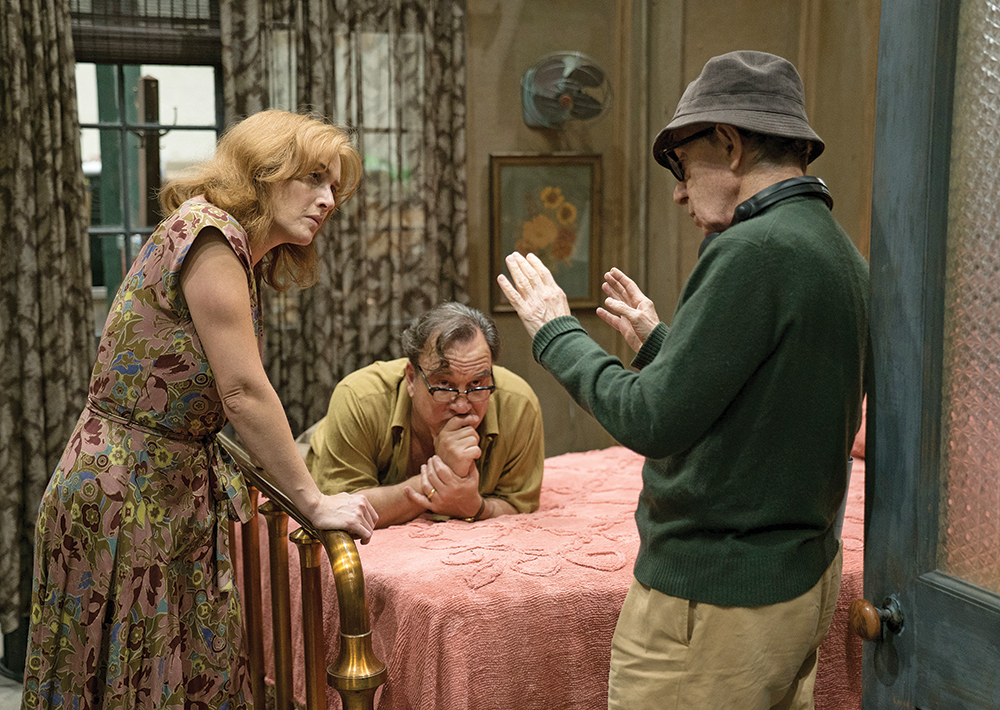
_______
Woody Allen sets up a shot with Kate Winslet and Jim Belushi.
_______
Quoting Mickey, who also speaks to us as narrator, “It just seems to go from one drama to another.” That pretty well sums up Allen’s screenplay, which comes across as pretty contrived and a bit too “unique” for its own good. The overlapping plot lines trail on without resolution, becoming more of a psychological study of Ginny and the sad existence of those around her.
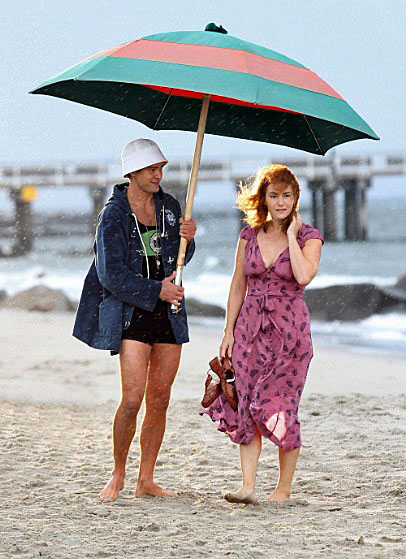 Still, Kate Winslet captures Ginny well, including her Brooklyn dialect, not easy for a Brit, and her frumpy body language. Mourning her own birthday celebration, she responds to the comment, “Turning 40 is a milestone”: “No, it’s a tombstone.” (A great Woody Allen line, if ever.) Obnoxiously insecure, she is self-centered with desperation. Like the park’s 150 foot ferris wheel of the film’s title, life turns.
As Ginny’s character ultimately morphs into a rough blend of Blanche Dubois and Norma Desmond, one speculates on her fate while admiring Winslet’s acting chops.
——————————
GRADE on an A-F Scale: B-
Dickens’ inspiration for ‘A Christmas Carol’ realized in ‘The Man Who Invented Christmas’
 By Steve Crum
Do not expect spectacular visual effects like materializing ghosts in The Man Who Invented Christmas. For that matter, forget about being transported via time machine to the past and future. But it is also true this is a movie involving Ebenezer Scrooge and Ghosts of Christmas Past, Present and Future. Based on Les Stanford’s historical fiction book of the same name, this film adaptation is closer to being a stage production than a digital effects-driven fantasy.
As such, The Man Who Invented Christmas is a handsomely filmed and solidly acted 104 minutes. Compelling? Well, so-so. A unique take on the familiar Charles Dickens tale, A Christmas Carol? Definitely.
Be forewarned: If you have neither read the book nor seen one of the 200-plus film and stage productions, forget about seeing this one. You just won’t get it.
 The Man Who Invented Christmas is aptly named since the film’s plot involves the six desperate weeks Charles Dickens had in 1843 to create what would be finally titled A Christmas Carol. It became his best remembered work, and a holiday season must-read and must-see. During radio’s golden heyday in the 1930’s and ‘40s, it also became a must-hear.
 Through screenwriter Susan Coyne and director Bharat Nalluri, we first see Charles Dickens (well played by Dan Stevens) during one of his touring lectures, playing to an audience packed with those who want to see and hear the author of the best selling novel, Oliver Twist. At this point, Dickens and his manager are in turmoil. Since Oliver Twist, Dickens had authored three books—all rejected by publishers. His professional fate now rests on creating a new novel, and the deadline grows near.
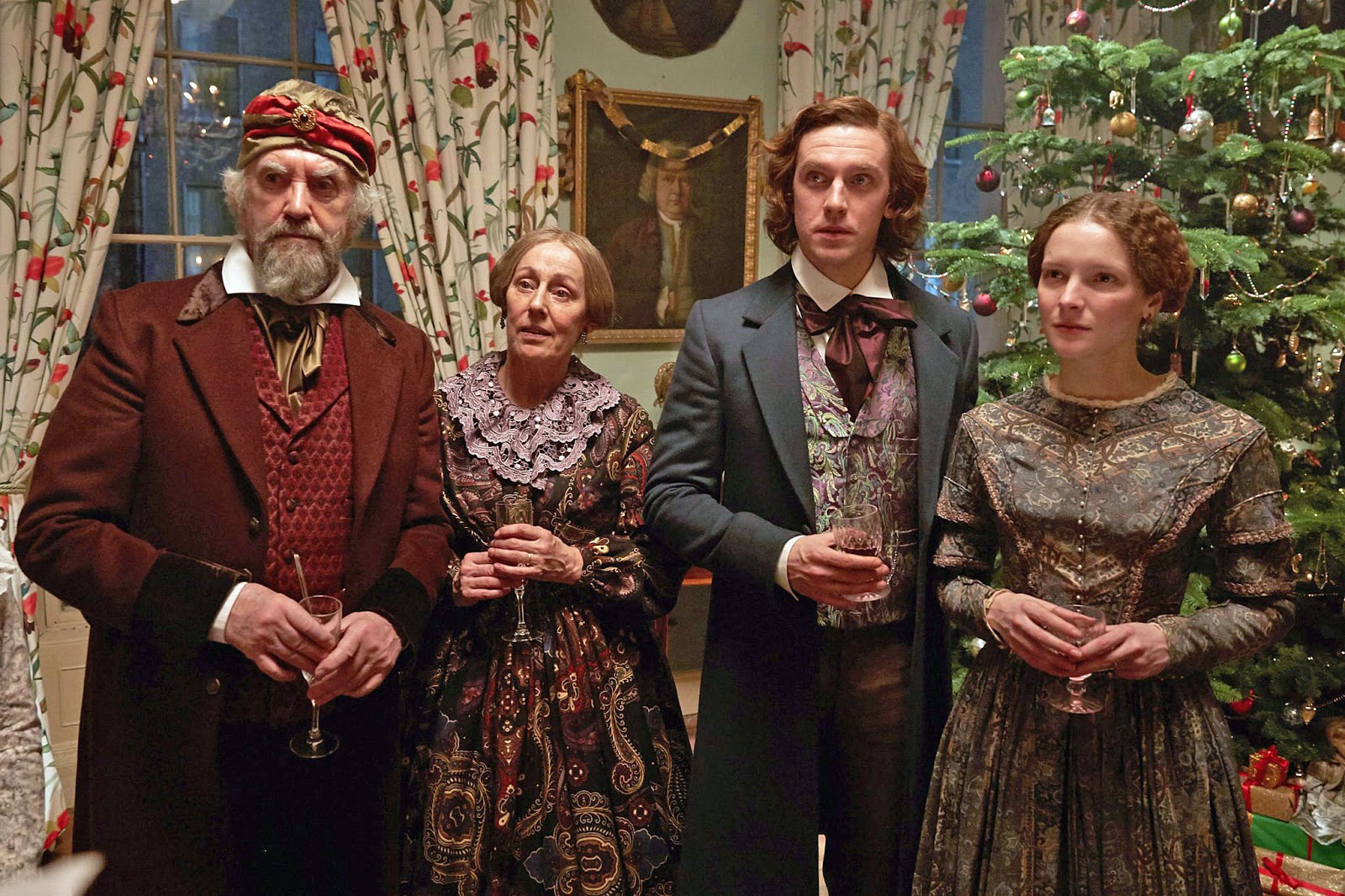 At this point in the film, Dickens’ creativity mixes with his personal life at home in London. He is surrounded by a doting (and pregnant) wife, several children, servants, and his live-in parents. His relationship with his deadbeat father John (Jonathan Pryce) is strained. And there are bills to be paid.
 There is sage advice I was once given when writing fiction: “Write about that which you know.” Dickens fully recognizes such, and begins creating characters to drive a plot around a central Christmas theme. “Get the name right,” he says, “and if you’re lucky, a character will appear.”
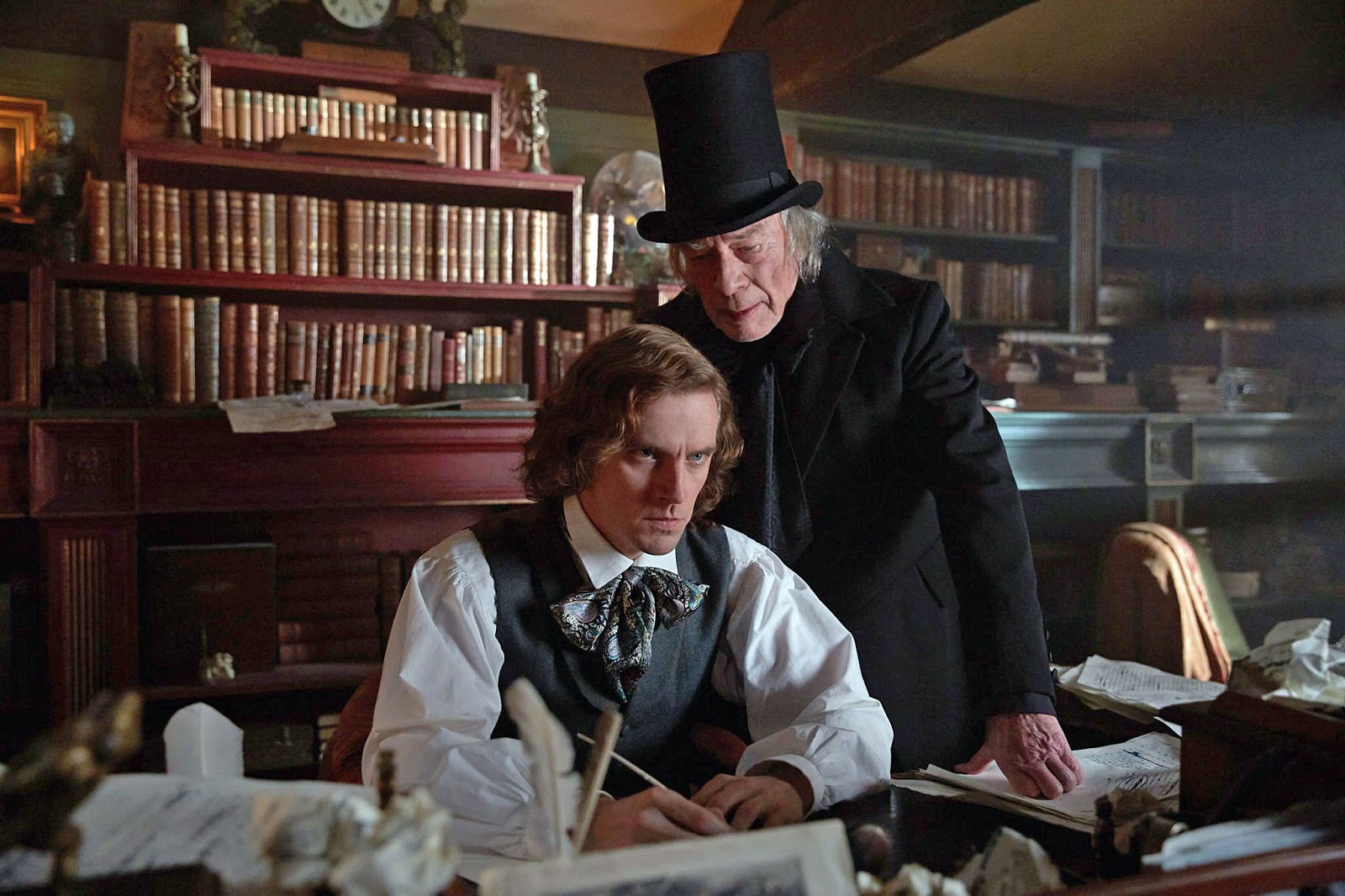
The characters’ names and personages are therefore based upon those who he knows…from relatives to strangers. His thoughts are then visualized for us. For example, one gent he briefly meets becomes Scrooge (finely portrayed by Christopher Plummer). Eventually, all the characters come to Dickens’ mind, and adapted into his new book. They even hang around his study, invisible to others since they are solely in his—as they say—mind’s eye.

The Man Who Invented Christmas is a well crafted film with gorgeous period settings and costumes. I guess there is nothing really wrong about it resembling a high budget Hallmark Channel movie.
——————————
GRADE on an A-F Scale: B-
Realistic firefighting sequences help carry above average ‘Only the Brave’
 By Steve Crum
Two factors elevating Only the Brave above the norm are the film’s location photography and realistic forest fire sequences. A third factor is the story’s basis, the history of Prescott, Arizona’s elite firefighting squad, the Granite Mountain Hotshots. Add to that a competent ensemble cast led by Josh Brolin, Miles Teller, Jeff Bridges, Jennifer Connelly, and Taylor Kitsch.
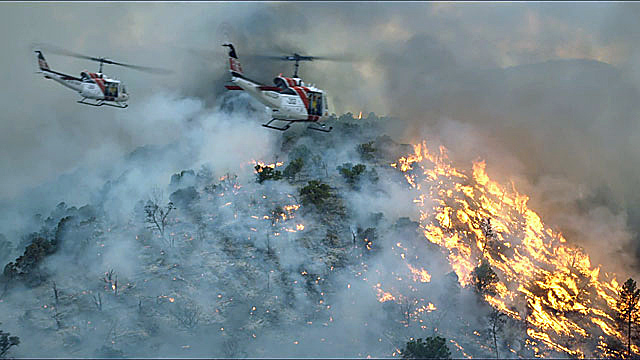 The film is really a gritty, action oriented war film with battles between the courageous firemen versus the deadly flames. Taking place during 2013 and before, the focus at first is on Eric “Supe” Marsh (James Brolin) and his wife Amanda (Jennifer Connelly). Eric is a seasoned firefighter. He is also driven to have his unit designated “hotshots,” a moniker given to first responder, front line firemen. He knows his men are more than capable to fulfill that dangerous job. But he must first convince his good friend and mentor, Duane Steinbrink (Jeff Bridges), to go to bat for him with the city’s mayor to financially back such a move.
  As the story unfolds, we get to know a half dozen of the squad pretty well, particularly “Donut” McDonough (Miles Teller). In fact, it’s the work of Teller that carries Only the Brave. It is his character who goes through the greatest transformation—from druggy to Hotshot. In between, his personal life is further stressed by an old girlfriend’s pregnancy. Teller does a marvelous job, and is a charismatic actor.
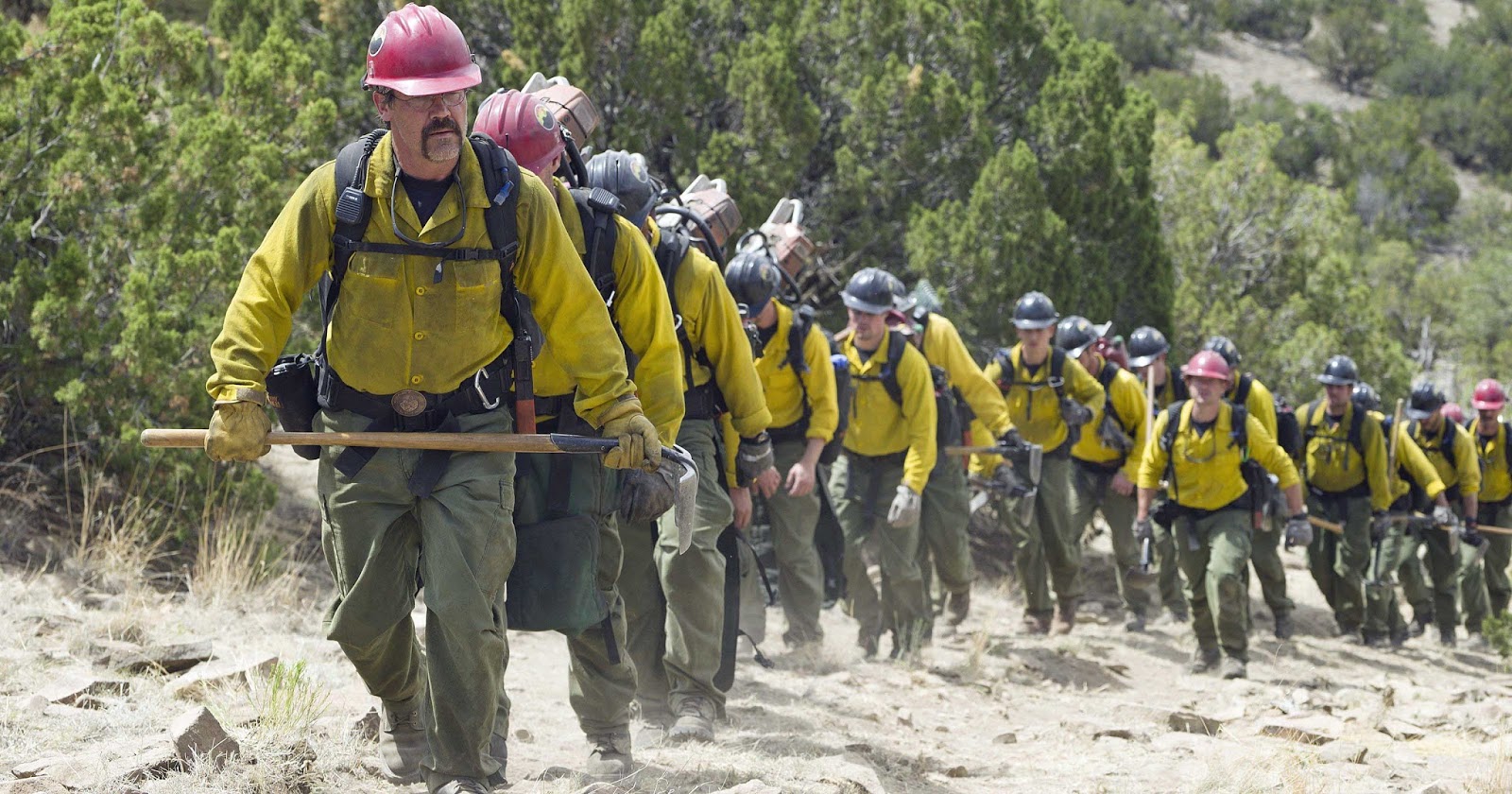 As referenced, Only the Brave is a war movie. Like military servicemen, the firefighters undergo their brand of basic training, which becomes a real trial for still drug recovering “Donut.” We see the men, the solders, repeatedly drilled to learn their tools of trade, essentially their weaponry—from spade diggers to flame throwers. We observe “Supe” doing the battle plan logistics…except this general leads from the front.
There are three or four forest fire sequences before the devastating Yarnell Hill Fire that caps this 133 minute film. By that time, we better know the heroes and their waiting back home families. And that also encompasses the movie’s weakness, the script. The screenplay, while based on fact, is cliché ridden and too often predictable. Nonetheless, there are emotional portions that are heartbreakingly tearful.
Director Joseph Kosinski’s imagery clearly outweighs Ken Nolan and Eric Warren Singer’s screenplay. It should be no surprise that Kosinski’s background is in computer graphics and computer generated imagery. He sure knows his stuff with digital forest fires. They look too real.
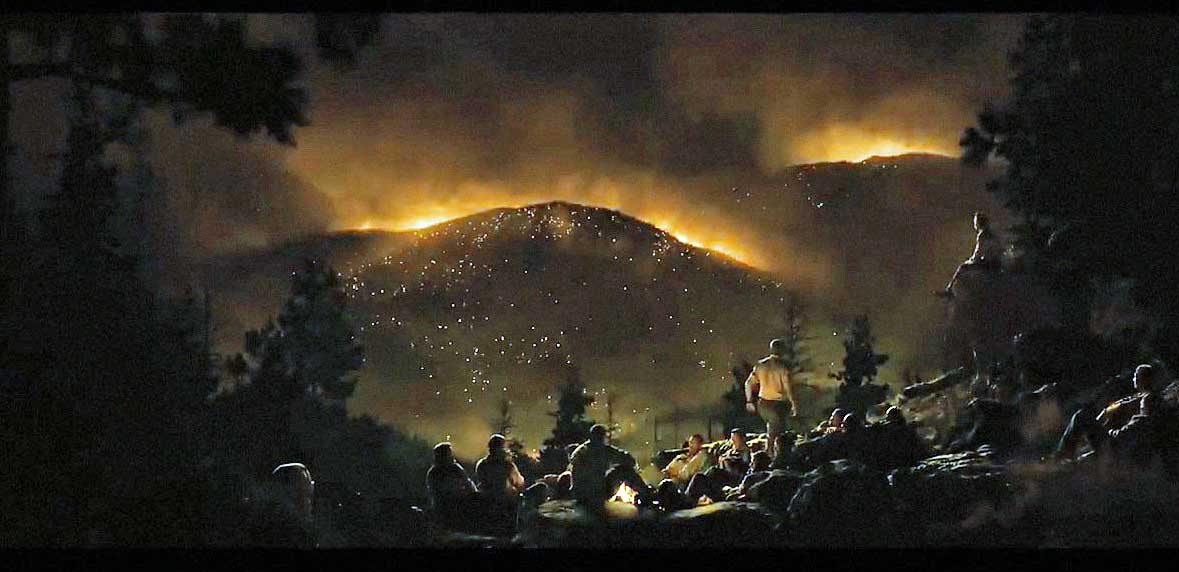
With this summer’s wildfires still terrorizing our Pacific Northwest, Only the Brave is timely if not redundant.
——————————
GRADE on an A-F Scale: B
WORTH A THOUSAND WORDS: ‘The Circle’ has its short radio run
 By Steve Crum
A buncha stars gather in 1939 for an NBC radio broadcast, The Circle: (from left) Groucho Marx, Cary Grant, Lawrence Tibbett, Chico Marx, Ronald Colman (host), and (in front) Carole Lombard. The one hour show had different famous guests every week discussing current events and the arts in a round-table format. Sponsored by Kellogg’s, The Circle is considered one of radio’s celebrated failures, struggling for listeners from 1939-40. High pay for guests + low ratings tells the story.
WORTH A THOUSAND WORDS: The House That Jolson Built
 By Steve Crum
Showgirl in Hollywood was a huge hit at the Winter Garden Theatre in New York City during 1930. From 1928-33, the legendary live stage theatre was leased to Warner Brothers to show their early talkies. The Winter Garden had been one of Broadway’s leading stages since the Shuberts owned it beginning in 1911. It reverted back to being a live stage venue in 1934.
Al Jolson and Ruby Keeler make a cameo appearance in Showgirl in Hollywood. Jolson, of course, is forever associated with the Winter Garden since he headlined several hit productions there in the 1910’s-20s. It was Jolson who had a runway built down the center of the Winter Garden so he could essentially be among his audience while performing. His audiences reportedly went wild when Jolie ran and danced its length while singing.