
THE DUKE

NOTE: A good friend of mine, Kansas City film critic MARIE ASNER, wrote the following poem about JOHN WAYNE in the 1990’s. The poem is now on display at the John Wayne Birthplace-Museum in Winterset, Iowa. Enjoy.
——————–
THE DUKE
By Marie Asner
Head slowly lowers to blue flannel chest
with chipped buttons and coffee stain.
Stage hands quietly drift past
not touching elbow or boot.
Soft snore fills the air
for those privileged to sit nearby.
Lunch time for the crew,
but the Duke is dreaming
of a green actor with chance
to ride the stagecoach,
fight back leather outlaws
and softly say, “ma’am,”
to feminine hearts around the world.
He stirs and the dream shifts—
his bones were stiff but one last ride
with reins in mouth and two guns blazing
to capture villains with true grit,
and show the world he was still royalty.
The script girl gently clears her throat
and he wakes, rising to full height.
“Let’s go, pilgrims.”
Cast gathers for another take
as swirls of dust lightly brush hand-tooled boots
and the leading lady’s heart flutters.
——————–
Duke Wayne narrates America, Why I Love Her: https://www.youtube.com/watch?v=yQM1oLnMLNU
——————–
Duke Wayne narrates America, Why I Love Her: https://www.youtube.com/watch?v=yQM1oLnMLNU
Keeping (sound) track of the movies

NOTE: FILM COMPOSER JOHN BARRY’S DEATH ON JANUARY 20, 2011 PROMPTED THE FOLLOWING PIECE.
By Steve Crum
John Barry’s music coincided with, and helped perpetuate, my love of motion pictures. It was not until 1962 and Dr. No, when I was 15, that the movie score became integral for me in connecting with a given film.
That same year, Maurice Jarre’s Lawrence of Arabia soundtrack music cemented my appreciation for film music, which exists more than ever today. On a more subliminal level my fond recollection of Erich Wolfgang Korngold’s compelling score for King’s Row dates to my preteen years, when I first saw the movie on TV. (OK, The Wizard of Oz and Disney animated musicals jam my recollections too, but we are talking scoring for non-musicals here.)
Realize too that until the dawn of Beta and VHS tapes, in 1975 and ’77, respectively, the only way to rent or “own” a favorite movie was via its soundtrack LP record. It is also true that one could, from the early 1950’s, audio tape an entire movie from TV, using a reel-to-reel tape recorder. This is something I did as well using my father’s machine, even though the tape would often run out before the movie ended. In those days, movies shown on TV were at least two decades old, not current like today. More extravagant budget types would collect movies, both old and relatively new, on 8 or 16 mm.
For the dollar challenged like yours truly, however, listening to a soundtrack album was the nearest thing to reliving a film recently seen in a theater. Listening conjured the movie’s images and dialogue, which was far better than relying solely on one’s memory. During radio’s golden era, pre-TV listeners did just that. They listened. From Charlie McCarthy to Jack Benny to dramatic programs like Suspense, listeners’ imaginations provided visuals to this solely audio medium. Radio writer/producer Arch Oboler called it, “Theater of the Mind.” (Many film composers, like Bernard Herrmann and Jerry Goldsmith, launched their careers as composers for radio programs.)
Likewise, listening to soundtrack music triggers image and dialogue from any particular film–but only if the music is catchy, identifiable, and emotionally involving. The composer’s genius of interpretation and translation is key.
 Plus, you could look at the album’s cover and liner notes to add to the illusion. A few albums included snippets of dialogue from the movie: The Odd Couple, along with Neal Hefti’s score; and Little Big Man, with a bountiful amount of dialogue, complemented by John Paul Hammond’s music, among them. Two LP’s were produced of the Elizabeth Taylor-Richard Burton starring vehicle, Who’s Afraid of Virginia Woolf?, based on Edward Albee’s play. One featured Alex North’s music only; the other, a double-LP, included all dialogue from the film. Both were simultaneously released by Warner Bros.
 Record album tracks, like today’s CD tracks, were titled after specific scenes or themes. Barry’s Thunderball soundtrack album, for example, includes the track, Mr. Kiss-Kiss, Bang-Bang, a reference both to a character and a line of dialogue. Musical themes date back to the beginning of sound movies, even to silents. Max Steiner’s Tara’s Theme, from 1939’s Gone With the Wind, is by no means the first to emotionalize a person or thing (in this case, the O’Hara mansion). In 1915, D. W. Griffith’s silent classic, Birth of a Nation, included an original score by Joseph Carl Breil that was played by musicians in the movie theater during the film’s showing. Birth’s love theme was later adapted as the signature music for radio and TV’s popular, albeit controversial, Amos ‘n Andy.
Even without background music underscoring my words in this piece, surely my love for film scores is obvious.Of the 20 or so great film composers, my most admired and collected are a foursome: Elmer Bernstein, John Barry, Jerry Goldsmith, and Bernard Herrmann. God knows there are also hours of Rosza, Williams, Copland, Korngold, Waxman, Mancini, Steiner, Elfman, and Jarre in my abode. Maurice Jarre, in fact, nearly makes the final four with his magnificent rendering of Lawrence of Arabia alone.
 In the heyday of collecting, my soundtrack LP’s numbered at 600+. That number has been reduced, due to economic, technological, and space reasons. Still, there are about 150 LP’s resting upright in plastic protectors, in my closet. These remaining albums are the rarest of the rare, until iTunes or commercial CD’s replace them. My Jerome Moross-composed The Cardinal used to be a lost soundtrack until iTunes recently made it available again via download.
Autographed soundtrack albums are rare, but I do have a CD of the Civil War epic, Gettysburg, signed by composer Randy Edelman. What I would not give for the soundtrack LP of 1956’s Forbidden Planet, signed on the cover by its composers, Louis and Bebe Barron. Their electronically produced music, with a Moog-ish sound, is considered an ahead-of-its-time classic due to its “electronic tonalities.” I bought this rarity via A-1 Record Finders, approximately 40 years ago, as a gift for a close friend. When he unexpectedly died two years ago, the Forbidden Planet album was among the items either sold or kept by his cousins. Let us hope it was not part of a dollar a handful, garage sale. Or, worse yet, that it was discarded. If someone now owns it, he or she has a gem of a collectible.
The same goes for my late friend’s vintage, still-in-the-box, Forbidden Planet “Robby the Robot” toy. Heavens to Morbius!
——————–
Sit back and savor these tributes to two of the greatest film composers of all time…
JERRY GOLDSMITH: http://www.youtube.com/watch?v=6cJ-rvGpW84
JOHN BARRY: http://www.youtube.com/watch?v=xYQ7dxwRkUM
Neeson searches for identity in thrill ride ‘Unknown’
By Steve Crum
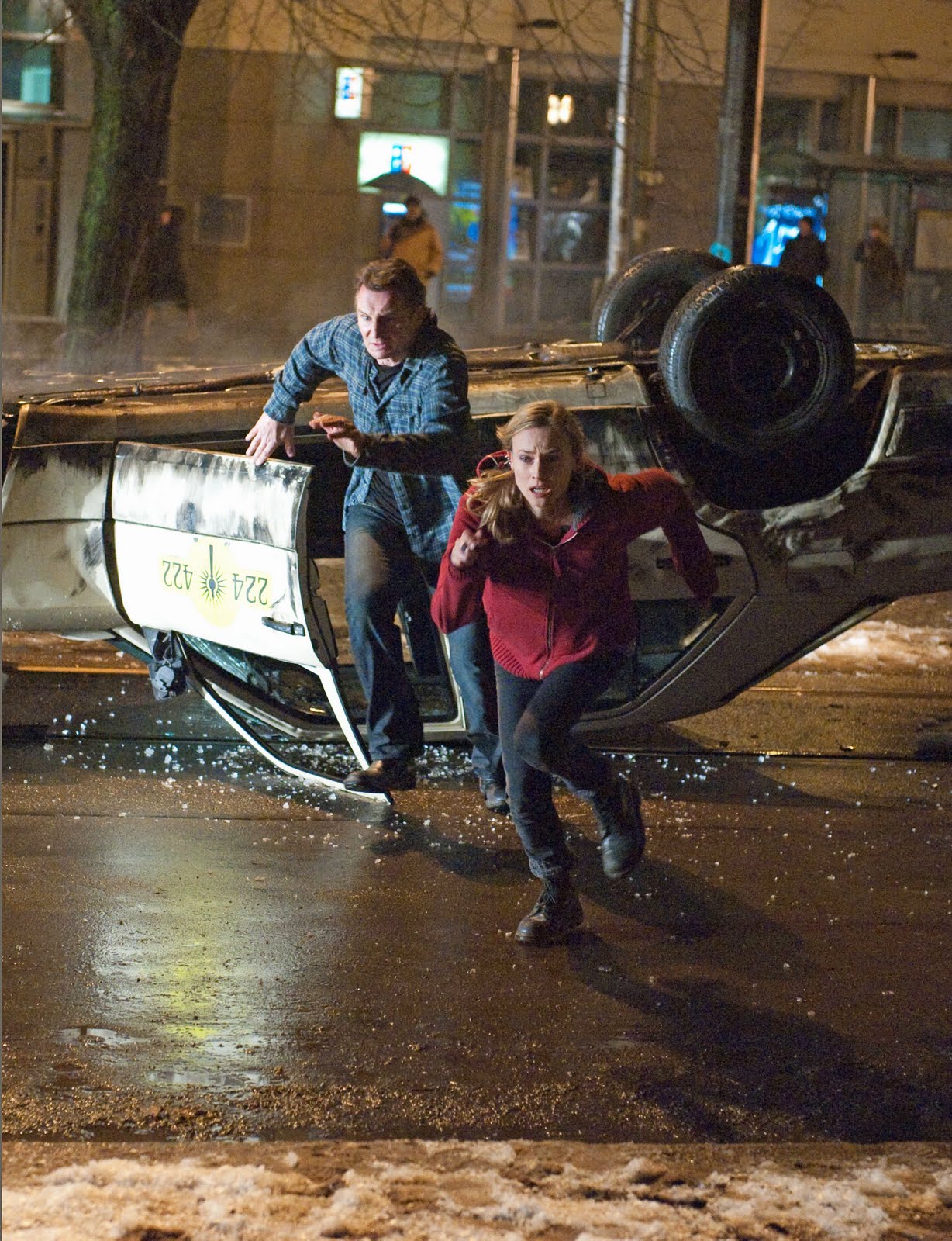
In Unknown, Liam Neeson’s strong willed, righteous character goes on a tear against forces threatening both a loved one and himself. Er, wait a second. That describes Neeson’s 2008 flick, Taken–yet another double-syllabled, purposely vague movie title. But wait, there’s more. It also describes his current thriller, Unknown–with some differences. (A past box office hit can’t be totally cloned, can it?)
For one, Neeson’s current vengeful force, Dr. Martin Harris, is pursuing his own identity, and with it, his wife. In Taken, his guy tracked down his daughter’s kidnappers. In both films, Neeson’s persona is that of a relentless, one-man army, imparting death and suffering on those standing in his way.
Per formula, the gangly, towering Neeson appears first as a genial everyman who is soon provoked into commando mode. By the time he is on an fisticuffs roll, we are totally with him, sympathetic to his cause and boiling for revenge. It is a formula that has worked since the dawn of storytelling, and fits Neeson like an Isotoner glove.
Unknown is an old school thriller with edgy, frenetic action. Though not a perfect movie due to plot holes, Unknown hooks and reels us, however implausibly, for its nearly two hour running time. It is a thrill ride worthy of Hitchcock, which is high praise for its director, the relatively unknown Jaume Collet-Serra (Orphan). Collet-Serra is a particularly stylish director, exemplified by the art gallery sequence, laced with cat-and-mouse weavings, by pursuer and the pursued, between and around painting display flats.
In fact, his directorial “weaving” is splendidly, and literally, showcased in several wild car chases shot in downtown Berlin. Talk about “wow.”
 Collet-Serra has been very public about his admiration of the Master of Suspense and his film theme commonality. “My favorite films are those Hitchcockian thrillers that have that mysterious atmosphere,” he says, “where the audience is as much in the dark as the characters, and you don’t really now where the story is going to take you.” Unknown pretty much succeeds in this suspension of disbelief, as we root for our put upon hero to find the truth and, as previously said, himself.
 That quest begins soon after Neeson’s Martin Harris and his wife Elizabeth (January Jones) arrive at the airport in modern day Berlin to attend an international meeting. Arriving at their hotel, Elizabeth goes inside to check in as Martin discovers his briefcase is missing. A simple matter, he thinks, as he takes a cab back to the airport to retrieve the item. Circumstances occur, however, and the cab wrecks. Martin awakens days later, his memory unclear. But soon he remembers, and forges back to the hotel to find his wife with a stranger (Aiden Quinn), who claims he is Dr. Martin Harris. Since Neeson’s Martin has since lost his passport and any identification, no one believes who he is. This includes his wife, who adamantly claims Quinn’s Martin as her husband.
So the story goes, and so goes Neeson’s Martin, just as adamant about proving his identity, and trying to find the truth behind his wife’s motive in disclaiming him.
Along the way, as he is put in the position of defending himself against assassins, he elicits help in proving who he really is by way of a young woman, Gina (Diane Kruger) and Ernst Jurgen (Bruno Ganz), a man of questionable past. Two others, played by Frank Langella and Sebastian Koch, also enter the equation.

One of my all time favorite TV programs was 24, which, week after week, clouded my logical sense via multiple plot twists, intense action, and loyalty to the central, determined character, Jack. It was not until after each episode that the show’s plot lackings would materialize. It was like taking a breath, and getting one’s mind back to solid ground. Unknown gave me a similar feeling. There are story questions that remain unanswered. For example, screenscribes Oliver Butcher and Stephen Cornwell have created a Berlin with virtually ineffectual police. After long stretches of either violent car chases or violent shootings within the heart of the city, police as pretty much invisible. They certainly never show up to impede any wild violence depicted.
Worse yet, and this is the major weakness, if Neeson/Harris has no idea of who he really is, why isn’t any DNA testing done? His fingerprints alone should do the trick. This is 2011 Germany?
Still, Unknown is a nail-biter, an edge-of-seater, and a fast couple of hours. It is just as well that its action moves faster than logic.
——————–
GRADE on an A to F scale: B-
——————–
The known trailer to UNKNOWN: http://www.youtube.com/watch?v=I-lDfKb2SBA
‘Green Hornet’ buzzes down, out to zzzzzz

By Steve Crum
What an odd choice, morphing a quasi-superhero genre with Jackass comedy. Make that an odd, wrong choice, since The Green Hornet is a grating misfire even before the first screech of Black Beauty’s ultra-vulcanized tires.
The movie, which overwhelms with explosions and car wrecks (in 3-D yet), is a wreck that wrecks itself. Now, that’s an underachievement. Seth Rogen, who co-produced and co-wrote The Green Hornet with Evan Goldberg, cast himself in the title role. Like the movie’s childish central character Britt Reid, he obviously had an egocentric moment, several moments, in the writing and casting.
Created by George W. Trendle, in 1936, for radio, The Green Hornet was a champion of justice, much like a modern Lone Ranger, another masked hero, except from the 19th Century West, whose roots are also in radio. Trendle created both characters, The Lone Ranger born first (1933), and even fictionally connected the two via the Reid family tree. Britt Reid/The Green Hornet is the grandnephew of John Reid aka The Lone Ranger. Both heroes had sidekicks: Tonto for the Ranger, Kato for the Hornet. The Ranger rode his great horse, Silver; The Hornet drove his great sedan, Black Beauty. And Beauty was a beast with revved up horsepower.
“He hunts the biggest of all game, public enemies who try to destroy our America!” That was the weekly intro for the radio series, which was broadcast, off and on, until 1952. A so-so Green Hornet movie serial followed in 1940, and a pretty lackluster, one season TV show came and went in 1966. (But it did feature some fun kicks and punches by Bruce Lee as Kato.) There were also Green Hornet comic books, beginning in 1940. So much for the somewhat glorious Hornet history, and now Seth Rogen has placed his dorky self in the tarnished franchise. (He always looks like he has a chaw of tobacco in his craw each time he speaks.) Evidently, the Trendle Estate gave this take its sanctioned blessing, undoubtedly swayed by the cash. Notice George W. Trendle Jr.’s name on the production credits.
What Rogen and cohorts have done, along with director Michel Gondry (Eternal Sunshine of the Spotless Mind), is “re-imagine” (that’s the popular, coined word these days) Britt Reid as a spoiled late 20-something, who despises his wealthy, late father, James (Tom Wilkinson) so much he lives to destroy basically everything connected with him. There is a flashback that shows the dad’s extreme cruelty when he destroys a superhero doll young Britt adores. Britt eventually grows up in age, but lacking mental and emotional savvy.
 Believe it or not, according to this movie, the first caper Reid and Kato (Jay Chou) tackle is to dress up in costumes and masks, hop in the impressive Black Beauty (created by the genius Kato), and drive to the park to literally saw off his father’s statue’s head as a prank. In fact, the breadth of the movie involves prank after prank, with Kato saving the idiot Britt’s butt in fight after fight. The Hornet just happens to encounter street gangs and thugs along the way, and blasts his way to safety (or Kato covers him), accidentally saving good people’s lives in the process. However, it is appalling that several policemen early on, pursuing in police cars, are wiped out by The Green Hornet as well. Such is the irresponsible Green Hornet persona scripted herein. Therefore, this “hero” is more often a punk felon out for a joy ride, who just happens to cross paths with the leader of the city’s crime syndicate, Chudnofsky, played by last year’s Oscar winner for Inglorious Basterds, Christoph Waltz. His character is scripted as a cold blooded killer, with a large, double-barreled pistol, no less. Yet he is nearly as lame brained, and semi- humorous, as Rogen’s Hornet.
 The movie’s pluses include a cameo by James Franco (127 Hours), and welcome but wasted support by Edward J. Olmos and Cameron Diaz. The car is stupendous. Actually, there are several Black Beauty vehicles in the movie, souped up with Knight Rider-like features. However, the negatives far outweigh any positives. The 3-D is wasted, having been an afterthought. (The end credits look cool with awesome depth, but that is it.) There are too many wrecks, too many explosions, too much broken glass, and a too loud soundtrack. There is an extended sequence between Kato and Reid that appears to mock the Peter Sellers’ Clouseau and (his) Kato scenes wherein they relentlessly try to out fight each other inside Clouseau’s apartment. A tribute to the late Blake Edwards, who directed the Pink Panther movies, this is not.
What should have been, could have been. It sure isn’t this Green Slacker.
Take my advice, please. Debuzz this Green Hornet, and look toward what appears to be a faithful adaptation of another early 20th Century pop culture icon, who also favors the lucky color, The Green Lantern. It opens June 17.
———-
GRADE On an A to F Scale: D
——————–
The Green Hornet trailer: http://www.youtube.com/watch?v=9btZIK3Obpg
‘The Social Network’ chosen 2010’s Best Film by KC critics

By Steve Crum
The Social Network, a compelling dramatization of the origin and ownership battles of the internet’s Facebook, was named Best Film of 2010 by the Kansas City Film Critics Circle, Jan. 2. The Social Network also garnered a Best Adapted Screenplay win for Aaron Sorkin.
Christopher Nolan’s sci-fi vision of mind control through entering another’s dreams, Inception, topped three other categories, including The Robert Altman Award for Best Direction (Nolan). Other winners include Best Actor, Colin Firth (The King’s Speech) and Best Actress, Natalie Portman (Black Swan).
The complete list of winners:
Best Film
THE SOCIAL NETWORK
Robert Altman Award for Best Director
CHRISTOPHER NOLAN–INCEPTION
Best Actress
NATALIE PORTMAN–BLACK SWAN
Best Actor
COLIN FIRTH–THE KING’S SPEECH
Best Supporting Actress
HAILEE STEINFELD–TRUE GRIT
Best Supporting Actor
CHRISTIAN BALE–THE FIGHTER
Best Foreign Language Film
MOTHER
Best Animated Film
TOY STORY 3
Best Documentary
EXIT THROUGH THE GIFT SHOP
Best Original Screenplay
INCEPTION–CHRISTOPHER NOLAN
Best Adapted Screenplay
THE SOCIAL NETWORK–AARON SORKIN
Vince Koehler Award for Best Fantasy, Science Fiction or Horror
INCEPTION
The KCFCC is the second oldest film critics society in the United States, and was established by the late Dr. James Loutzenhiser.
——————–
Enjoy the trailer of the winning film, The Social Network: https://www.youtube.com/watch?v=lB95KLmpLR4