Blomkamp’s sci-fi yarn ‘Elysium’ has its moments, but pales to his ‘District 9’

By Steve Crum


Elysium concerns the haves and have-nots, featuring a society with no middle class, only the rich and poor, and a strictly enforced border to keep the two classes separated. Why, it’s a documentary about 2013 USA! No, it is a sci-fi yarn set in “the late 21st Century” which paints a bleak future for the world. Like the Tom Cruise vehicle Oblivion that came and went earlier this summer, Elysium is all about the social mores of control, particularly government control. Just to emphasize the connection to the status quo, there are references to Homeland Security. 

Current paranoia about our federal government is realized here, probably enough to reinforce those who reportedly are storing up their guns and ammo in fear of some kind of takeover. In Elysium, there are indeed stored guns, but per se underground, accessed through illegal means. Earth’s leaders do not permit its slave-like citizenry to have weapons. 

Director-screenwriter Neill Blomkamp, who imprinted the movie history map with his incredibly original District 9, does not equal that triumph. But portions of Elysium come near. Reminiscent of District 9 is the overall slum that earth has become. Blomkamp frequently and wisely cuts to overhead establishing shots so we are reminded. Ground zero is a life of filth, disease and squalor, gang graffiti-splattered walls, and raggedly dressed civilians kowtowing to robot policemen figuratively and sometimes literally keeping them in line. When central character Max DeCosta (Matt Damon) snidely jokes with one cop, he is immediately beaten to the ground for insubordination. In fact, his jesting nearly gets him arrested with another robot. In flashback, we find DeCosta has been a rebellious back talker since he was raised by orphanage nuns. 

DeCosta’s childhood friend and sweetheart, Frey (Alice Braga) is now a nurse supporting a terminally ill little daughter. By the time DeCosta reunites with her, he has a criminal record, and is soon to contract a cancer virus thanks to an accident at his workplace factory. The plot really gets interesting when he, his old girlfriend, and her child shuttle off to the luxurious, high tech space station Elysium. Think the stereotypical circular space station depicted in 2001: A Space Odyssey, and the indoor track astronauts would jog. Multiply the size of the station by about 10, and you have Elysium, within which a huge city exists with manicured lawns, trees, modern buildings, and swimming pools. 

Factor in that DeCosta has willingly been transformed into an android to sustain his life by giving him superhuman strength. In the trailers, one can see metallic additions from his bald head and down. Since Elysium citizens have access to MRI-like machines that rid one’s body of any imperfections, including diseases, both DeCosta and Frey definitely want to take advantage. 


Elysium turns out to be not so utopian after all, since it is on the verge of a coup due to the rambunctious and cold blooded Secretary of Defense Delacourt (Jodie Foster) wanting control over the slightly more humanistic President Patel (Faran Tahir). 


Blomkamp definitely has a flair for sci-fi, and does well with the look and feel of a future earth. Action sequences are very well done, but, like most movies of this genre, acting overall is secondary to the action. However, both Damon and Copley stand out. Jodie Foster is virtually wasted with little dialogue and no memorable scenes. Her best line is representative: “Send them to deportation! Get them off this habitat!” Incidentally, the always watchable William Fichtner is notable as a factory CEO. 

Oh, and add some drones the government uses to keep its earthlings in line. Surely Blomkamp is not referencing anything to do with 2013. 
———-
GRADE on a scale of A to F: B
——————–

Check out the Elysium trailer: https://www.youtube.com/watch?v=QILNSgou5BY


Share:

The X factor for ‘The Wolverine’ features incredible action sequences


By Steve Crum

 
Marvel has the most tortured, flawed superheroes in the comic book universe. Proof positive is substantiated throughout The Wolverine, arguably the best of the shiv-wristed franchise. It is also the most grueling to watch. 
 
Unlike most superheroes, Marvel or otherwise, Wolverine’s roots have never been fully explained–at least in the movies. We know Spider-Man evolved after Peter Parker was bitten by a radioactive spider, and that Superman began as a Kryptonian baby. However, Wolverine aka Logan (played with perfection by Hugh Jackman) is an enigma. He is a mutant suffering from a kind of sleep apnea, and prone to nightmares. During one dream, we see him as he physically looks today, except it 68 years ago when he is imprisoned at a Japanese POW camp located on Nagasaki, Japan. A U.S. bomber then drops the atomic bomb–a sadly historic moment. And Wolverine obviously survives. Unlike other dreams he has, this is a valid memory, not a hallucination. How can this be? (Gasp as you ask.)
 
It is an intriguing premise, which also opens the movie, immediately hooking the audience. No surprise when the story’s locale easily shifts from the USA to present-day Japan, where it remains until the end of the film. With virtually any movie set in Japan, expectations include at least an appearance by ninjas or samurais. The Wolverine gives us pagodas packed with kicking, jabbing, and arrow shooting ninja warriors. As for a samurai warrior, would you believe a gigantic, silver-plated, robotic samurai? Ah so. 
 
To take up any slack at Japanese action central, prepare yourself for dozens of lethal Yakuza thugs. Wolverine is multi-challenged. Fortunately, his body absorbs any bullets, arrows, stabs, and punches, and then immediately heals itself. Thanks to some scientific conniving, orally delivered by a lethal babe appropriately called “Viper,” Wolverine’s regenerative powers are jeopardized, affecting his life and those he is trying to protect. 
 
Time to backpedal a bit, plot-wise, without disclosing too much. Be aware that The Wolverine is essentially a sequel to X-Men: The Last Stand, which ended with Logan in deep depression and traipsing out to the wilderness following the death of Jean Grey, his honey. He has frequent dreams  in which she appears next to him in bed and elsewhere. In each case, she implores him to join her in death. 
 
Now a recluse, and looking the part of a homeless man with unkempt beard and all, he is tracked down by a pert young lady adept at martial arts, Yukio, charismatically played by Rita Fukushima. She is sent by an old colleague of sorts who immediately needs his help in Japan. By the way, in this early part of the movie, Wolverine has already encountered a Grizzly as well as a half dozen thugs in a barroom. In fact, the fight scenes are plentiful, lengthy, and wow-factor impressive. Listing all of them in detail would be a disservice, but I have to mention one action stunner involving Wolverine battling a squad of killers atop a moving Japanese train zooming 300 mph. Fight scenes on top of moving trains have been around since the dawn of motion pictures, but this new ingredient takes the cake. Sorry, sushi.


For good reason, The Wolverine is reminiscent of a favorite James Bond adventure, 1967’s You Only Live Twice, also set in Japan. Both heroes battle martial arts foes, and both fall in love with a Japanese woman. For Wolverine’s Logan, she is the young lady he repeatedly saves, Mariko Yashida (Tao Okamoto).

 
Director James Mangold and screenscribes Christopher McQuarrie, Mark Bomback, and Scott Frank transition Wolverine on an incredible journey from 1945 to present day Nagasaki. By the finale, the body count is high, and Wolverine’s purpose in life is ascertained. Doubters need only catch the brief epilogue inserted about three minutes into the credits, featuring a couple of major folks in Marvel’s gallery. Set in an airport as Logan prepares to return to the USA, the bit also serves as hype for Wolverine’s inclusion in the next X-Men flick. What brilliant, comic book showmanship.  
———-
GRADE on a Scale of A to F: B+
——————–
 
Share:

Return of hilarious minions plus awesome 3-D make ‘Despicable Me 2’ must-see


By Steve Crum
 
The minions have me hooked again. Despicable Me 2 again wisely features the diminutive little critters, resembling yellow board game pieces with a big eye or two. As in Despicable Me #1, they are dedicated and loyal factory workers for their boss, the once evil Gru. He’s the lanky, pointy-nosed, bald fellow who stole the moon in the 2010 animated film. Gru became an adoptive father in the first movie, reformed his evil ways, and continues to raise his three youngsters here. 
 
Despicable Me 2 is just as charming, hilarious, clever, and well paced as its predecessor. The credit goes to the same crew who created DM1: co-directors Pierre Coffin and Chris Renaud, writers Cinco Paul and Ken Daurio, and the army of talented Illumination Entertainment technicians and artists. 
 

Funny how voice actors are now so recognized, given top billing, and paid so well…compared to Golden Age of Animation voice artists like Mel Blanc, June Foray, and Daws Butler. They are better known today, thanks to a wide recognition of their talents during the last three decades. Classic Disney movies like Pinocchio and Snow White seldom employed major name actors to voice cartoon characters. While comedians like Ed Wynn and Phil Harris would occasionally voice for a feature cartoon, their names were never prominently displayed in the titles. 
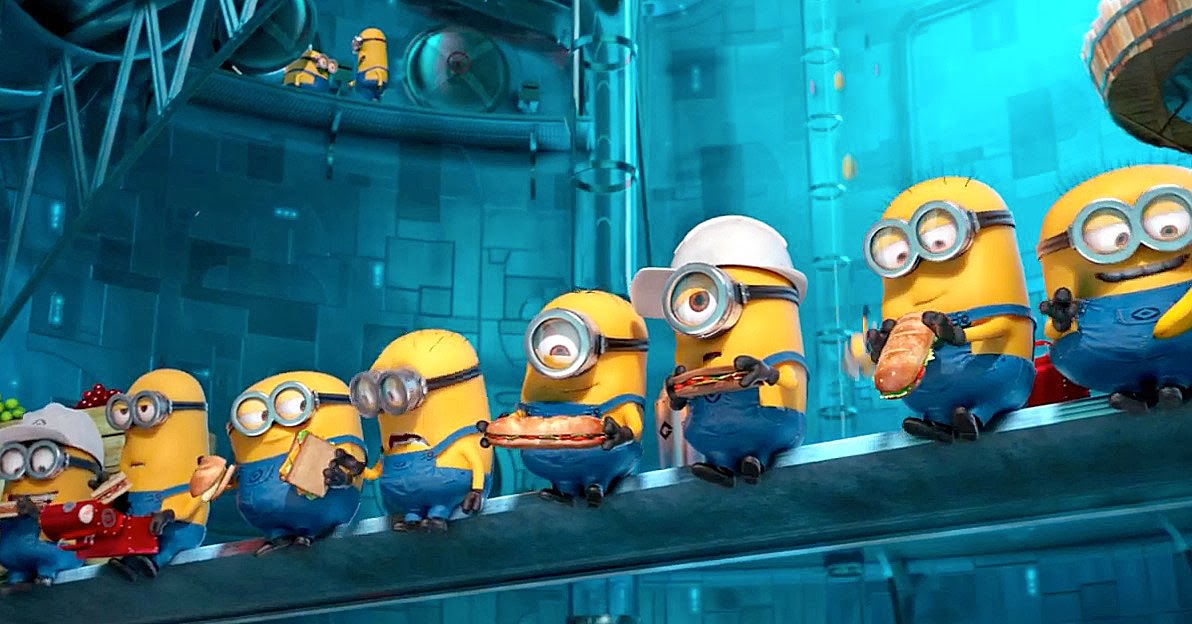
 
In this truly second Golden Age of Animation, major stars voicing in animated features have become a given, and several have expressed their pleasure for getting paid so well for the use of their voice talents. Despicable Me 2 is trendy in that respect, featuring the voices of Steve Carell, Kristen Wiig, Benjamin Bratt, Russell Brand, and Ken Jeong. Their names are highly touted in movie ads, hooking patrons to see the film. 


The plot of DM2, taking up pretty much where the first movie ended, follows the Anti-Villain League as it tries to find who stole a lab, using a giant magnet (!), which contains a dangerous chemical compound that morphs living things into indestructible monsters. AVL agent Lucy Wilde (voiced by Kristen Wiig) is on the case, and enlists former villain but still super genius Gru (Steve Carell) to join her in the hunt. But Gru is into fatherhood, even dressing up as a fairy princess for his three kids. 
 
Gru relents, and the ensuing chase includes bouts with TNT, an active volcano, a wig store, a Mexican restaurant, a giant shark, and dealing with his oldest daughter’s new boyfriend. The boyfriend might be connected to El Macho (Benjamin Britt), who is an AVL suspect. Factor in visual jokes via the hundreds of minions being experimented upon with the evil chemical, and fun ensues. In fact, it is fun for the entire family, a rarity in Hollywood movies these days.
 
If you can see Despicable Me 2 in 3-D, do so. Particularly during the clever closing credits, the three dimensional effects are the best of any movie. Ever.
———-
GRADE on a Scale of A to F: A
——————–
Share:

Unfortunately, ‘The Lone Ranger’ is really Tonto’s variety show

By Steve Crum
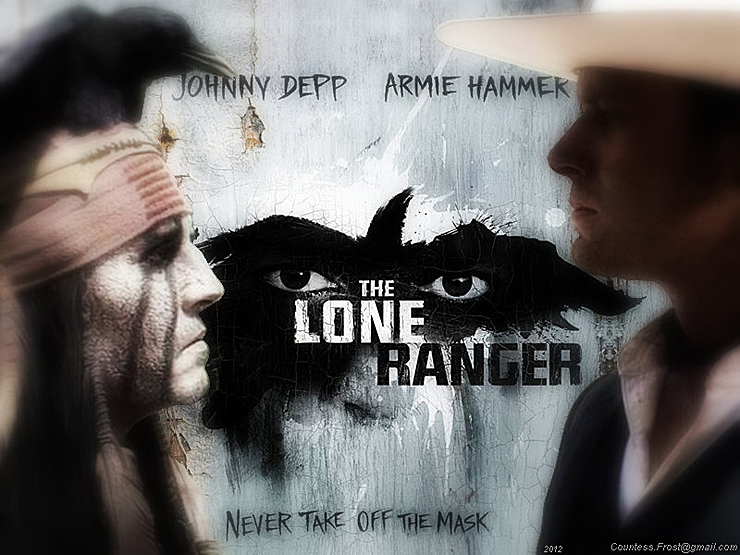

Lone Ranger creators George W. Trendle and Fran Striker are surely doing pinwheels in their respective graves. This new take on the legendary masked man is far from what the radio pioneers had in mind back in 1933. The Lone Ranger (2013, not the 1956 feature film) is an odd mix of parody, homage, and re-imagining of the legend. Tis pity, since just about all the basic elements are present: sidekick Tonto, horses Silver and Scout, the mask, a silver bullet (but only one), bad guy Butch Cavindish, and The Lone Ranger himself. Even the famous theme music,  Rossini’s William Tell Overture, is included big time in the film’s exhausting finale.

The primary reason The Lone Ranger fails is because cohesiveness is missing. Written by Justin Haythe, Ted Elliott, and Terry Rossio, the story plays out like three drafts meshed together. The marketing strategy was obviously to please three targets: elderly Lone Ranger fans, pre-teens who have never heard of The Lone Ranger, and hard core action movie fans. As for the latter, the head outlaw cuts out and eats the heart of one of his victims! Why has Butch Cavendish (William Fichtner) become Hannibal Lector? 

God knows there have been endless send-ups of The Lone Ranger, including Lenny Bruce’s famous routine, Thank You, Masked Man, which was even made into an animated short. Stan Freberg satirized the Ranger on radio and record, turning him into a psychiatrist on horseback, The Lone Analyst. Pronto was his sidekick. Freberg even hired the “real” Lone Ranger and Tonto, Clayton Moore and Jay Silverheels, to appear fully costumed in a pizza commercial: “Hi-o, pizza rolls!” After a dud revival movie, 1981’s The Legend of the Lone Ranger, how could the Ranger be salvaged in 2013?

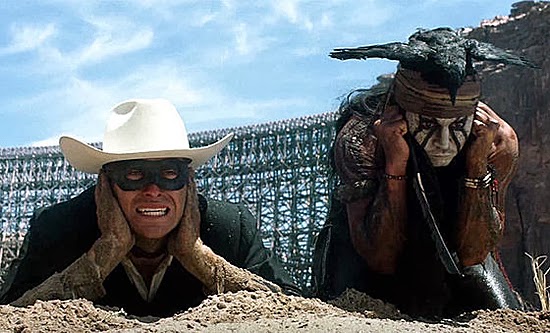
Disney Studios hired Pirates of the Caribbean director Gore Verbinski to fashion this Lone into a makeshift Pirates movie,   substituting trains for ships, and starring Captain Jack himself, Johnny Depp, as what used to be The Lone Ranger’s sidekick. However, in this bastardized version, Tonto is the star and the masked man is his sidekick. Depp’s Tonto is definitely the reason to see this movie, from his quirky, mystical silliness to his elaborate Native American war paint and dead crow head gear to his obviously superior intelligence. The Lone Ranger aka John Reid (Armie Hammer) is characterized as a half-witted, cowardly, Eastern dweeb. His only save is that he has traveled West to practice law and visit his brother, a truly heroic Texas Ranger. Hammer plays the role the best anyone could, that of a drab, one dimensional character. 
I do need to sandwich in a couple of actors whose roles call for flamboyance, and they succeed fabulously. One is the always watchable Tom Wilkinson as a seething railroad bad guy, and the other is Helena Bonham Carter’s saloon owner, Reed Harrington. Her role is definitely one Striker and Trendle could and would never have created. Not only does she dress like the madam she is, she sports a pistol firing mechanism at the base of her false, porcelain leg. Just another goody for the kids in the audience.


At the outset, Tonto’s disdain for his future saddle pal includes him dragging a wounded Reid across the prairie, and through horse dung. It is Tonto who opens the film, come to life in Night at the Museum fashion, in a San Francisco museum, circa 1933. His skin looking akin to Jack Crabb’s in Little Big Man, Tonto becomes storyteller to a young Lone Ranger fan, who is a museum patron. In flashback, we learn how Tonto met John Reid in 1879 after saving him when he, his brother, and a band of Texas Rangers are left for dead after being ambushed by the Butch Cavindish gang. The huge rewrite here is that Tonto reluctantly rescues Reid. Mentoring Reid by teaching him to ride and shoot was never remotely in his plan. Incidentally, the great horse Silver miraculously appears in the desert when John Reid needs transportation. Even Silver has more savvy than Reid/Ranger, and certainly more sense of humor. Tonto refers to the steed as a “spirit horse.” 

For 80 years, the legendary Lone Ranger has endured pop culture, and much of that is debunked during this nearly two and a half hours of misguided storytelling. Much like Silver’s sudden appearance, The Lone Ranger himself undergoes a miraculous transformation via the visually stunning finale. All of a sudden, he and Tonto work as a team; the Ranger rides the great horse Silver across the top of a speeding train; and all his pistol shots are bullseyes. Without explanation, via Tonto’s sage recollection, a superhero of the Old West is born. Clark Kent indeed becomes Superman, per se. 


Hollywood has already done its hack job, rather successfully, on Sherlock Holmes, making him a kick boxing sleuth. Now it’s the Lone Ranger. Prepare yourself for Armie Hammer as good guy spy Illya Kuryakin in next year’s The Man From U.N.C.L.E., based on the TV series. Henry Cavill, currently playing Superman in The Man of Steel (another hero reworking), will star as Napoleon Solo. 

It seems everything old is new again, but not nearly as entertaining. 
———-
GRADE on a Scale of A to F: C-
——————–

Is The Lone Ranger really depicted as a wimpy idiot in this movie? The answer is in this trailer: https://www.youtube.com/watch?v=JjFsNSoDZK8

Compare it with the trailer to 1956’s The Lone Ranger: https://www.youtube.com/watch?v=mjQPxtMv3vY
Share:

F-bombing, raucous Melissa McCarthy dominates ‘The Heat’


By Steve Crum
 
Were funny man Steve Allen still alive, what would he think of Melissa McCarthy? Two of Allen’s best selling books analyzed comedians, and his last book, Vulgarians at the Gate, blasted the deterioration of comedy and the mass media overall due to…well, vulgarity. In the 12 years since that book was published, foul language has become commonplace on TV and in movies. Just what Allen feared.
 

The Heat, starring Melissa McCarthy and Sandra Bullock as law enforcement buddies, is McCarthy at her bawdiest. The f-bomb isn’t just used, it is part of McCarthy’s character’s breathing process. Frankly, after the 38th f-you, it had gone beyond boring. The word itself is used an incredible 190 times, so put that in your Guiness Book. Yet there were many at the screening–puzzlingly, mostly women–who howled with laughter each and every time McCarthy blasted profane. 

 
Katie Dippold’s cop buddy movie plot is saved only by director Paul Feig’s choice to let McCarthy veer from her lines to improvise, which is her forte. That the improvisations tend to build in crassness is also her forte. They sound spontaneous because they are, making Melissa McCarthy the Robin Williams of the potty mouth set. She’s not as outright sleazy as standup Lisa Lampanelli, but she reaches. Feig undoubtedly knew McCarthy’s manic schtick talent before he directed her in Bridesmaids. Her penchant for pratfalls is unique among female comics, reminiscent of rotund comics Chris Farley and Fatty Arbuckle.
 
So goes The Heat, in which McCarthy’s bar fighting and wrestling with seedy bad guys are punctuated by endless f-bombings. McCarthy portrays Boston undercover Detective Shannon Mullins, whose daily regimen includes stakeouts and takedowns of local drug pushers. FBI Agent Sarah Ashburn (Sandra Bullock) is tracking an elusive Russian drug lord centered in Boston, so the two law enforcers are teamed up. The impetus of the story is that Ashburn and Mullins are total opposites in style and personality. 
 
Ashburn is straight laced and by the book. Her arrogance and showboating have made fellow agents avoid her as a friend or colleague. She is bucking for promotion to head of her division, but even her soon departing boss cannot stand her braggadocio. “No wonder she’s single,” an agent tells another. Her existence is a mundane private life without any close friends. 
 
Then there is Officer Mullins, who is raucous, instinctive, and bullies her suspects. She is so macho she snacks on large, red peppers. Well known and respected in her community, Mullins is pretty much out of control down at her precinct. She has little respect for her captain. In fact, a scene inside the captain’s office develops into Mullins’ tirade about the size of his testicles…shouted in a lengthy McCarthy riff that is shamelessly hilarious. Yes, I laughed. 
 
It becomes clear why Detective Mullins acts the way she does. Her large family behaves the same way. We first see them gathered around the dining room table, cursing, shouting, and punching each other. 


From the get-go, Mullins and Ashburn despise each other. I will not divulge their relationship at film’s end. If you’ve seen other buddy cop movies, you will predict the conclusion as I did. 
 
Did I mention the movie’s gangster rap soundtrack, heavy on f-bombs? Consider it mentioned.


———-
GRADE on a Scale of A to F: D+
——————–
Share: