
Miklos Rozsa, ‘Dragnet’ & a ‘dumb-de-dumb-dumb’ mistake
By Steve Crum

 THIS was the city. Los Angeles, California. Home of movies, TV, and the people who make them. Sometimes they break laws, by mistake or on purpose. That’s part of my job: report them.
 My name’s not Friday. I’m not a cop. These are just the facts, ma’am…
In 1954, composer Walter Schumann (1913-58) won the first Emmy ever awarded to a composer for original television music. It was for his memorable theme to the popular cop series, Dragnet, which was created and produced by Jack Webb (pictured at left), and starred Webb as Sgt. Joe Friday. Dragnet had begun on radio in 1949 (running until 1957), and segued into TV (1951-58) in its first of several versions.
The “dum-de-dum-dum” theme was so familiar and popular that satirist Stan Freberg sold millions of records in 1951 using the theme in his comedy take-off, St. George and the Dragonet. Ray Anthony’s jazz version of the Dragnet theme was another best seller in 1953. The four “dum” notes even made the cover of Time Magazine in March, 1954, along with Jack Webb’s photo.
The Dragnet music would be Schumann’s musical legacy, even though he scored the cult classic thriller, Night of the Hunter, and fronted his own choral group, The Voices of Walter Schumann, on several albums.
All was rosy-cozy, except for Rozsa, Miklos Rozsa.

Miklos Rozsa (1907-95) wrote numerous film scores throughout the golden years of Hollywood and beyond. The Hungarian-born, award winning composer wrote stunning music for Ben-Hur, Spellbound, A Double Life, and Madame Bovary, among dozens more from 1936-82. No one was more stunned, however, than Walter Schumann when he was served papers by Rozsa’s lawyers for allegedly stealing the Dragnet “dum-de-dum-dum” notes from Miklos Rozsa.
Schumann was accused of plagiarism and copyright infringement, the claim being the Dragnet four-note motif was lifted from Rozsa’s score of The Killers (1946). Both Schumann and his orchestrator, Nathan Scott, plead that the similarity was totally unintentional. In other words, the four famous notes were accidentally, subconsciously borrowed. Schumann’s lawyers counter-claimed that Rozsa had lifted his notes from both Dvorak and Brahms.
That counter-claim went nowhere. However, the two composers agreed to settle the “dum-de-dum-dum” issue out of court for $100 thousand (to Rozsa), plus a 50-50 split between Schumann and Rozsa of future Dragnet theme royalties.

It was the closest Miklos Rozsa came to scoring a TV show or series.
This has (not) been a Mark VII Production. Fade out.
——————–
Stage Disruptions, starring Jackman, Rathbone & Jolson

By Steve Crum
Last week, Hugh Jackman stopped his on-stage dialogue with co-star Daniel Craig during a performance of their Broadway show, A Steady Rain, as an air headed audience member’s cell phone rang–and continued to ring. Breaking character, Jackman faced the guilty party from stage and asked, “You want to get that?” The waiting Jackman paced; Craig patiently sat; and the phone rang for another minute. “Come on,” Jackman pleaded, “just turn it off.” Finally the cell ceased, and Jackman got back into character and his lines.
Audience rudeness and disruptions have plagued live theater, and movie theaters, for that matter, long before cell phones. Ticket holders’ talking to each other during a performance is common. Sometimes it escalates to arguing and beyond, like the time I witnessed two burly guys literally fighting over a front row seat at the premiere of The Godfather movie at the old Empire Theater in Kansas City. The movie had begun, and Marlon Brando’s mafioso seemed to be looking down on these two Neanderthals. Life imitates art.
 Pat Hunt, a good friend and former teaching colleague, tells a great audience rudeness story involving Basil Rathbone when he performed at The University of Kansas. Rathbone is forever remembered for his starring role in many Sherlock Holmes movies as well as his dueling villainy versus Errol Flynn’s title hero in The Adventures of Robin Hood.
 “I was a student at KU,” she says, “so the performance was in the early sixties, 1961-64. It was at the big auditorium at KU. It was a one-man performance; he (Rathbone) performed a selection of soliloquies from Shakespeare. As I recall, he had begun Romeo’s speech at the beginning of the balcony scene.
“After one or two lines, a baby began to cry loudly from somewhere in the upper balcony. He froze, turned to face the audience, and in his inimical rich baritone, commanded loudly and firmly, ‘Remove that baby at once!’ The audience, after a stunned silence, applauded. He didn’t move until he apparently saw that the child had been taken out, and the audience was silent again. Then he turned, and began the speech again. I was mightily impressed and thankful that it wasn’t I who had brought the child to the theater that night.”
 Some 50 years before the Rathbone escapade, in 1915, Al Jolson told a Kansas City Star reporter about losing composure with his audience. The great entertainer Jolson, in town for his touring show, Dancing Around, is quoted from “No Joke On the City Now,” published Oct. 6, 1915:
“You know, I think I’m developing a temperament,” said Jolson. “Honest I do. It used to be they could unload a ton of scrap iron back stage when I was working and I’d shout a little louder to drown the noise and never mind it. I thought I was good then. The other night a man came in late, and when I saw him coming down the aisle it sent me up in the air. I almost blew up. If that isn’t temperament, what is it?” This comes from an egoist who, legend says, never played to an empty seat throughout his illustrious career.
Were that Rathbone and Jolson had to deal with cell phones.
——————–
‘Zombieland’ is dead on funny bash
By Steve Crum
 Like vampires, zombies are very fashionable now. That does not mean either linkage to the horror genre is my particular cup of corpuscle. To be honest, I had to drag myself to Zombieland. And, horrors upon hilarity, I laughed throughout it. Chalk it up to the comedy’s rapid pacing, graphics, makeup, actors, and clever writing. In other words, zombie-shuffle the kudos to director Ruben Fleischer and co-writers (and producers) Rhett Reese and Paul Wernick. For all three, Zombieland is their first significant film. They should definitely helm the inevitable sequel.
Set in either a parallel universe or merely a fictional present (it is never clarified), Zombieland first centers on 20-something Columbus (Jesse Eisenberg), who also narrates the story. Immediately, we are introduced to a society in which zombies are the world majority, wandering streets, parking lots, and vacant stores. (Mad Cow Disease is the possible culprit.) Following a grossly violent opening showing zombies attacking and chomping upon innocent human by-walkers and drivers, it is clear Columbus is a survivor by no accident. He really knows his way around the walking dead. His outthinking the enemy takes the form of clever rules to live by, which are boldly flashed on the screen and explained by him at given, zombie peril, moments.
For example, one from Columbus’ book of how to avoid zombies is: “RULE #23, The Double Tap. Always Smash Your Zombie Twice.” As already mentioned, the graphics are a plus, particularly since the rules are displayed in animated fashion during the 20 or so zombie attacks. They are flashed on screen like it is the National Safety Test. It is reminiscent of the silly “BAM” and “CRUNCH” graphics flashed during fight scenes in the old Batman TV series.
Obviously, the rules work. Columbus soon teams with Tallahassee (Woody Harrelson), a fellow human he meets en route to…well, we never really know their destination either. Since the entire world is zombie central, where could they be headed? It is Tallahassee who gives both himself and Columbus the city names, since he feels it best to remain mostly anonymous to each other. After picking up two more humans, immediately labeled Wichita (Emma Stone) and Little Rock (Abigail Breslin), the four venture to anywhere in pursuit of zombie-less trappings. All are loaded with rifles and ammo, which they repeatedly use on zombie after gurgling zombie.

The zombie shootings, hackings, bashings, and general clobberings are certainly violent, but surrealistically. Since zombies by nature are not human anymore, it seems justifiable, if not justifiable homicide, to eliminate them. They are certainly trying to kill and eat any and all humans. Really, knocking off a zombie in Zombieland is emotionally and morally akin to scoring points in a video game or shooting an air rifle to hit bad guys at an arcade.
So much for Zombieland’s plot. There just isn’t much to it, except to hang a half dozen hilariously grim set pieces upon a road movie. I can tell you the four do not get along with each other–at least throughout most of the film. What I cannot divulge is the hands down, funniest bit of the entire flick. All critics were ordered not to say who or what is involved. Just prepare yourself for a delightful surprise, and the film’s real centerpiece. By adhering to the film distributor’s demand not to say anything specific, this also creates an effective hook to get you into the theater. No harm done; you will not be disappointed.
What I can also say is that the four principals, particularly Harrelson and Eisenberg, obviously had a fun time during the filming. In turn, the audience has a great time. A running gag has Tallahassee searching the territory for Twinkies to satisfy his craving.
There must be zombie symbolism linked to this blatant product placement.
——————–
On an A to F Grade Scale: B+
——————–
Beating up on Jay Leno
By Steve Crum
So Jay Leno’s new prime time show is being criticized for being a clone of his old Tonight Show. I’d be surprised if it wasn’t.
 It is a case of not fixing something unless is it broken, and it is more than that. Leno’s late night gig, which he did for *can you believe it* 17 years, was essentially a dupe of what his predecessor, Johnny Carson, did for 30 years. That includes an opening monologue (like Carson, David Letterman, and Conan O’Brien); humorous repartee with the band leader (Letterman and O’Brien do the same); reading funny newspaper items and bloopers; guest interviews from behind a desk (this dates back to Steve Allen); introducing stand-up comedians (done since The Tonight Show’s beginning); and comedy sketches featuring Leno (all predecessors did this too). Even Leno’s Jaywalking was done (under different title) by Steve Allen when he hosted the show. Everything old gets new again.
Steve Allen (from 1954-57 the first Tonight Show host) segued from a daily, live, late night show to a recorded, weekly, prime time hour with a near copycat comedy-variety show. He brought along his orchestra leader, Skitch Henderson. A big difference was his establishment of a comic gang of regulars that included Don Knotts, Louis Nye, and Tom Poston. They performed in what became the centerpiece of Allen’s prime time show: the comedy sketches. Music, particularly jazz, was featured, an Allen mainstay throughout his career. Minus the familiar host desk and guest chairs, his prime time show was pretty much a mirror reflection of his recently departed Tonight Show.
Ernie Kovacs, who alternated with Allen as host on The Tonight Show from 1956-57, changed some things when he went to prime time. His series and specials focused on visual comedy. Gone was the live studio audience, since the visual bits and sketches had to be prerecorded. With him as sketch comedian and occasional singer was Edie Adams, who along the way became his real life wife. Kovacs’ foray into prime time included a couple of comedy enhanced game shows.
Jack Paar’s emotional five years as Tonight Show host, 1957-62, emphasized talk, sometimes serious talk (like his infamous interview with Fidel Castro), along with the music and comedy. When Paar shifted to a weekly hour-long prime time show after leaving Tonight, he brought along his orchestra leader, Jose Melis. Familiar Tonight Show guests like Jonathan Winters, Oscar Levant and Alexander King would occasionally appear. Paar also booked personalities like Billy Graham and Richard Nixon. Outside of the studio audience being much more subdued, Paar’s new show, which again included his opening monologue, was only marginally different from his Tonight job. Oh yes, gone was the host’s desk. He had chairs placed beside each other, like Jay Leno now has.
Johnny Carson neither followed his 30 years on The Tonight Show with a prime time show nor did he even have occasional specials. There were rumors he would do the latter, but it never happened.
 When it was first announced Jay Leno would have an hour long, nightly prime time show, I was concerned about Leno’s health. Allen and Paar helmed a prime time 60 minutes, with Kovacs settling into a half hour slot. They all stressed over the once a week work load. Sure they had successfully survived the daily grind of late night, but a prime time slot meant stiffer competition and ratings pressure. Steve Allen eventually lost his show to both Ed Sullivan and Maverick.
 Leno is tackling prime time for an hour every single week day. Guests have to be higher profile and bigger budget, and the comedy and music have to be A-1 to compete against the ratings rich drama and reality shows CBS, ABC, Fox and the vast cable wasteland offer. Leno is depending on tried and true comedy like Jaywalking, but yet he is experimenting with newer bits like 10 at 10, and the green car racetrack. His opening crowd high fives, the comedy monologue, and his banter with band leader Kevin Eubanks are comfortable Tonight Show deja vu.

As Jay Leno bounces familiar jokes against his new set’s acoustics, think survival. If he makes it through this TV season in ratings splendor, and I hope he does, Leno just might accomplish what his Tonight Show predecessors failed to do. Undoubtedly this involves sacrificing the few remaining black hairs amongst the silver on his head.
——————-
You ain’t heard nothin’ yet!: When Jolson hit Kansas City
By Steve Crum
AL JOLSON (May 26, 1886 in Lithuania to Oct. 25, 1950) was then and remains now the most talented and idolized singer and comedian of the first half of the Twentieth Century. I could write volumes about the songs he introduced and the impact this man had on show business–and on yours truly, but it would take a blog site unto itself to cover it all.
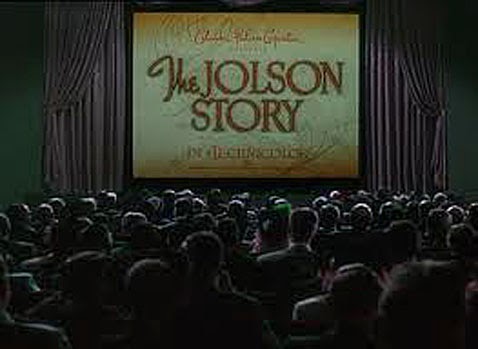 Jolie was the Crosby, the Sinatra, the Elvis, and The Beatles of his day. From 1911-28, his nine Shubert produced Winter Garden shows were all standing room only hits. Jolson had over 80 best selling records during his career. He starred in 16 national and international touring shows. He headlined several top radio shows, and starred in the first successful talking movie, 1927’s The Jazz Singer. A string of Warner Brothers musicals followed. In 1946, Larry Parks portrayed him, lip synching Jolson’s pre-recorded songs, in the blockbuster musical biography, The Jolson Story. Parks played him again, and Jolson did the songs once more, in Jolson Sings Again (1949). Jolson was set to play himself in yet a third film about his life, but died after entertaining our troops during the Korean War, in 1950. His death was front page news worldwide.
From the beginning of the 1900’s through the ’30s, Jolson toured in minstrel shows, vaudeville, and Broadway productions. In fact, he was the first to take his NYC shows on tour, at his insistence. Where would talking pictures, records, and touring stage plays be today without the great Jolson?
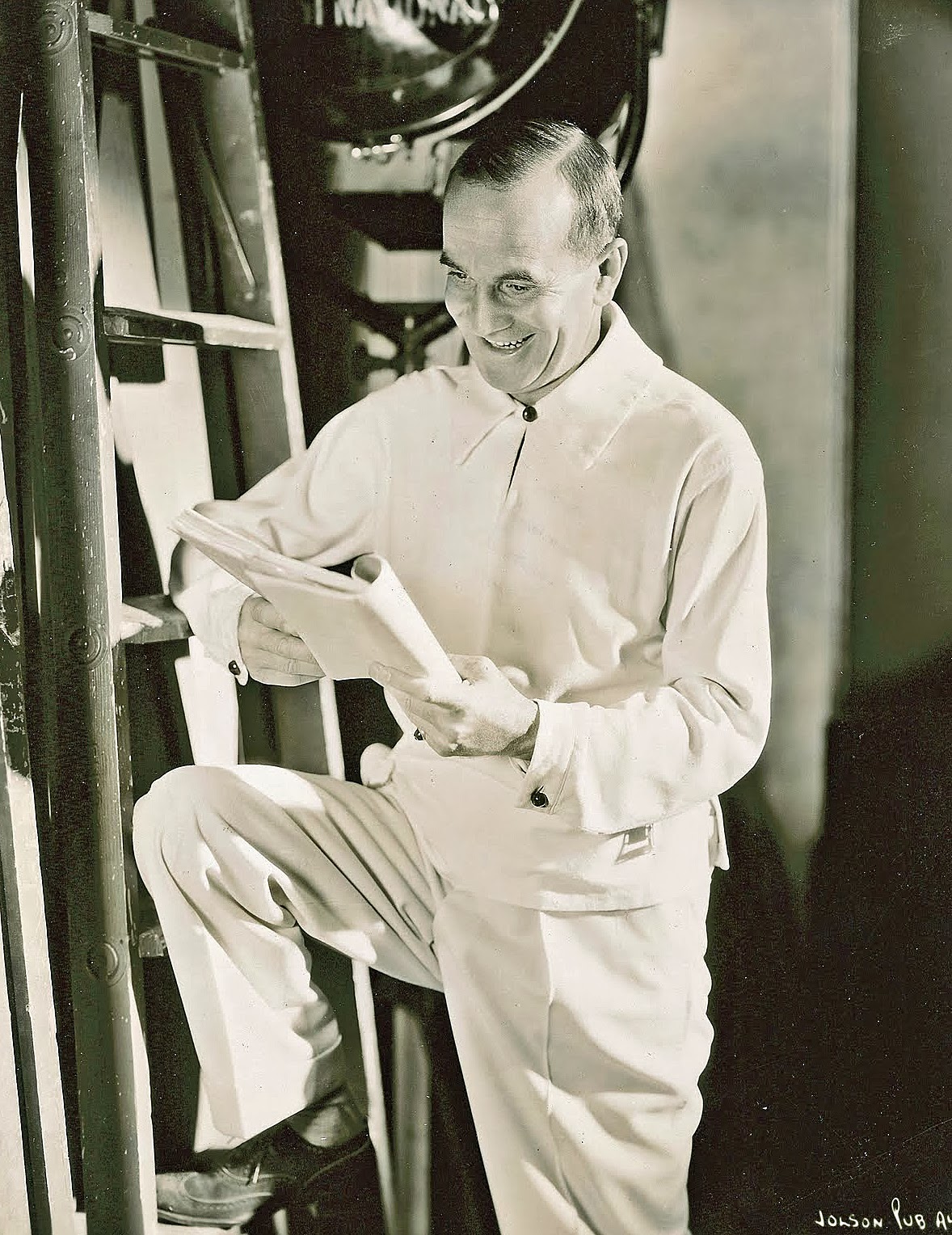 I am in the midst of a labor of true love, compiling text and images I have been working on for some time. After many hours researching Al Jolson’s appearances at the long gone Shubert and Grand Theaters in Kansas City, which I found in the archives of my local newspaper, The Kansas City Star (and Times), I discovered photos, caricatures, reviews, and feature stories covering Jolson’s triumphant performances here. Eventually, my efforts will be featured in an upcoming Jolson Journal, the impressive publication of The International Al Jolson Society http://www.jolson.org/. Following is a preview of my treasures.
 I used a magnifying glass to transcribe what you read here from the original, which is difficult to read due to age. This review of one of Jolie’s hit musicals, Sinbad, was published on Oct. 25, 1920. Jolson was in KC for a week, part of a cross country tour. Since there is no film footage of Jolson actually performing in one of his shows on stage, just reading the description (by an uncredited KC Star reporter) of his performance seems to transport one back nearly 90 years when Jolson was King of Broadway and, as he was billed, The World’s Greatest Entertainer.
——————–
JOLSON AS GOOD AS EVER
Capacity House Welcomed Comedian to Kansas City Last Night
———-
“Sinbad” Won with Its Blackface Star, Its Cast, the Songs, Costumes and Scenery
———-
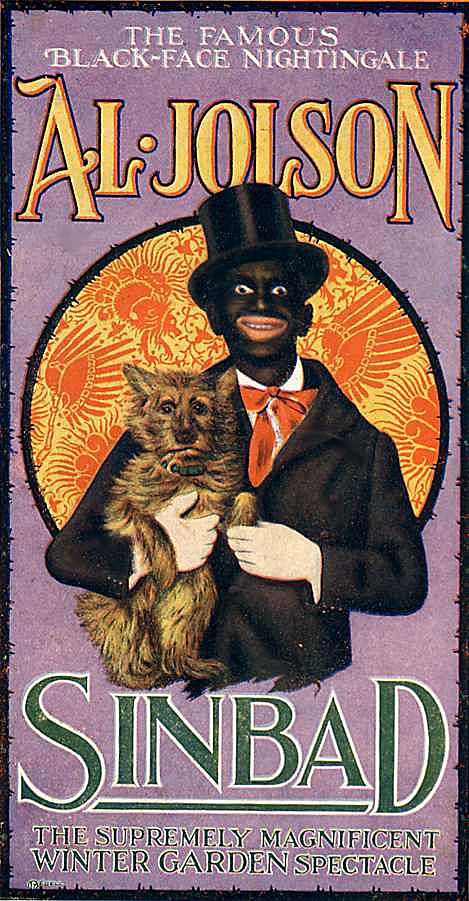 Al Jolson won Kansas City at 10:48 p.m. last night. He had finished singing his last song, “Avalon,” and had walked into the wings, and blonde little Virginia Smith was standing bravely on the runway and trying to lead a chorus through “Hold Me.” The noise the girls struggled against was like the pound of the surf on the beach. It must have awakened the residents in Dodson, Mo.
Jolson strolled back on the stage in a red, black and yellow bathrobe that hit one between the eyes. “This is my last season in this sort of stuff,” he told the audience determinedly. “I’m going to keep acting. I don’t know any other business. But next season I’m going to gratify a lifelong ambition. It’s a crazy wish, but somehow or other I’ve always longed to do it. I’m going to come on stage–on a horse.”
Every seat in the Shubert was taken for Jolson’s opening in “Sinbad” last night, including about five rows of chairs in the rear of the house. It was a Jolson crowd, that was plain from the start. When the comedian, as familiar blackface Gus, came on the stage in the second scene, the performance stopped while he bowed and scraped his appreciation.
“Wait,” he told the orchestra leader, “I want to speak to this audience.” Then, in a surprise aside, he said, “Say, for $3.85 they ought to be spoken to.”
HE SANG–THAT WAS ENOUGH
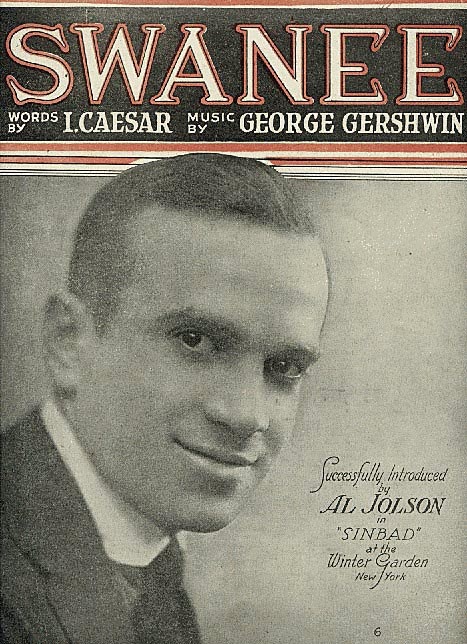 The rest of the evening kept piling up Jolson’s popularity. His first song was “Swanee,” and he had to rely on his old faithful, “You ain’t heard nothing yet,” to still the house when he finished. He got the same results with “That Says It All,” which came near the end of the first act.
His runway monologue, with the usual two songs, came near the close of the performance. The first number was “By the Honeysuckle Vine,” then the talk, which, if it wasn’t pretty extemporaneous, was a masterful piece of acting, then “Avalon.” Then the deluge.
Jolson is the same Al Kansas City knew in “Robinson Crusoe Jr.,” and its predecessors. His comedy seems to have gained and it is delivered so naturally it seems as though Jolson is telling it all to you walking from hole to hole on a golf course, or waiting for the coffee after a good dinner. It is hard to recall former houses almost losing control of themselves as last night’s did when he said, “You have to have a letter from the pope to get into the Muehlebach,” and then described the tea dancers there.
His voice still has the almost prayerful quality he puts into every tone, and he still sings with his mouth, shoulders, arms, hips, legs, feet. He had his own company laughing as hard as the spectators last night, which is the tribute supreme to any actor. In summary, Al still is Al–and there are few entertainers quite like him.
THE PRODUCTION A BIG ONE
 As for the production, “Sinbad” is a massive spectacle, girls, music, beautiful scenes, splendid costumes. It must have cost a lot of money to stage and its salary list also should prove a source of profitable investigation to the income tax collector. There is a thread of plot running through the evening, much more clearly defined than in most similar productions, and the two acts and fourteen scenes unfold picture after picture which please.
Among the noteworthy scenes are a street in Bagdad, the palace of Sinbad, the grotto in the Valley of Diamonds, and the Island of Eternal Youth. Meghans’s leaping hounds, dogs that register 100 per cent as an animal act, raise the house to a high pitch of enthusiasm–even before Jolson appears.
A uniformly good cast is in “Sinbad.” Supporting the star are: [Seven cast names follow that are in smaller print and nearly impossible to read.]
There is a chorus which changes costumes many times and wears tights often. It does its work well. There also is Ma-Belle, a good toe dancer; Wilburt Dunn, a very acceptable partner for her; and Eddie Lynn and William Burns, who dance well with Sue Creighton.
There also is Jolson. Now, speaking of Jolson….
——————–