
Sadistic, yes, but ‘The Girl With the Dragon Tattoo’ delivers suspense, thrills

By Steve Crum
First, no. I have neither seen the already released Swedish versions of The Girl With the Dragon Tattoo series nor have I read Stieg Larsson’s best selling books. But how could I have avoided–even though I was not trying to do so– hearing about the books and the movies? Point made, since you need to to realize the lack of tattoo girl baggage I brought to the screening of this English language adaptation. Director David Fincher has crafted a disturbing dazzler of a thriller, embellished by sharp acting.
Central to the murder-mystery plot, explained ahead, is the complex title heroine, Lisbeth Salander, brilliantly portrayed by Rooney Mara. Salander is indeed a girl just turning legal age, whose dark features accentuate her goth clothing, facial piercing, and demeanor. Tattoos decorate her body, including a large dragon. As the story progresses, we know Salander is far more than a loner with dubious sexuality and limited intellect.
 Daniel Craig plays the driven writer/researcher (“financial reporter” is his official designation) Mikael Blomkvist. Looking for work after losing his job in a libel scandal, Blomkvist is hired by wealthy Swedish industrialist, Henrik Vanger (Christopher Plummer). Journeying to a remote village on the Swedish coast, Blomkvist is initially surprised Vanger wants him to solve a cold case murder of his niece, Harriet. Missing for 40 years, she is assumed to be dead since her body was never found. Vanger believes she was murdered by one of his relatives who live nearby. Interestingly, his family members are pretty much estranged from each other, yet live in separate houses within walking distance.
 Agreeing to accept what is a private eye’s job, Blomkvist chooses the unlikely Lisbeth Salander as his assistant/researcher. The irony is that Salander is an employee for the security firm that helped ruin Blomkvist’s previous career. Nonetheless, she impresses Blomkvist with her unusual investigative methods. She is likewise impressed with him, and the challenge to solve a possible murder. Her drive, memory skills and high IQ prove invaluable. Still, Lisbeth’s motorcycle riding, black leather persona symbolizes a life of mistrust and pain. As both Blomkvist and Salander delve into Vanger Family history, it is apparent this family has its own demons, including multiple murders.
 While the murder mystery itself is involving, there is a disturbing side-story regarding Lisbeth’s financial status, and her legal guardianship. Circumstances have placed her under the legal power of a sleaze who demands sexual favors from her so she can receive minimal money for food. It turns out he is not only sleazy, but brutal. Without specifying and revealing too much, just realize Lisbeth is a lethal force unto herself. I could not help comparing her to the Kalinda character in TV’s The Good Wife. Kalinda Sharma, played by Archie Panjabi, works as an investigator for a law firm, and will do virtually anything to get what she needs, professionally and personally. While they are kindred spirits, it is Lisbeth who possesses the cutthroat DNA.
Speaking of violence, there are heaps of it, including with sadism, rape and torture, in TGWTDT. It continues to amaze and (truthfully) disturb me that studios choose to release violent, exploitive, R-rated films during the season of good will toward men. But, a dollar is a dollar, and apparently justification enough.
Artistically, TGWTDT boasts fine photography (Jeff Cronenweth), particularly of snowy, Swedish landscapes; and interiors by production designer Donald Graham Burt. The unusual yet memorable score is by Trent Reznor and Atticus Ross.
No doubt that the American film version of the next book, The Girl Who Played With Fire, is planned.
———-
GRADE On an A to F Scale: A-
——————–
——————–
‘Tower Heist’ provides laughs, cliffhanger thrills

By Steve Crum
Multiple choice test. Spot the heist movie: (a) The Anderson Tapes (b) Topkapi (c) The Day They Robbed the Bank of England (d) The Italian Job (e) Oceans 11. Answer: The whole lot. Two of them, Topkapi and Oceans 11 (the original, and its remake and sequels) include comedy elements. Now comes the blatantly named Tower Heist, which is played for broad laughs, including Harold Lloyd-like, hanging from building shtick.
The screenplay, written by Ted Griffin and Jeff Nathanson, has about a relevant center as one can get. Decades ago, it would have been advertised with “torn from the front pages” hyperbole, since it concerns an ultra wealthy investment titan, Arthur Shaw (played with oozing sleaze by Alan Alda), who has ripped off $2 billion from trusting investors. No mistake that his character is based on the infamous Bernie Madoff.
Shaw resides in the top floor suite of NYC’s most luxurious hotel, simply called The Tower. (Consider the hotel an actor unto itself since it is really Trump Tower.) Opening scenes establish that Shaw is extremely friendly with and very dependent upon the hotel’s manager, Josh Kovaks (Ben Stiller). who seems to know the nuances of each and every resident and employee. Ultra efficient is he.
 Shaw is so wealthy that he keeps his gleaming red, prized possession, a 1953 Ferrari once owned by Steve McQueen, parked in his living room. How did he get it there? It is logical, as explained in the film. I won’t spoil it.
 It is when Stiller’s Kovaks finds out Shaw has absconded with the pensions of virtually all the hotel’s staff that the revenge-based plot ensues. This occurs after Shaw has been put under house arrest, pending trial, for the $2 billion charge. Kovaks is soon fired, along with other staffers, for harming Shaw’s prized car. A plan hatches, spurred by retaliation and reimbursement. Kovaks and associates will steal the millions reputedly hidden in Shaw’s apartment, and redistribute the wealth to Shaw’s hotel victims.
The motley recruits for the caper include Charlie (Casey Affleck), destitute ex-Wall Street broker Mr. Fitzhugh (Matthew Broderick), bellhop Dev’Reaux (Michael Pena), and man-hunting bachelorette Odessa (Gabourey Sidibe). Tea Leoni’s FBI agent, Claire Denham, provides both love interest and caper roadblock for Kovaks. The acting, and laughs, are well distributed and handled among the ensemble. Then there is Slide, played by Eddie Murphy, a petty crook bailed out of jail by Kovaks to teach the amateurs the fine art of gangsterdom.
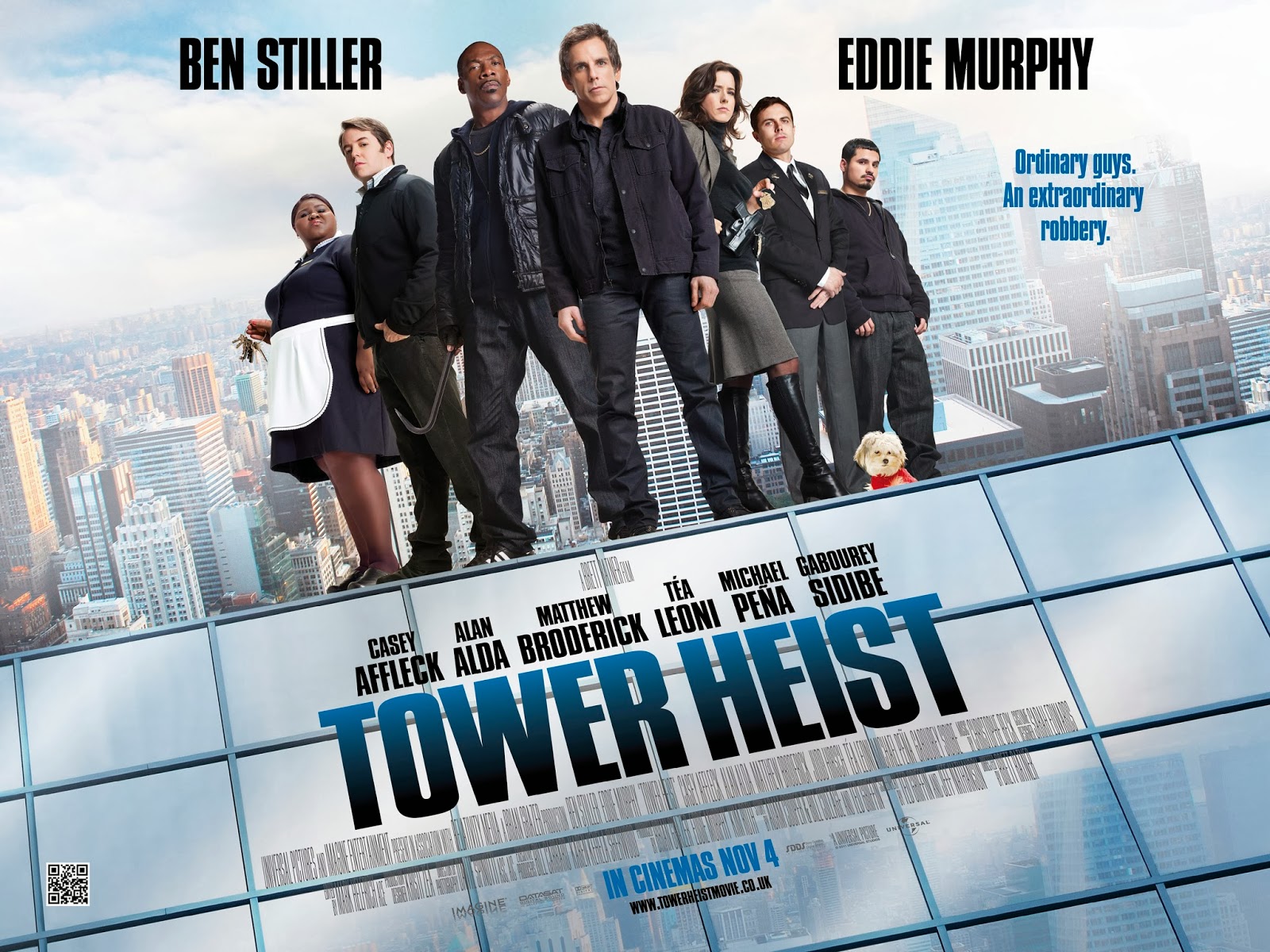 As for this being Eddie Murphy’s great comeback movie, think again. Think about the fact Murphy has hardly been away long enough for any supposed comeback. His Shrek Donkey persona, via voice, has kept Murphy’s comedy going nonstop, in sequel after sequel. Just consider his Tower Heist role as his voice reconnected with human body. The delivery, and frequently crude cracks, are essentially Donkey-alike. “Look at her big ass….eww, but she has a big ass!” Maybe Donkey-like IS appropriate here.
 Really, Eddie Murphy fits perfectly within the Tower ensemble, much like he does within his Shrek crowd. Even though he is billed under Ben Stiller as lead actor, his role is more supporting than star. Stiller is the film’s true anchor. No doubt Murphy’s reputation (and agent) demanded the spotlight.
The production overall is breezy and fun, with a nonstop pace after the first half hour. That is when the action really kicks in. The on location filming, particularly Trump Tower and the Macy’s Thanksgiving Parade, is superb. The cliffhanging sequences from the top of the building will cause anyone with acrophobia (like I suffer) to frequently avert the eyes. Director Brett Ratner (Rush Hour) is adept at such screen thrills. He also does fine by a solid, funny cast.
GRADE On an A-F Scale: B
——————–
——————–
Farewell, Steverino
[Published 11 years ago, Nov. 3, 2000, in The Kansas City Kansan, regarding Steve Allen’s death]
By Steve Crum
 Death of an icon. The passing of a show business pioneer. Cliché headlines that are true in this case. As I sit here Tuesday afternoon, two hours after hearing of Steve Allen’s death, I am stunned.
Friends have called, leaving messages of his sudden death that occurred Oct. 30, the day before I write this. According to the Allen family’s official statement, he was “at the home of his youngest son, Bill, in Encino, California. Mr. Allen was resting after a visit with four of his 12 grandchildren when he lost consciousness and died of an apparent heart attack.”
Steve Allen was about a month away from his 79th birthday.
Press reports got the story mostly right, even though half the TV and newspaper blurbs incorrectly said he had died Oct. 31. Six different media sources that I read and heard (including the three major TV networks) said that Allen had written 4,000 songs in his career. This is true, but not all the truth. He actually had over 8,500 original songs published, which garnered him the Guinness Book distinction as “the most prolific composer of all time.”
 I was well aware of the media errors, because I have made it my business to know Steve Allen. He is the person about whom I have said from my youth I would most like to emulate. The majority of wit and humor I have been accused of possessing is traceable to Allen. Maybe all of it. Because of him, I sneaked late night TV viewings from as far back as grade school in the late 1950’s. He exposed me to humor–purely zany, wonderfully ridiculous, infectious and inventive. I was a member of his comedy club of which there were millions more like me, inclusive of all ages. It was a vicarious experience, of course, but with me were Tom Poston, Louis Nye, Don Knotts, Gabe Dell, and Dayton Allen.
 And it was a party time full of laughter and camaraderie. The skits were clever with characterizations as defined as Nye’s Gordon Hathaway (“Hi, ho, Steverino”), Poston’s man on the street who never could recall his name, and Knott’s nervously shaking persona. Steve Allen, the host, was always the joyful ringleader. He laughed at his comics, and at himself. His was a high-pitched blast of a laugh that some have labeled a cackle. But it was more like an amplified, uncontrollable giggle–and America loved to hear it. That is because it was a spontaneous happening triggered by someone’s wig slipping or a piece of scenery falling or a wild double take. Not only was Allen’s laugh in itself funny, his reaction also abetted the overall hilarity.
I shall not try to repeat what the media has already said this week regarding Allen’s show business credentials. In fact, I devoted two consecutive columns weeks ago to his accomplishments. That was after I spent three days in Allen’s presence during his Lawrence-to-Iola, Kansas tour in conjunction with the annual Buster Keaton Celebration held at the end of September. (Allen performed at Lied Center in Lawrence and was special guest speaker at the Keaton affair.)
 Saying at the time that it would probably be the last time I would ever get to see Steve Allen in person (I had interviewed him in 1964 as a Wyandotte High School Pantograph reporter), I meant it in a proximity sense, since Allen resided on the West Coast. Allen and his wife Jayne still did limited touring with a romantic play, and Allen himself performed various one-nighters–like the one he did in Lawrence. There he reminisced, played the piano, sang some of his great songs like This Could Be the Start of Something Big, and relaxed on an on-stage couch commenting on clips shown from his six decades on TV and the movies.
 In Iola, I sat a seat behind Allen as he and a packed auditorium watched Buster Keaton’s 1924 classic, Sherlock Jr. Allen suppressed his famous giggle, but he chuckled constantly. Afterwards he admitted he had never seen this Keaton film, and felt it was “way ahead of its time in humor and film technique.” He even asked for a video copy to take home to show his grandchildren. He got his wish.
Steve Allen was always a great social observer and lover of language. At least half of his 50-plus books deal with such subject matter. No doubt that is why he became so adamant a supporter for cleaning up what he considers the film filth and moral decay promoted through the entertainment industry. The Parents for Television Council, led by spokesman Allen, feel that the media is “leading children down a moral sewer.” It was Allen’s passion that his cause would change our lives and our children’s lives for the better.
Now he is gone, but his reform movement not only survives but flourishes, thanks in huge part to him. We also have late night talk shows because of him, as well as his music, recordings, books, and memories.
 Oh, those great TV shows with you, Mr. Allen: The Tonight Show, the men on that street, the angry letters to the editor, The Question Man, the ad libs, The Gravy Waltz, Vine Street, the Be-Bop Fables, a Hebrew National Salami, What is a Freem?, Meeting of the Minds, Andy Williams, Steve Lawrence and Eydie Gorme, on opposite Johnny Carson, earlier up against Ed Sullivan, your great love of jazz.
 And your great love of life that you shared with me and the world, Steverino.
——————–
Addendum: In Iola, I asked Steve Allen about his daily regimen. Allen replied, “My daily regimen? It’s easy. I just get up at the crack of dawn, stuff up the crack, and climb back into bed.”
——————–
‘Real Steel’ needs more grit, less melodrama

By Steve Crum
Real Steel could have been, should have been much more. Based on Richard Matheson’s 1956 short story and his gritty 1964 Twilight Zone TV episode, Steel (starring Lee Marvin), Real Steel is neither gritty nor classic. Instead, it succeeds as a sort of Family Channel robot bonding tale, in some ways a live action Iron Giant. Such is far from my expectations.
Director Shawn Levy (Night at the Museum) and screenwriter John Gatins have circumvented Matheson’s original premise of a down and out boxer who literally climbs inside his robot boxer for a desperately needed final victory. In this reboot (or re-robot), the focus is on both Charlie Kenton (Hugh Jackman) and his estranged, 11 year-old son, Max (Dakota Goyo). Sure, there are various robots along the way, and they look cool while performing spectacularly. As one robot after another is beaten into scrap iron, from Ambush (who fights live bulls at rodeos) to the flashy import Noisy Boy, Charlie’s great metal hope is accidentally discovered mostly buried at a metal parts junkyard. Soon after named Atom, the robot has a literal hand in saving Max’s life. The boy is immediately smitten with Atom, and proceeds to rebuild and recondition the discarded sparring-bot to champion status.

The premise for Real Steel is, nonetheless, fascinating. Set in a future of human-less (and bloodless) boxing matches, robots are the superstars. (Humans still coach, ref, and promote the matches.) Championship bouts are held at the Crash Palace, the Madison Square Garden of tomorrow. It is interesting that, except for the robots and the technology involved in the matches (humans sometimes operate computer control panels to control the robots), the future looks like our present day.
For example, take the impressive opening sequence set in a county fair rodeo arena, which features the robot Ambush tussling with an 800 pound raging bull–not played by De Niro. The set resembles any typical rodeo of today, including screaming fans. As the robot matador tries to clobber the beast into unconsciousness, he/it loses a leg, yet tries to continue fighting, balancing on his good one. The mistake occurs due to trainer Charlie’s neglect at managing Ambush’s remote control on the sidelines. This is the best sequence in the film because of its no frills, bare-boned action. No animals were harmed during the making of this movie, but plenty of robots were.
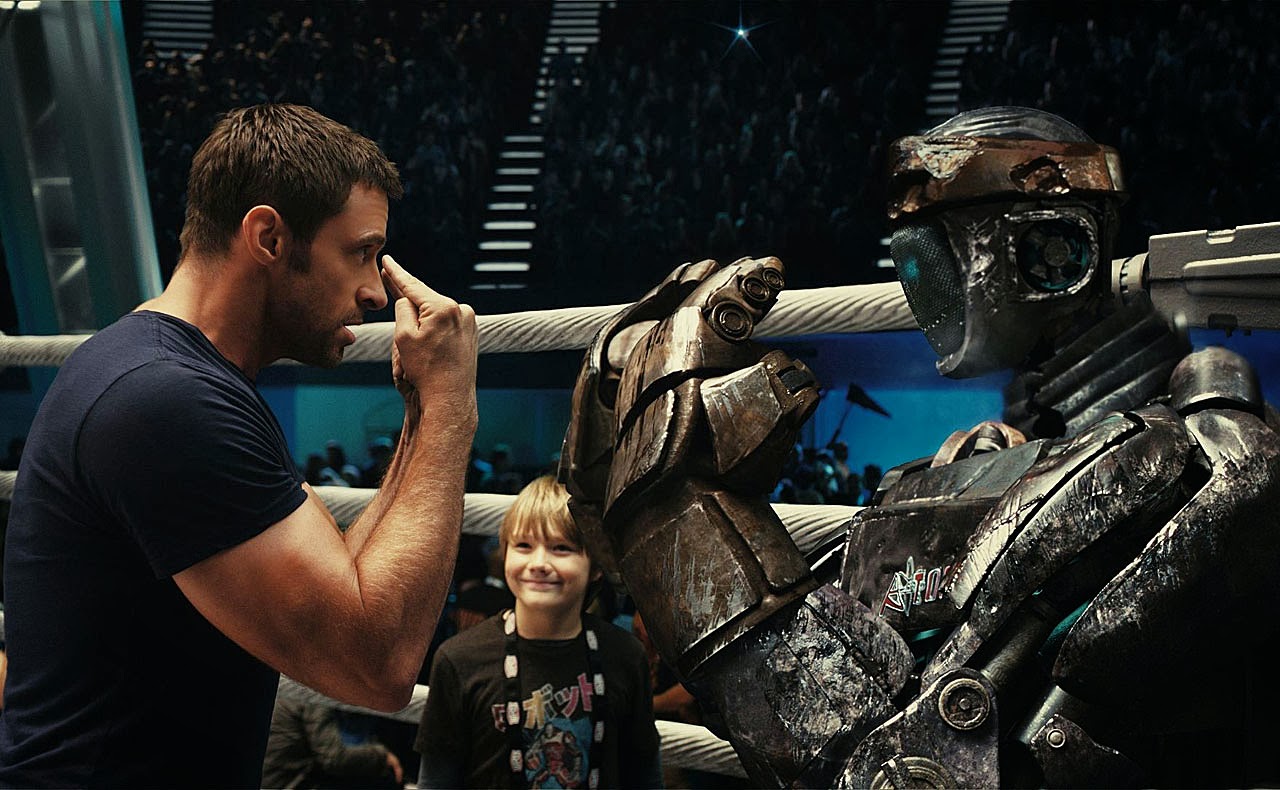 There are sub-plots of Charlie’s wheeling and dealing with bookies and loan sharks (he is over his head for thousands), and his friendship with robot tech Bailey Tallet (Evangeline Lilly). But the crux of the story centers on Charlie and son Max. Via divorce, Max has exclusively lived with his mother. His mother’s sudden death forces Max to either live with his dad (Charlie) or his rich aunt and uncle. At first, Charlie is happy to sign court papers for Max to move in with his ex-wife’s sister, especially since her husband offers Charlie big bucks to legally sign the boy over to them. However, as Max becomes more involved with bot fighting, he and his father grow closer. While the father-son scenes set a positive, moral tone for the film, they are often ponderous, and distract from the core theme of battling robots, and man’s obvious need for violence, even on a simulated basis. This need for violence extends to children aka Max.
 Incidentally, Sugar Ray Leonard supervised the boxing scenes, via professional boxers who were “motion-captured,” computer-wise.
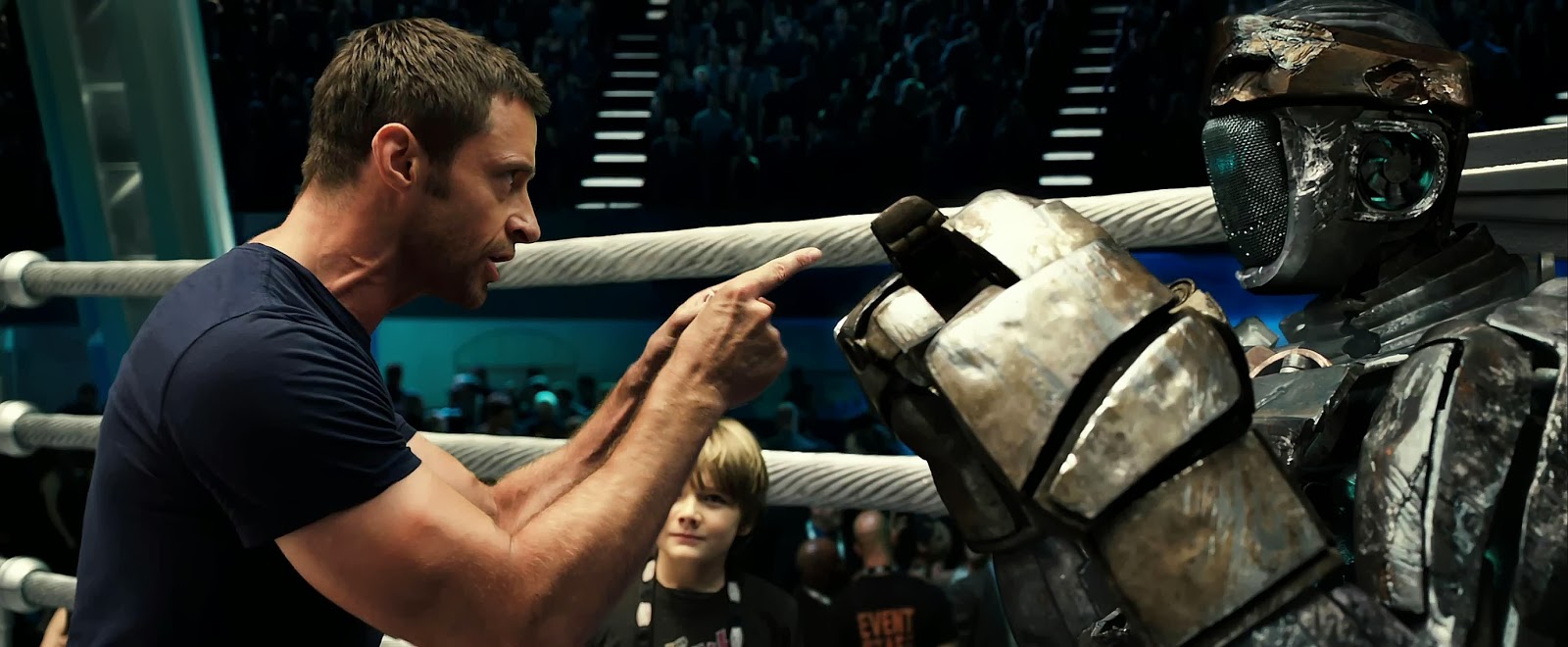 Acting in Real Steel is generally very good, with Jack’s desperate trainer and Goyo’s whiz kid personas particularly impressive. But what one takes from the movie, cutting through all the human family melodrama, are some outstanding robot sequences. After all the Transformers exposure over the last few years, who would have guessed more battling bots would hook our interest? Maybe it is because Real Steel’s bots need humans to think for them.
 ——————–
GRADE on an A-F Scale: B-
——————–
NIGHTMARES for the American Dream Factory/Remembering 9-11

Originally published in The Kansas City Kansan, Sept. 28, 2001
By Steve Crum
The horrific events of Sept. 11 continue to affect every American. What was funny on Sept. 10 is not so funny now. Humor, particularly political satire, instantly fell out of fashion as politicians fast became heroes or, at the very least, harbingers of hope and justice.
The mass media, reflecting an awkward stock market, began playing bear with its entertainment news industries. The mood of a country influences its citizens’ viewing, listening and reading habits, of course.
During the last 17 days, initial shock has given to patriotism and a somber uncertainty. Movie studios, networks and publishers sensed that mood immediately, and acted upon it. No upcoming motion picture was going to be even hinted at as distasteful, unpatriotic or insensitive.
The so-called “dream factory,” always catering to its ticket-buying public (after all, we are talking about a multibillion dollar industry), rushed to edit or re-shoot scenes in a number of films. Soon to be released movie openings were changed–some to next year, some to an undetermined date.
TV shows were likewise handled. A handful of programs slated for a September premiere are on hold until the barometer of viewers’ feelings changes. Add print media to the affected mass. The New Yorker magazine, the long time, slick paper voice of Big Apple culture, appropriately featured a Sept. 24 cover of chilling impact. What appears at first to be a solid black cover (with the title, date and price in bold white across the top), a closer look reveals the silhouette of the twin WTC towers in solid black, set against an ultra dark, purple sky.
Inside, film critic Anthony Lane, in his essay, “This Is Not a Movie,” speaks of mass media’s link with reality. After repeated doses of explosions and catastrophes via motion picture special effects, we were force fed the real thing.
“It was hard to make the switch,” he writes. “The fireball of impact was so precisely as it should be, and the breaking waves of dust that barreled down the avenues were so absurdly recognizable–we have tasted them so frequently in other forms, such as water, flame, and Godzilla’s foot.” Except these were no stunt men. No computer graphics here. “Here,” Lane observes, “as emergency services groped through the black-and-white fallout of the vanished towers, and as color drained from the scene, the horror was new. We could bear to look, and all we did was look.”

The entertainment industry responds: Arnold Schwarzenegger, a man whose career was built on gun blasts and explosions, needs a comeback. Maybe later. The Oct. 5 release of his new flick, Collateral Damage, is now delayed, very likely until 2002. Warners decided the violent plot is ill-timed.
Schwarzenegger plays a fireman whose wife and young son are killed when a Colombian terrorist blows up an American consulate building. He seeks revenge. No question why this was shelved.
Both David Letterman and Jay Leno have stopped political jibes. Bill Maher, host of TV’s Politically Incorrect, was criticized for the very thing about which he is noted: being politically incorrect. After making comments about our government’s past military actions, and saying terrorists who crash into buildings “are anything but cowards,” several sponsors canceled. A you’re-either-with-or-against-the-USA attitude prevails. Maher apologized on air.
 The enjoyable preview for the upcoming movie, Spider-Man, was yanked. In it, which I saw a couple of times, a helicopter full of robbers speeds around a building in Manhattan. Suddenly, a force drags them backwards. The camera pulls back, showing the helicopter caught in a giant spider web that is suspended between the World Trade Center towers. Word is that this scene was shot only for the trailer, so no editing will be necessary in the actual movie.
 Tim Allen’s yet unreleased feature film, Big Trouble, which ends with a nuclear bomb being smuggled into an airport, is on hiatus until next year…or later.
KCPT-19, Kansas City’s public television station, is in the process of re-editing showings of the sketch comedy program, Right Between the Ears. The locally produced show, heard nationally on National Public Radio stations, taped three heralded TV shows this summer. Having not missed a taping of their radio show (from Lawrence’s Liberty Hall) during the last three years, I know that at least half of the funny group’s skits focus on politicians.
Cynthia Smith, former Channel 4 anchor and now a KCPT executive, told me this week that all political jokes are being cut or at least reconsidered. “They are editing the tapes as we speak,” she said.
“And that is not all,” she said. “Channel 19 canceled an episode of its popular kids’ show, Jay Jay, the Jet Plane, because it showed a plane crash.” It would have run at 11 a.m. on September 11.
——————–