
Author: Steve Crum
Arnold suffers damage beyond repair in ‘Collateral Damage’
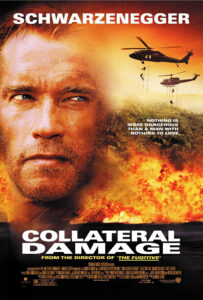 Published Feb. 9 of 2002 in The Kansas City Kansan newspaper, my review speaks unkindly of this Arnold Schwarzenegger flick.
By Steve Crum
It is uncanny timing, this Schwarzenegger movie.
Collateral Damage, which opened yesterday, parallels the Sept. 11, 2001 tragedy in so many ways that it is incredulous to swallow the claim that this movie was in the can PRIOR to the Twin Towers attack. But it was.
Screenwriters David and Peter Griffiths did base their tale on an actual incident—the Pan Am Flight 103 that exploded over Lockerbie, Scotland in 1988. Their wonderment over the reactions of the victims’ relatives is embodied in Arnold Schwarzenegger’s Gordy Brewer.
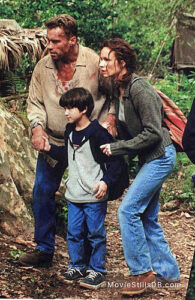
Brewer is a Los Angeles firefighter who, we observe at the film’s opening, is dedicated to his dangerous job as well as his family. Shortly 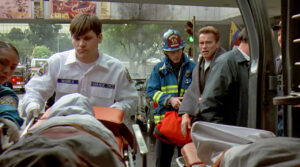 after driving downtown to pick up his wife and young son, he witnesses a bomb explode in a nearby vehicle. Among those killed are his wife and boy. Injured and hospitalized, Brewer soon yanks out his I.V. and barrels onward in revenge mode.
Things occur in rapid progression at this point: Brewer has lined the walls of his living room with giant blowups of Colombian maps…a CIA link has given him info about the head terrorist, known as El Lobo…Brewer has somehow financed (via the Fireman’s Fund?) an armed, one-man trek on foot through the Colombian jungles to find the terrorists’ compound. Brewer not only finds it in quick time, but infiltrates it, is taken prisoner, and befriend the leader’s wife and kid. Think of what he could do in the caves of Afghanistan!
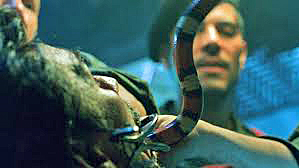 I won’t spoil the fun of Brewer’s further journey through Vengeance Valley, but Arnold fans will see plenty of their hero taking on two, three and more at once, in the process lobbing and igniting an arsenal of explosives.
Incidentally, what other movie in our lifetimes can claim the hideous sequence of a man being force-fed a live, poisonous snake?
I will say this for Arnold, I should look that good when I am 54 years old. What a minute, I AM 54. And I don’t.
Director Andrew Davis has proven himself with The Fugitive that he can do great things with a good script and cast. Unfortunately, this 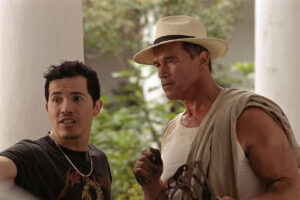 effort is no Fugitive. Even his use of potentially interesting characters disappoints. Extended cameos by gifted actors John Turturro and John Leguizamo are wasted.
As for the similarities between Collateral Damage and the events of Sept. 11, just start with the fireman angle.
“I can be a hero on the screen, but the real heroes are these guys who are there every day, bravely doing their jobs.” So goes Schwarzenegger’s press released comment about firmen—post Sept. 11 words.
And speaking of firefighters, a controversy exists because of Arnold’s persona in the film. Many firemen object to his vengeful-hero depiction. The fact that Gordy Brewster’s character abandons his job, ignoring the helpful pleas of two fellow firemen, probably sparks even more complaints.
 It is widely known that Collateral Damage is the high profile movie that was delayed from release for four months, fearing a backlash due to Sept. 11 public sentiment. In a somewhat cleansing way, Collateral Damage soothes the revenge we have felt as the irritating search for Bin Laden continues. That is because Arnold nabs HIS bad guy within a couple of hours.
What does Collateral Damage have to offer, entertainment-wise? This is an Arnold movie, solidly. The revenge formula has worked for him before in Commando, and he even gets to to bare his rippling pecs a couple of times. Just use brawn over brain in accepting the logical order of events in this film.
Early this week, Schwarzenegger baited the press about his desire to run for public office, possibly Governor of California. Hmm. Married to a Kennedy. A staunch Republican. And now THE timely movie hero, a terrorist-hunting firefighter.
Run that up the flag pole, and watch the salutes.
∞∞∞∞∞
RATING on an A-F scale: D
∞∞∞∞∞
PEGGY LEE: She gave us fever
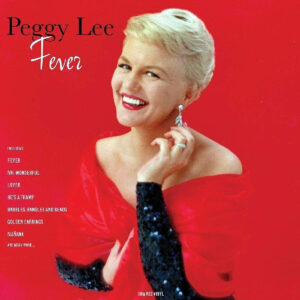 Peggy Lee’s death at 81 on January 21, 2002 prompted my tribute to her. It was published in The Kansas City Kansan on February 2, 2002.
By Steve Crum
When news of Peggy Lee’s death at 81 last week reached me, I was touched in several ways. She was not only a great singer, but a very good actress. Even though she seldom acted in 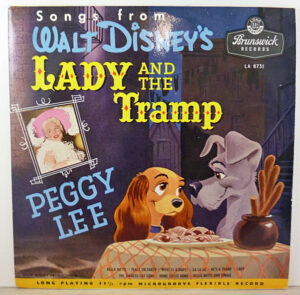 movies, when she did, it was an event. Her supporting role in Jack Webb’s wonderful Pete Kelly’s Blues (1955) brought her a well earned Oscar nomination.
Her movie links include voice work (singing and dialogue) in Walt Disney’s classic animated Lady and the Tramp (1952). Lee also co-wrote the movie’s songs, including “She’s a Tramp” and “We Are Siamese (If You Please).”
Lee made 700 recordings and 79 record albums. Speaking of her song writing abilities, she is credited with having written more than 200 songs, mostly as lyricist. Anyone alive since 1940 will remember some of the other tunes she penned: “It’s a Good Day,” “Mañana” and “I Don’t Know Enough About You.”
Of course, the song that immediately comes to mind when mentioning Peggy Lee is her signature, “Fever.” “Fever” is unique in that her  accompaniment is solely a bass and drum. The arrangement, emphasizing Lee’s bluesy voice, is simply terrific.
Her other hits (“Golden Earrings,” “Big Spender,” “Lover,” “Them There Eyes,” “You’re My Thrill”) hardly compare to my favorite Peggy Lee sound, the unforgettable “Is That All There Is?” When I hear it, I think of a smokey bar in Lake Charles, La., during 1970 when I played it on the joint’s jukebox. It prompted another bourbon and Coke.
∞∞∞∞∞
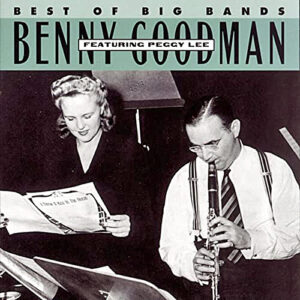 Most people do not realize that Peggy Lee wrote the music for the legendary Joan Crawford western, Johnny Guitar. She also wrote the lyrics to Duke Ellington’s “I’m Gonna Go Fishing” for the 1957 movie, Anatomy of a Murder. Although it was before my time, I have recordings of Lee as a big band singer for Benny Goodman. She was also the weekly singer on Jimmy Durante’s radio program throughout its late 1940s run.
After numerous physical problems, including stroke, broken spine, viral pneumonia, temporary blindness and diabetes, Peggy Lee performed as long as she could. It is reported that during the last few years, when she was bedridden, she loved to paint and grow roses.
She still listened to her favorite music—the sounds of Debussy, Chopin, Ray Charles and Frank Sinatra.
#
‘Black Hawk Down’: Heroics go hardcore
 NOTE: Published in The Kansas City Kansan newspaper, January 18, 2002. At the screening a month earlier, several heroic veterans of the battle were in the audience. We critics got to meet them following the viewing. It was truly a privilege.
By Steve Crum
Based on the actual 1993 Battle of Somalia in Mogadishu, Black Hawk Down stars Pearl Harbor’s Josh Hartnett, as well as Ewan McGregor and Tom Sizemore. This is a movie that when your friends ask, “Who’s 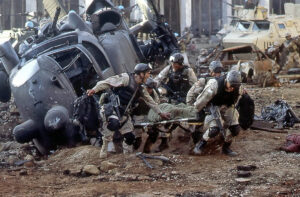 in it?”, you answer, “There are no big stars here, but this is a big movie.”
Superbly directed by Ridley Scott, the film serves as a historical document of tragedy that occurred when U. S. Forces were sent to the region to aid the United Nations in the distribution of food and supplies to literally starving Somalis. Over 300,000 had already starved to death due to local warlords hoarding the food to assume control of the city.
As one Black Hawk helicopter is shot down over the heart of the city—and soon followed by another, the Americans are drawn into an unplanned battle, virtually with the entire city.
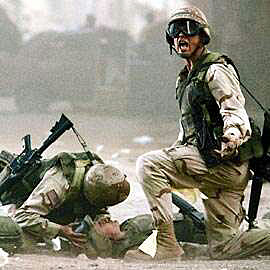 The storyline is segmented, focusing on many strings of happenings: a ranger falls from a copter, and is rescued under fire; a soldier has to reach barehanded into another’s insides to pinch off an artery—and there is no morphine available to cut the pain. A grunt is deafened when a buddy fires too close to his ear. A soldier picks up a fellow soldier’s severed hand, and dutifully stuffs it into his belt pack.
Ridley Scott’s excited camera juts to a rocket screaming toward two soldiers who crouch near a  doorway. And the air is full of battle pollution, looking like volcanic ash, looking like the air images of New York City and the Twin Towers hell.
All the while, the cool-under-fire strategists, safely back at base camp, relay straight-on orders through ground leaders’ high tech head sets.
Black Hawk Down jerks you around, slaps the side of your head, and kicks your butt back up to keep moving on. It is as close to interactive as any movie…ever.
GRADE on an A-F Scale: A
THE KANSAS CITY JOLSON STORY…Part 4: “THE WHIRL OF SOCIETY” and “A NIGHT WITH THE PIERROTS”
By Steve Crum
NOTE: The images and copied text are from both The Kansas City Times & The Kansas City Star, both newspapers owned by the same company.
∞∞∞∞∞
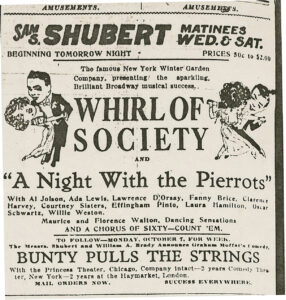 Broadway, exemplified by The Winter Garden Theater, was the perfect fit for Al Jolson. Billed as a featured performer from the start, Jolson would soon become headliner extraordinaire. Jolie, in blackface, portrayed Erastus Sparkler in “La Belle Paree” from March 20-June 10, 1911. The show then toured a few Eastern cities. He was Claude, a black waiter, in “Vera Violetta,” Nov. 3, 1911-Feb. 29, 1912 (includes another Eastern city tour).
After a March 1-2, 1912 preview in Albany, “The Whirl of Society” and “A Night With the Pierrots” opened March 5 at the Winter Garden. It ran through June 19, followed by an interestingly plotted tour of mainly Eastern cities, along with a handful of Midwest sites and two dates in Canada: Montreal and Toronto.
The Sam S. Shubert Theater in Kansas City was stop two on the trek, following a month’s booking in Chicago. Jolson and company played KC, Sept. 29-Oct. 5, 1912. It was in “The Whirl of Society” that Jolson sang “Snap Your Fingers,” “Row, Row, Row,” and “Waiting for the Robert E. Lee.”
———-
The ads and engravings for the Kansas City production show Jolson, caricatured with dark eyes, bending back his partner. Then again, perhaps it is not Jolson since 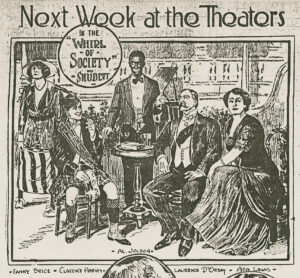 he is not “blacked up.” In another promo for the show that appears to be an engraving, Jolson is in blackface, playing his soon to be trademarked character Gus. Cast member Fanny Brice is pictured to Jolson’s right.
∞∞∞∞∞
Advance Story under etching:
Shubert~”Whirl of Society.”
One of the biggest attractions to play the Shubert Theater this season will be given there next week, when the New York Winter Garden Company presents “The Whirl of Society” and “A Night With the Pierrots.” The engagement will open tomorrow night. The company has just finished a long run at 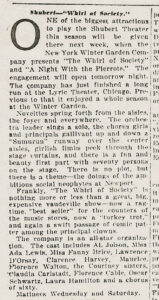 the Lyric Theater, Chicago. Previous to that it enjoyed a whole season at the Winter Garden.
Novelties spring forth from the aisles, the foyer and everywhere. The orchestra leader sings a solo, the chorus girls and principals gallivant up and down a “Sumurun” runway over the center aisles, girlish limbs peek through the stage curtains, and there is a fun and beauty first part with seventy persons on the stage. There is no plot, but there is a theme–the doings of the ambitious social neophytes at Newport.
Frankly, “The Whirl of Society” is nothing more or less than a great, big, expensive vaudeville show–now a ragtime “best seller” for the counters of the music stores, now a “turkey trot,” and again a swift passage of comic patter among the principal clowns.
The company is an all-star organization. The cast includes Al. Jolson, Miss Ada Lewis, Miss Fanny Brice, Lawrence D’Orsay, Clarence Harvey, Maurice, Florence Walton, the Courtney Sisters, Claudia Carlstadt, Florence Cable, Oscar Schwartz, Laura Hamilton and a chorus of sixty.
Matinees Wednesday and Saturday.
_____
NEXT, Part 5 of The Kansas City Jolson Story: Jolson’s first extravaganza as star, “THE HONEYMOON EXPRESS.” [Please use Search for Honeymoon Express.]
THE KANSAS CITY JOLSON STORY…Part 3: Al Jolson’s Single Act in Vaudeville
 By Steve Crum
The following images were culled from both “The Kansas City Times” and “The Kansas City Star” from 1909-11. (Both newspapers were owned by the same company, with the “Times” being the morning edition and the “Star,” the evening.)
∞∞∞∞∞
More than a year after Jolson left 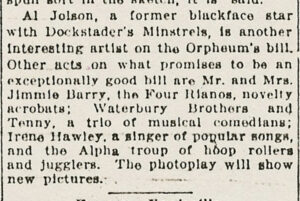 Dockstader on Dec. 18, 1909, he hit the UBO vaudeville circuit, beginning Dec. 27, 1910. His last date in vaudeville was Feb. 20-25, 1911 at Hammerstein’s Victoria in New York City. That location rings bells for “Jolson Story” fans since it is depicted in the film that Jolson nearly makes his breakthrough at Hammerstein’s. Instead, some time later, he opens at the Winter Garden, and maneuvers his way on stage to sing “My Mammy.”
In actuality, before he was a sensation at the Winter Garden in “La Belle Paree” beginning March 20, 1911, Jolie was a single in Kansas City at the Orpheum, Dec. 4-10, 1910. Billed as “Al. Jolson, Late Star Dockstader’s Minstrels,” he gets billing just below the headlining Dinkle-Speil’s Christmas.
A note for the keen eye: The Dec. 5, 1910 display ad for Jolson’s single act (with Dinklespeil’s Christmas) includes a 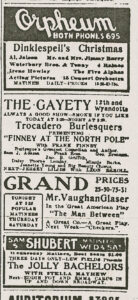 curiosity. Three ads below Jolson’s is a promo for Shubert’s “The Jolly Bachelors.” The star, Stella Mayhew, would four months later co-star with Jolson in Jolie’s first Shubert musical, “La Belle Paree.” She would continue performing with him in Jolson’s next two Shubert shows, “Vera Violetta” and “The Whirl of Society.”
∞∞∞∞∞
A thought in perspective: Think about it. It has been over a century since these Jolson events occurred.
∞∞∞∞∞
Coming in Part 4: Jolson’s Broadway theater break in “The Whirl of Society.”